







Question: I need help on figuring out formulas and equations for problem # 10 To find the KE initial over total KE/final Suppose a 0.250 kg
I need help on figuring out formulas and equations for problem # 10 To find the KE initial over total KE/final
Suppose a 0.250 kg ball is thrown at16.0m/s to a motionless person standing on ice who catches it with an outstretched arm as shown in Figure 9.31. Figure 9.31.
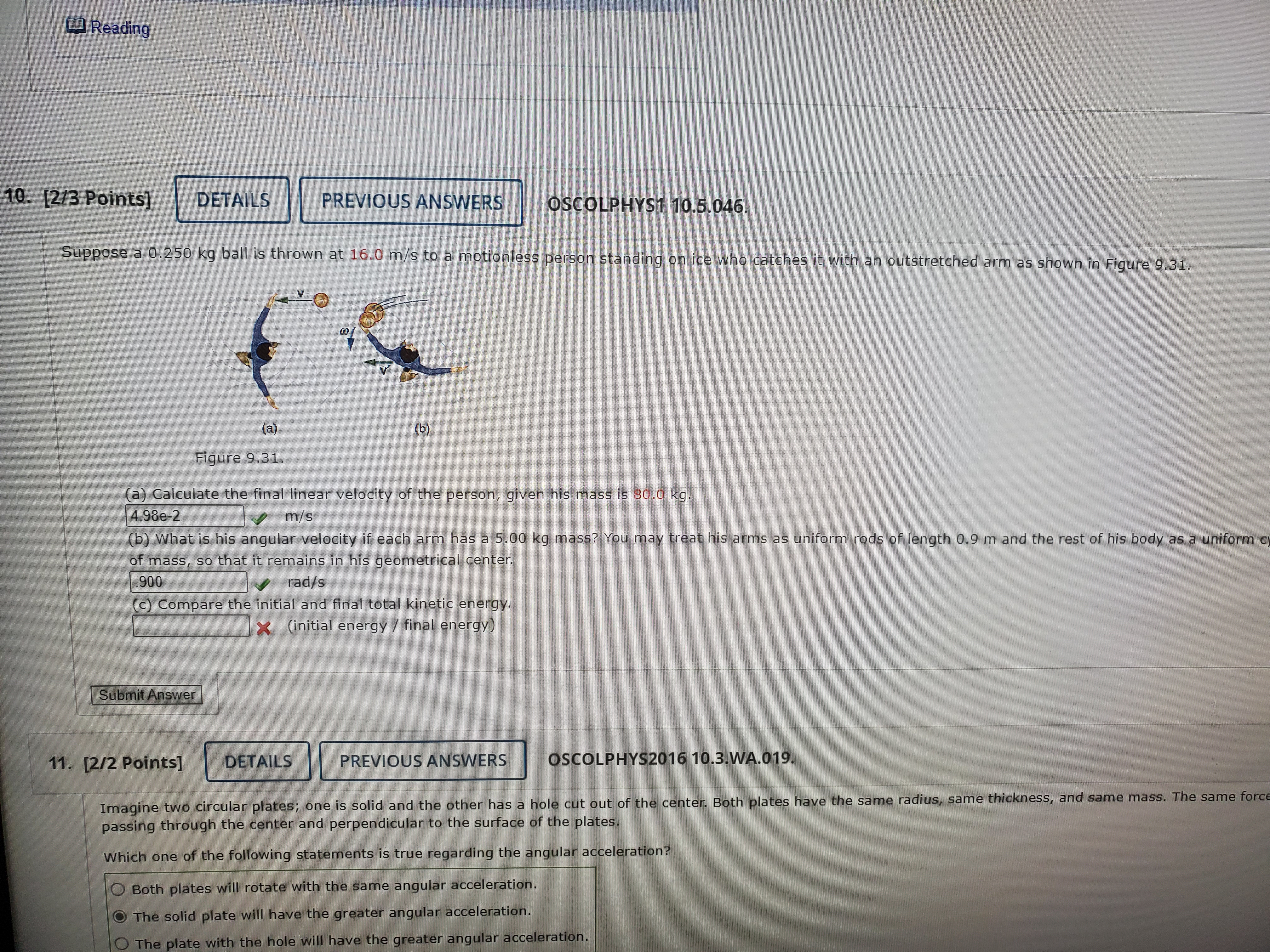
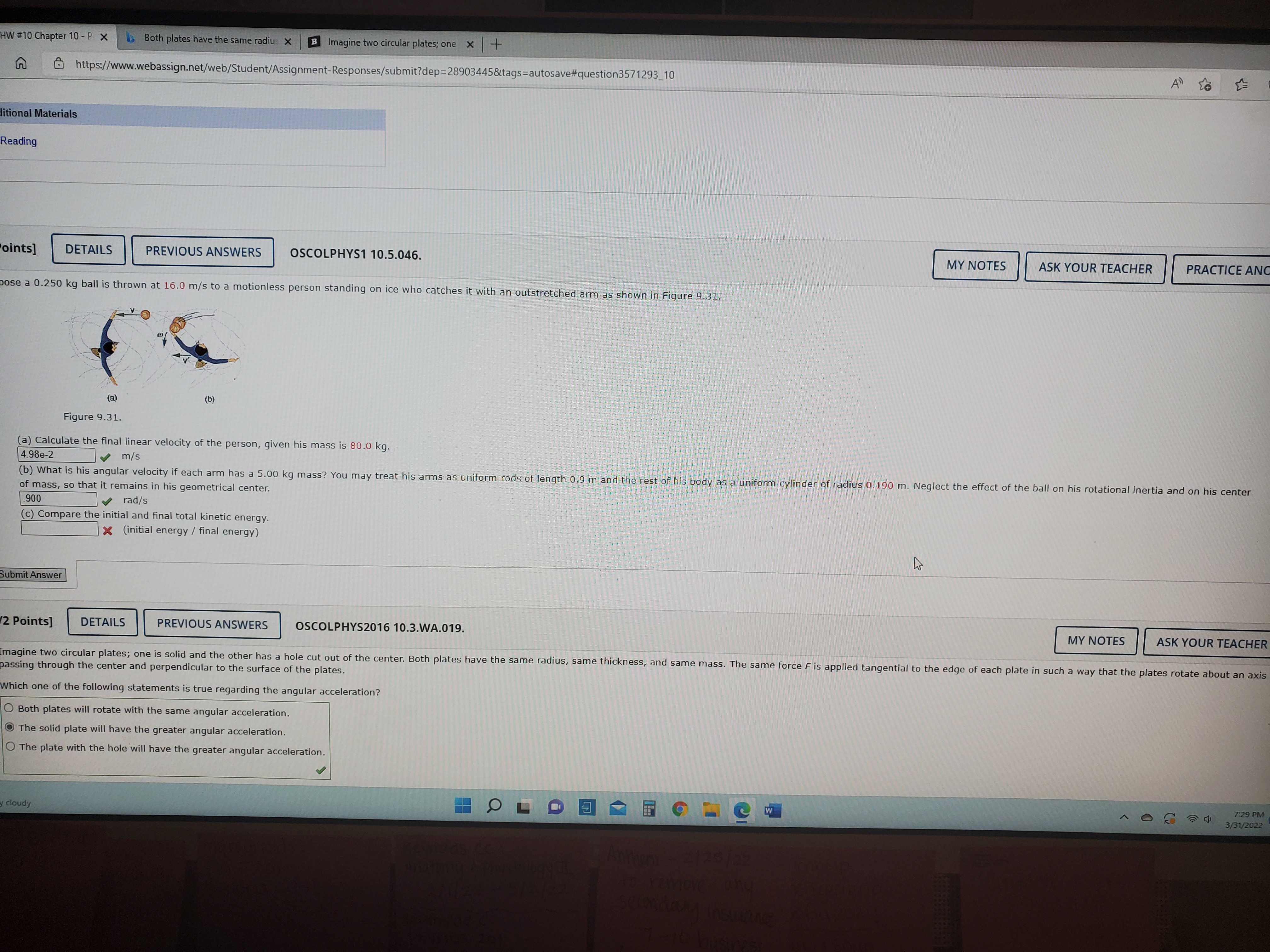
Reading 10. [2/3 Points] DETAILS PREVIOUS ANSWERS OSCOLPHYS1 10.5.046. Suppose a 0.250 kg ball is thrown at 16.0 m/s to a motionless person standing on ice who catches it with an outstretched arm as shown in Figure 9.31. (a) Figure 9.31. (a) Calculate the final linear velocity of the person, given his mass is 80.0 kg 4.98e-2 m/s (b) What is his angular velocity if each arm has a 5.00 kg mass? You may treat his arms as uniform rods of length 0.9 m and the rest of his body as a uniform of mass, so that it remains in his geometrical center. .900 rad/s (c) Compare the initial and final total kinetic energy. x (initial energy / final energy) Submit Answer 11. [2/2 Points] DETAILS PREVIOUS ANSWERS OSCOLPHYS2016 10.3.WA.019. Imagine two circular plates; one is solid and the other has a hole cut out of the center. Both plates have the same radius, same thickness, and same mass. The same forc passing through the center and perpendicular to the surface of the plates. Which one of the following statements is true regarding the angular acceleration? O Both plates will rotate with the same angular acceleration. O The solid plate will have the greater angular acceleration. The plate with the hole will have the greater angular acceleration.HW #10 Chapter 10 - P X Both plates have the same radiu X B Imagine two circular plates; one x + https://www.webassign.net/web/Student/Assignment-Responses/submit?dep=28903445&tags=autosave#question3571293_10 itional Materials Reading oints] DETAILS PREVIOUS ANSWERS OSCOLPHYS1 10.5.046. MY NOTES ASK YOUR TEACHER PRACTICE AN pose a 0.250 kg ball is thrown at 16.0 m/s to a motionless person standing on ice who catches it with an outstretched arm as shown in Figure 9.31. ( b ) Figure 9.31. (a) Calculate the final linear velocity of the person, given his mass is 80.0 kg. 4.98e-2 m/s (b) What is his angular velocity if each arm has a 5.00 kg mass? You may treat his arms as uniform rods of length 0.9 m and the rest of his body as a uniform cylinder of radius 0.190 m. Neglect the effect of the ball on his rotational inertia and on his center of mass, so that it remains in his geometrical center. .900 rad/s (c) Compare the initial and final total kinetic energy. X (initial energy / final energy) ubmit Answer (2 Points] DETAILS PREVIOUS ANSWERS OSCOLPHYS2016 10.3.WA.019. MY NOTES ASK YOUR TEACHER Imagine two circular plates; one is solid and the other has a hole cut out of the center. Both plates have the same radius, same thickness, and same mass. The same force F is applied tangential to the edge of each plate in such a way that the plates rotate about an axis passing through the center and perpendicular to the surface of the plates. Which one of the following statements is true regarding the angular acceleration? Both plates will rotate with the same angular acceleration. The solid plate will have the greater angular acceleration. The plate with the hole will have the greater angular acceleration. 7:29 PM y cloudy 3/31/2022
Step by Step Solution
There are 3 Steps involved in it

Get step-by-step solutions from verified subject matter experts
 Study Help