



Question: I need help on only part C and D! Thank you 3. The primary change in going from translation to rotation is found in going
I need help on only part C and D! Thank you
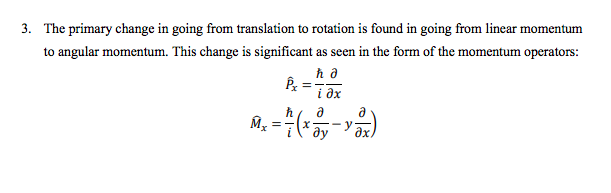
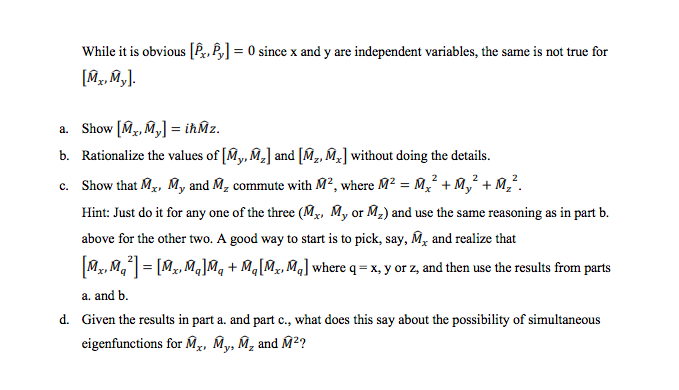
3. The primary change in going from translation to rotation is found in going from linear momentum to angular momentum. This change is significant as seen in the form of the momentum operators: ha By h a M: =f(* -P) a X- = While it is obvious [fr, Py] = 0 since x and y are independent variables, the same is not true for [M,,M,]. = 2 a. Show (Mx, M, ] = in Mz. b. Rationalize the values of [My, M2] and [M,,Mx] without doing the details. c. Show that Mx, M, and M, commute with M2, where M2 = M ? + M,? + M,? Hint: Just do it for any one of the three (Mx, My or M,) and use the same reasoning as in part b. above for the other two. A good way to start is to pick, say, M, and realize that [M., M,?] = [M., M.]M, + M,[M., M.] where q= x, y or 2, and then use the results from parts a. and b. d. Given the results in part a. and part c., what does this say about the possibility of simultaneous eigenfunctions for Mx, My, M, and M?? X
Step by Step Solution
There are 3 Steps involved in it

Get step-by-step solutions from verified subject matter experts