Question: ***I need help on question #2*** ***I need help on question #2*** The Solution to question 1 is attached. 1. The demand for a certain
***I need help on question #2***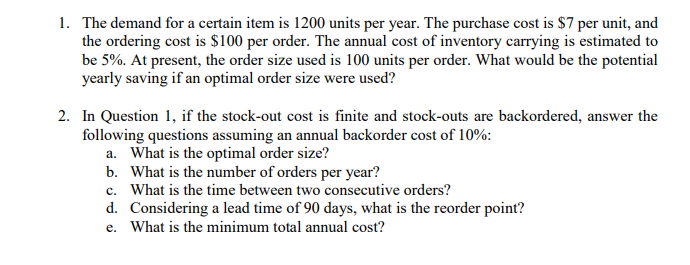
 ***I need help on question #2*** The Solution to question 1 is attached.
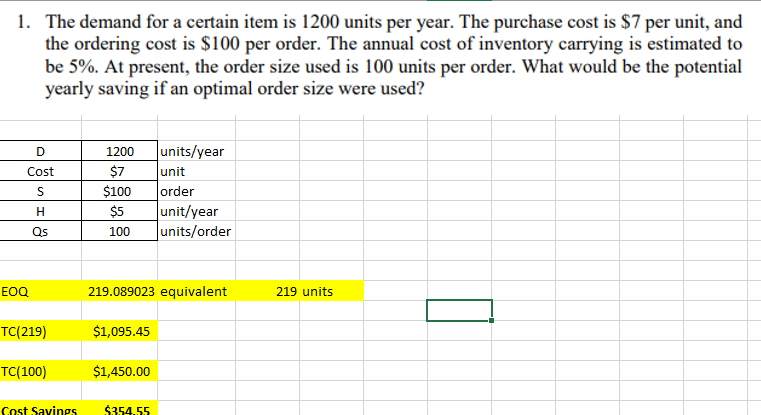
1. The demand for a certain item is 1200 units per year. The purchase cost is $7 per unit, and the ordering cost is $100 per order. The annual cost of inventory carrying is estimated to be 5%. At present, the order size used is 100 units per order. What would be the potential yearly saving if an optimal order size were used? 2. In Question 1, if the stock-out cost is finite and stock-outs are backordered, answer the following questions assuming an annual backorder cost of 10%: a. What is the optimal order size? b. What is the number of orders per year? c. What is the time between two consecutive orders? d. Considering a lead time of 90 days, what is the reorder point? e. What is the minimum total annual cost? 1. The demand for a certain item is 1200 units per year. The purchase cost is $7 per unit, and the ordering cost is $100 per order. The annual cost of inventory carrying is estimated to be 5%. At present, the order size used is 100 units per order. What would be the potential yearly saving if an optimal order size were used? D Cost 1200 $7 $100 $5 100 units/year unit order unit/year units/order EOQ 219.089023 equivalent 219 units TC(219) $1,095.45 TC(100) $1,450.00 Cost Savings $354.55 1. The demand for a certain item is 1200 units per year. The purchase cost is $7 per unit, and the ordering cost is $100 per order. The annual cost of inventory carrying is estimated to be 5%. At present, the order size used is 100 units per order. What would be the potential yearly saving if an optimal order size were used? 2. In Question 1, if the stock-out cost is finite and stock-outs are backordered, answer the following questions assuming an annual backorder cost of 10%: a. What is the optimal order size? b. What is the number of orders per year? c. What is the time between two consecutive orders? d. Considering a lead time of 90 days, what is the reorder point? e. What is the minimum total annual cost? 1. The demand for a certain item is 1200 units per year. The purchase cost is $7 per unit, and the ordering cost is $100 per order. The annual cost of inventory carrying is estimated to be 5%. At present, the order size used is 100 units per order. What would be the potential yearly saving if an optimal order size were used? D Cost 1200 $7 $100 $5 100 units/year unit order unit/year units/order EOQ 219.089023 equivalent 219 units TC(219) $1,095.45 TC(100) $1,450.00 Cost Savings $354.55









 Study Help