







Question: I need help please, the first 2 pages is my question and the third page is the question that my question depend on thanks what
I need help please, the first 2 pages is my question and the third page is the question that my question depend on
thanks
what exactly you need, I added the question I need you to answer it and the previous question that you need to solve my question
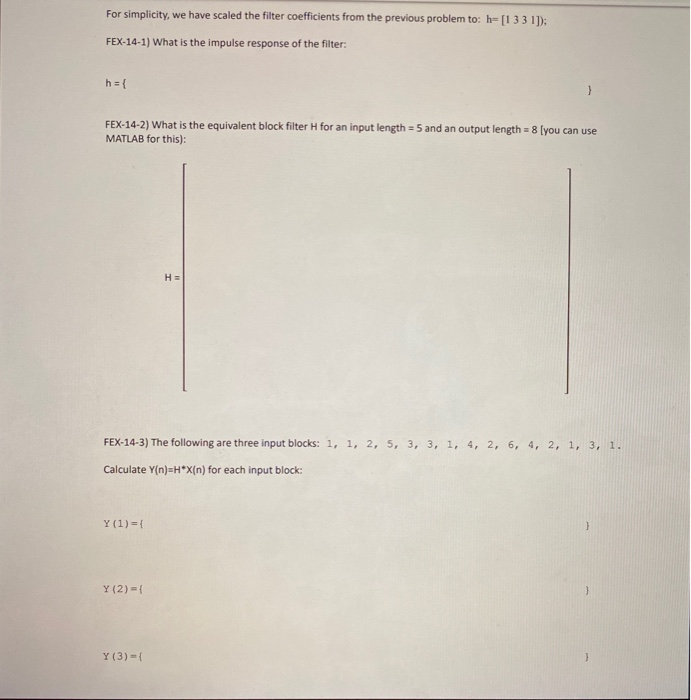
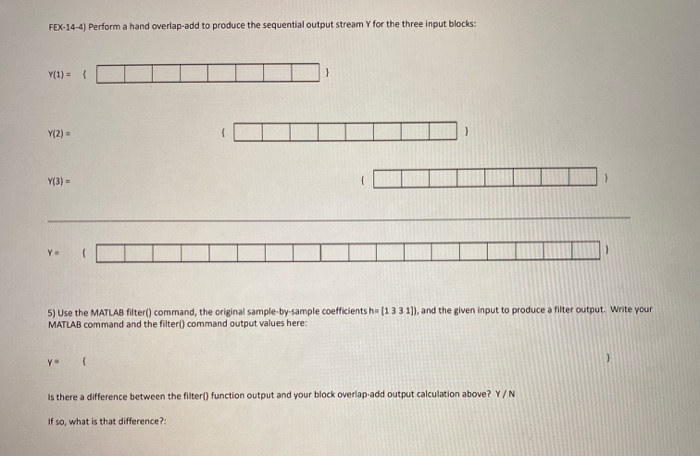
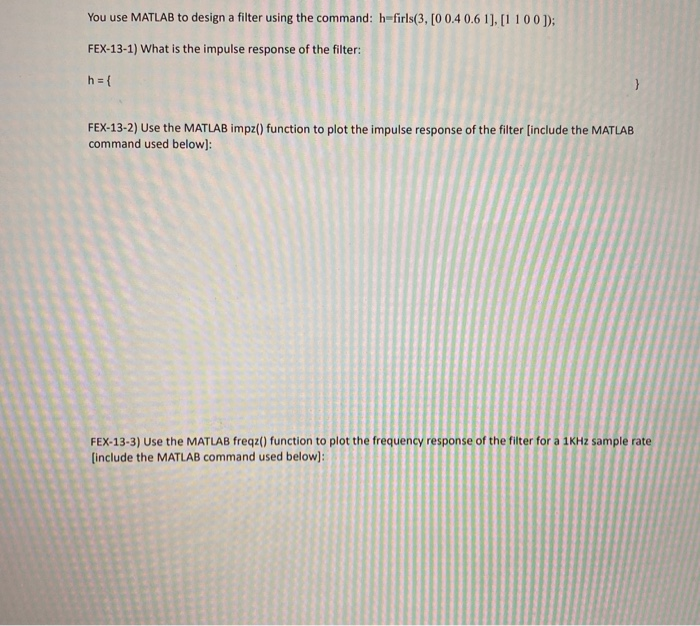
For simplicity, we have scaled the filter coefficients from the previous problem to: h-[1331]): FEX-14-1) What is the impulse response of the filter: h = { FEX-14-2) What is the equivalent block filter H for an input length = 5 and an output length = 8 [you can use MATLAB for this): FEX-14-3) The following are three input blocks: 1, 1, 2, 5, 3, 3, 1, 4, 2, 6, 4, 2, 1, 3, 1. Calculate Y(n)=H*X(n) for each input block: Y(1)={ Y (2)={ Y(3) = 1 FEX-14-4) Perform a hand overlap-add to produce the sequential output stream Y for the three input blocks: Y[2) - Y(3) - 5) Use the MATLAB filter() command, the original sample-by-sample coefficients ha (1 331]), and the given input to produce a filter output. Write your MATLAB command and the filter) command output values here: y ( Is there a difference between the filter() function output and your block overlap-add output calculation above? Y/N If so, what is that difference?: You use MATLAB to design a filter using the command: hefirls(3.[0 0.4 0.61],[1100D: FEX-13-1) What is the impulse response of the filter: h = { FEX-13-2) Use the MATLAB impz() function to plot the impulse response of the filter [include the MATLAB command used below]: FEX-13-3) Use the MATLAB freqz() function to plot the frequency response of the filter for a 1KHz sample rate [include the MATLAB command used below]: For simplicity, we have scaled the filter coefficients from the previous problem to: h-[1331]): FEX-14-1) What is the impulse response of the filter: h = { FEX-14-2) What is the equivalent block filter H for an input length = 5 and an output length = 8 [you can use MATLAB for this): FEX-14-3) The following are three input blocks: 1, 1, 2, 5, 3, 3, 1, 4, 2, 6, 4, 2, 1, 3, 1. Calculate Y(n)=H*X(n) for each input block: Y(1)={ Y (2)={ Y(3) = 1 FEX-14-4) Perform a hand overlap-add to produce the sequential output stream Y for the three input blocks: Y[2) - Y(3) - 5) Use the MATLAB filter() command, the original sample-by-sample coefficients ha (1 331]), and the given input to produce a filter output. Write your MATLAB command and the filter) command output values here: y ( Is there a difference between the filter() function output and your block overlap-add output calculation above? Y/N If so, what is that difference?: You use MATLAB to design a filter using the command: hefirls(3.[0 0.4 0.61],[1100D: FEX-13-1) What is the impulse response of the filter: h = { FEX-13-2) Use the MATLAB impz() function to plot the impulse response of the filter [include the MATLAB command used below]: FEX-13-3) Use the MATLAB freqz() function to plot the frequency response of the filter for a 1KHz sample rate [include the MATLAB command used below]
Step by Step Solution
There are 3 Steps involved in it

Get step-by-step solutions from verified subject matter experts
 Study Help