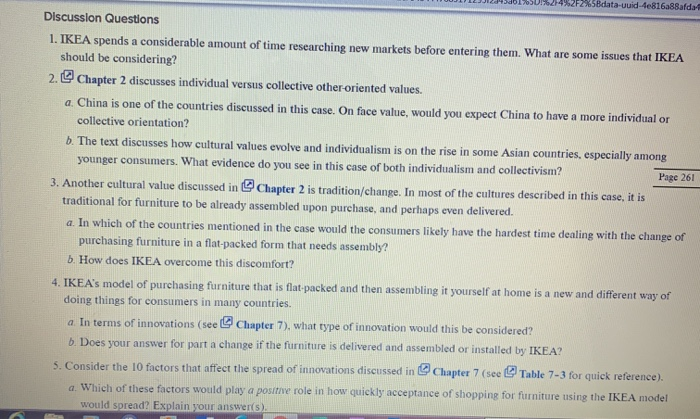
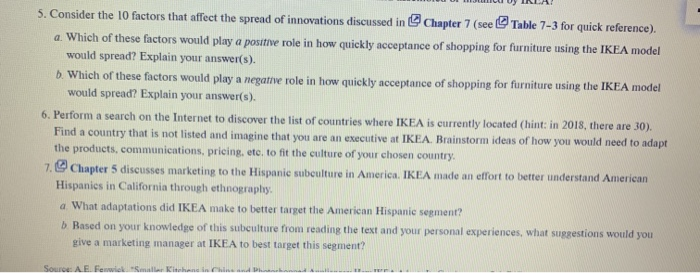
Question: i need help responding the question in the last two pictures. the answer have to be short in some cases i need it ASAP THANK
i need help responding the question in the last two pictures. the answer have to be short in some cases i need it ASAP THANK YOU
QA 2-1 IKEA USES MARKET RESEARCH TO ADAPT FOR GLOBAL MARKETS IKEA is a well-known Swedish retail company that sells low-cost, stylish furniture that is purchased in a flat-packed form and usually assembled at home. It is known for a simplistic, clean lined Scandinavian style. IKEA has large warehouse style stores throughout the world. Although there are differences in various regions, the stores are typically set up into "rooms" that show the furniture arranged as it would be in homes so visitors can experience it. They also host kid-friendly play areas and cafeterias with Scandinavian foods, as well as some local dishes. IKEA stores are often destination shopping centers where consumers frequently travel many miles to visit and spend the day enjoying the experience. IKEA executives believe one reason for IKEA's success is it listens to its customers' needs and wants to co-create value. However, the exact Swedish model does not translate well directly into all cultures. So, the company takes plenty of time before entering a market to make sure it is done right. Even so, IKEA has encountered some missteps. Years often are spent conducting extensive market research and ethnography (the study of local customers and cultures), both before and after entry into a new market. IKEA researchers visit surrounding homes and talk with numerous consumers to discover local tastes, preferences, and ways of living. They also pour over market reports and perform company and consumer surveys. These practices allow IKEA to attain success in a variety of different cultures with disparate tastes and values through local adaptations. Adaptations can be found in many areas, including catalogs, products, pricing, and shopping styles. According to IKEA Chief Executive Mikael Ohlsson: Most people don't really know and can hardly imagine that we visit thousands of homes around every store in the world every year, We sit down in the kitchen and talk to them. That's the way we try to learn and understand. "What are you annoyed with? What are your frustrations? What would you like to have? How much can you afford? What are your alternatives?" Most people don't really know and can hardly imagine that we visit thousands of homes around every store in the world every year. We sit down in the kitchen and talk to them. That's the way we try to learn and understand. "What are you annoyed with? What are your frustrations? What would you like to have? How much can you afford? What are your alternatives? CATALOG ADAPTATIONS Each year, IKEA distributes a catalog in each of the countries in which it is located. This is a massive undertaking, especially considering the vast array of lifestyles and values across the various markets. For example, in 2017. IKEA distributed 203 million copies of its 324 page catalog. There were 72 different versions specific to various regional cultures. IKEA's extensive research allows for tailoring the communication and imagery to best target consumers in a given region. There are many different types of kitchens throughout the world and the images attempt to fit the norms of the locations where consumers are viewing the catalogs. For example, in China kitchens are smaller than in the United States. IKEA modifies its catalog photos and in-store kitchen models to reflect the smaller kitchen size, as well as other important aspects appealing to Chinese consumers. Other changes are more dramatic, such as the edition for Orthodox Jews in Israel. In the Israeli version, no female models are included in the photos. Instead, all models are male and some are studying religious texts. The 2011 and 2012 versions for Saudi Arabia similarly omitted female models, or in some cases the images for the Saudi editions contain no models at all. This omission of women in these versions was meant to appeal to those male dominated cultures. However, after consumer protests, IKEA had to issue apologies in both instances and recognize such practices are not consistent with IKEA values. This is the 2017 statement: We realize that people are upset about this and that the publication does not live up to what IKEA stands for and we apologize for this. We will make sure that future publications will reflect what IKEA stands for and at the same time show respect for the Haredi community PRODUCT ADAPTATIONS Marketing research and talking with consumers reveal several adaptions to product offerings in the United States. IKEA quickly learned that homes are larger and Americans prefer their household furnishings to be larger as well. Curtains are made longer, sofas are made Page 260 deeper, spaces in kitchen cabinetry are widened to accommodate U.S. appliances, and tableware is enlarged. Upon first entry. IKEA executives pondered why they were selling unusually high numbers of vases. It did not take long to realize that Americans were buying them as drinking glasses because the actual initial drinking glasses offered were too small for American tastes. Also, IKEA stores initially lacked large tables and serving platters to accommodate large groups of people because Thanksgiving was an unfamiliar concept. IKEA performs this type of research even within regions of the same country. Recently, IKEA felt it may have been out of touch with the large Hispanic population in California. After visiting many homes, IKEA made product adaptations such as adding more bold colors and elaborate picture frames to its offerings. Likewise, IKEA found several differences in regional tastes, values, and preferences in India that shaped product offerings there. The market research revealed that Indian consumers prefer home furnishings with vivid colors the family life centers around the sofa in the living room where they eat their meals, do homework, and even sleep: and Indians do not enjoy the do it yourself culture. In response, products offered in the Indian market are adapted to have more vivid colors, in contrast to the Scandinavian versions where white and beige color schemes are preferred. Sofas also are redesigned so that they are expandable for sleeping and entertaining and collapsible for maximizing space. Finally, delivery, assembly, and installation are highlighted ancillary products to overcome the antipathy to do it yourself culture. PRICING ADAPTATIONS In China, research shows key differences from other regions: Chinese consumers are highly price sensitive to products for domestic consumption, like household furnishings, and they view shopping as an experience more so than many other cultures. Chinese people are willing to pay a price premium for more visible Western brands, such as automobiles and Starbucks coffee. However, furniture is a much less conspicuous form of consumption. Additionally, there are many low-cost competitors of household furnishings in China. Therefore, IKEA had to reduce prices by about 50 percent before Chinese sales really took off. It was a successful strategy though, as evidenced by IKEA becoming the largest foreign commercial landowner. An average Saturday in the Bejing IKEA sees about 28.000 visitors, which approximates the weekly average in European stores. SHOPPING STYLE ADAPTATIONS Many Chinese visitors enjoy the shopping experience but do not make a purchase. In fact, in contrast to IKEA stores in other countries, China's IKEA stores are often filled with people sleeping in the model beds and on the sofas. It is not uncommon for whole families to pile into the bedroom displays alongside strangers to nap and then go eat in the IKEA cafeteria after awaking Chinese IKEA management welcomes them because they will likely become customers later and by allowing visitors to spend the day in the store resting and enjoying the air-conditioning. IKEA is accommodating local culture and building brand relationships IKEA is committed to understanding its customers by continuously engaging in ethnography and other forms of marketing research to keep in touch with their needs, preferences, and values in regions and countries where IKEA is located and those in which it may potentially enter Discussion Questions 1. IKEA spends a considerable amount of time researching new markets before entering them. What are some issues that IKEA should be considering? 2. Chapter 2 discusses individual versus collective other oriented values. a China is one of the countries discussed in this case. On face value, would you expect China to have a more individual or collective orientation? b. The text discusses how cultural values evolve and individualism is on the rise in some Asian countries, especially among younger consumers. What evidence do you see in this case of both individualism and collectivism? Page 261 3. Another cultural value discussed in Chapter 2 is tradition/change. In most of the cultures described in this case, it is traditional for furniture to be already assembled upon purchase, and perhaps even delivered. a. In which of the countries mentioned in the case would the consumers likely have the hardest time dealing with the change of purchasing furniture in a flat-packed form that needs assembly? b. How does IKEA overcome this discomfort? 4. IKEA's model of purchasing furniture that is flat-packed and then assembling it yourself at home is a new and different way of doing things for consumers in many countries. a. In terms of innovations (see Chapter 7). what type of innovation would this be considered? b. Does your answer for part a change if the furniture is delivered and assembled or installed by IKEA? 5. Consider the 10 factors that affect the spread of innovations discussed in Chapter 7 (see Table 7-3 for quick reference). a. Which of these factors would play a positive role in how quickly acceptance of shopping for furniture using the IKEA model would spread? Explain your answers 5. Consider the 10 factors that affect the spread of innovations discussed in Chapter 7 (see Table 7-3 for quick reference). a. Which of these factors would play a positive role in how quickly acceptance of shopping for furniture using the IKEA model would spread? Explain your answer(s). 6. Which of these factors would play a negative role in how quickly acceptance of shopping for furniture using the IKEA model would spread? Explain your answer(s). 6. Perform a search on the Internet to discover the list of countries where IKEA is currently located (hint: in 2018, there are 30). Find a country that is not listed and imagine that you are an executive at IKEA. Brainstorm ideas of how you would need to adapt the products, communications, pricing, etc. to fit the culture of your chosen country. 7. Chapter 5 discusses marketing to the Hispanic subculture in America. IKEA made an effort to better understand American Hispanies in California through ethnography a What adaptations did IKEA make to better target the American Hispanic segment? b. Based on your knowledge of this subculture from reading the text and your personal experiences, what suggestions would you give a marketing manager at IKEA to best target this segment









 Study Help