







Question: I need help solving PROBLEM F. The problem must be done in excel and formulas given per cell. A B C D E F H
I need help solving PROBLEM F. The problem must be done in excel and formulas given per cell.
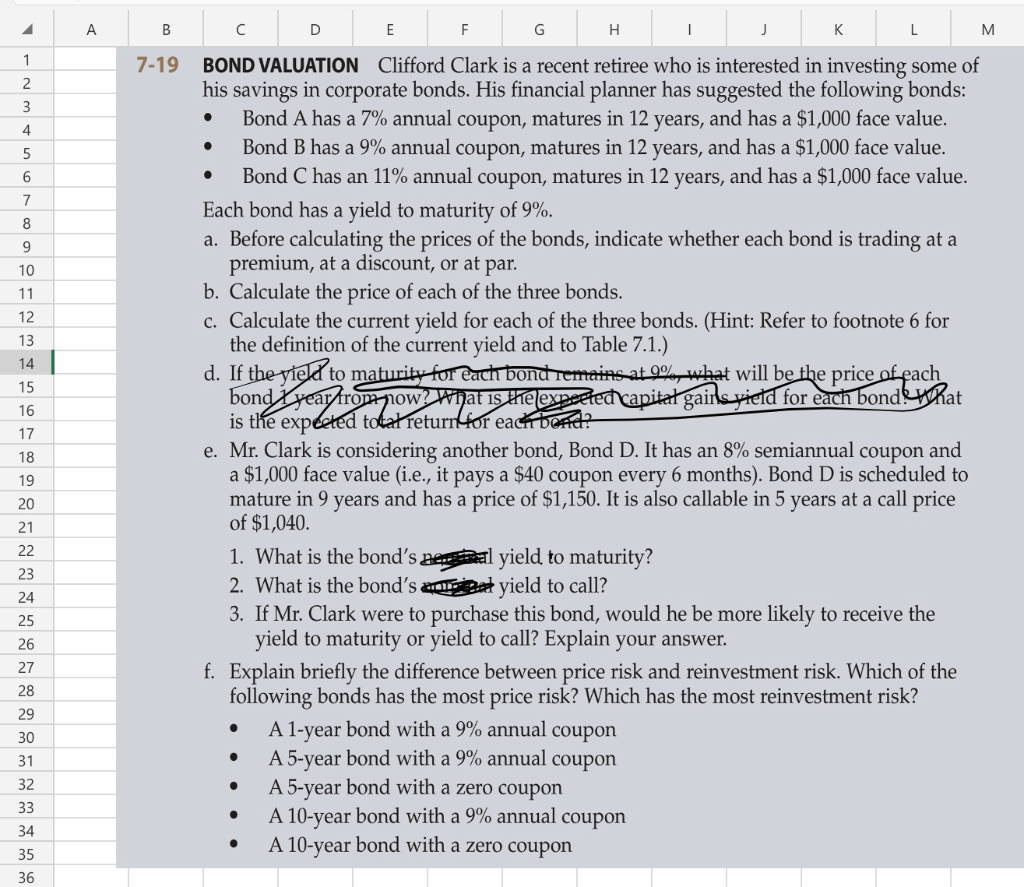
A B C D E F H I J L M 1 7-19 2 3 4 5 6 7 8 9 10 11 12 13 14 15 16 17 18 19 20 21 BOND VALUATION Clifford Clark is a recent retiree who is interested in investing some of his savings in corporate bonds. His financial planner has suggested the following bonds: Bond A has a 7% annual coupon, matures in 12 years, and has a $1,000 face value. Bond B has a 9% annual coupon, matures in 12 years, and has a $1,000 face value. Bond C has an 11% annual coupon, matures in 12 years, and has a $1,000 face value. Each bond has a yield to maturity of 9%. a. Before calculating the prices of the bonds, indicate whether each bond is trading at a premium, at a discount, or at par. b. Calculate the price of each of the three bonds. c. Calculate the current yield for each of the three bonds. (Hint: Refer to footnote 6 for the definition of the current yield and to Table 7.1.) d. If the yield to maturity for each bond remains at 9%, what will be the price of each bond year rom now? What is the expected capital gairls yield for each bondhat is the expected total return for each bestet? e. Mr. Clark is considering another bond, Bond D. It has an 8% semiannual coupon and a $1,000 face value (i.e., it pays a $40 coupon every 6 months). Bond D is scheduled to mature in 9 years and has a price of $1,150. It is also callable in 5 years at a call price of $1,040. 1. What is the bond's persal yield, to maturity? 2. What is the bond's cred yield to call? 3. If Mr. Clark were to purchase this bond, would he be more likely to receive the yield to maturity or yield to call? Explain your answer. f. Explain briefly the difference between price risk and reinvestment risk. Which of the following bonds has the most price risk? Which has the most reinvestment risk? A 1-year bond with a 9% annual coupon A 5-year bond with a 9% annual coupon A 5-year bond with a zero coupon A 10-year bond with a 9% annual coupon A 10-year bond with a zero coupon 22 23 24 25 26 27 28 29 . 30 . 31 32 33 34 . 35 36 A B C D E F H I J L M 1 7-19 2 3 4 5 6 7 8 9 10 11 12 13 14 15 16 17 18 19 20 21 BOND VALUATION Clifford Clark is a recent retiree who is interested in investing some of his savings in corporate bonds. His financial planner has suggested the following bonds: Bond A has a 7% annual coupon, matures in 12 years, and has a $1,000 face value. Bond B has a 9% annual coupon, matures in 12 years, and has a $1,000 face value. Bond C has an 11% annual coupon, matures in 12 years, and has a $1,000 face value. Each bond has a yield to maturity of 9%. a. Before calculating the prices of the bonds, indicate whether each bond is trading at a premium, at a discount, or at par. b. Calculate the price of each of the three bonds. c. Calculate the current yield for each of the three bonds. (Hint: Refer to footnote 6 for the definition of the current yield and to Table 7.1.) d. If the yield to maturity for each bond remains at 9%, what will be the price of each bond year rom now? What is the expected capital gairls yield for each bondhat is the expected total return for each bestet? e. Mr. Clark is considering another bond, Bond D. It has an 8% semiannual coupon and a $1,000 face value (i.e., it pays a $40 coupon every 6 months). Bond D is scheduled to mature in 9 years and has a price of $1,150. It is also callable in 5 years at a call price of $1,040. 1. What is the bond's persal yield, to maturity? 2. What is the bond's cred yield to call? 3. If Mr. Clark were to purchase this bond, would he be more likely to receive the yield to maturity or yield to call? Explain your answer. f. Explain briefly the difference between price risk and reinvestment risk. Which of the following bonds has the most price risk? Which has the most reinvestment risk? A 1-year bond with a 9% annual coupon A 5-year bond with a 9% annual coupon A 5-year bond with a zero coupon A 10-year bond with a 9% annual coupon A 10-year bond with a zero coupon 22 23 24 25 26 27 28 29 . 30 . 31 32 33 34 . 35 36
Step by Step Solution
There are 3 Steps involved in it

Get step-by-step solutions from verified subject matter experts
 Study Help