







Question: I need help solving some statistic problem. The problems are based on the Forecasting Using Smoothing Methods. Just do problem 3 and 4. Section 16.3
I need help solving some statistic problem. The problems are based on the Forecasting Using Smoothing Methods. Just do problem 3 and 4.
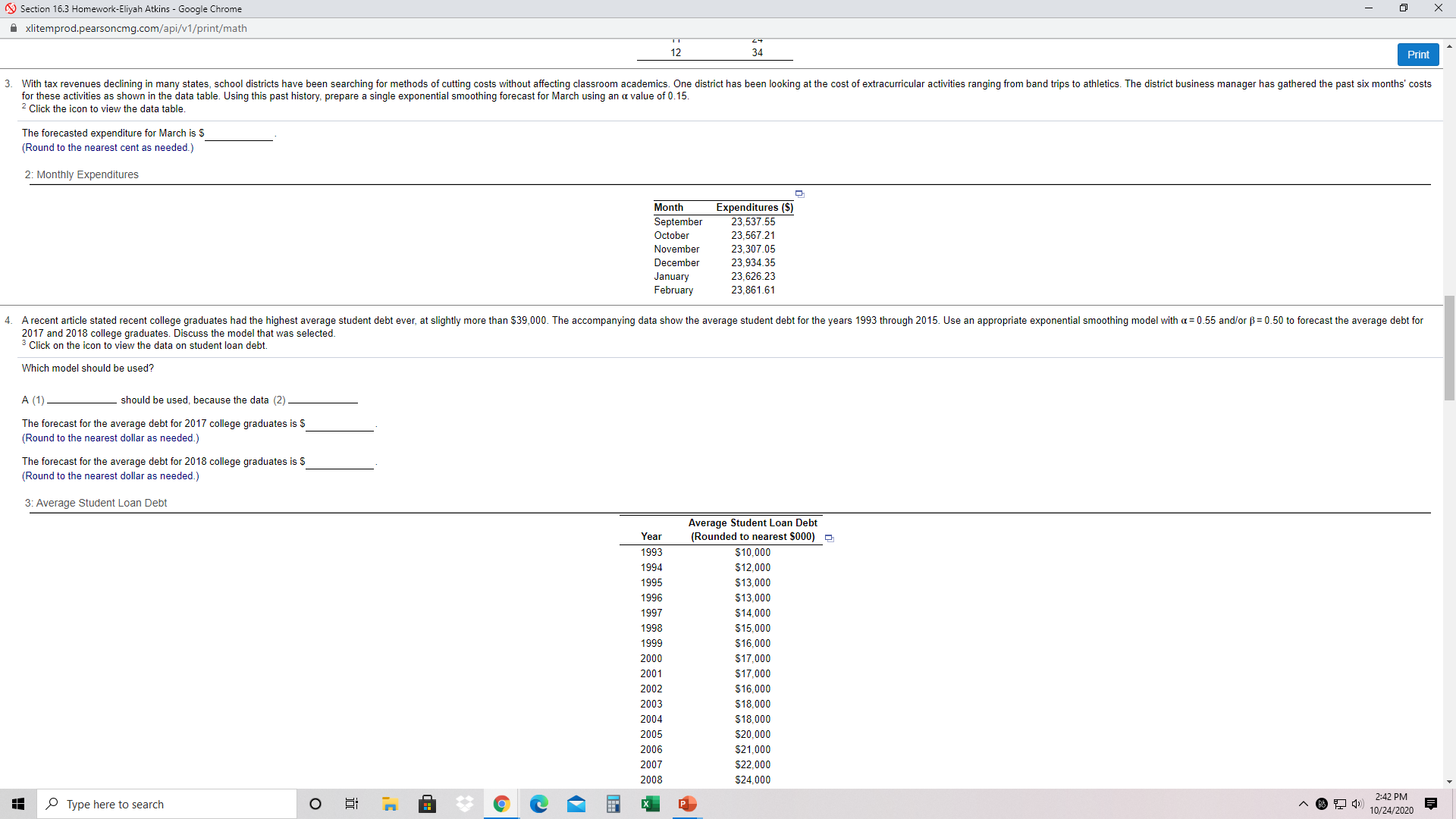
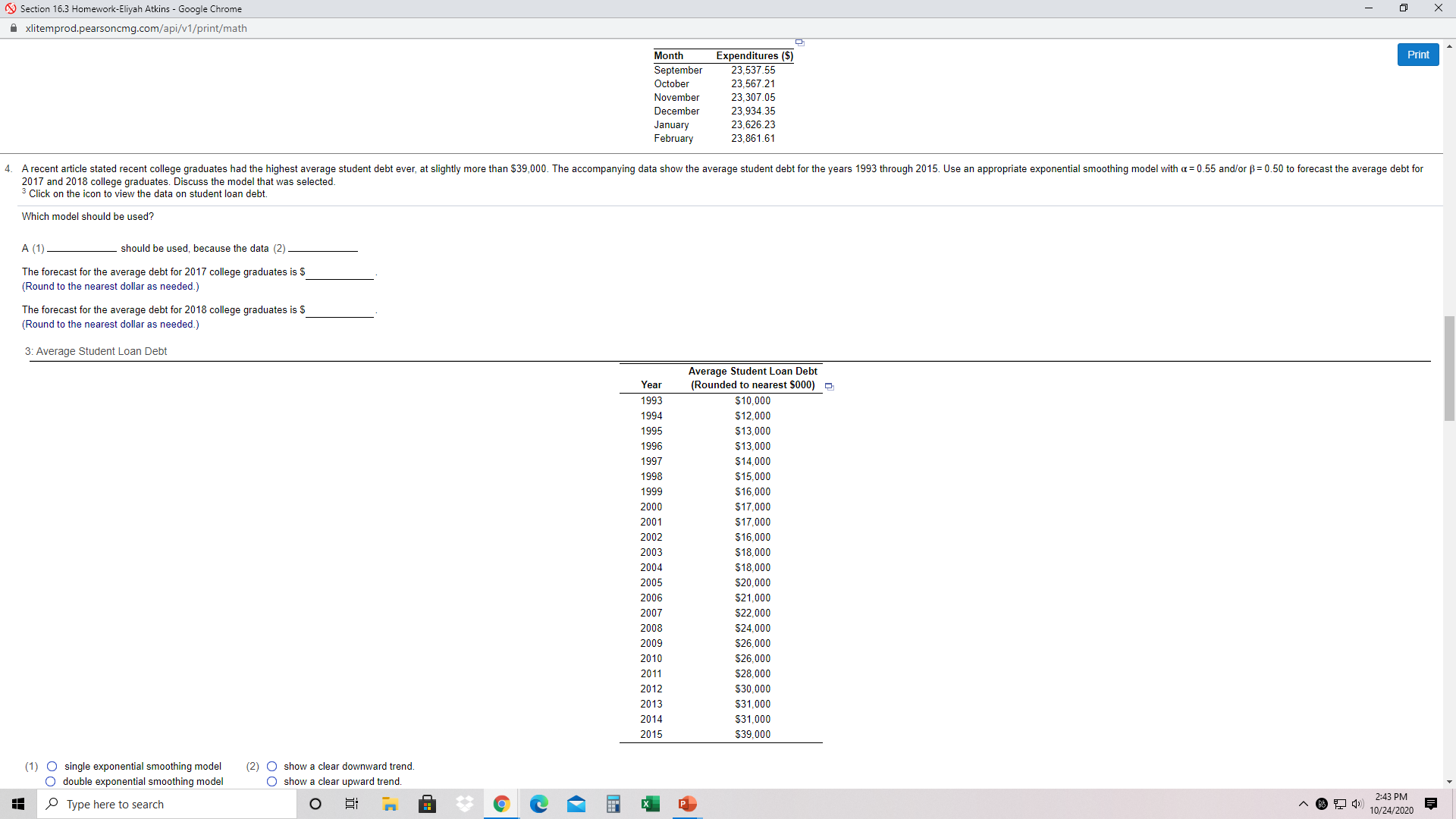
Section 16.3 Homework-Eliyah Atkins - Google Chrome X xlitemprod.pearsoncmg.com/api/v1/print/math 34 Print 3. With tax revenues declining in many states, school districts have been searching for methods of cutting costs without affecting classroom academics. One district has been looking at the cost of extracurricular activities ranging from band trips to athletics. The district business manager has gathered the past six months' costs for these activities as shown in the data table. Using this past history, prepare a single exponential smoothing forecast for March using an a value of 0. 15. Click the icon to view the data table The forecasted expenditure for March is $ (Round to the nearest cent as needed.) 2: Monthly Expenditures Month Expenditures ($) September 23,537.55 October 23,567.21 November 23,307.05 December 23,934.35 January 23,626.23 February 23,861.61 . A recent article stated recent college graduates had the highest average student debt ever, at slightly more than $39,000. The accompanying data show the average student debt for the years 1993 through 2015. Use an appropriate exponential smoothing model with a = 0.55 and/or B= 0.50 to forecast the average debt for 2017 and 2018 college graduates. Discuss the model that was selected. Click on the icon to view the data on student loan debt Which model should be used? A 1 should be used, because the data (2) The forecast for the average debt for 2017 college graduates is $ (Round to the nearest dollar as needed.) The forecast for the average debt for 2018 college graduates is $ (Round to the nearest dollar as needed.) B: Average Student Loan Debt Average Student Loan Debt Year Rounded to nearest $000) 1993 $10,00 1994 $12,000 1995 $13,000 1996 $13,000 1997 $14,000 1998 $15,000 1999 $16,000 2000 $17,000 2001 $17,000 2002 $16,000 2003 $18,000 2004 $18,000 2005 $20,000 2006 $21,000 2007 $22,000 2008 $24,000 O P 2:42 PM Type here to search 10/24/2020X Section 16.3 Homework-Eliyah Atkins - Google Chrome xlitemprod.pearsoncmg.com/api/v1/print/math Month Expenditures ($) Print September 23,537.55 October 23,567.21 November 23,307.05 December 23,934.35 January 23,626.23 February 23,861.61 . A recent article stated recent college graduates had the highest average student debt ever, at slightly more than $39,000. The accompanying data show the average student debt for the years 1993 through 2015. Use an appropriate exponential smoothing model with a = 0.55 and/or = 0.50 to forecast the average debt for 2017 and 2018 college graduates. Discuss the model that was selected. Click on the icon to view the data on student loan debt. Which model should be used? A (1 - should be used, because the data (2) The forecast for the average debt for 2017 college graduates is $ (Round to the nearest dollar as needed.) The forecast for the average debt for 2018 college graduates is $ (Round to the nearest dollar as needed.) 3: Average Student Loan Debt Average Student Loan Debt Year (Rounded to nearest $000) 1993 $10,000 1994 $12,000 1995 $13,000 1996 $13,000 1997 $14,000 1998 $15,000 1999 $16,000 2000 $17,000 2001 $17,000 2002 $16,000 2003 $18,000 2004 $18,000 2005 $20,000 2006 $21,000 2007 $22,000 2008 $24,000 2009 $26,000 2010 $26,000 2011 $28,000 2012 $30,000 2013 $31,000 2014 $31,000 2015 $39,000 (1) O single exponential smoothing model (2) O show a clear downward trend. O double exponential smoothing model O show a clear upward trend. 2:43 PM Type here to search O Ei 10/24/2020
Step by Step Solution
There are 3 Steps involved in it

Get step-by-step solutions from verified subject matter experts
 Study Help