







Question: I need help solving this problem please. 3. On July 15, 1980, Kentucky raised the cap on weekly earnings that were covered by workers' compensation
I need help solving this problem please.
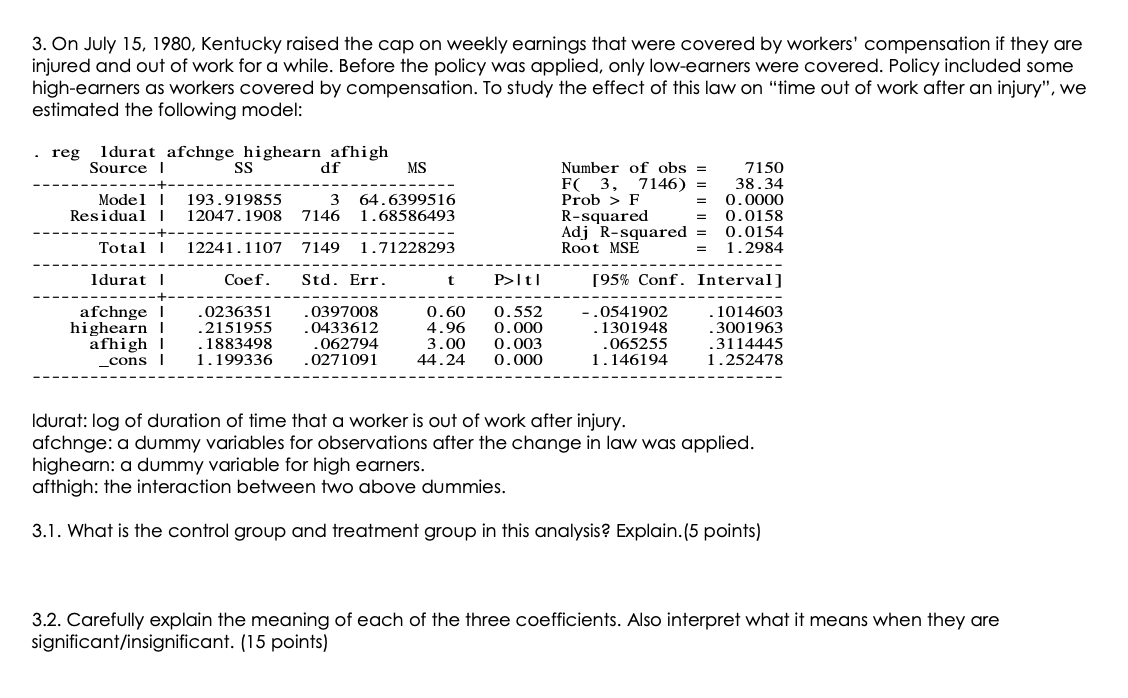
3. On July 15, 1980, Kentucky raised the cap on weekly earnings that were covered by workers' compensation if they are injured and out of work for a while. Before the policy was applied, only low-earners were covered. Policy included some high-earners as workers covered by compensation. To study the effect of this law on "time out of work after an injury", we estimated the following model: reg Idurat afchnge highearn afhigh Source I SS df MS Number of obs = 7150 F( 3, 7146) 38.34 Model 193 .919855 3 64. 6399516 Prob > F II 0. 0000 Residual 12047 . 1908 7146 1. 68586493 R-squared 0. 0158 Adj R-squared 0. 0154 Total I 12241 . 1107 7149 1.71228293 Root MSE 1 . 2984 Idurat I Coef. Std. Err. Poltl [95% Conf. Interval] afchnge . 0236351 . 0397008 0. 60 0.552 . 0541902 1014603 highearn 2151955 0433612 4.96 0. 000 . 1301948 . 3001963 afhigh 1883498 . 062794 3.00 0. 003 . 065255 . 3114445 cons 1. 199336 . 0271091 44.24 0. 000 1 . 146194 1.252478 Idurat: log of duration of time that a worker is out of work after injury. afchnge: a dummy variables for observations after the change in law was applied. highearn: a dummy variable for high earners. afthigh: the interaction between two above dummies. 3.1. What is the control group and treatment group in this analysis? Explain. (5 points) 3.2. Carefully explain the meaning of each of the three coefficients. Also interpret what it means when they are significant/insignificant. (15 points)
Step by Step Solution
There are 3 Steps involved in it

Get step-by-step solutions from verified subject matter experts
 Study Help