







Question: I need help to answer these questions please. NOTE: if you do researching, i can please have the links so i can go and read
I need help to answer these questions please.
NOTE: if you do researching, i can please have the links so i can go and read it too.
BIG Thanks!!!
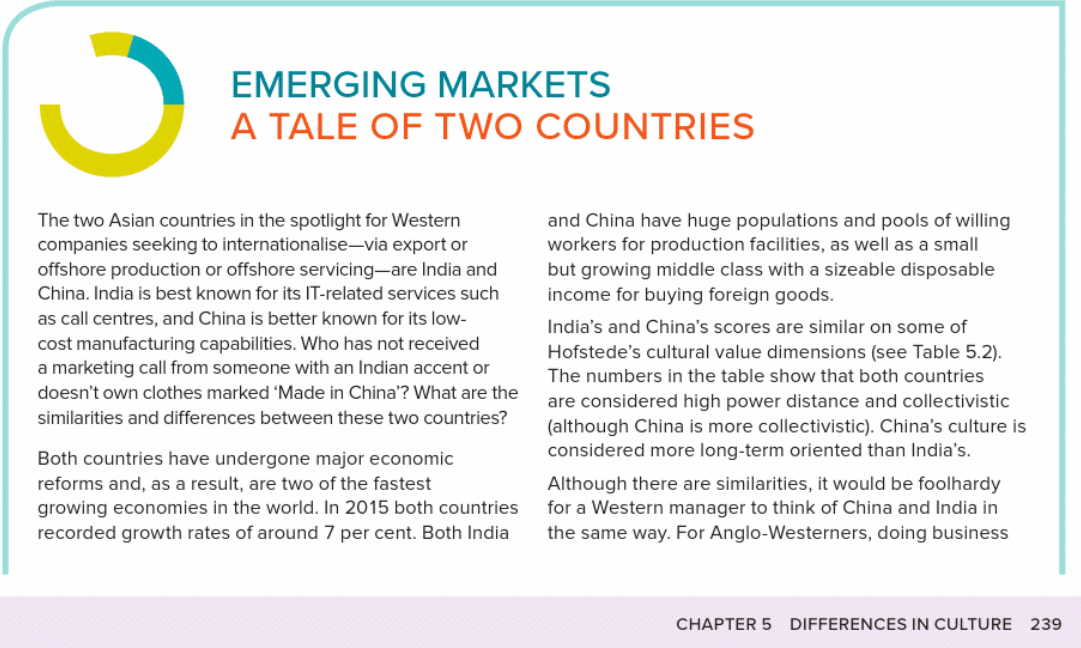
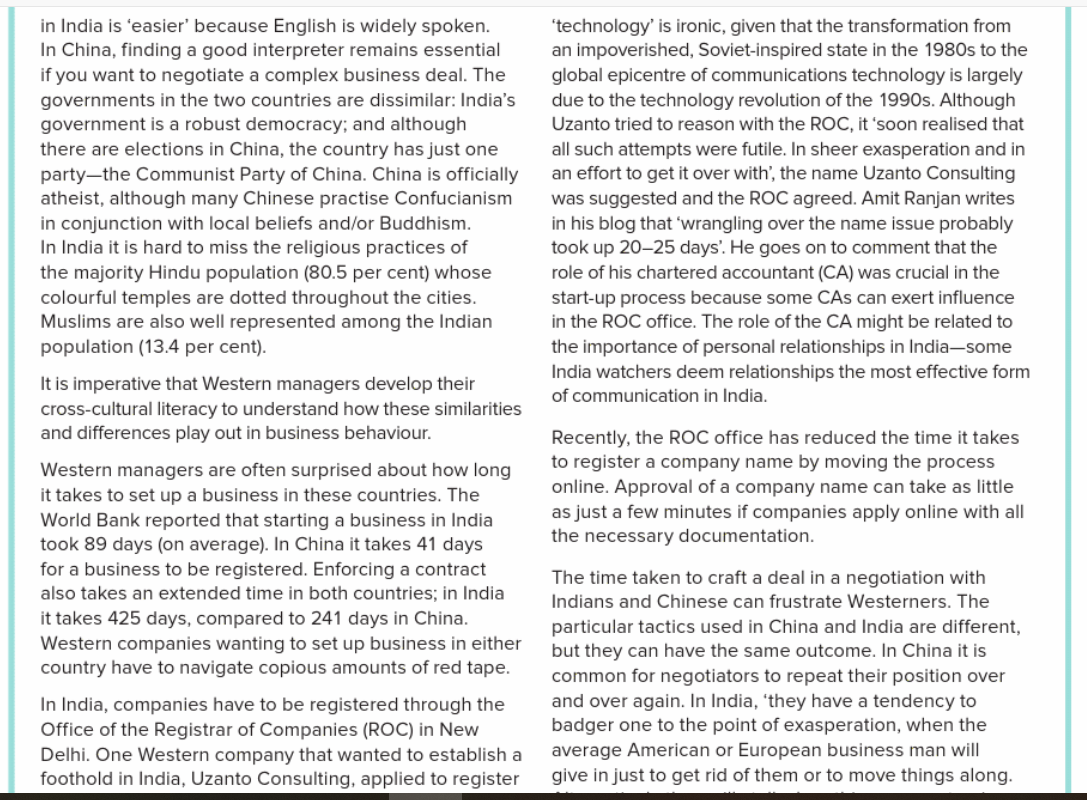
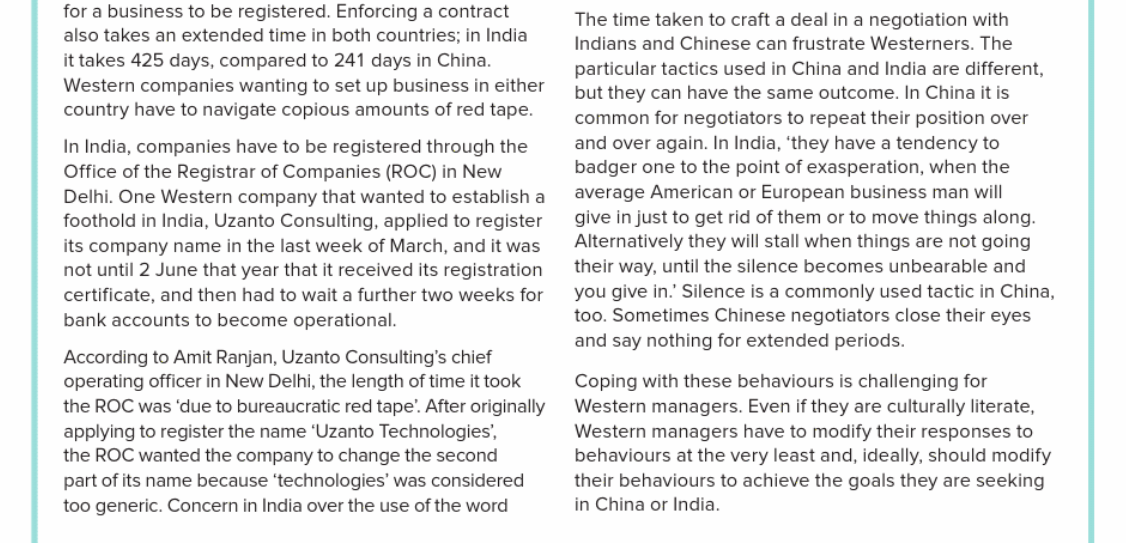
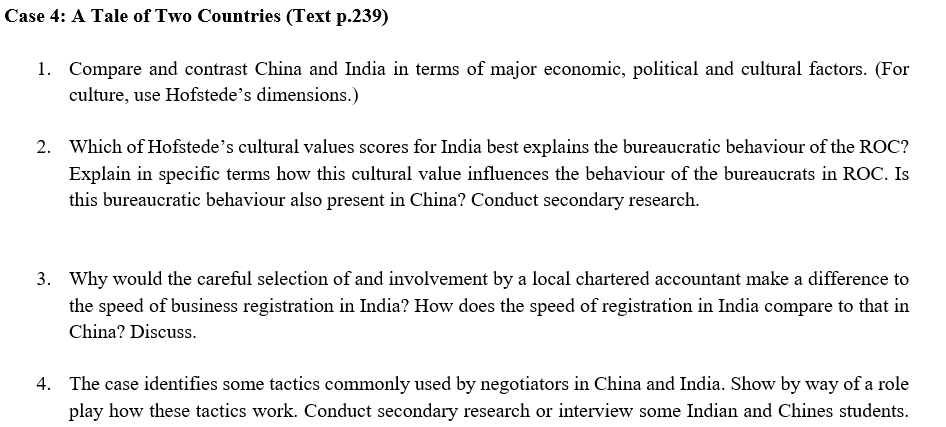
EMERGING MARKETS A TALE OF TWO COUNTRIES The two Asian countries in the spotlight for Western companies seeking to internationalisevia export or offshore production or offshore servic in gare India and China. India is best known for its IT-related services such as call centres. and China is better known for its low cost manufacturing capabilities. Who has not received a marketing call from someone with an Indian accent or doesn't own clothes marked 'Made in China"? What are the similarities and differences between these two countries? Both countries have undergone major economic reforms and. as a result, are two of the fastest growing economies In the world. In 2015 both countries recorded growth rates of around 7 percent. Both India and China have huge populations and pools of willing workers for production facilities. as well as a small but growing middle class with a sizeable disposable income for buying foreign goods. India's and China's scores are similar on some of Hofstede's cultural value dimensions {see Table 5.2}. The numbers In the table show that both countries are considered high power distance and coliectlvlstic {although China is more collectivlstlc). China's culture is considered more long-term oriented than India's. Although there are similarities, it would be foolhardy for a Western manager to think of China and lndia in the same way. For Anglo-Westerners. doing business CHAPTERE DIFFERENCES IN CULTURE 239 in India is 'easier' because English Is widely spoken. In China, finding a good Interpreter remains essential if you want to negotiate a complex business deal. The governments in the two countries are dissimilar: India's government Is a robust democracy; and although there are elections In China, the country hasjust one partythe Communist Party of China. China is officially atheist. although many Chinese practise Confucianism in conjunction with local beliefs andfor Buddhism. In India it is hard to miss the religious practices of the majority Hindu population (80.5 per cent) whose colourful temples are dotted throughout the cities. Muslims are also well represented among the Indian population (13.4 per cent). It Is imperative that Western managers develop their cross-cultural literacy to understand how these similarities and differences play out in business behaviour. Western managers are often surprised about how long It takes to set up a business In these countries. The World Bank reported that starting a business in India took 89 days (on average}. In China it takes 41 days for a business to be registered. Enforcing a contract also takes an extended time in both countries; In India it takes 425 days. compared to 241 days in China. Western companies wanting to set up business in either country have to navigate copious amounts of red tape. In India. companies have to be registered through the Office of the Registrar of Companies (ROG) in New Delhi. One Western company that wanted to establish a foothold in India, Uzanto Consulting. applied to register 'techno logy' is ironic, given that the transformation from an Impoverished. Soviet-inspired state In the 19805 to the global epicentre of communications technology is largely due to the technology revolution of the 19905. Although Uzanto tried to reason with the ROC, It 'soon realised that all such attempts were futile. In sheer exasperation and In an effort to get it over with'. the name Uzanto Consulting was suggested and the ROC agreed. Amlt Ranjan writes In his blog that 'wrangling over the name issue probably took up 2025 days'. He goes on to comment that the role of his chartered accountant (CA) was crucial in the start~up process because some CA5 can exert inuence in the ROC office. The role of the CA might be related to the importance of personal relationships In Indiasome India watchers deem relationships the most effective form of communication In India. Recently, the ROC office has reduced the time it takes to register a company name by moving the process online. Approval ofa company name can take as little asjust a few minutes if companies apply onllne with all the necessary documentation. The time taken to craft a deal in a negotiation with Indians and Chinese can frustrate Westerners. The particular tactics used in China and india are different, but they can have the same outcome. In China it is common for negotiators to repeat their position over and over again. In India, 'they have a tendency to badger one to the point of exasperation. when the average American or European business man will give injust to get rid of them or to move things along. for a business to be registered. Enforcing a contract also takes an extended time in both countries; in India it takes 425 days. compared to 241 days in China. Western companies wanting to set up business in either country have to navigate copious amounts of red tape. In India. companies have to be registered through the Office of the Registrar of Companies {ROC} in New Delhi. One Western company that wanted to establish a foothold in india, Uzanto Consulting. applied to register its company name in the last week of March, and it was not until 2 June that year that it received its registration certificate, and then had to wait a further two weeks for bank accounts to become operational. According to Amit Ranjan, Uzanto Consulting's chief operating ofcer in New Delhi. the length of time It took the ROC was 'due to bureaucratic red tape'. After originally applying to register the name 'Uzanto Technologies', the ROC wanted the company to change the second part of its name because 'technologies' was considered too generic. Concern in India over the use of the word The time taken to craft a deal in a negotiation with Indians and Chinese can frustrate Westerners. The particular tactics used in China and indie are different, but they can have the same outcome. in China it is common for negotiators to repeat their position over and over again. In India, 'they have a tendency to badger one to the point of exasperation, when the average American or European business man will give injust to get rid of them or to move things along. Alternatively they will stall when things are not going their way, until the silence becomes unbearable and you give In.' Silence is a commoniy used tactic in China, too. Sometimes Chinese negotiators close their eyes and say nothing for extended periods. Coping with these behaviours is challenging for Western managers. Even if they are culturally literate, Western managers have to modify their responses to behaviours at the very least and. ideally, should modify their behaviours to achieve the goals they are seeking in China or India. Case 4: A Tale of Two Countries {Text p.239) 1. Compare and contrast China and India in terms of major economic, political and cultural factors. (For culture, use Hofstede's dimensions.) 2. Which of Hofstede's cultural values scores for India best explains the bureaucratic behaviour of the ROC? Explain in specic terms how this cultural value inuences the behaviour of the bureaucrats in ROC. Is this bureaucratic behaviour also present in China? Conduct secondary research. 3. Why would the careful selection of and involvement by a local chartered accountant make a difference to the speed of business registration in India? How does the speed of registration in India compare to that in China? Discuss. 4. The case identies some tactics commonly used by negotiators in China and India. Show by way of a role play how these tactics work. Conduct secondary research or interview some Indian and Chines students
Step by Step Solution
There are 3 Steps involved in it

Get step-by-step solutions from verified subject matter experts
 Study Help