



Question: i need help with all three questions 1. Suppose a consumer has u - 17 z . Further. suppose that A/ = 100. and p;
i need help with all three questions
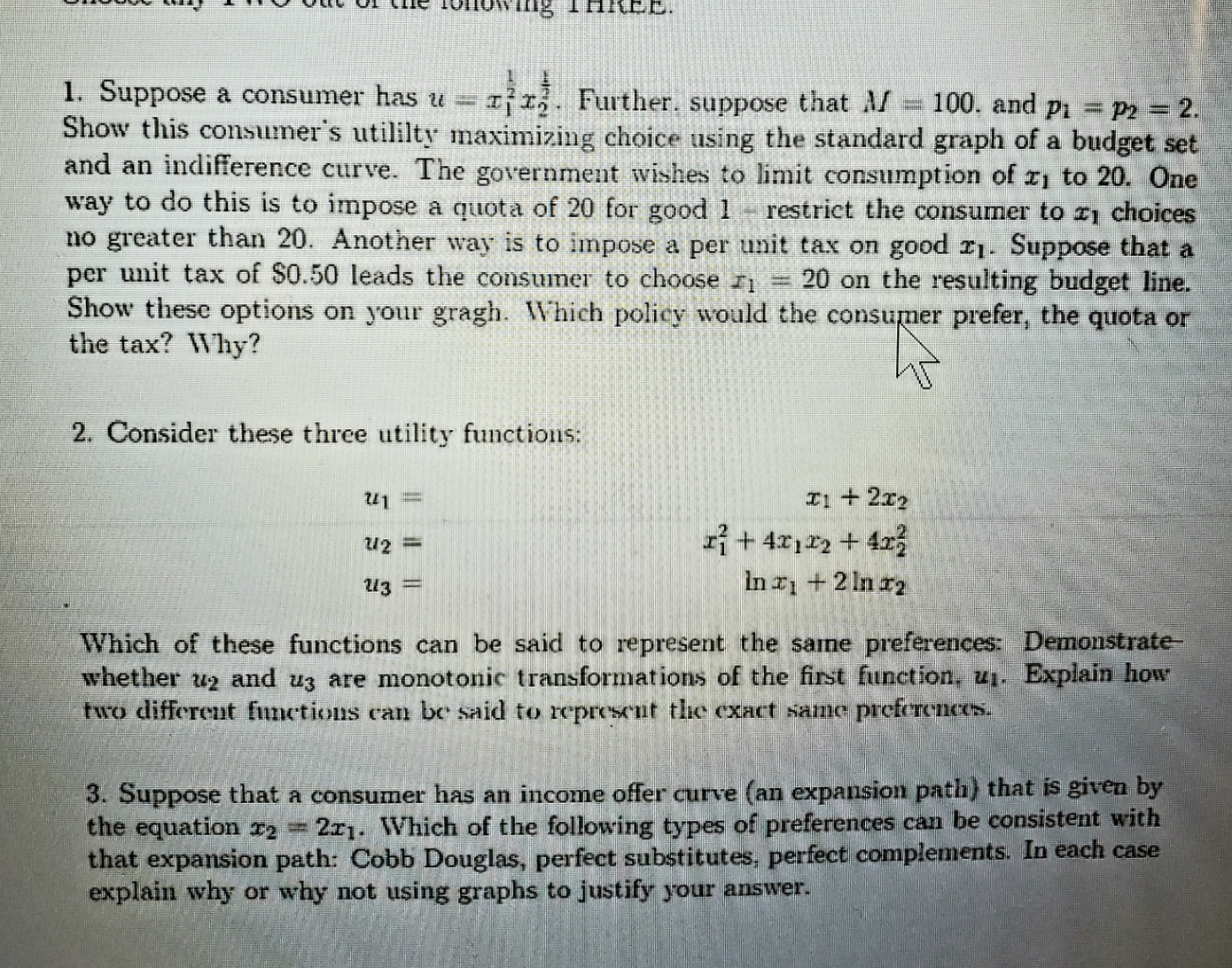
1. Suppose a consumer has u - 17 z . Further. suppose that A/ = 100. and p; = p2 = 2. Show this consumer's utility maximizing choice using the standard graph of a budget set and an indifference curve. The government wishes to limit consumption of z, to 20. One way to do this is to impose a quota of 20 for good 1 - restrict the consumer to z1 choices no greater than 20. Another way is to impose a per unit tax on good 21. Suppose that a per unit tax of $0.50 leads the consumer to choose s] = 20 on the resulting budget line. Show these options on your gragh. Which policy would the consumer prefer, the quota or the tax? Why? 2. Consider these three utility functions: D1 + 2x2 U2 - 23 In + 2In32 Which of these functions can be said to represent the same preferences: Demonstrate- whether u2 and us are monotonic transformations of the first function, up. Explain how two different functions can be said to represent the exact same preferences. 3. Suppose that a consumer has an income offer curve (an expansion path ) that is given by the equation x2 - 2rj. Which of the following types of preferences can be consistent with that expansion path: Cobb Douglas, perfect substitutes, perfect complements. In each case explain why or why not using graphs to justify your
Step by Step Solution
There are 3 Steps involved in it

Get step-by-step solutions from verified subject matter experts