







Question: i need help with C on #1 and help with questions 2 and 3 i need help with C of question 1 and the question
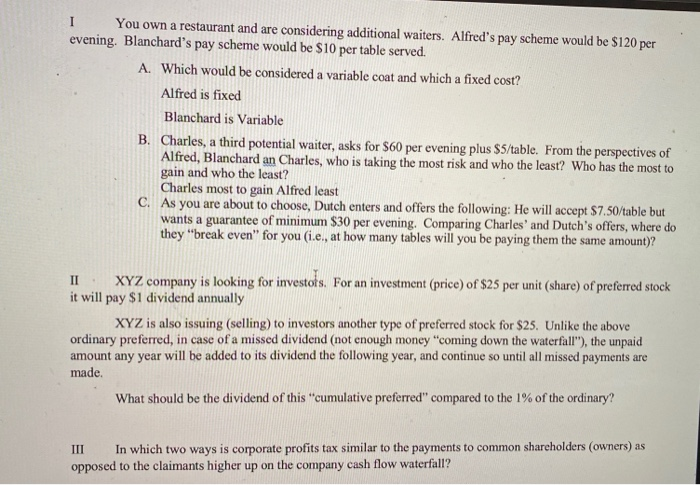
I You own a restaurant and are considering additional waiters. Alfred's pay scheme would be $120 per evening. Blanchard's pay scheme would be $10 per table served. A. Which would be considered a variable coat and which a fixed cost? Alfred is fixed Blanchard is Variable B. Charles, a third potential waiter, asks for $60 per evening plus $5/table. From the perspectives of Alfred, Blanchard an Charles, who is taking the most risk and who the least? Who has the most to gain and who the least? Charles most to gain Alfred least C. As you are about to choose, Dutch enters and offers the following: He will accept $7.50/table but wants a guarantee of minimum $30 per evening. Comparing Charles' and Dutch's offers, where do they "break even" for you (i.e., at how many tables will you be paying them the same amount)? II XYZ company is looking for investos. For an investment (price) of $25 per unit (share) of preferred stock it will pay $1 dividend annually XYZ is also issuing (selling) to investors another type of preferred stock for $25. Unlike the above ordinary preferred, in case of a missed dividend (not enough money "coming down the waterfall"), the unpaid amount any year will be added to its dividend the following year, and continue so until all missed payments are made. What should be the dividend of this "cumulative preferred" compared to the 1% of the ordinary? In which two ways is corporate profits tax similar to the payments to common shareholders (owners) as opposed to the claimants higher up on the company cash flow waterfall
Step by Step Solution
There are 3 Steps involved in it

Get step-by-step solutions from verified subject matter experts
 Study Help