



Question: I need help with calculation of answer , I am attaching the question & solution , no need to solve the question just explain the
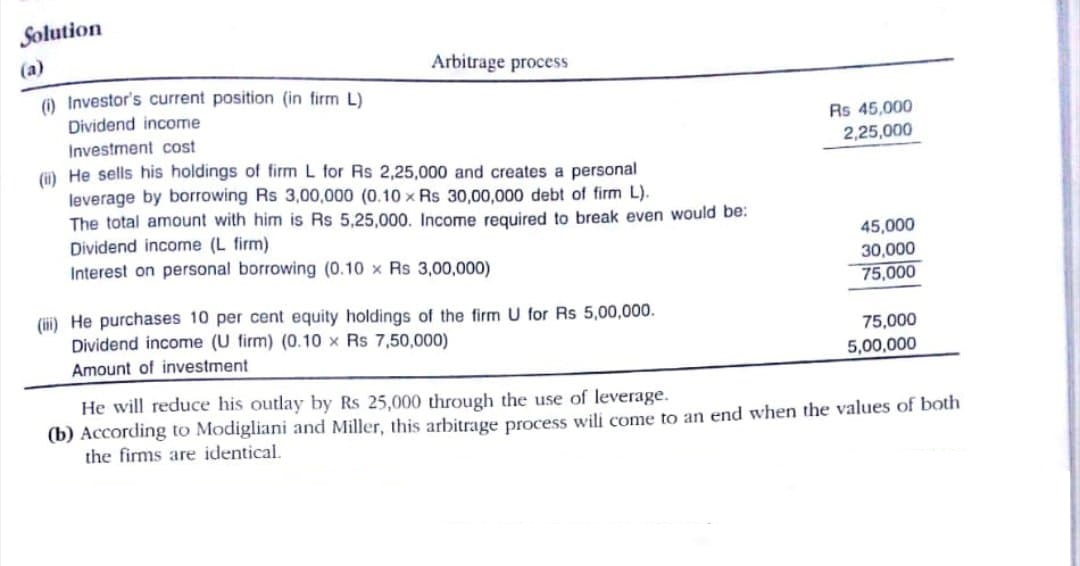
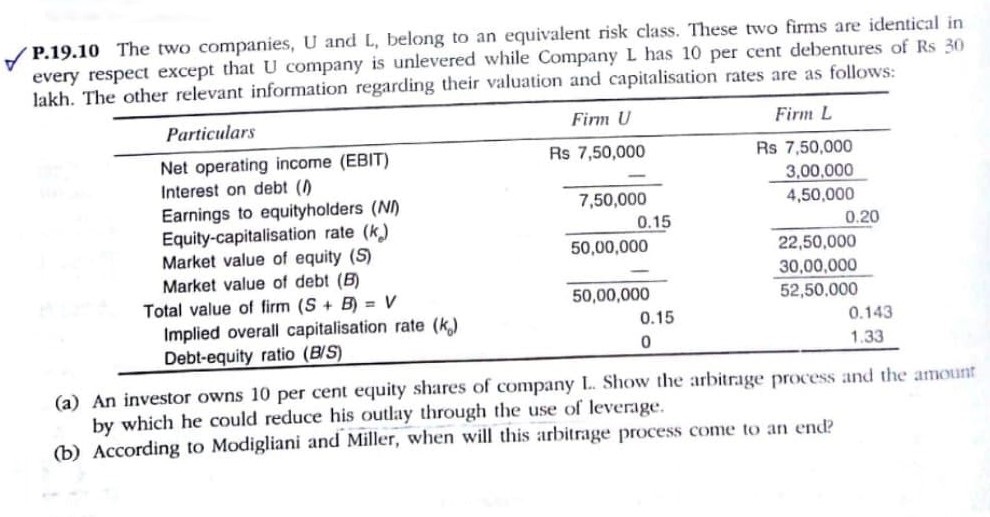
I need help with calculation of answer , I am attaching the question & solution , no need to solve the question just explain the calculations .Thanks
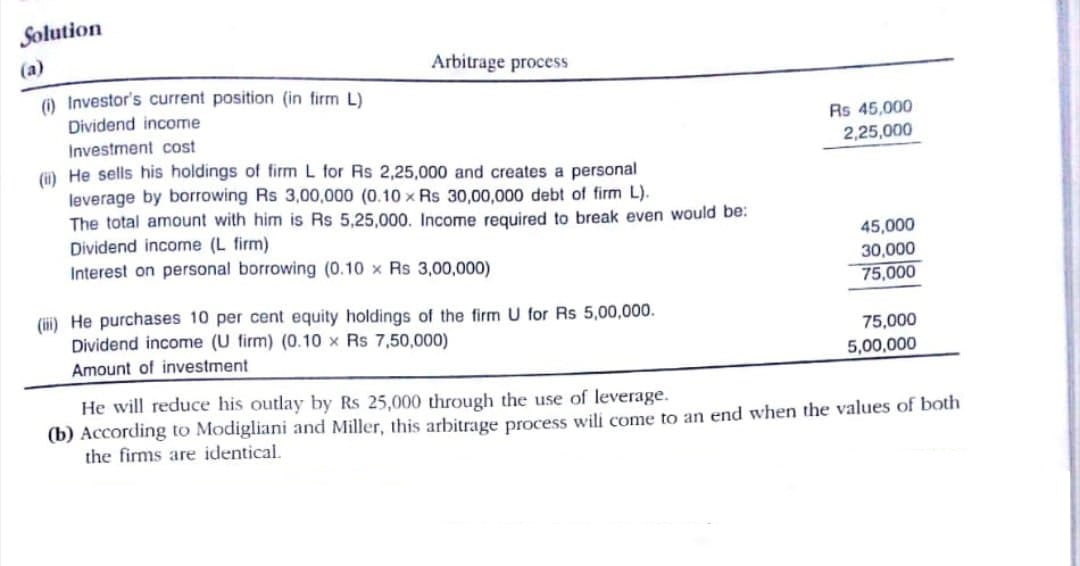
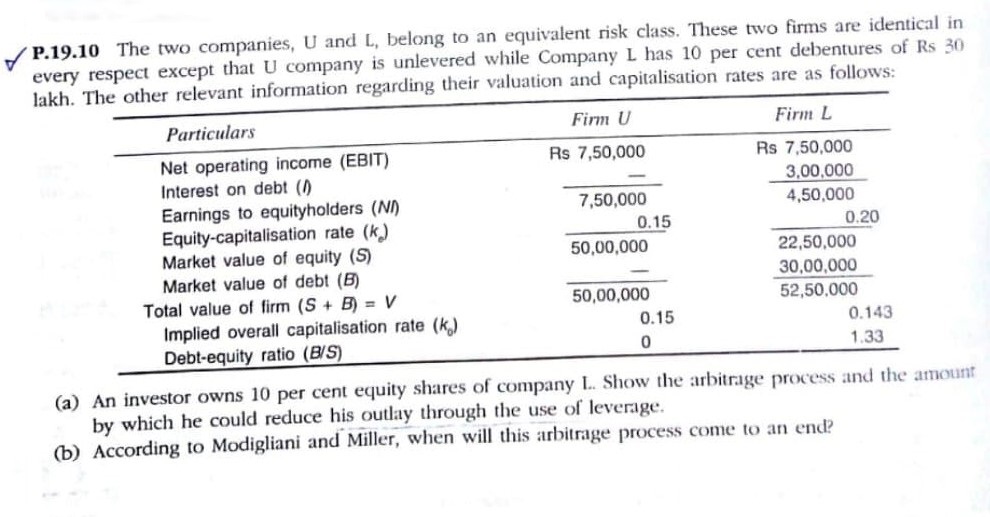
Solution (a) Arbitrage process () Investor's current position (in firm L) Dividend income As 45,000 Investment cost 2,25,000 (in) He sells his holdings of firm L for As 2,25,000 and creates a personal leverage by borrowing Rs 3,00,000 (0.10 x Rs 30,00,000 debt of firm L) The total amount with him is Rs 5,25,000. Income required to break even would be: Dividend income (L firm) 45,000 Interest on personal borrowing (0.10 x Rs 3,00,000) 30,000 75,000 (1ii) He purchases 10 per cent equity holdings of the firm U for As 5,00,000. Dividend income (U firm) (0.10 x Rs 7.50,000) 75,000 Amount of investment 5,00,000 He will reduce his outlay by Rs 25,000 through the use of leverage. (b) According to Modigliani and Miller, this arbitrage process will come to an end when the values of both the firms are identical.P.19.10 The two companies, U and L, belong to an equivalent risk class. These two firms are identical in every respect except that U company is unlevered while Company L has 10 per cent debentures of Rs 30 lakh. The other relevant information regarding their valuation and capitalisation rates are as follows: Particulars Firm U Firm L Net operating income (EBIT) As 7,50,000 Rs 7.50,000 Interest on debt () 3,00,000 Earnings to equityholders (NI) 7,50,000 4,50,000 Equity-capitalisation rate (k) 0.15 0.20 Market value of equity (S) 50,00,000 22,50.000 Market value of debt (B) 30,00,000 Total value of firm (S + B) = V 50,00,000 52,50.000 Implied overall capitalisation rate (k.) 0.15 0.143 Debt-equity ratio (B/S) 0 1.33 (a) An investor owns 10 per cent equity shares of company L.. Show the arbitrage process and the amount by which he could reduce his outlay through the use of leverage. (b) According to Modigliani and Miller, when will this arbitrage process come to an end
Step by Step Solution
There are 3 Steps involved in it

Get step-by-step solutions from verified subject matter experts