



Question: I need help with conclusion please Introduction We had to unite as individuals over the semester to become a productive group. We may now determine
I need help with conclusion please 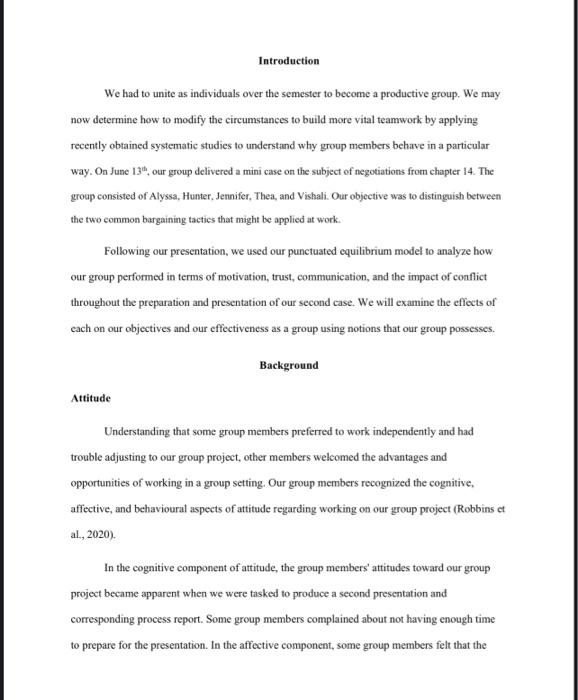
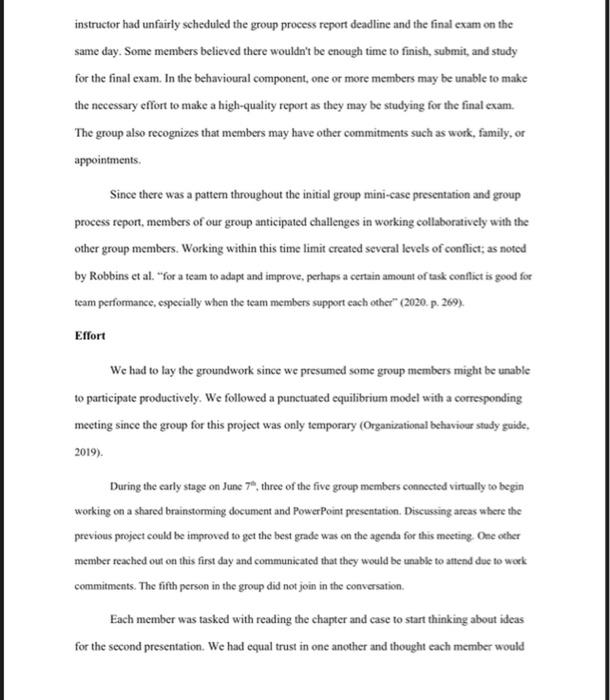
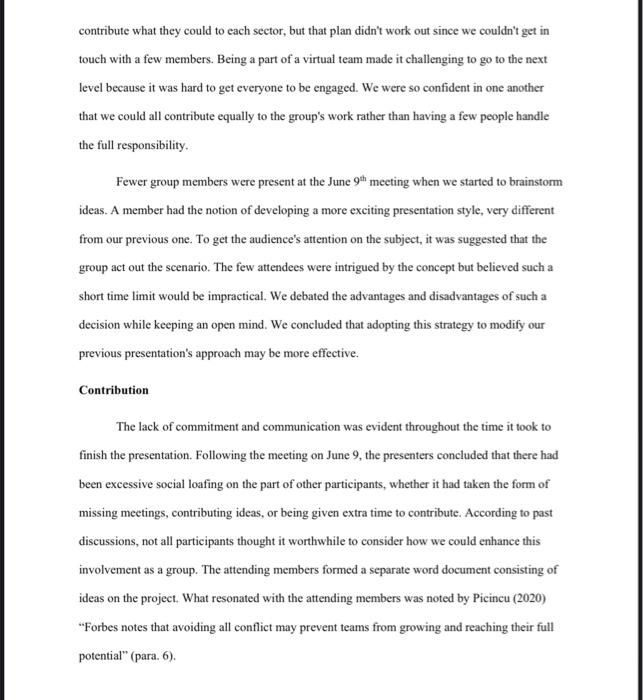
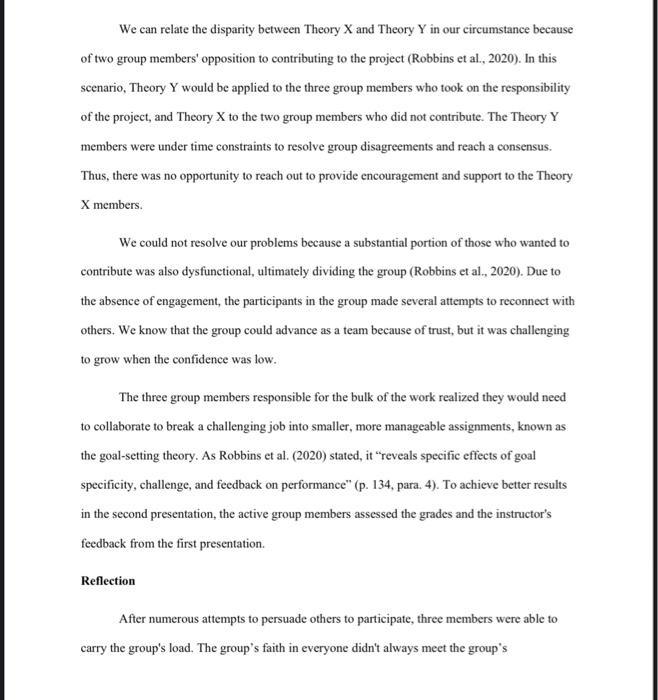

Introduction We had to unite as individuals over the semester to become a productive group. We may now determine how to modify the circumstances to build more vital teamwork by applying recently obtained systematic studies to understand why group members behave in a particular way. On June 13, our group delivered a mini case on the subject of negotiations from chapter 14. The group consisted of Alyssa, Hunter, Jennifer, Thea, and Vishali. Our objective was to distinguish between the two common bargaining tactics that might be applied at work. Following our presentation, we used our punctuated equilibrium model to analyze how our group performed in terms of motivation, trust, communication, and the impact of conflict throughout the preparation and presentation of our second case. We will examine the effects of each on our objectives and our effectiveness as a group using notions that our group possesses. Background Attitude Understanding that some group members preferred to work independently and had trouble adjusting to our group project, other members welcomed the advantages and opportunities of working in a group setting. Our group members recognized the cognitive, affective, and behavioural aspects of attitude regarding working on our group project (Robbins et al., 2020). In the cognitive component of attitude, the group members' attitudes toward our group project became apparent when we were tasked to produce a second presentation and corresponding process report. Some group members complained about not having enough time to prepare for the presentation. In the affective component, some group members felt that the instructor had unfairly scheduled the group process report deadline and the final exam on the same day. Some members believed there wouldn't be enough time to finish, submit, and study for the final exam. In the behavioural component, one or more members may be unable to make the necessary effort to make a high-quality report as they may be studying for the final exam. The group also recognizes that members may have other commitments such as work, family, or appointments. Since there was a pattern throughout the initial group mini-case presentation and group process report, members of our group anticipated challenges in working collaboratively with the other group members. Working within this time limit created several levels of conflict; as noted by Robbins et al. "for a team to adapt and improve, perhaps a certain amount of task conflict is good for team performance, especially when the team members support each other" (2020. p. 269). Effort We had to lay the groundwork since we presumed some group members might be unable to participate productively. We followed a punctuated equilibrium model with a corresponding meeting since the group for this project was only temporary (Organizational behaviour study guide, 2019). During the early stage on June 7, three of the five group members connected virtually to begin working on a shared brainstorming document and PowerPoint presentation. Discussing areas where the previous project could be improved to get the best grade was on the agenda for this meeting. One other member reached out on this first day and communicated that they would be unable to attend due to work commitments. The fifth person in the group did not join in the conversation. Each member was tasked with reading the chapter and case to start thinking about ideas for the second presentation. We had equal trust in one another and thought each member would contribute what they could to each sector, but that plan didn't work out since we couldn't get in touch with a few members. Being a part of a virtual team made it challenging to go to the next level because it was hard to get everyone to be engaged. We were so confident in one another that we could all contribute equally to the group's work rather than having a few people handle the full responsibility. Fewer group members were present at the June 9th meeting when we started to brainstorm ideas. A member had the notion of developing a more exciting presentation style, very different from our previous one. To get the audience's attention on the subject, it was suggested that the group act out the scenario. The few attendees were intrigued by the concept but believed such a short time limit would be impractical. We debated the advantages and disadvantages of such a decision while keeping an open mind. We concluded that adopting this strategy to modify our previous presentation's approach may be more effective. Contribution The lack of commitment and communication was evident throughout the time it took to finish the presentation. Following the meeting on June 9, the presenters concluded that there had been excessive social loafing on the part of other participants, whether it had taken the form of missing meetings, contributing ideas, or being given extra time to contribute. According to past discussions, not all participants thought it worthwhile to consider how we could enhance this involvement as a group. The attending members formed a separate word document consisting of ideas on the project. What resonated with the attending members was noted by Picincu (2020) "Forbes notes that avoiding all conflict may prevent teams from growing and reaching their full potential" (para. 6). We can relate the disparity between Theory X and Theory Y in our circumstance because of two group members' opposition to contributing to the project (Robbins et al., 2020). In this scenario, Theory Y would be applied to the three group members who took on the responsibility of the project, and Theory X to the two group members who did not contribute. The Theory Y members were under time constraints to resolve group disagreements and reach a consensus. Thus, there was no opportunity to reach out to provide encouragement and support to the Theory X members. We could not resolve our problems because a substantial portion of those who wanted to contribute was also dysfunctional, ultimately dividing the group (Robbins et al., 2020). Due to the absence of engagement, the participants in the group made several attempts to reconnect with others. We know that the group could advance as a team because of trust, but it was challenging to grow when the confidence was low. The three group members responsible for the bulk of the work realized they would need to collaborate to break a challenging job into smaller, more manageable assignments, known as the goal-setting theory. As Robbins et al. (2020) stated, it "reveals specific effects of goal specificity, challenge, and feedback on performance" (p. 134, para. 4). To achieve better results in the second presentation, the active group members assessed the grades and the instructor's feedback from the first presentation. Reflection After numerous attempts to persuade others to participate, three members were able to carry the group's load. The group's faith in everyone didn't always meet the group's expectations. To help the group function more evenly, each participant was encouraged to share their ideas. Once all participants joined on the final day, we discussed what was still needed to complete the project. The discussion included the objectives, the expectations to work as a united group, and how best to alter the situation toward a functional outcome (Robbins et al., 2020). As the punctuated equilibrium model describes, this is common in temporary groups due to the impending deadline. Each participant had the opportunity to express their opinions during the final meeting and change portions to reflect their views. To ensure we were all on the same page, the group went through several practice runs before finalizing the presentation. This discussion was crucial to maintaining the project's coherence and enabling us to receive the highest grade possible despite the setbacks
Step by Step Solution
There are 3 Steps involved in it
1 Expert Approved Answer
Step: 1 Unlock

Question Has Been Solved by an Expert!
Get step-by-step solutions from verified subject matter experts
Step: 2 Unlock
Step: 3 Unlock