







Question: I need help with everything on the chart paper, 1,2,3 and final responses. The measures of the circles from top to bottom- the biggest circle
I need help with everything on the chart paper, 1,2,3 and final responses. The measures of the circles from top to bottom- the biggest circle is 3 inches, the middle circle is 2 1/2 inches and the smallest circle is 2 inches. Thanks! I'll leave a great rating.
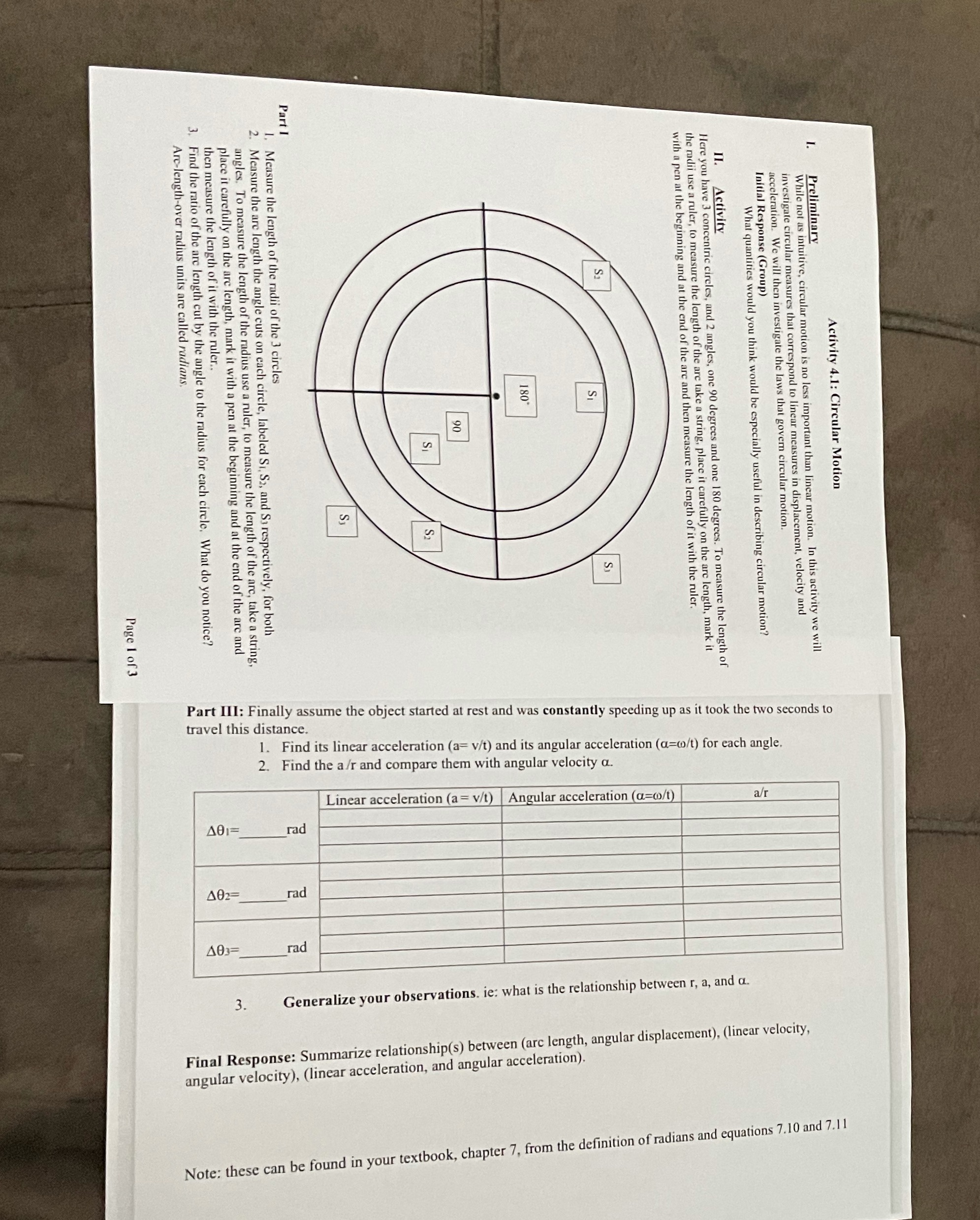
Activity 4.1: Circular Motion Preliminary While not as intuitive, circular motion is no less important than linear motion. In this activity we will Investigate circular measures that correspond to linear measures in displacement, velocity and acceleration. We will then investigate the laws that govern circular motion. Initial Response (Group) What quantities would you think would be especially useful in describing circular motion? a/r n. Activity Here you have 3 concentric circles, and 2 angles, one 90 degrees and one 180 degrees. To measure the length of the radii use a ruler, to measure the length of the are take a string, place it carefully on the are length, mark it with a pen at the beginning and at the end of the are and then measure the length of it with the ruler. in in 180 1. Find its linear acceleration (a= v/t) and its angular acceleration (a=/t) for each angle. Part III: Finally assume the object started at rest and was constantly speeding up as it took the two seconds to Generalize your observations. ie: what is the relationship between r, a, and a. Note: these can be found in your textbook, chapter 7, from the definition of radians and equations 7.10 and 7.1 1 Linear acceleration (a = v/1) Angular acceleration (a=(/1) Final Response: Summarize relationship(s) between (arc length, angular displacement), (linear velocity, 90 2. Find the a/r and compare them with angular velocity a angular velocity), (linear acceleration, and angular acceleration). Part I 1. Measure the length of the radii of the 3 circles rad rad rad 2. Measure the are length the angle cuts on each circle, labeled SI, $2, and Sy respectively, for both angles. To measure the length of the radius use a ruler, to measure the length of the are, take a string, place it carefully on the arc length, mark it with a pen at the beginning and at the end of the arc and travel this distance. 3. then measure the length of it with the ruler.. 3. Find the ratio of the are length cut by the angle to the radius for each circle, What do you notice? ZOV =fOV Arc-length-over radius units are called radians, Page I of 3
Step by Step Solution
There are 3 Steps involved in it

Get step-by-step solutions from verified subject matter experts
 Study Help