







Question: i need help with my homework Nutrient deficiencies exist extensively among many members of the U.S population. More specifically, a research company claims that 90%
i need help with my homework
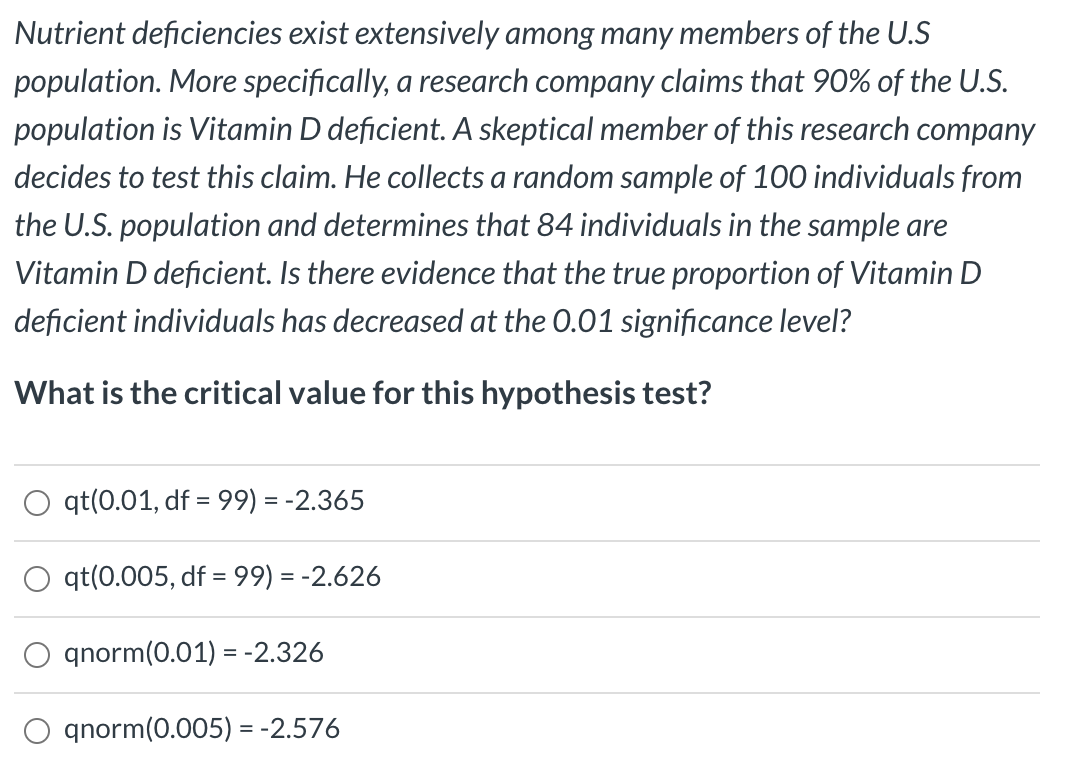
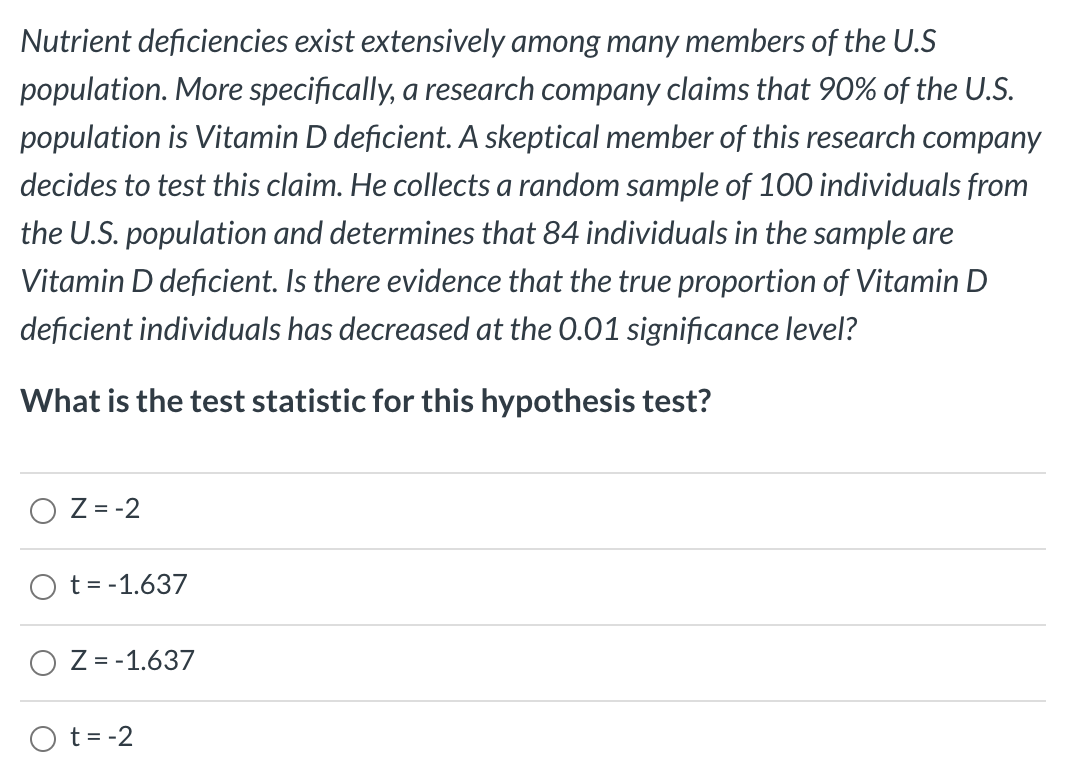
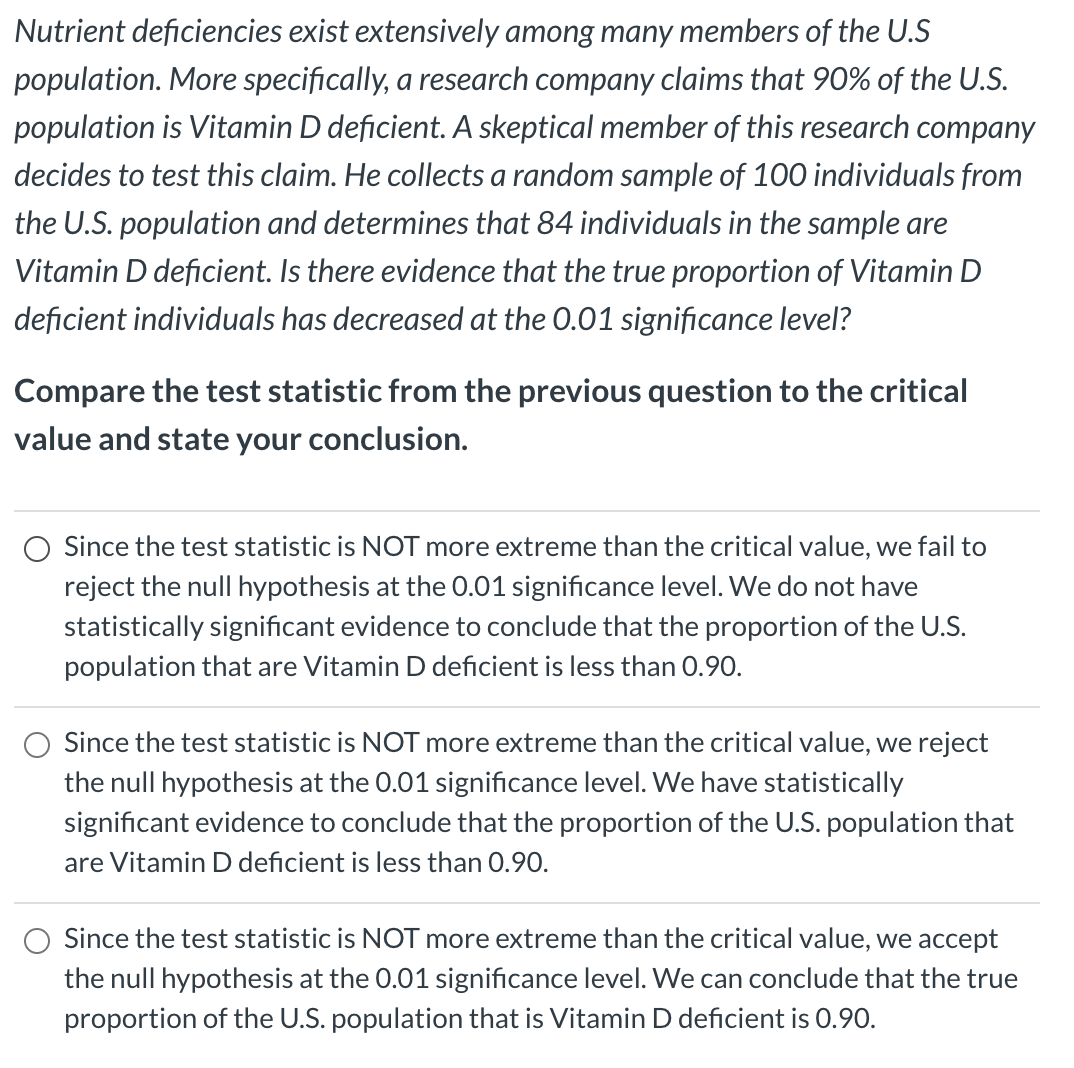
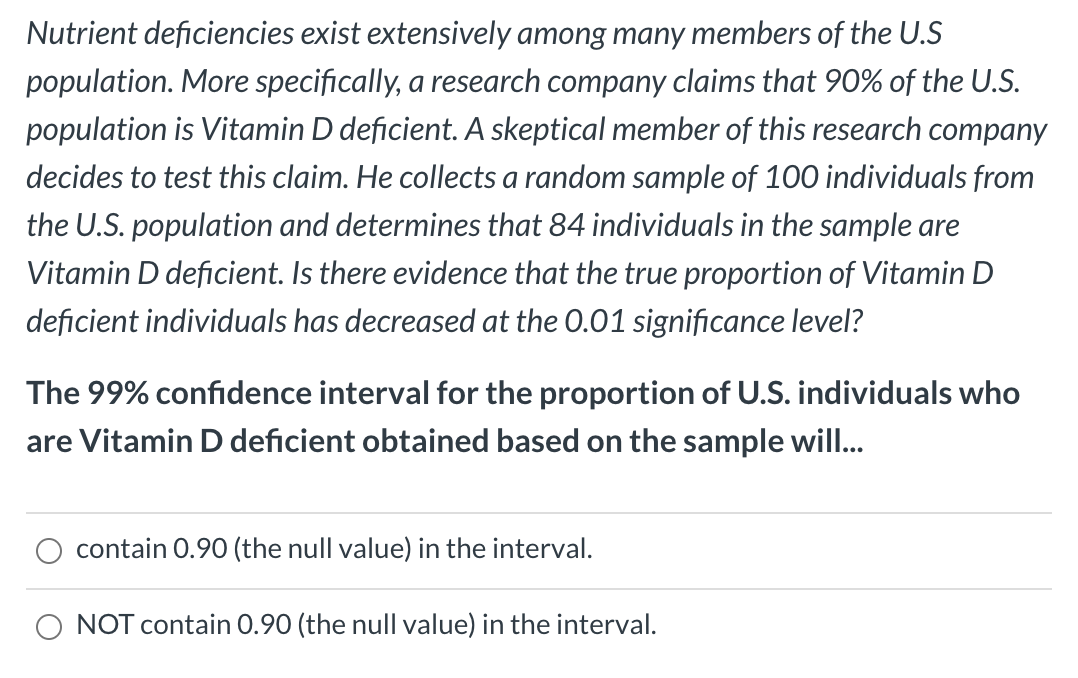
Nutrient deficiencies exist extensively among many members of the U.S population. More specifically, a research company claims that 90% of the U.S. population is Vitamin D deficient. A skeptical member of this research company decides to test this claim. He collects a random sample of 100 individuals from the U.S. population and determines that 84 individuals in the sample are Vitamin D deficient. Is there evidence that the true proportion of Vitamin D deficient individuals has decreased at the 0.01 significance level? What is the critical value for this hypothesis test? O qt(0.01, df = 99) = -2.365 O qt(0.005, df = 99) = -2.626 O qnorm(0.01) = -2.326 O qnorm(0.005) = -2.576Nutrient deficiencies exist extensively among many members of the U.S population. More specifically, a research company claims that 90% of the U.S. population is Vitamin D deficient. A skeptical member of this research company decides to test this claim. He collects a random sample of 100 individuals from the U.S. population and determines that 84 individuals in the sample are Vitamin D deficient. Is there evidence that the true proportion of Vitamin D deficient individuals has decreased at the 0.01 significance level? What is the test statistic for this hypothesis test? O Z =-2 O t = -1.637 O Z =-1.637 O t = -2Nutrient deficiencies exist extensively among many members of the U.S population. More specifically, a research company claims that 90% of the U.S. population is Vitamin D deficient. A skeptical member of this research company decides to test this claim. He collects a random sample of 100 individuals from the U.S. population and determines that 84 individuals in the sample are Vitamin D deficient. Is there evidence that the true proportion of Vitamin D deficient individuals has decreased at the 0.01 significance level? Compare the test statistic from the previous question to the critical value and state your conclusion. O Since the test statistic is NOT more extreme than the critical value, we fail to reject the null hypothesis at the 0.01 significance level. We do not have statistically significant evidence to conclude that the proportion of the U.S. population that are Vitamin D deficient is less than 0.90. O Since the test statistic is NOT more extreme than the critical value, we reject the null hypothesis at the 0.01 significance level. We have statistically significant evidence to conclude that the proportion of the U.S. population that are Vitamin D deficient is less than 0.90. O Since the test statistic is NOT more extreme than the critical value, we accept the null hypothesis at the 0.01 significance level. We can conclude that the true proportion of the U.S. population that is Vitamin D deficient is 0.90.Nutrient deficiencies exist extensively among many members of the U.S population. More specifically, a research company claims that 90% of the U.S. population is Vitamin D deficient. A skeptical member of this research company decides to test this claim. He collects a random sample of 100 individuals from the U.S. population and determines that 84 individuals in the sample are Vitamin D deficient. Is there evidence that the true proportion of Vitamin D deficient individuals has decreased at the 0.01 significance level? The 99% confidence interval for the proportion of U.S. individuals who are Vitamin D deficient obtained based on the sample will... O contain 0.90 (the null value) in the interval. O NOT contain 0.90 (the null value) in the interval
Step by Step Solution
There are 3 Steps involved in it

Get step-by-step solutions from verified subject matter experts
 Study Help