



Question: I need help with part d, f and g. Everything else is right Neighborhood Insurance sells fire insurance policies to local homeowners. The premium is
I need help with part d, f and g. Everything else is right
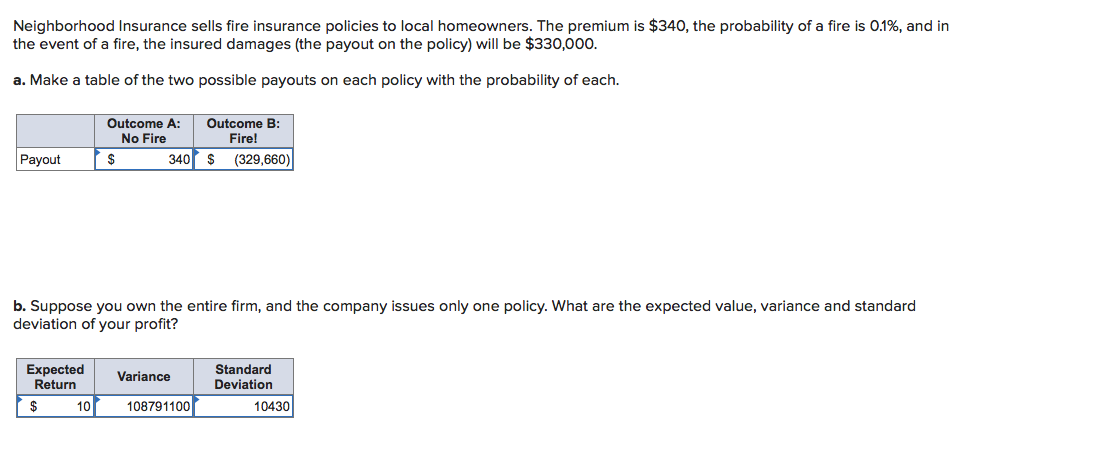
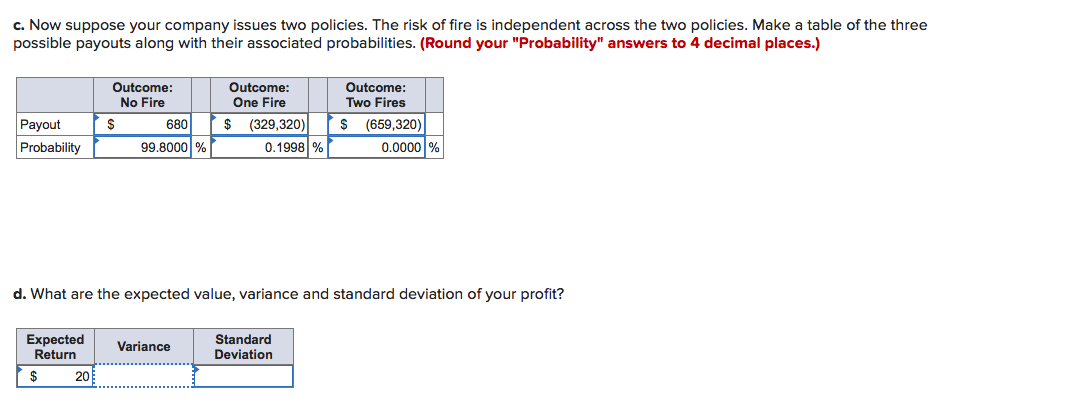
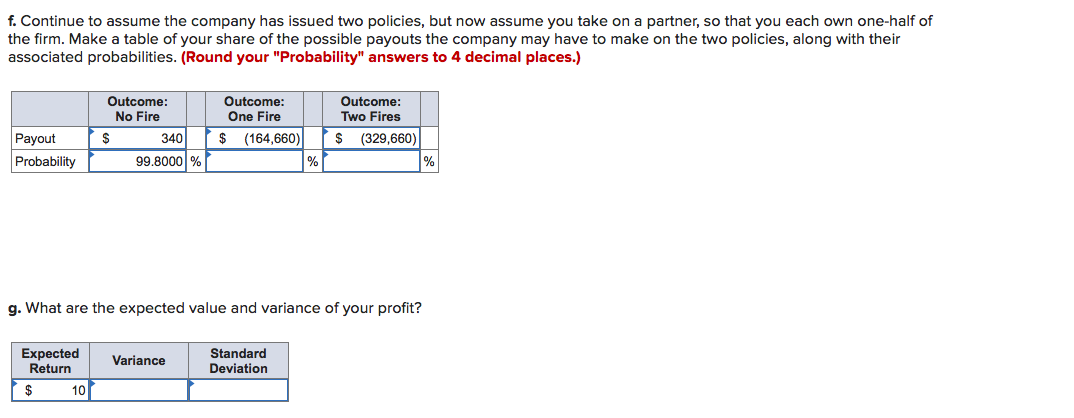
Neighborhood Insurance sells fire insurance policies to local homeowners. The premium is $340, the probability of a fire is 0.1%, and in the event of a fire, the insured damages (the payout on the policy) will be $330,000. a. Make a table of the two possible payouts on each policy with the probability of each. Outcome A: Outcome B: No Fire Fire! $ 340 $ (329,660) Payout b. Suppose you own the entire firm, and the company issues only one policy. What are the expected value, variance and standard deviation of your profit? Variance Expected Return $ 10 Standard Deviation 10430 1087911001 c. Now suppose your company issues two policies. The risk of fire is independent across the two policies. Make a table of the three possible payouts along with their associated probabilities. (Round your "Probability" answers to 4 decimal places.) Outcome: No Fire $ 680 Payout Probability Outcome: One Fire $ (329,320) 0.1998 % Outcome: Two Fires $ (659,320) 0.0000 % 99.8000 % d. What are the expected value, variance and standard deviation of your profit? Variance Expected Return 20 Standard Deviation f. Continue to assume the company has issued two policies, but now assume you take on a partner, so that you each own one-half of the firm. Make a table of your share of the possible payouts the company may have to make on the two policies, along with their associated probabilities. (Round your "Probability" answers to 4 decimal places.) Outcome: No Fire $ 340 Outcome: One Fire $ (164,660) Outcome: Two Fires $ (329,660) Payout Probability 99.8000 % g. What are the expected value and variance of your profit? Variance Expected Return $ 10 Standard Deviation Neighborhood Insurance sells fire insurance policies to local homeowners. The premium is $340, the probability of a fire is 0.1%, and in the event of a fire, the insured damages (the payout on the policy) will be $330,000. a. Make a table of the two possible payouts on each policy with the probability of each. Outcome A: Outcome B: No Fire Fire! $ 340 $ (329,660) Payout b. Suppose you own the entire firm, and the company issues only one policy. What are the expected value, variance and standard deviation of your profit? Variance Expected Return $ 10 Standard Deviation 10430 1087911001 c. Now suppose your company issues two policies. The risk of fire is independent across the two policies. Make a table of the three possible payouts along with their associated probabilities. (Round your "Probability" answers to 4 decimal places.) Outcome: No Fire $ 680 Payout Probability Outcome: One Fire $ (329,320) 0.1998 % Outcome: Two Fires $ (659,320) 0.0000 % 99.8000 % d. What are the expected value, variance and standard deviation of your profit? Variance Expected Return 20 Standard Deviation f. Continue to assume the company has issued two policies, but now assume you take on a partner, so that you each own one-half of the firm. Make a table of your share of the possible payouts the company may have to make on the two policies, along with their associated probabilities. (Round your "Probability" answers to 4 decimal places.) Outcome: No Fire $ 340 Outcome: One Fire $ (164,660) Outcome: Two Fires $ (329,660) Payout Probability 99.8000 % g. What are the expected value and variance of your profit? Variance Expected Return $ 10 Standard Deviation
Step by Step Solution
There are 3 Steps involved in it

Get step-by-step solutions from verified subject matter experts