







Question: I need help with preparing a case brief for this case attached. The case brief should have separate headings for each element, and include the
I need help with preparing a case brief for this case attached.
The case brief should have separate headings for each element, and include the following: Facts:This is where you put the facts of the case into your own words and explain what the reader needs to know to understand the case. In some cases, the facts are long, so you need to be able to distil the important elements. Issues: What is the issue that the court has to determine? What is the source of dispute? Rule: The actual sections/provisions at issue. Some professors insist that this be a separate heading, but if you want to quote the section of the statute as part of your "Issues" section, that's fine. Analysis: This section is where you explain the court's reasoning. What did the court decide and how did they come to their decision? How did the court apply the rules to the facts to decide the issue? Conclusion: Ultimately, what is the significance of the case? What does it all mean? Any advice going forward?
![2022 JUSTICE M.J. VALENTE REASONS FOR JUDGMENT Introduction [1] In the morning](https://dsd5zvtm8ll6.cloudfront.net/si.experts.images/questions/2024/12/674d5bc11cdc7_008674d5bc0ee6dc.jpg)
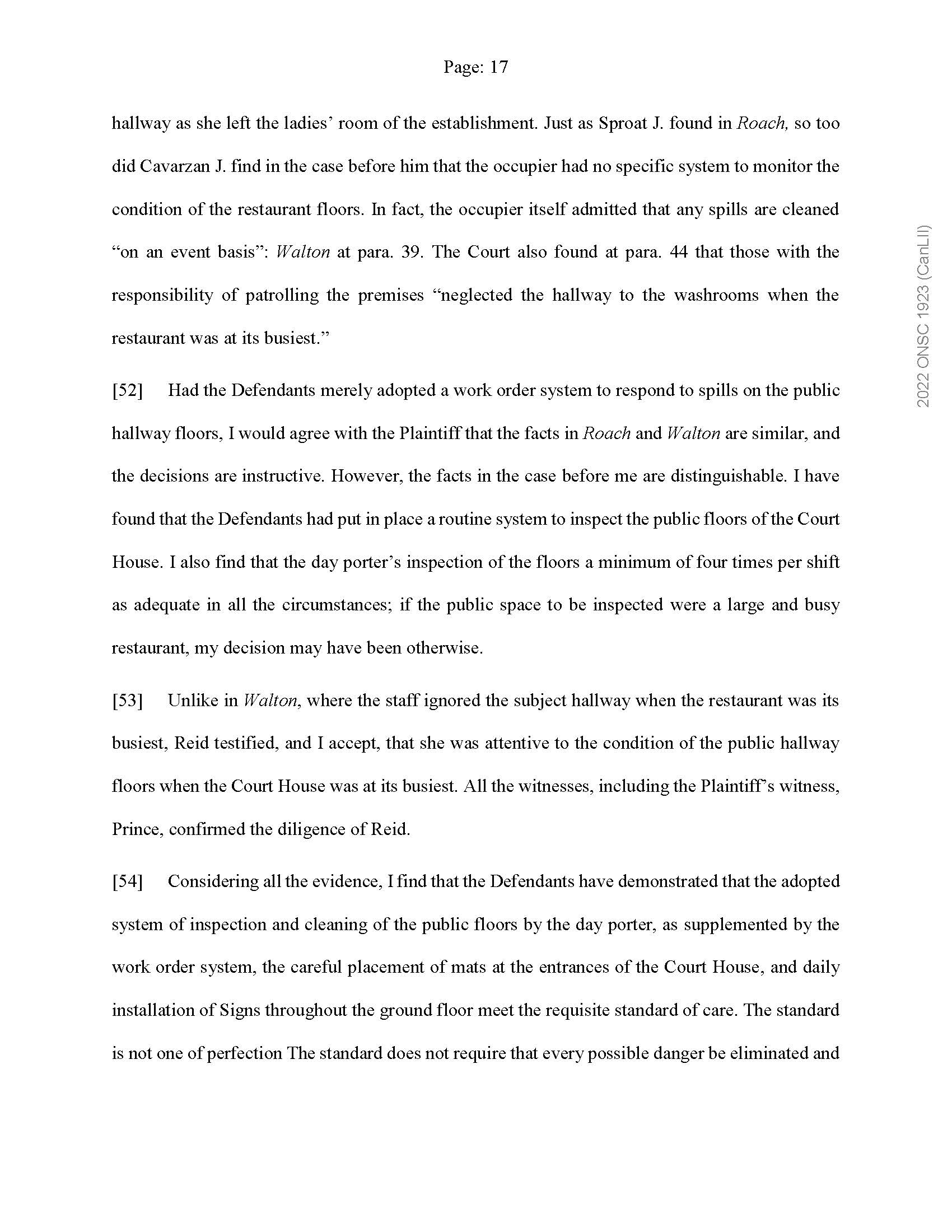
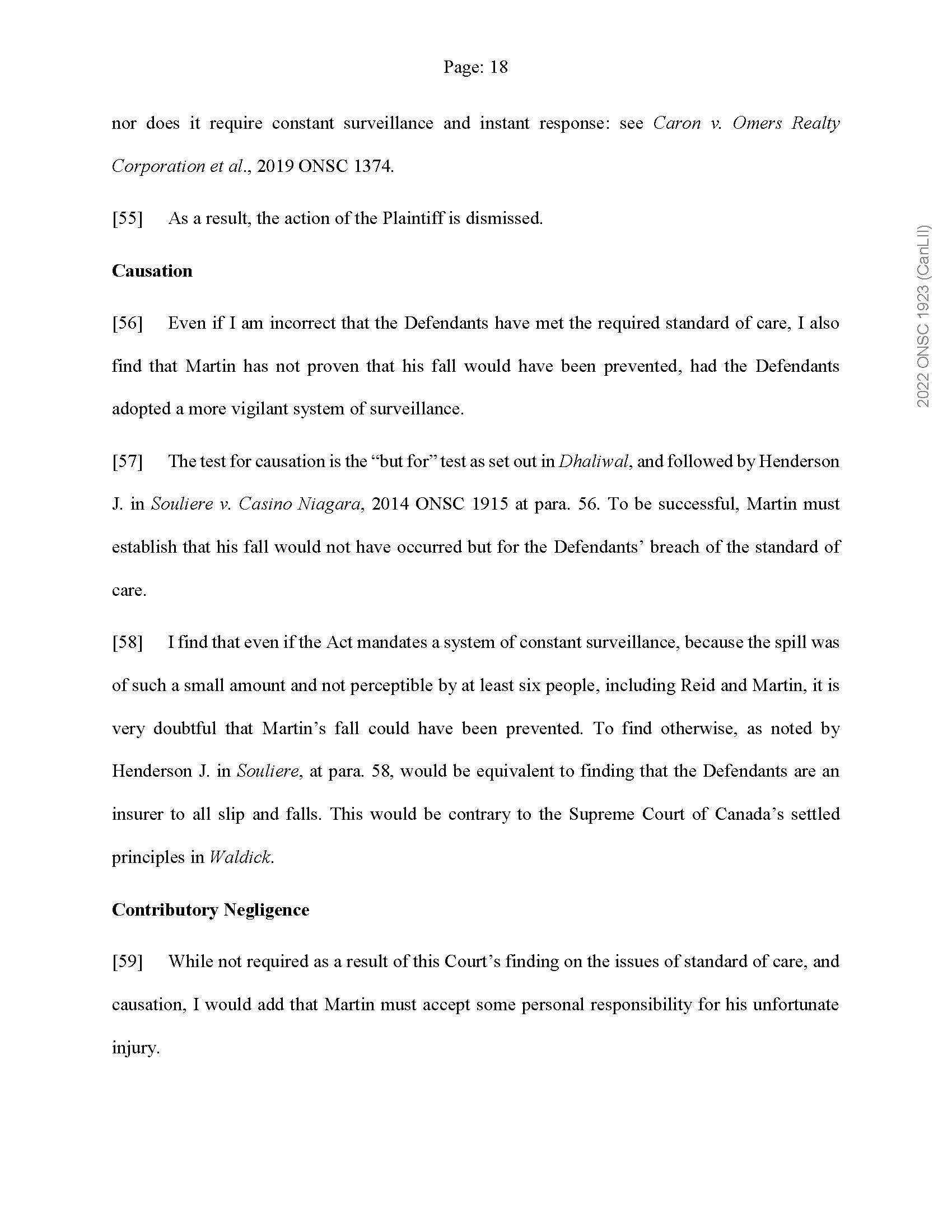
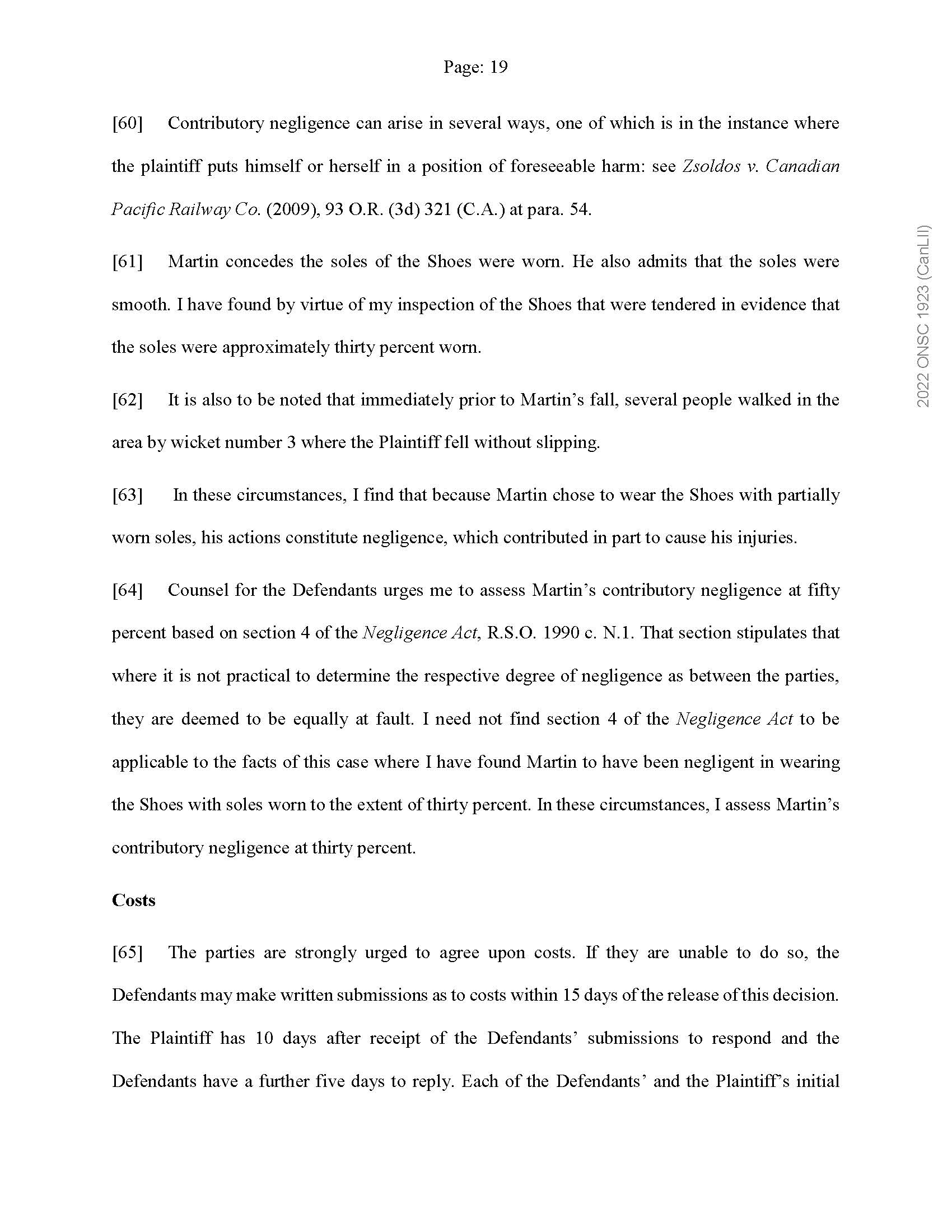
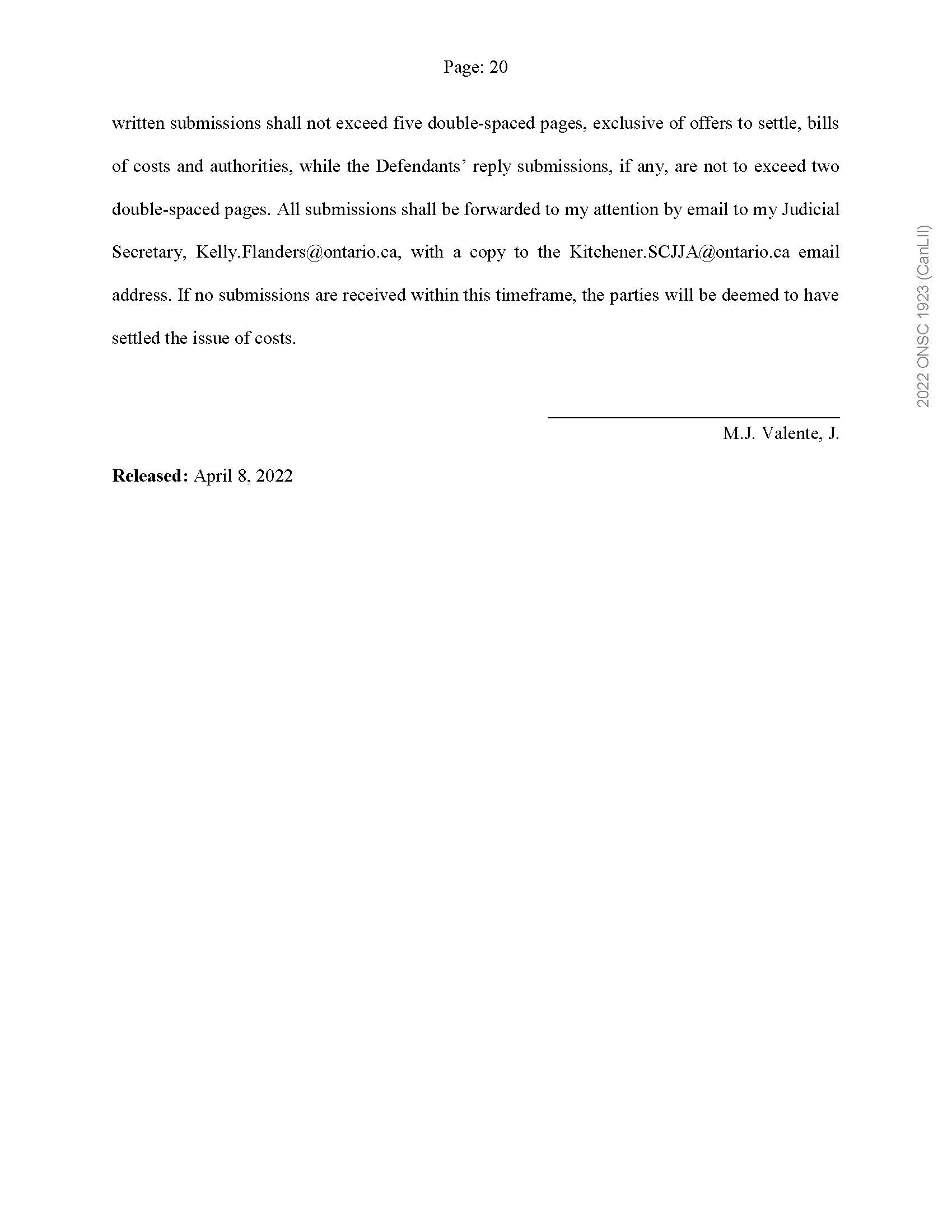
CITATION: Martin v. AGO et al, 2022 ONSC 1923 COURT FILE NO.: CV-17-61472 DATE: 2022-04-08 ONTARIO SUPERIOR COURT OF JUSTICE BETWEEN: 2022 ONSC 1923 (CanLil) Derek Martin Raymond Di Gregorio, for the Plaintiff Plaintiff - and - Attorney General of Ontario, Frank Kolenko, for the Defendants Ontario Infrastructure and Lands Corporation, CBRE Limited, and Bee-Clean Building Maintenance Defendants HEARD: February 7, 8, 9 and 10, 2022 JUSTICE M.J. VALENTE REASONS FOR JUDGMENT Introduction [1] In the morning of July 14, 2015, the plaintiff, Derek Martin ("Martin"), slipped and fell while walking near wicket number 3 in the ground floor lobby of the John Sopinka Court House in Hamilton (the "Court House"). Martin alleges that the defendants, Ontario Infrastructure and Land Corporation ("Ontario Infrastructure"), CBRE Limited ("CBRE") and Bee-Clean Building Maintenance ("Bee-Clean") jointly and severally breached the standard of care required of them by section 3(1) of the Occupiers' Liability Act, R.S.O. 1990, c. O.2 (the "Act") and/or are otherwise negligent, and as a result of their breach of the Act and/or duty of care, Martin suffered damages.Page: 2 [2] Martin discontinued his claim against the defendant, Attorney General of Canada, prior to trial. [3] Martin is a lawyer who attended the Court House, prior to the COVID-l9 pandemic, on an average of three times per week. [4] Ontario Infrastructure is the owner of the Court House. Ontario Infrastructure hired CBRE to act as property manager of the Court House. CBRE contracted with Bee-Clean to perform a variety of janitorial services. [5] The parties have agreed on the quantum of damages but have not resolved the issues of liability and contributory negligence. [6] There are, therefore, two broad issues to be decided. They are as follows. i. Did Ontario Infrastructure, CBRE and Bee-Clean (collectively, the \"'Defendants\") breach the standard of care established by the Act or are they otherwise liable to Martin? ii. If the Defendants are liable to compensate Martin for his injuries, is Martin contributorily negligent? Agreed Statement 01' Facts [7] Prior to trial, the parties agreed to certain facts for which I am most appreciative. For purposes of this Judgment, I am relying upon the following agreed facts that have not been stipulated in the Introduction to this Judgment. i. It rained on July 14, 2015. ii. Martin slipped on a \"small amount of water\". iii. iv. vi. vii. viii. ix. Page: 3 The water accumulated from the wet umbrella of a Court House visitor who had previously stood in the area of Martin's fall. The contract or Service Agreement, dated April 1, 2014, between CBRE and Bee- Clean (the \"Service Agreement\") requires Bee-Clean to perform carpet and floor care, among other responsibilities. Pursuant to the Service Agreement, warning signage was to be placed appropriately for all wet floor areas. Overnight cleaning took place after business hours. During business hours, a day porter employed by Bee-Clean, was on site. Supervisory staff were also on site and completed periodic inspections of the day porter's work. The day porter was responsible for monitoring and cleaning the public areas of the Court House, including the hallways, bathrooms and lobby areas. The day porter did not clean offices or courtrooms unless a specific work order required her to do so. Upon her arrival at the Court House, the day porter immediately placed wet floor signs on all seven oors of the Court House, excluding the basement. A total of four wet oor signs are placed on the ground floor. The four signs are placed at the front and rear entrances and in the \"main hallways\". Two wet oor signs are placed on each of the other floors. During the day, the day porter patrols the public areas of the Court House. The day porter is responsible for tasks such as picking up litter, cleaning coffee spills and anything wet. Page: 4 xi. Martin was carrying a cup of coffee in his left hand and a briefcase in his right hand when he fell. xii. Martin did not nd the oor to be slippery or wet in the other areas of the Court House. xiii. Martin's clothing was not wet when he was lifted from the oor after his fall. xiv. There is CCTV footage of the fall. xv. The footage shows the day porter walking by the fall location toward the public washroom. xvi. The day porter was cleaning the washroom when Martin fell and emerged from the washroom when she heard screaming. xvii. The day porter wiped up the water with a paper towel. xviii. The water did not require a mop to clean up or remove. xix. June Prince (\"Prince\") witnessed Martin's fall. xx. Martin was diagnosed with a torn hamstring as a result of the fall. Findings of Fact A. Martin '3 Court House Route Prior to the Fall [8] Martin was 68-years-old when he testied at trial. Martin practices criminal and quasi criminal law in Hamilton, Brantford, and the Halton Region. Although Martin's testimony is vague with respect to some issues, I generally accept his evidence regarding his route and activities in the Court House on the day prior to the fall. Martin does not recall when he arrived at the Court House nor when he fell but on cross-examination, agreed that the fall could have occurred at approximately 11:30 am. Martin also does not recall if it rained on the morning of July 14, 2015. Page: 5 Not only is it an agreed fact that it rained but the Environment Canada report for July 14, 2015 conrms that it rained from 7:00 am. to at least noon. [9] Martin testied that he routinely used the principal entrance of the Court House on Main Street East to enter the building whenever it was his intention to attend the Crown Attorney's ofce. On the morning of July 14, 2015, Martin's intention was to attend the Crown Attorney's ofce. Although Martin has no specic recollection of which entrance he used on the morning in question, I nd that he entered via the Main Street doors which Martin described as revolving doors. After attending the Crown's ofce on the fourth floor, Martin descended to the ground floor by elevator and walked along the ground oor hallway of the Court House, described by Martin and all the witnesses as the \"Heritage Hallway\Page: 6 the point of his fall to the double glass doors. I also accept Martin's evidence that he was not in a rush when he fell. [12] At the time of the fall, Martin was wearing his usual work shoes. They were \"Rockport Weatherproof\" shoes with rubber soles (the \"Shoes\"). Martin testied that he never had any problems with the Shoes' grip and had never slipped before, while wearing the Shoes. He also testied that following his fall, he never wore the Shoes and the Shoes, as tendered in evidence, were in the same condition as at the date of the fall. [13] On cross-examination, Martin admitted that the soles of the Shoes were worn. He also admitted that at the date of the fall, the soles were smooth and \"not gritty\". On inspection of the Shoes, I nd that much of the soles' original tread are worn to the extent of approximately thirty percent. B. T he Placement OfMats [14] Martin testied that he could not recall if mats were placed on the inside of the revolving doors to the Main Street East entrance to the Court House on July 14, 2015. [15] Each of the Bee-Clean day porter, Tammy Reid (\"Reid\"), Reid's supervisor, Jorgina Paulino (\"Paulino\") and the Bee-Clean district manager, Dany Mederios (\"Mederios\"), testied that in the summer months, mats are located on the inside of all three entrances to the Court House, including the Main Street East principal entrance. [16] Paulino is responsible for ordering the large industrial mats placed at each of the entrances and she ensures that they are properly arranged. In the case of the Main Street East entrance, she ensures that mats are arranged in such manner that they cover the entire terrazzo floor surface from the entrance to the visitor security check point. It is Paulino's evidence that in July 2015, it would Page: 7 be impossible for any visitor using any of the three public entrances not to walk on mats after entering the Court House. The mats are placed so that the public can wipe their feet at the entrances particularly when it is raining. [17] Paulino's evidence with respect to the positioning of the mats is corroborated by Reid and Mederios. In addition, the 2015 CBRE facility manager, Patricia Furney (\"Furney\"), and Prince, conrm that on July 14, 2015, mats were placed immediately on the inside of the Main Street East revolving doors to the security check point. Prince also agreed that mats were placed in July 2015 on the inside of the remaining two public entrances to the Court House. [18] I therefore nd that it was the Defendants' policy in July 2015 to ensure that mats were placed on the inside of each of the three Court House public entrances. I also nd that when Martin entered the Court House on the morning of July 14, 2015, through the revolving doors, he walked continuously along the industrial mats until he reached the public security check point. C. Placement ofWer Floor Signs [19] Martin testied that he saw no Wet Floor Signs (\"Signs\") in the area of his fall by wicket number 3. [20] Prince, who testied on behalf of Martin, is a law clerk of some 33 years of experience. Prior to the pandemic, Prince attended the Court House daily and is very familiar with it. She was standing by the double glass doors in the public hallway as Martin walked towards her and fell. Prince witnessed his fall. After Martin fell, Prince walked to the Security Ofce to request something to dry the wet floor where Martin had fallen but instead Prince testied she was given a Sign to cover the spill. Prince does not remember seeing any Signs and did not see a Sign anywhere outside the Security Ofce. Page: 8 [21] The day porter employee, Reid, conrmed the agreed fact that each weekday morning, at approximately 7:00 am, she places Signs on the seven oors of the Court House except for the basement. It is agreed by the parties that four Signs are placed on the ground floor at: the front Main Street entrance, the rear King Street East entrance, and in the public main hallway. Reid, however, testied that each morning she routinely places six, and not four Signs, on the ground oor as a precautionary measure in the event that oor is wet. These signs are routinely placed at the Main Street East and King Street East entrances, in the main public hallway between the double glass doors and the Lawyers' Closet by the bank of elevators leading to the Heritage Hallway (the \"Lawyers' Closet Sign\"), and nally, in the hallway leading to the King Street East entrance. Reid's evidence is that no Signs are stored in the Security Ofce. [22] Reid testied that after she heard Martin's yell following his fall, she walked from the ground floor public washrooms that she was cleaning, through the double glass doors to wicket number 3 to investigate the incident, when she saw the Lawyers' Closet Sign in the same place that she had set it earlier that morning. It is also Reid's evidence that the Lawyers\" Closet Sign was visible to Martin as he walked down the main public hallway in the direction of the double glass doors. [23] Reid's immediate supervisor, Paulino, admitted that she did not know how many Signs she passed on July 14, 2014 as she walked from the Heritage Hallway and along the main public hallway towards the double glass doors but she does know for certain that the Lawyers' Closet Sign was in its usual place. She further testied that the distance between the Lawyers' Closet Sign and where Martin fell is approximately 23 feet. Page: 9 [24] The CBRE Property Manager also testified that a Sign was placed by the double glass doors in the main public hallway and was visible from the Heritage Hallway. It is also Furney's evidence that no Signs are stored in the Security Office. [25] I find Prince's evidence with respect to the events surrounding Martin's fall generally unreliable. Prince has no recollection of it raining on July 14, 2014, she does not know what time of the day Martin fell, cannot recall who served her at wicket number 3 prior to the fall and has no recollection of Reid wiping the spill following Martin's fall. Reid, on the other hand, had a clear recollection of her activities immediately prior and after the fall. Reid also impressed me as a very diligent Bee-Clean employee who takes pride in her work. Paulino described Reid as an \"excellent\" employee. In the opinion of the Bee-Clean district supervisor, Reid was an \"outstanding\" employee. From 2012 to the date of trial, Reid was employed as the Court House day porter notwithstanding that CBRE awarded its janitorial services contract to two different firms during Reid's tenure as day porter. [26] Itherefore accept Reid's testimony that she routinely places six Signs on the ground floor of the Court House each morning in the locations that I have previously described, including the location of the Lawyers' Closet Sign, and that no Sign was stored in the Security Oice. I also find based on the evidence of Reid, as corroborated by Paulino and Furney, that the Lawyers' Closet Sign was visible to Martin as he walked down the main public hallway. D. Amount of Water [27] The parties agreed prior to trial that Martin slipped on a \"small amount of water\". They also agreed that the water had accumulated from the wet umbrella of a visitor who had stood in the area of the fall. After Martin's fall, Reid wiped up the liquid with three paper towels, one of Page:10 which ripped in the process. Reid testified that she needed three paper towels to clean the floor because, in addition to the water from the umbrella, the coffee that Martin had been holding in his left hand had spilled on the oor. Martin's coffee had been in a disposable coffee cup with a plastic lid. [28] Plaintiffs counsel suggested to Reid in her cross-examination that three paper towels, and not a lesser number, were required for the Clean up because of the volume of water on the oor and not the quantity of spilled coffee. Reid denied this proposition. It therefore appears that the description of the volume of water on the floor as \"small\" is a relative term and requires investigation. [29] Martin did not recall seeing any water on the main public hallway's floor prior to his fall. Likewise, after his fall, he does not recall noticing any water. After reviewing the video of the events immediately prior to his fall, Martin conceded that four people, including Prince, walked in the area of his fall without gesturing to the water. [30] For her part, Prince did not see any water prior to the fall. She did however see the water when she bent down to pick up Martin's briefcase. Prince described the amount of water as that which results from a melted ice cube. Prince also testified that over the years that she attended the Court House, she had seen Reid clean its floors, never recalled the floors being slippery and \"not once\" did she have to ask Reid to clean water on the floor. [31] Reid had completed a patrol of the ground floor main public hallway for garbage and water shortly before she began cleaning the public washrooms by the Main Street entrance and Martin's fall. She did not see the water as she passed through the area of the fall, and no one alerted her to water on the floor by wicket number 3 prior to the fall. When Reid attended to wipe up the oor, Page:11 she saw the water for the rst time and spilled coffee. The water was the size of a quarter, according to Reid. [32] Reid testied that she maintained a daily logbook in which she recorded events of the day outside of her regular routine duties. Her log for July 14, 2015 records her clean up of the water but does not reference the spilled coffee. Reid notes in the log, \"it wasn't much water cause I was able to clean it up with hand paper towels.\" On cross-examination, Reid could not explain why she did not reference her clean up of the coffee spill in the log, other than to suggest that she was upset by Martin's fall. [33] Each of Paulino, Mederios and Furney described Reid as very procient and diligent in her patrol of the Court House floor surfaces to ensure that they were free of trash and spills. Mederios testied that Reid would clean a spill before a third-party request for a spill clean up had been communicated to her. In her testimony, Furney went further. She stated that \"ninety-nine percent of the time\" Reid had already cleaned up a spill before a third-party request to attend to the spill had been communicated to her. [34] Based on the evidence, I reject the suggestion of Martin's counsel that most of the liquid cleaned by Reid following the fall was water. I accept the evidence of Prince and Reid that the volume of water upon which Martin slipped was very small: equivalent to that of a melted ice cube or the size of a quarter. The volume of water explains why it was not identied prior to the fall by four Court House visitors, including Prince and Reid, all of whom walked in the area of the fall without identifying the water that had accumulated from a wet umbrella. For this reason and because of Reid's history of identifying and cleaning spills, Ind that the water spill was not, on the balance of probabilities, perceptible. Page: 12 E. The Defendant's System of Inspection and Work Order Policy [35] Reid's duties as a day porter consist of twenty-seven tasks. Some of these tasks are to be completed daily and others on a monthly or bi-monthly basis. Most of the tasks require only five minutes of Reid's time and on average no task requires more that twenty minutes. Reid completes her assigned tasks in the Court House basement at the beginning of her shift each day. These tasks 2022 ONSC 1923 (CanLI!) require forty minutes. Reid's daily routine tasks on the remaining seven floors of the Court House require on average one hour and five minutes per floor. These routine patrol duties include, but are not limited to, cleaning the washrooms, dusting, wiping fingerprints and ensuring that there is no garbage or spills on the public floors (the "Patrol Duties"). Reid testified that, on average, she completes her Patrol Duties on each of the seven public Court House floors four times per day. [36] Reid does not document the completion of her Patrol Duties each shift. Duties outside of her Patrol Duties are generally documented in her logbook along with any "unusual matters" and the completion of work orders (described below in this Judgment). Reid conceded in cross- examination that none of the twenty-seven tasks comprising her job description specifically reference a requirement to monitor and clean floor spills. The day porter's job description does, however, mandate the cleaning of public areas on all floors of the building. Paulino's evidence, as confirmed by Reid, is that Reid was instructed to ensure that her floor patrols include an examination of the floor surface to ensure that it is free of trash and spills. [37] There are no formal criteria for the inspection of floor surfaces by the day porter and although Reid was trained to fulfill her duties as a day porter when she began her job in 2012, she could not recall who trained her or the specifics of the training. Reid did testify, however, on cross- examination that she was specifically trained to scan her eyes along the public hallways to lookPage: 13 for spills. Reid also testified that she examines the entire floor surface in the public hallways for trash and spills and not merely the delineated marked pathways. Reid also testified that she takes pride in her work and relies on no one to assist her in her duties, including her patrol of the public hallways. [38] Reid's evidence is that she was never told that she failed to address floor spills or that the 2022 ONSC 1923 (CanLII) frequency of her completed Patrol Duties was inadequate. As Reid's immediate supervisor, Paulino undertook regular weekly inspections of Reid's work and found her work to be excellent. Paulino also undertook monthly inspections of Reid's work with Furney. Furney testified that Reid's work satisfied "white glove" inspections and at no time did she have any concerns with Reid's ability to complete her Patrol Duties, address any work order requests or appropriately place Signs and mats. [39] I reject Plaintiff's counsel's submission that Bee-Clean failed to implement a system of floor inspections, and if such a system was established, Reid failed to complete it. Plaintiff's counsel argues that there was no such system because it is not listed as one of the day porter's duties and there is no written confirmation of daily floor inspections. He also argues that Reid was not specifically trained to inspect the floors for spills and her other duties as a day porter prevented her from completing the otherwise required floor inspections. (40] I find Reid to be a conscientious and diligent employee. Based on Reid's very detailed explanations of the way she completes her Patrol Duties and other daily tasks, I find that she completes her Patrol Duties, including a floor inspection, at least four times per day on each of the seven public floors of the Court House. I also find that as an experienced day porter with a provenPage:14 track record of excellence, Reid had the necessary skills to competently inspect the public floors for spills. [41] In addition to the day porter's inspection of the public floors, CBRE, in conjunction with Bee-Clean, implemented a work order protocol. Any member of the Court House staff or public may contact the CBRE call centre to report a matter that requires immediate attention, including a spill. The call centre telephone number is communicated directly to the Court House staff and is posted on signs throughout the Court House for the benefit of the public. Ifthe matter of the work order falls within the duties of the day porter, such as in the case of a spill, Paulino routinely contacts Reid by cell phone or walkie-talkie to direct her to attend to the matter, which Reid promptly does unless she had previously addressed it. Martin offered no evidence to dispute the work order protocol described by each of Reid, Paulino and Furney, and therefore, I find that it was in place in July 2015. Did the Defendants Breach the Standard ofCare? [42] Section 3(1) of the Act provides as follows: An occupier of premises owes a duty to take such care as in all the circumstances of the case is reasonable to see that persons entering on the premises, and the property brought on the premises by those persons are reasonably safe while on the premises. [43] The Act establishes a duty of care. It does not create a presumption of negligence: see Gemelus v. Ecole Secondaire C atholique Renaissance, 2010 ONSC 4232. While the Act imposes a positive duty on occupiers to take such care as in all the circumstances is reasonable to make the premises reasonably safe, the duty is not an absolute one. This principle is clearly stated by the Supreme Court of Canada in Waldz'ck v. Malcom, [1991] 2 S.C.R. 456 at para. 472, a decision upon Page:15 which the Plaintiff and the Defendants both rely. The standard of care for occupiers is one of reasonableness. [44] Both the Plaintiff and Defendants agree that the Supreme Court of Canada has established that the determination of whether an occupier has satisfied its duty to take reasonable care is fact- specic: the statutory duty on occupiers is framed quite generally, as indeed it must be. That duty is to take reasonable care in the Circumstances to make the premises safe. That duty does not Change but the factors which are relevant to an assessment of what constitutes reasonable care will necessarily be very specic to each fact situation thus the proviso \"such care as in all circumstances of the case is reasonable\" See Waldick, at para. 472 (emphasis in original). [45] In its later 1999 decision ofRyan v. Victoria (City), [1999] 1 S.C.R. 201 at para. 28, the Supreme Court states that liability is to be imposed under the Act if the conduct of the occupier creates a risk of harm that is objectively unreasonable: Conduct is negligent if it creates an objectively unreasonable risk of harm. To avoid liability, a person must exercise the standard of care that would be expected of an ordinary, reasonable and prudent person in the same circumstances. The measure of what is reasonable depends on the facts of each case, including the likelihood of a known foreseeable harm, the gravity of that harm, and the burden or cost which would be incurred to prevent the injury. In addition, one may look to external indicators of reasonable conduct, such as custom, industry practice, and statutory or regulatory standards. [46] Both the Plaintiff and the Defendants agree that the test is not one of perfection, but one of reasonableness. The duty of care does not require the occupier to remove every possibility of danger: see Garofaio v. Canada Safeway Ltd, [1998] 0.1. No. 302 (Gen. Div.) at para. 28. [47] Both the Plaintiff and the Defendants also agree that for an occupier's liability claim to succeed, the plaintiff \"must be able to pinpoint some act or failure to act on the part of the occupier Page:16 that caused the plaintiffs injury\": see Nandlal v. Toronto Transit Commission, 2014 ONSC 4760 at para. 8. [48] The liability exposure of an occupier regarding a slip and fall in a public place requires an analysis of whether the occupier had instituted reasonable policies and procedures for the inspection and maintenance of the premises and whether those policies and procedures were followed: see Dhaliwal v. Premier Fitness Clubs Inc, 2012 ONSC 4711, at para. 25. [49] The Plaintiff argues that the Defendants\" failure to establish a policy of patrolling and cleaning the Court House's public hallways at regular intervals during the day and failure to employ a person whose primary duty is to inspect and clean the floors is the cause of his injury. The Plaintiff advances this argument without proposing how frequently the public hallways are to be inspected other than to suggest that the day porter's inspection of the oors is insufcient. I have previously found in this decision that Reid, in her capacity as day porter, inspects the public hallway floors a minimum of four times during her day shift along with the satisfactory fulfillment of her other duties. [50] Martin relies on two decisions in support of his position. In Roach 1). Mississauga (City) [2007] 0.]. No. 4106 (S.C.), the plaintiff slipped on the tile floor as she exited a community centre after some twelve hours of rain. In her decision, the trial judge found that the City of Mississauga, in its capacity as the occupier of the community centre, failed to maintain any system to identify wet floors. The Court described the City's system to be that \"[i]f we notice the oor is wet or it is reported to us that it is wet, we take steps to deal with it. . .\" Roach, at para. 19. [51] The Plaintiff also relies on the decision of this Court in Walton v. Plainsman Dining Room Ltd, 2004 CanLII 20529 (Ont. S.C.). In this case, the plaintiff slipped on a spill in a restaurant Page:17 hallway as she left the ladies1 room of the establishment. Just as Sproat J. found in Roach, so too did Cavarzan J. nd in the case before him that the occupier had no specic system to monitor the condition of the restaurant floors. In fact, the occupier itself admitted that any spills are cleaned \"on an event basis\": Walton at para. 39. The Court also found at para. 44 that those with the responsibility of patrolling the premises \"neglected the hallway to the washrooms when the restaurant was at its busiest.\" [52] Had the Defendants merely adopted a work order system to respond to spills on the public hallway oors, I would agree with the Plaintiff that the facts in Roach and Walton are similar, and the decisions are instructive. However, the facts in the case before me are distinguishable. I have found that the Defendants had put in place a routine system to inspect the public floors of the Court House. I also find that the day porter's inspection of the floors a minimum of four times per shift as adequate in all the circumstances; if the public space to be inspected were a large and busy restaurant, my decision may have been otherwise. [53] Unlike in Walton, where the staff ignored the subject hallway when the restaurant was its busiest, Reid testied, and I accept, that she was attentive to the condition of the public hallway oors when the Court House was at its busiest. All the witnesses, including the Plaintiff's witness, Prince, conrmed the diligence of Reid. [54] Considering all the evidence, If1nd that the Defendants have demonstrated that the adopted system of inspection and cleaning of the public oors by the day porter, as supplemented by the work order system, the careful placement of mats at the entrances of the Court House, and daily installation of Signs throughout the ground floor meet the requisite standard of care. The standard is not one of perfection The standard does not require that every possible danger be eliminated and Page:18 nor does it require constant surveillance and instant response: see Caron v. Omers Realty Corporation at 611., 2019 ONSC 1374. [55] As a result, the action of the Plaintiff is dismissed. Causation [56] Even if I am incorrect that the Defendants have met the required standard of care, I also find that Martin has not proven that his fall would have been prevented, had the Defendants adopted a more vigilant system of surveillance. [57] The test for causation is the \"but for\" test as set out in Dhaliwal, and followed by Henderson J. in Saulz'ere v. Casino Niagara, 2014 ONSC 1915 at para. 56. To be successful, Martin must establish that his fall would not have occurred but for the Defendants' breach of the standard of care. [58] I find that even if the Act mandates a system of constant surveillance, because the spill was of such a small amount and not perceptible by at least six people, including Reid and Martin, it is very doubtful that Martin's fall could have been prevented. To find otherwise, as noted by Henderson J. in Souliere, at para. 58, would be equivalent to nding that the Defendants are an insurer to all slip and falls. This would be contrary to the Supreme Court of Canada's settled principles in Waldick. Contributory Negligence [59] While not required as a result of this Court's finding on the issues of standard of care, and causation, I would add that Martin must accept some personal responsibility for his unfortunate injury. Page:19 [60] Contributory negligence can arise in several ways, one of which is in the instance where the plaintiff puts himself or herself in a position of foreseeable harm: see Zsoldos 1). Canadian Pacific Railway Co. (2009), 93 OR. (3d) 321 (C.A.) at para. 54. [61] Martin concedes the soles of the Shoes were worn. He also admits that the soles were smooth. I have found by virtue of my inspection of the Shoes that were tendered in evidence that the soles were approximately thirty percent worn. [62] It is also to be noted that immediately prior to Martin's fall, several people walked in the area by wicket number 3 where the Plaintiff fell without slipping. [63] In these circumstances, I find that because Martin chose to wear the Shoes with partially worn soles, his actions constitute negligence, which contributed in part to cause his injuries. [64] Counsel for the Defendants urges me to assess Martin's contributory negligence at fifty percent based on section 4 of the Negligence Act, R.S.O. 1990 c. N. 1. That section stipulates that where it is not practical to determine the respective degree of negligence as between the parties, they are deemed to be equally at fault. I need not nd section 4 of the Negligence Act to be applicable to the facts of this case where I have found Martin to have been negligent in wearing the Shoes with soles worn to the extent of thirty percent. In these circumstances, I assess Martin's contributory negligence at thirty percent. Costs [65] The parties are strongly urged to agree upon costs. If they are unable to do so, the Defendants may make written submissions as to costs within 15 days of the release of this decision. The Plaintiff has 10 days after receipt of the Defendants' submissions to respond and the Defendants have a further five days to reply. Each of the Defendants' and the Plaintiff's initial Page: 20 written submissions shall not exceed five double-spaced pages, exclusive of offers to settle, bills of costs and authorities, while the Defendants' reply submissions, if any, are not to exceed two double-spaced pages. All submissions shall be forwarded to my attention by email to my Judicial Secretary, Kelly. Flanders@ontario.ca, with a copy to the Kitchener. SCJJA@ontario.ca email address. If no submissions are received within this timeframe, the parties will be deemed to have 2022 ONSC 1923 (CanLil) settled the issue of costs. M.J. Valente, J. Released: April 8, 2022CITATION: Martin v. AGO et al, 2022 ONSC 1923 COURT FILE NO.: CV-17-61472 DATE: 2022-04-08 ONTARIO 2022 ONSC 1923 (CanLII) SUPERIOR COURT OF JUSTICE Derek Martin Plaintiff - and - Attorney General of Ontario, Ontario Infrastructure and Lands Corporation, CBRE Limited, and Bee-Clean Building Maintenance Defendants REASONS FOR JUDGMENT M.J. Valente, J. Released: April 8, 2022
Step by Step Solution
There are 3 Steps involved in it

Get step-by-step solutions from verified subject matter experts
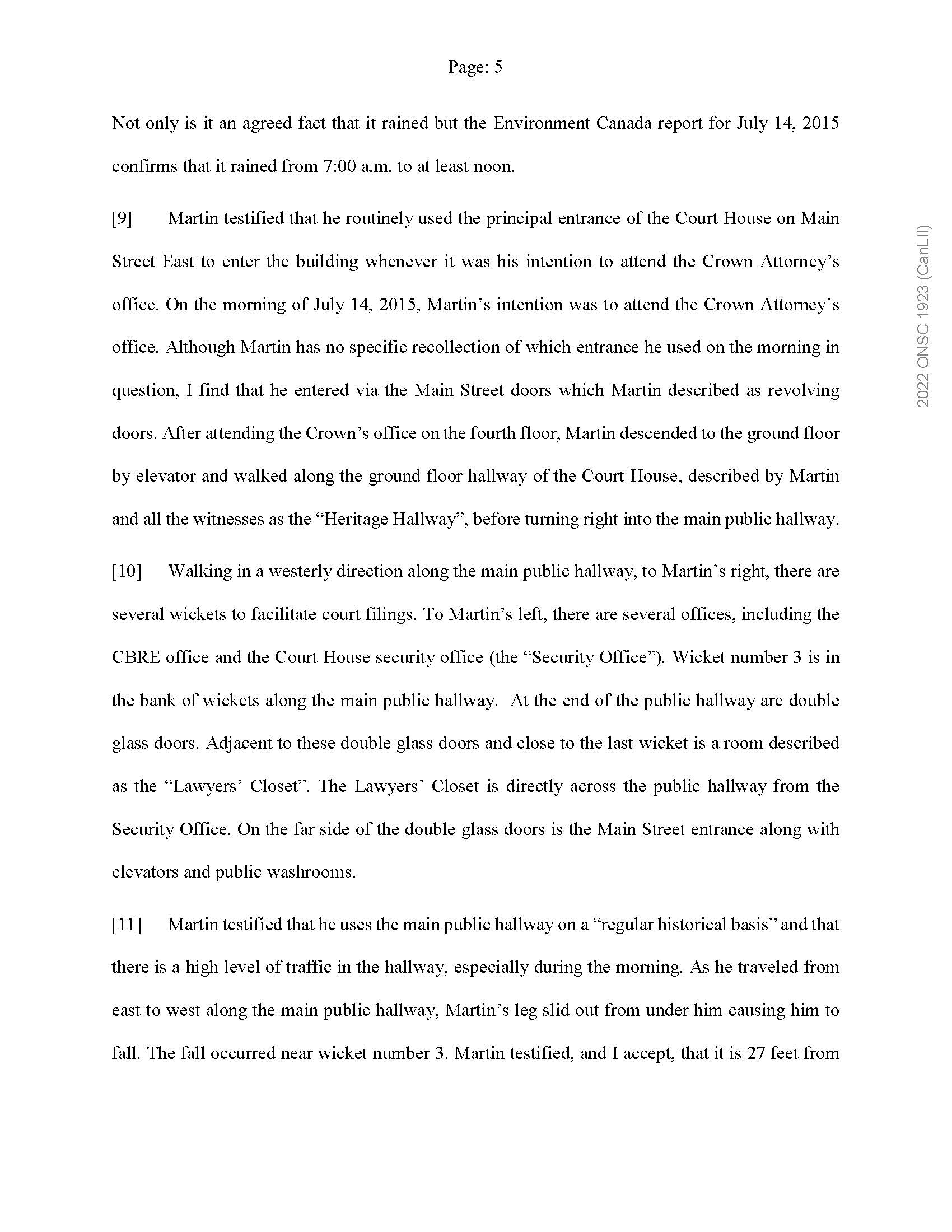
 Study Help