



Question: Using Westlaw, I need help with an Appellate Case Brief on Miranda v. Arizona. I screenshotted it and provided the images below. Can also use
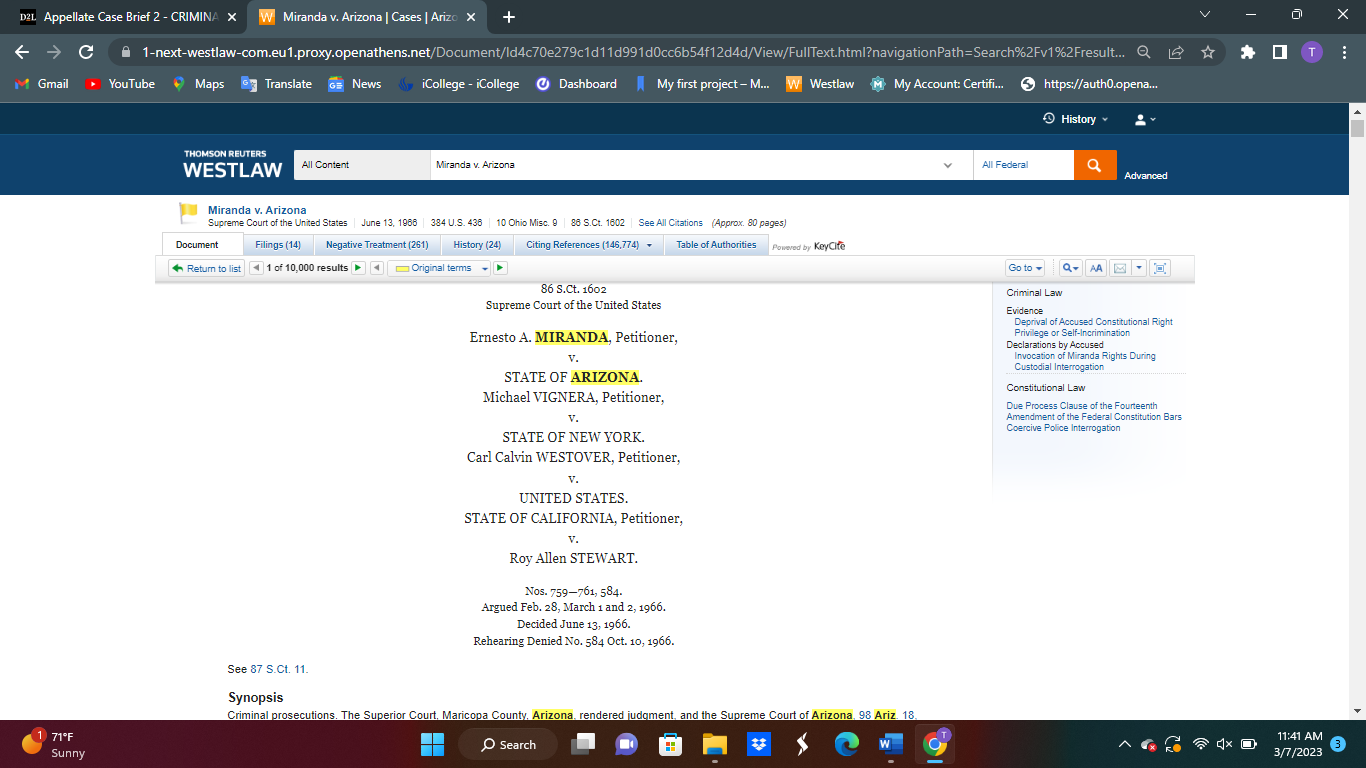
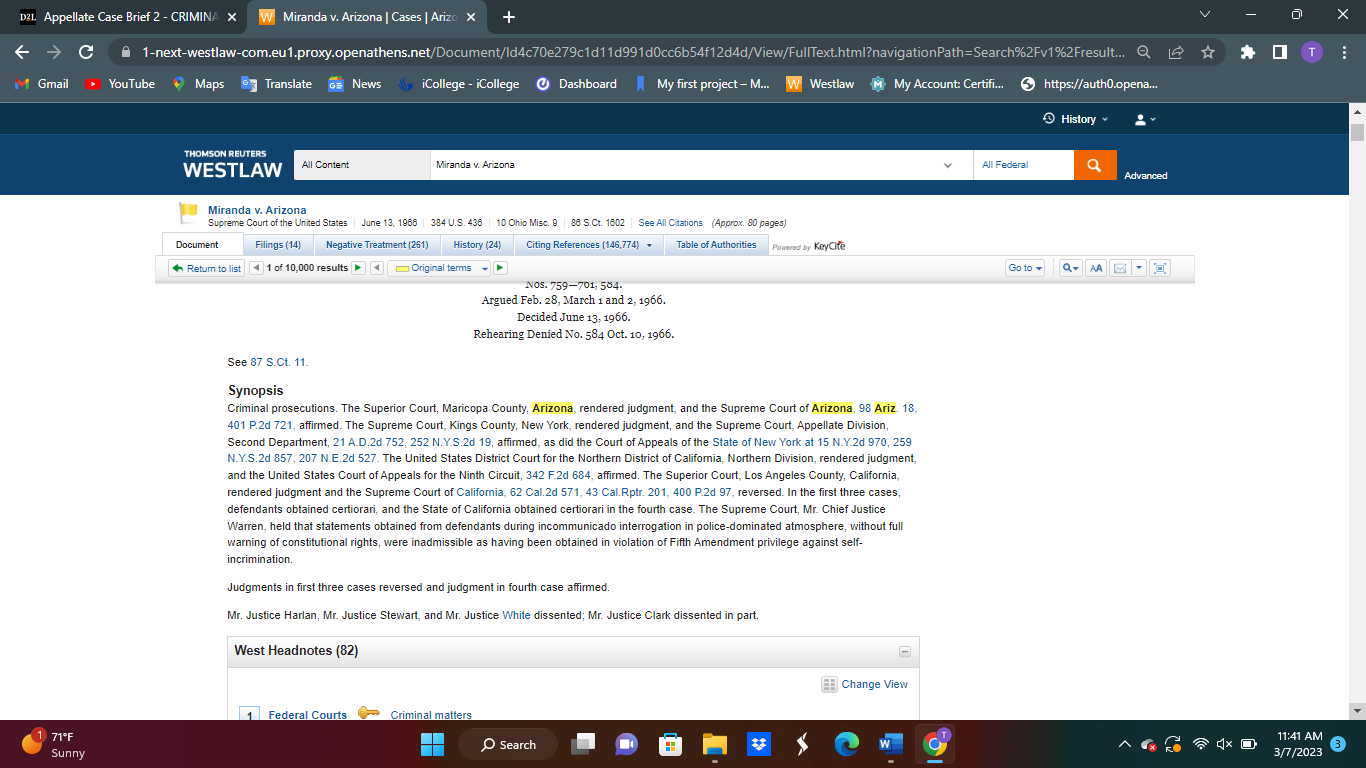
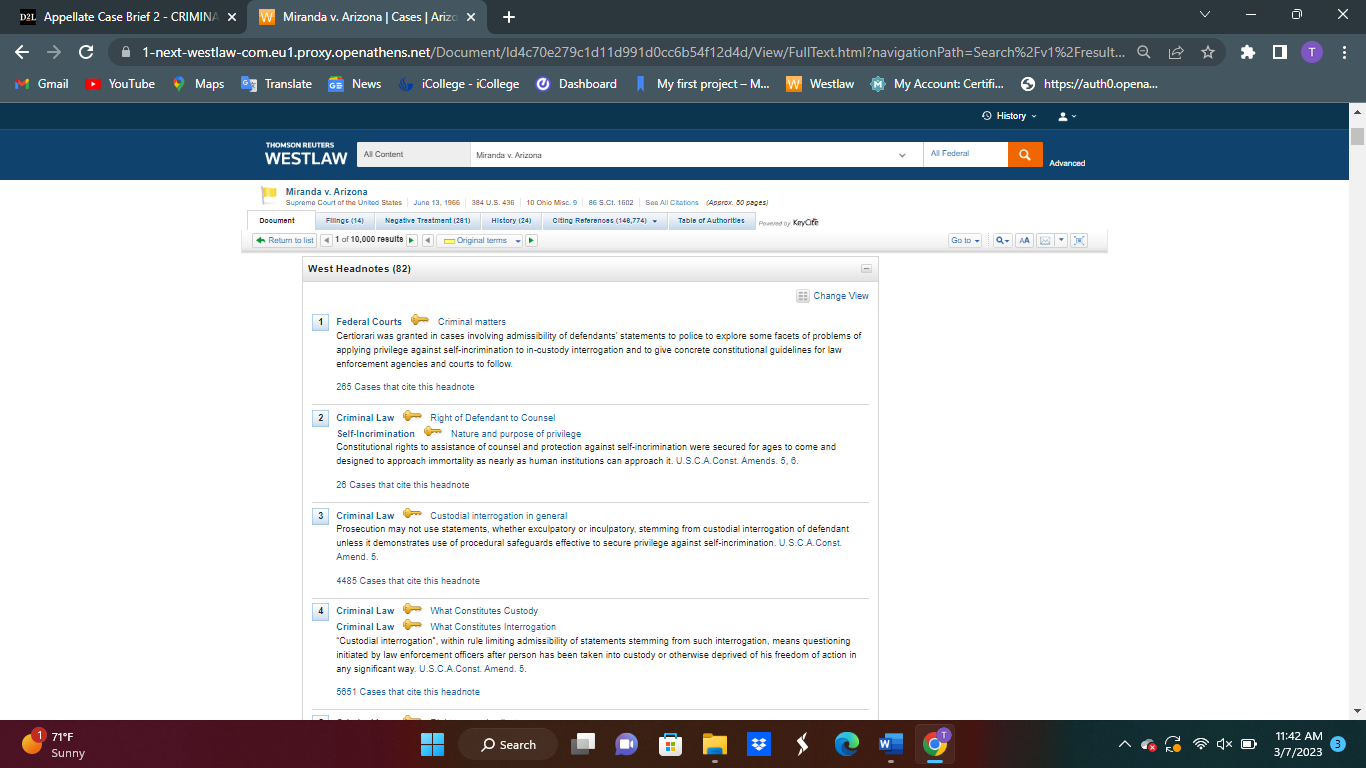
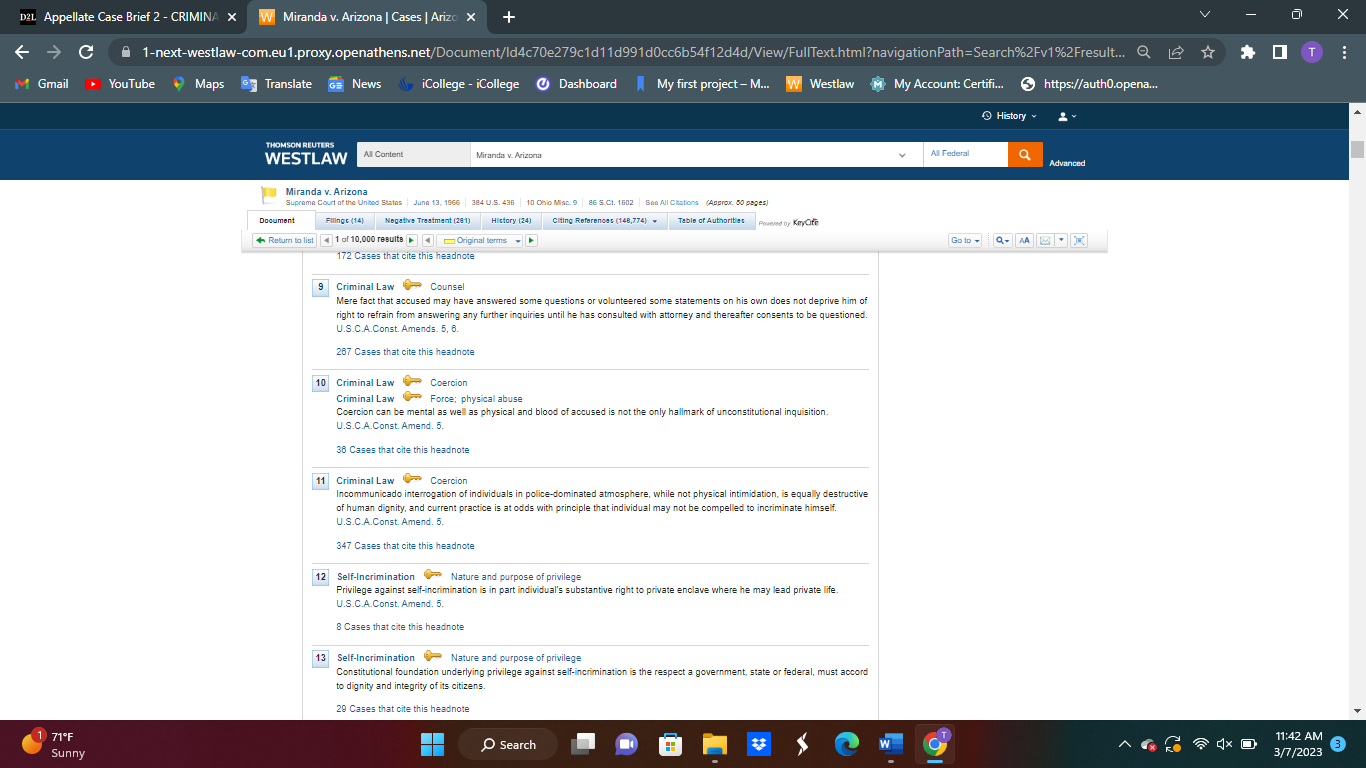
Using Westlaw, I need help with an Appellate Case Brief on Miranda v. Arizona. I screenshotted it and provided the images below. Can also use knowledge already known. Sorry for all the pictures.
There are 11 sections of an Appellate Case Brief: Case Name, Citation, & Year, Relevant Facts, Procedural History, Precedents, Legal Issue, Ruling, Rationale, Disposition, Concurrence, Dissent, and Conclusion.
1. Case Name, Citation, & Year ? The case name (sometimes called the "style" of the case) and citation describe the parties and how to find the published case. ? Parties are listed in either italicized or underlined text and display the Appellant (the losing party in the case below) and the Appellee (the winning party below). ? The parties are separated by lowercase "v" followed by a period. ? The remaining text is unformatted and includes a comma, the volume number, the abbreviation for the reporter, the page where the opinion begins, and the year of the decision in parentheses. ? Example: Miranda v. Arizona, 384 U.S. 436 (1966)
2. Relevant Facts ? Following the case name and citation, briefly describe the relevant facts of the case. ? The summary should run approximately one paragraph and focus on the facts that lead to the legal issue the current court is being asked to resolve. ? Avoid a lengthy discussion of tangential or irrelevant facts. 3. Procedural History ? This section is an explanation of legal steps that lead to the case being in the current the court, including matters at the trial (for example the filing of a motion to suppress or a plea) and intermediate appellate levels (legal arguments raised in the appellate court(s) and the decision of that court/ those courts). ? In short, it describes the legal path that bought the case to the current court for disposition. 4. Precedents ? Before determining the outcome of the current cases, the court must consider significant prior cases addressing the same or similar legal issues. ? You can find these cases in the body of the majority opinion. ? Be certain to use a full and proper citation for each precedential case and add a brief, 1-2 sentences, explanation of its relevance to the current case as that demonstrates comprehension. 5. Legal Issue ? Appellate courts want to issue a narrow decision. ? What is the current court being asked to decide? ? Phrase this in the form of a question in a single sentence. ? Be certain to address applicable law likely from the Bill of Rights (federal law) and if appropriately made applicable to the states (through the Fourteenth Amendment). ? Whether the Fifth and Sixth Amendments to the Constitution of the United States made applicable to the states through the Fourteenth Amendment, require that the record of the prior proceedings show that an accused made a voluntary guilty plea? 6. Ruling ? The "Legal Issue" section of the brief posed a question for the court to determine. ? In the "Ruling" section, answer that question (yes or no) and include a brief rationale for the majority's decision. 7. Rationale ? Expand on the brief explanation of the rationale identified in the Ruling section. ? Using your own words, paraphrase the basis of the majority's decision. ? Remember to include the name of the author of the majority's opinion. 8. Disposition ? What is the next step for the case? ? Was the lower court's ruling affirmed, such that the case is over? ? Was the lower court's decision reversed, meaning the current court found a substantial error? Or ? Was the lower court's decision reversed and remanded, meaning that not only did the current find the substantial error but it sent the case back down to the lower court to correct the error? 9. Concurrence ? Concurring opinions are written to express different rationales for the case from the majority's opinion. ? The "vote" is counted with the majority, but the author of a concurring opinion found a different basis for the decision. ? If no concurring opinion was written, simply write "none" in this section. 10. Dissent ? Dissenting opinions are written because the author disagrees with the majority decision. ? Frequently, dissenting opinions express an opposing rationale such that the case could have been decided differently. ? It is important to note dissenting opinions, especially in a close decision, as a change in the composition of the court or simply the passing of time may yield a different result, than the one espoused by the dissenting opinion's author. ? If no dissenting opinion was written, simply write "none" in this section. 11. Conclusion



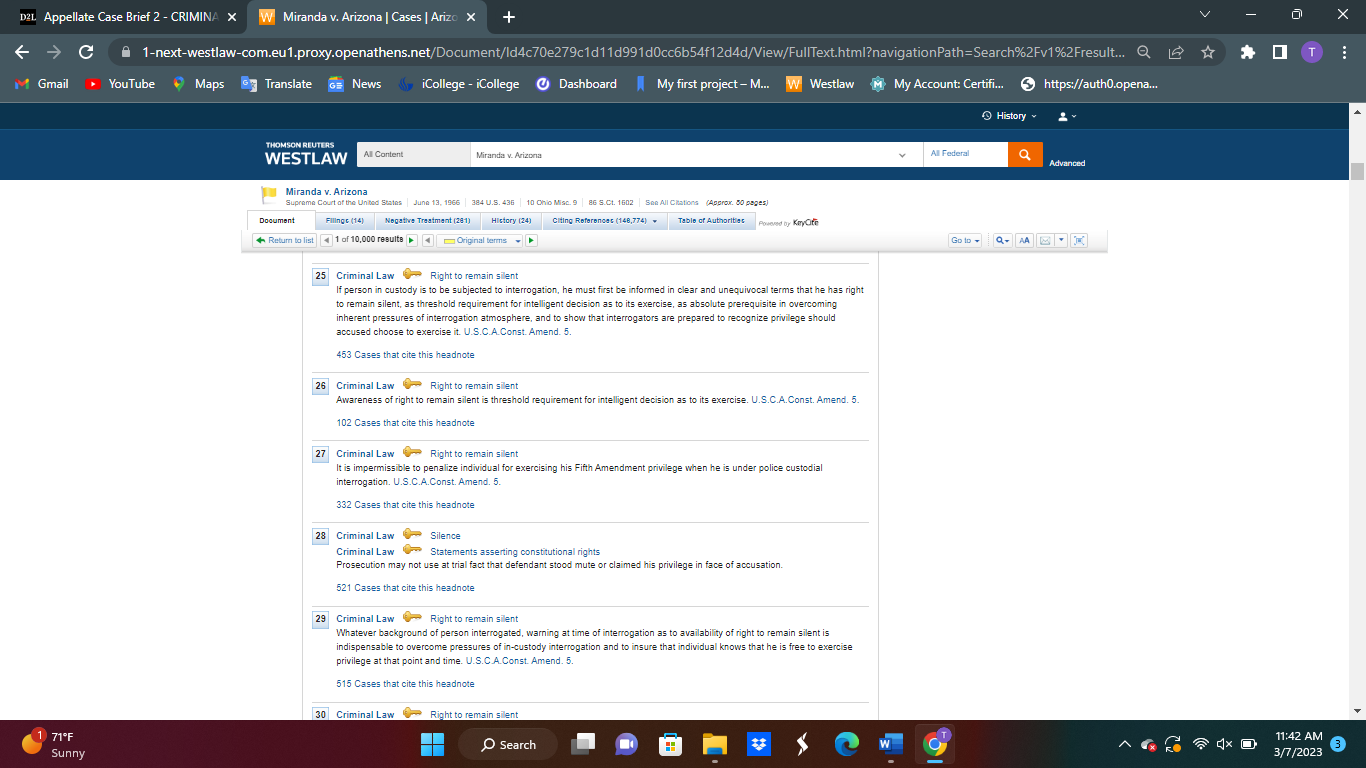







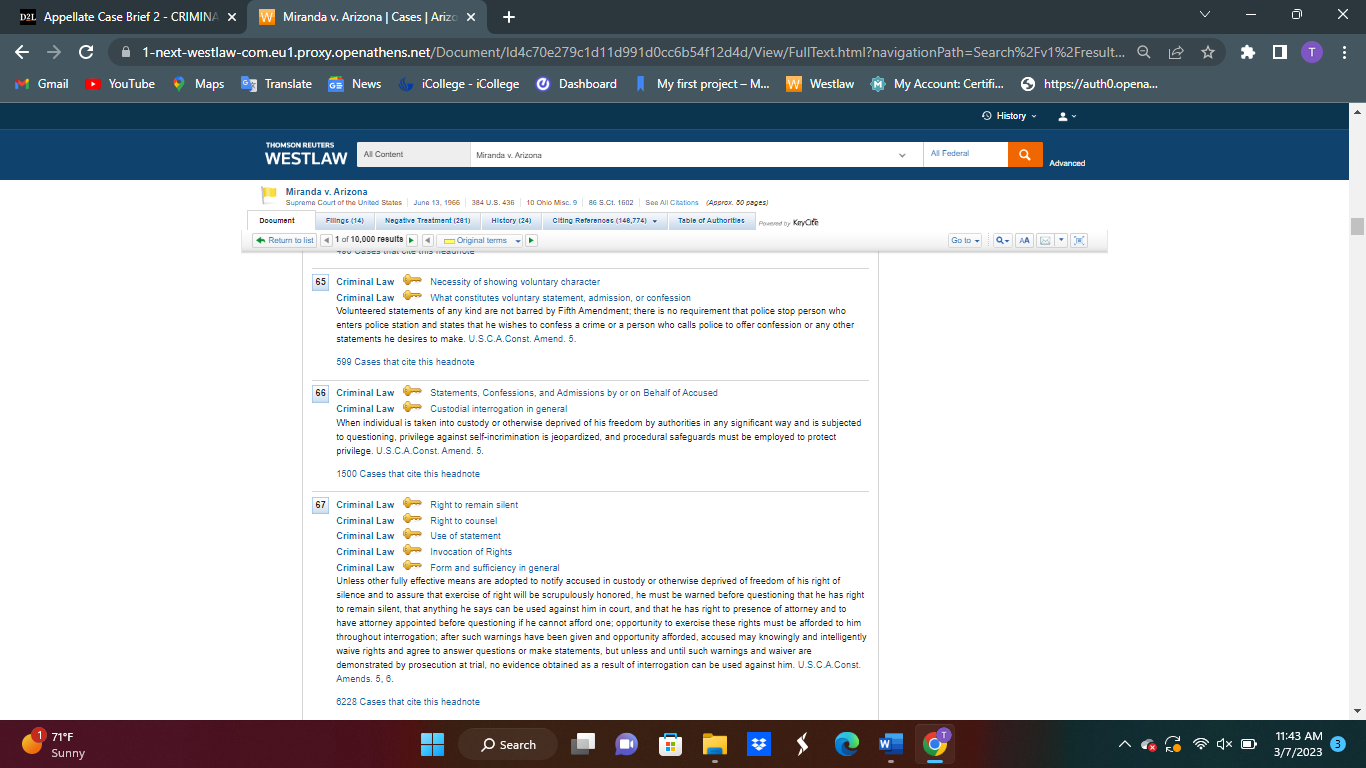


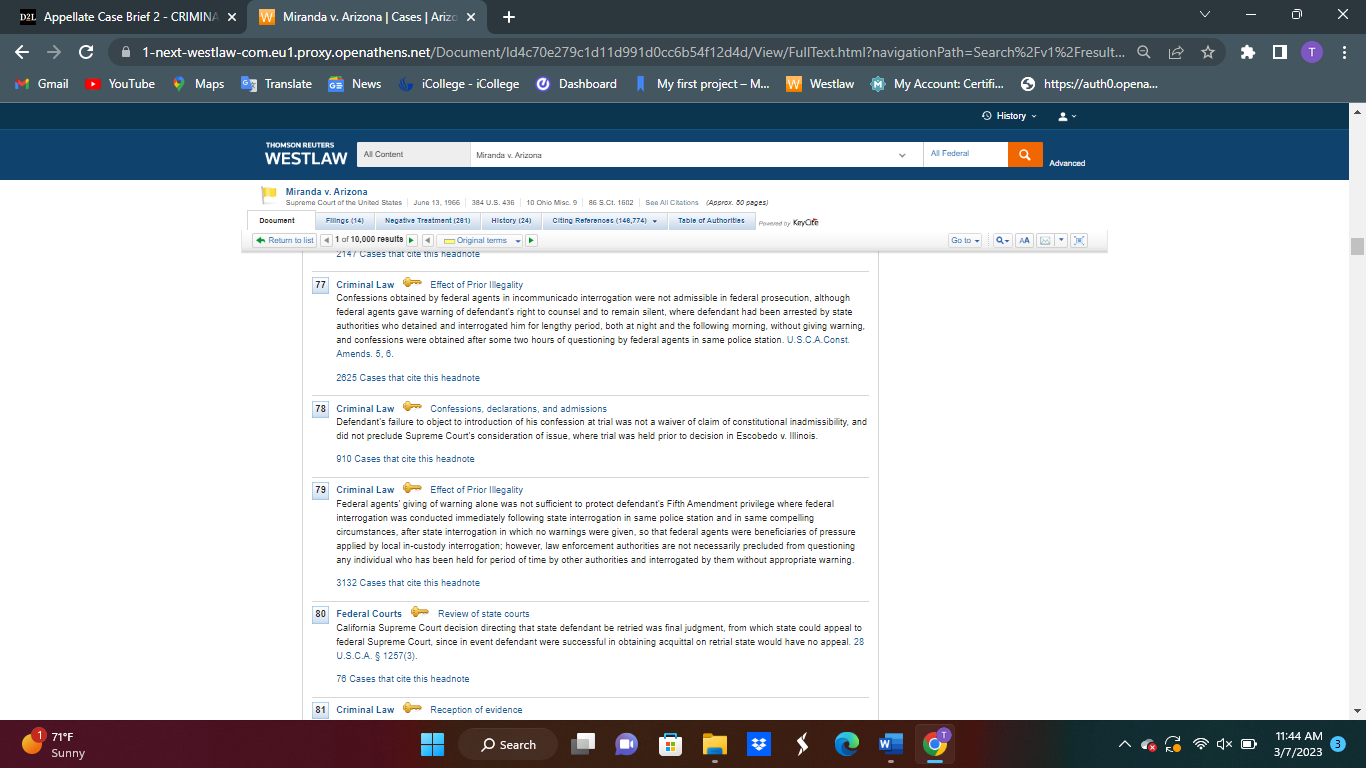


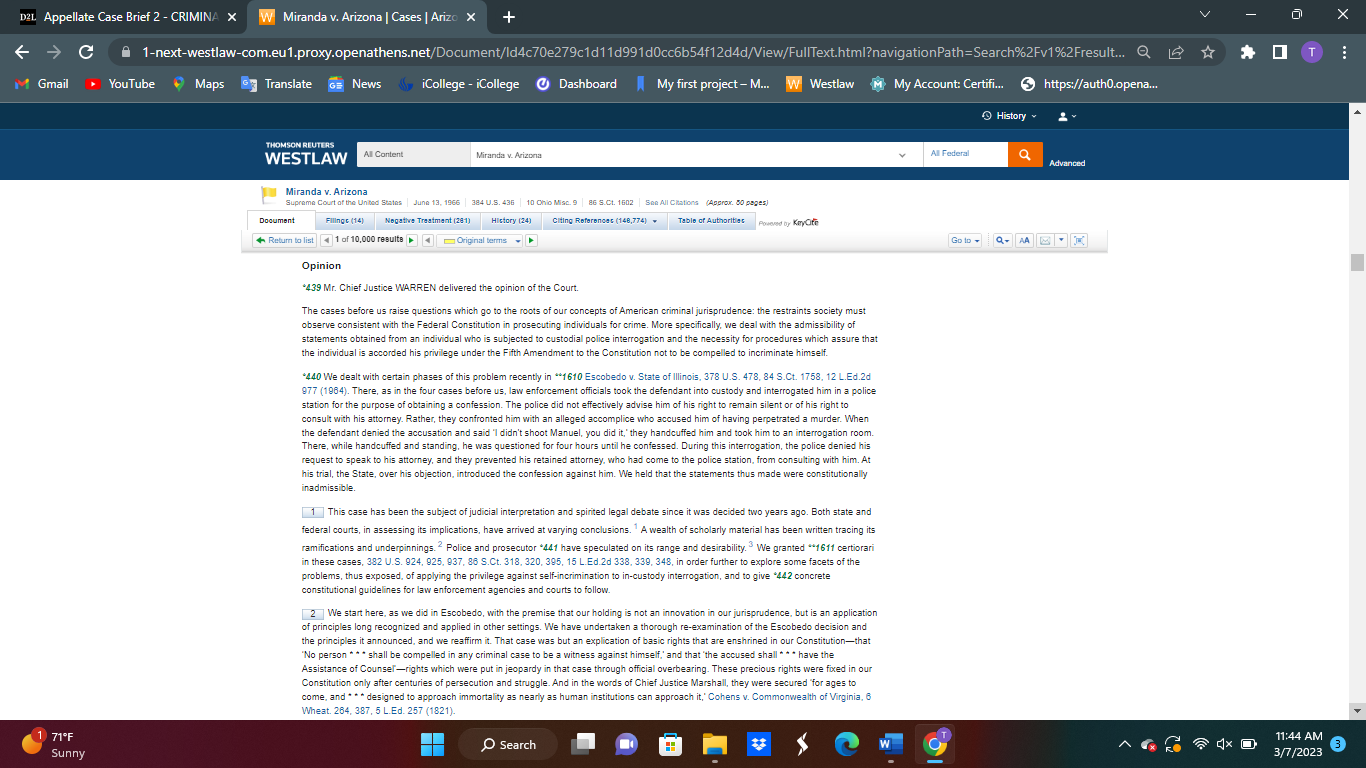
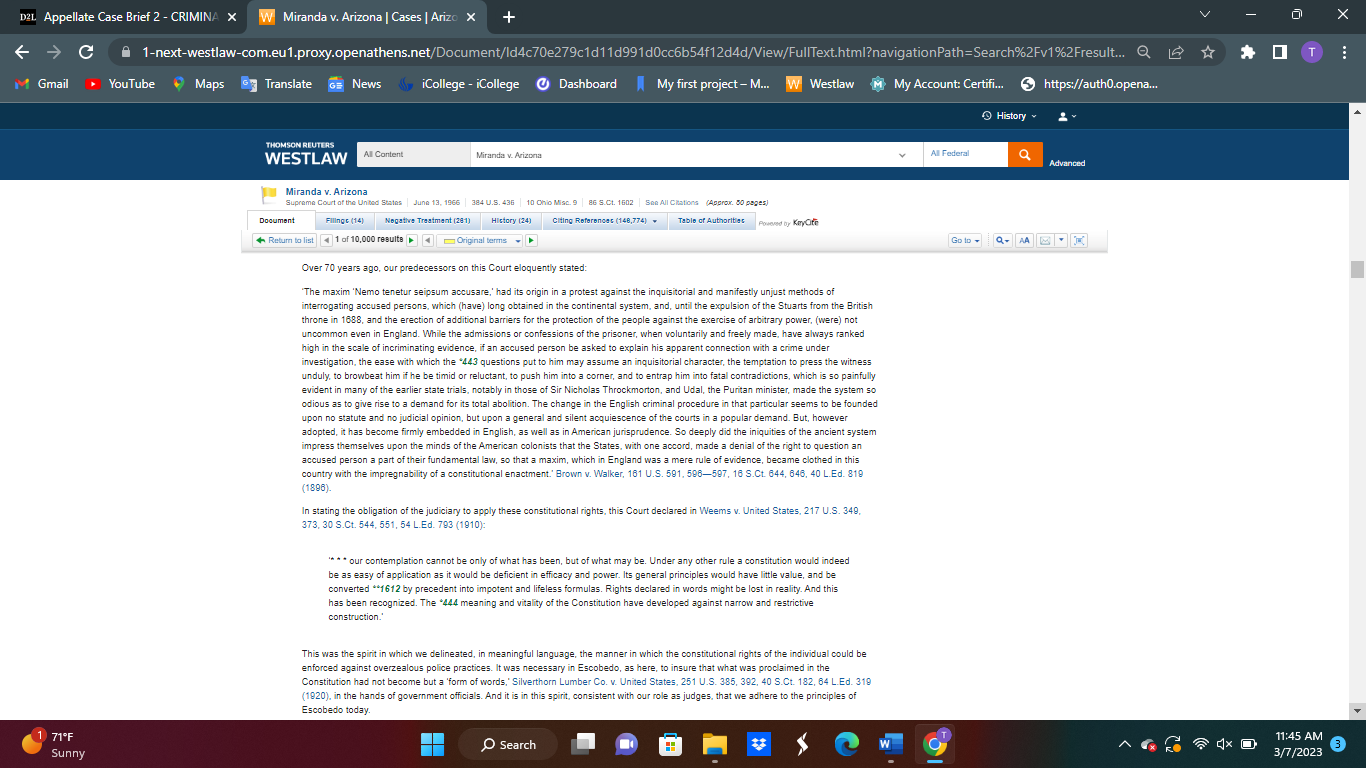
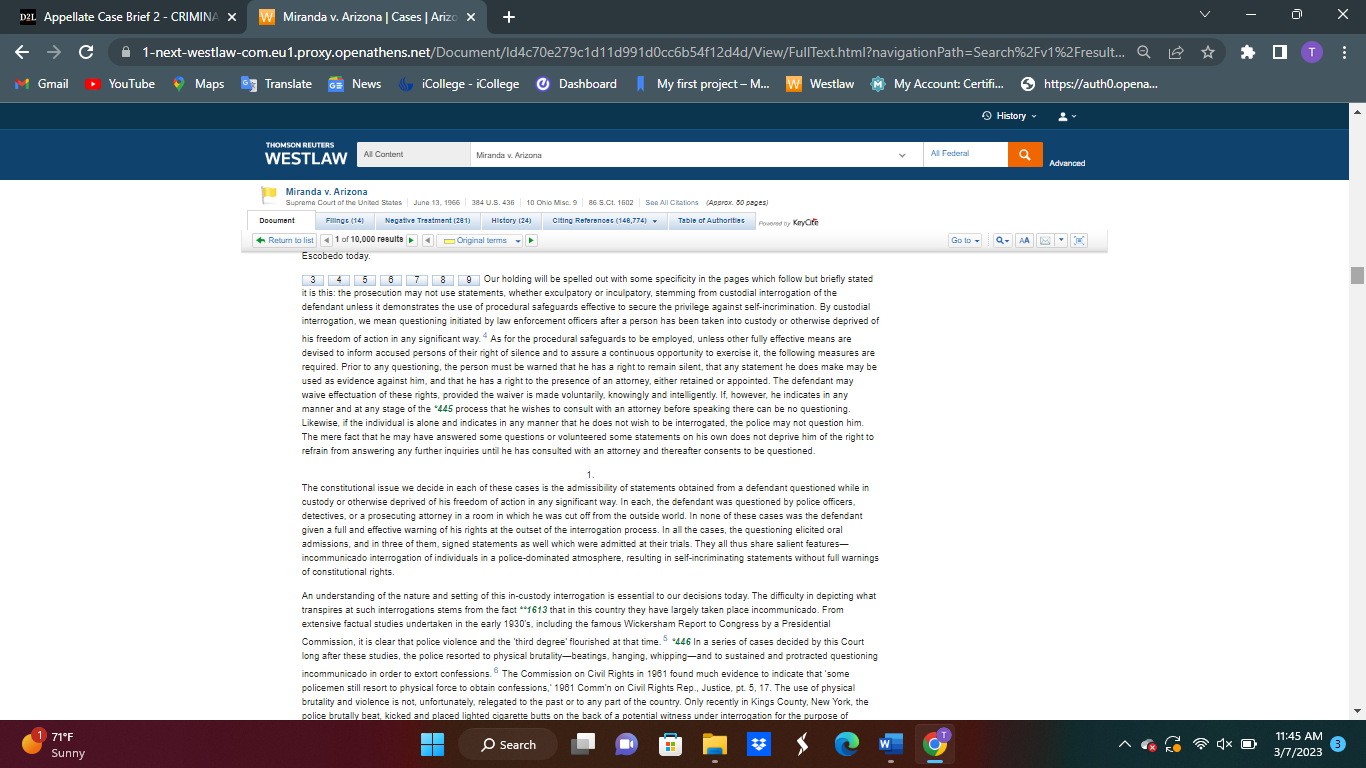
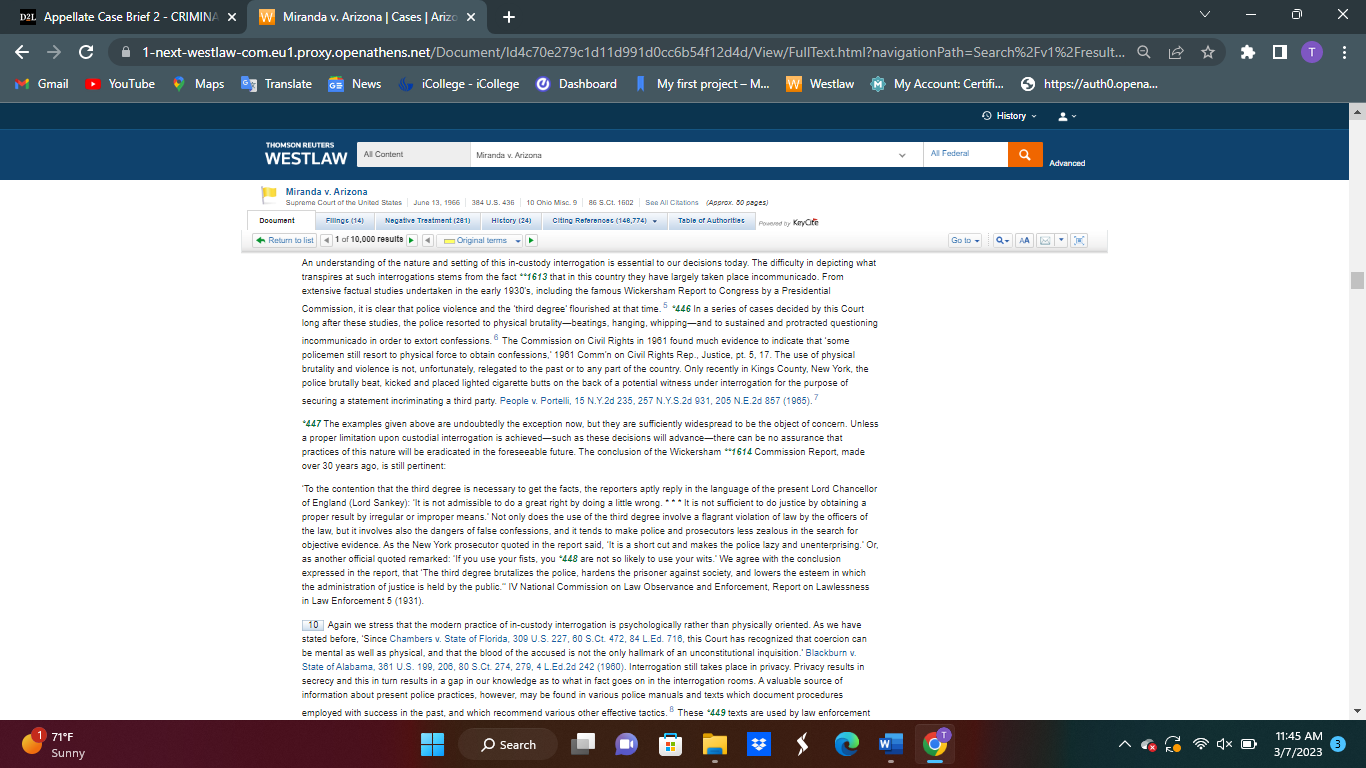
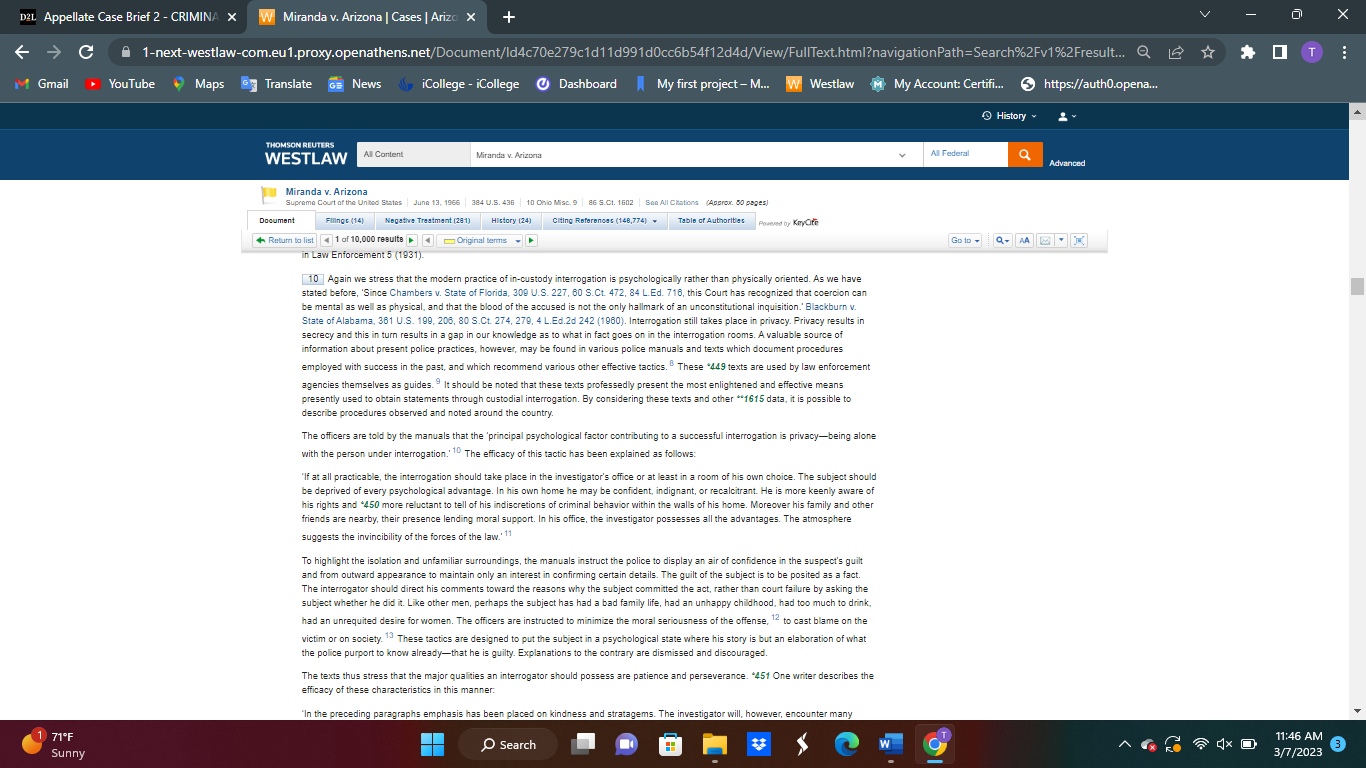


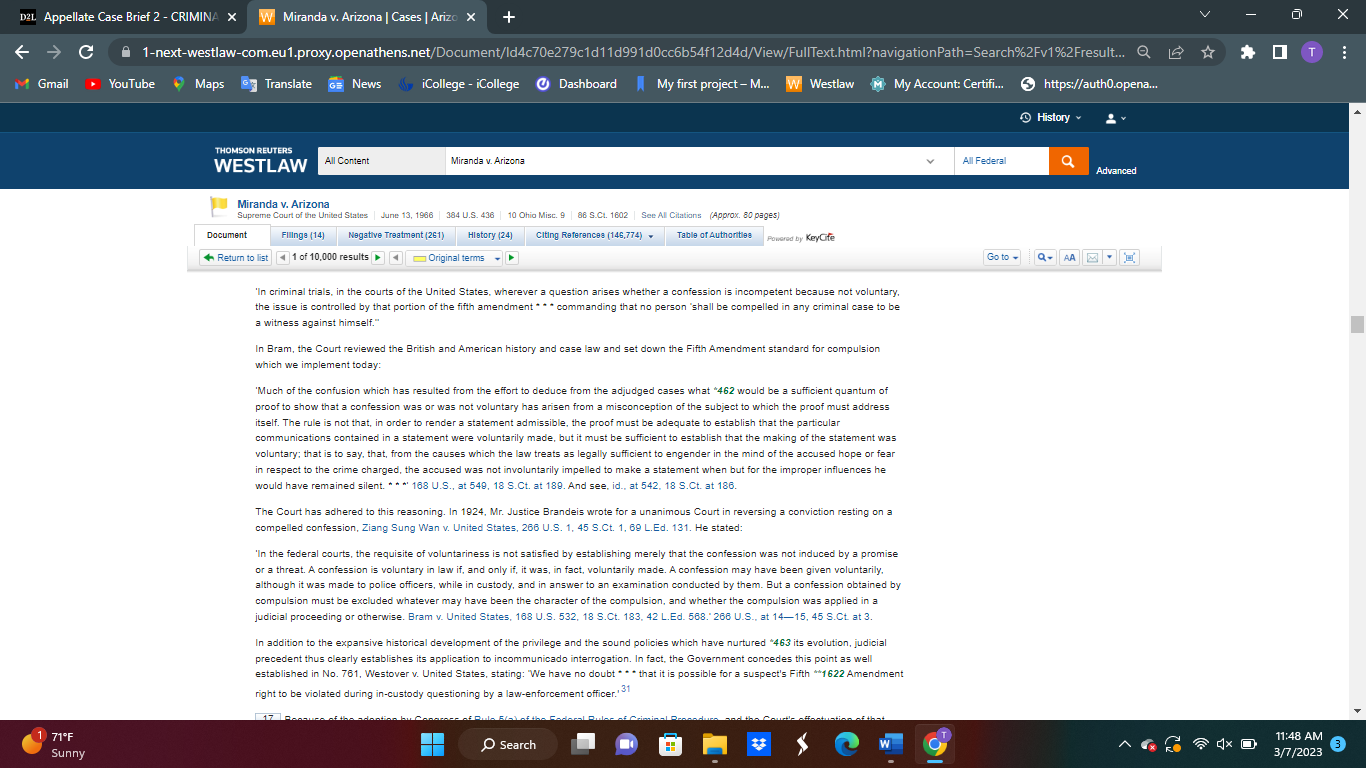
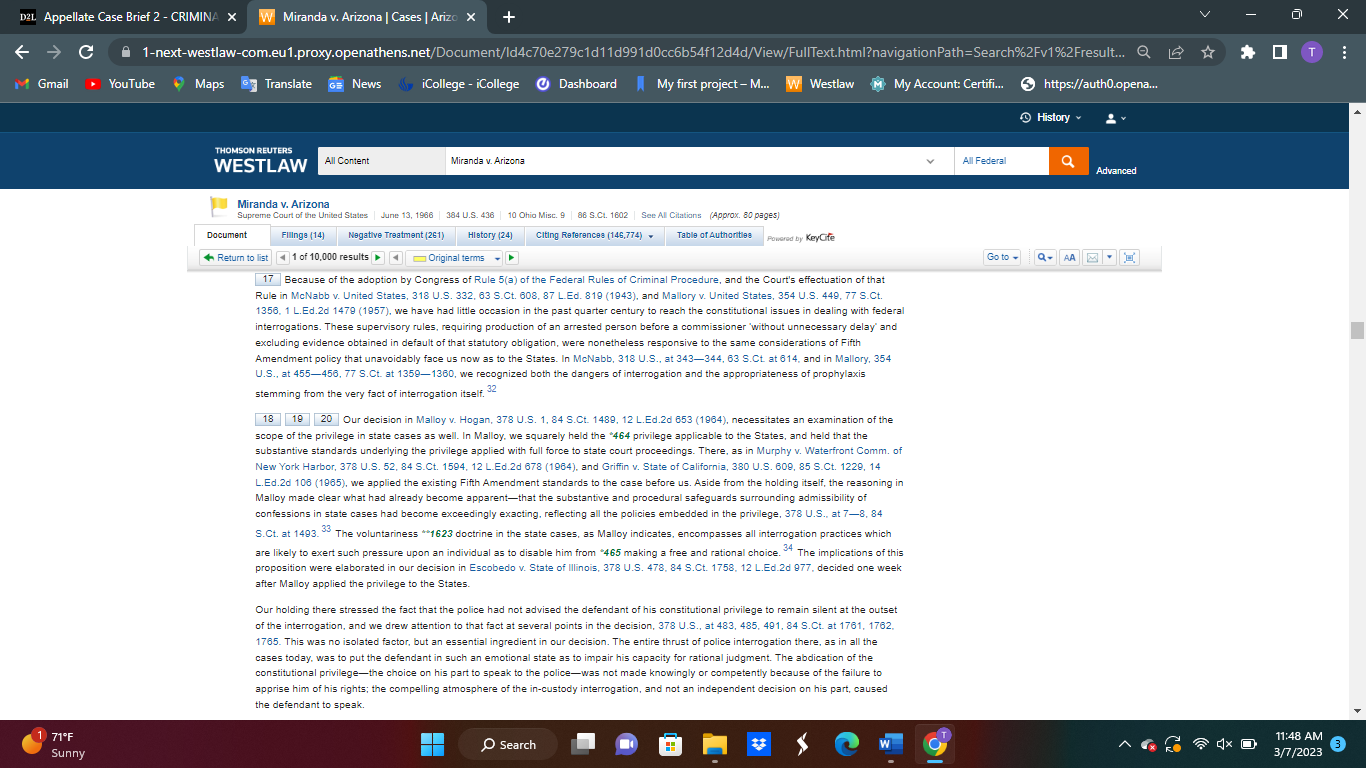
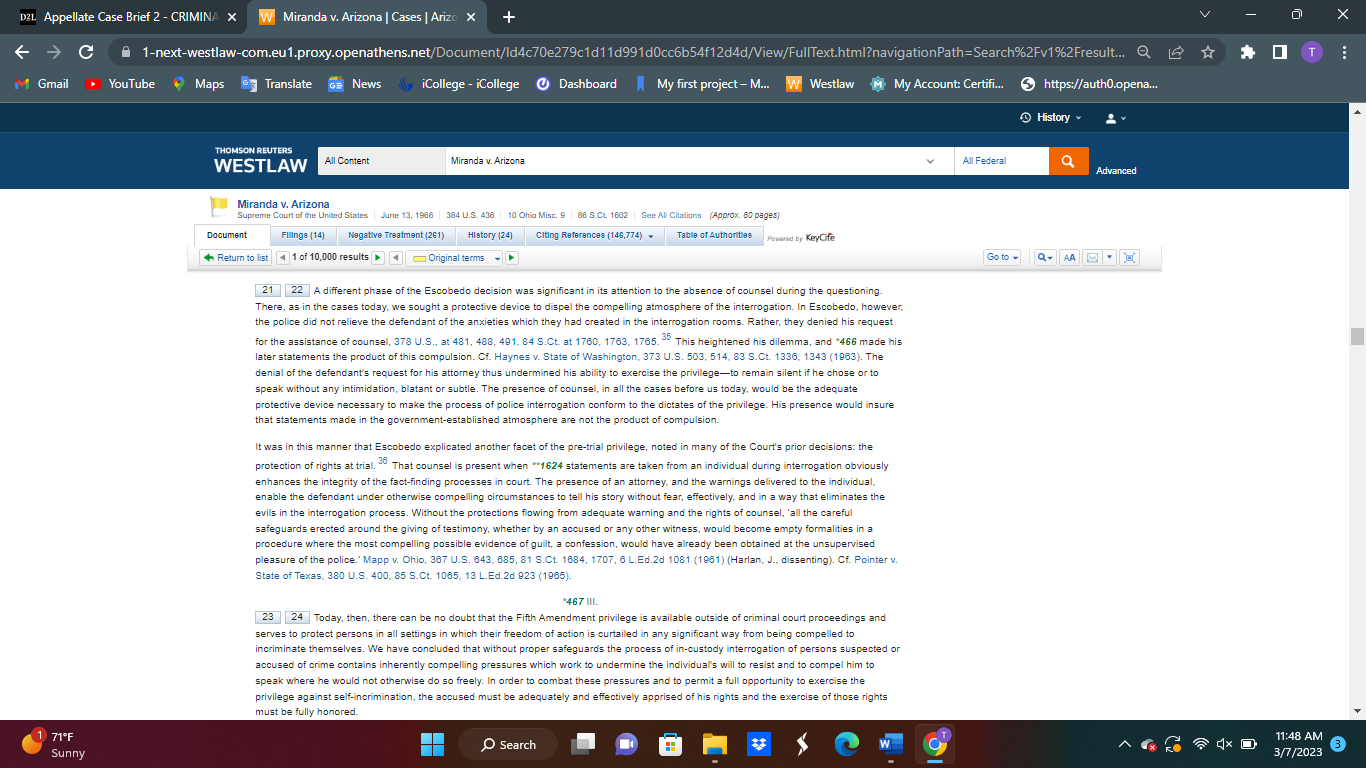
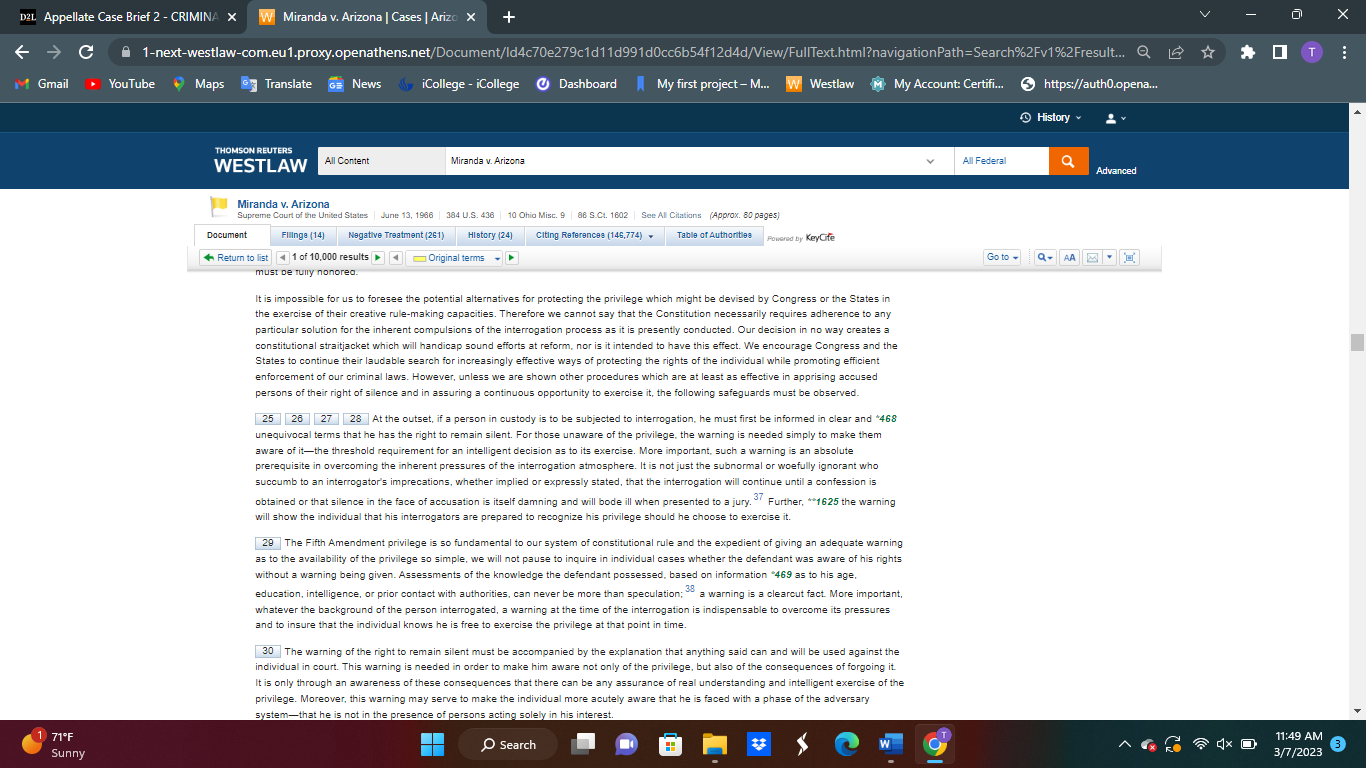
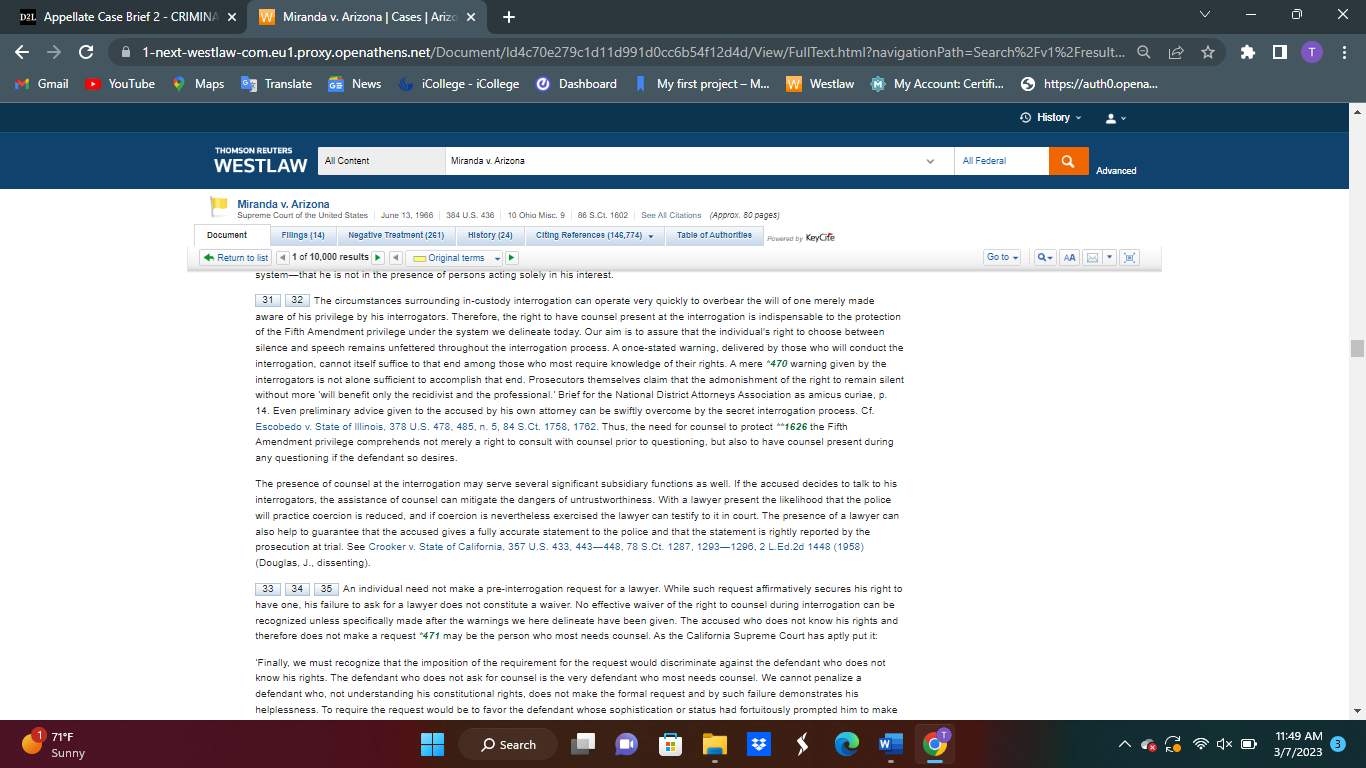
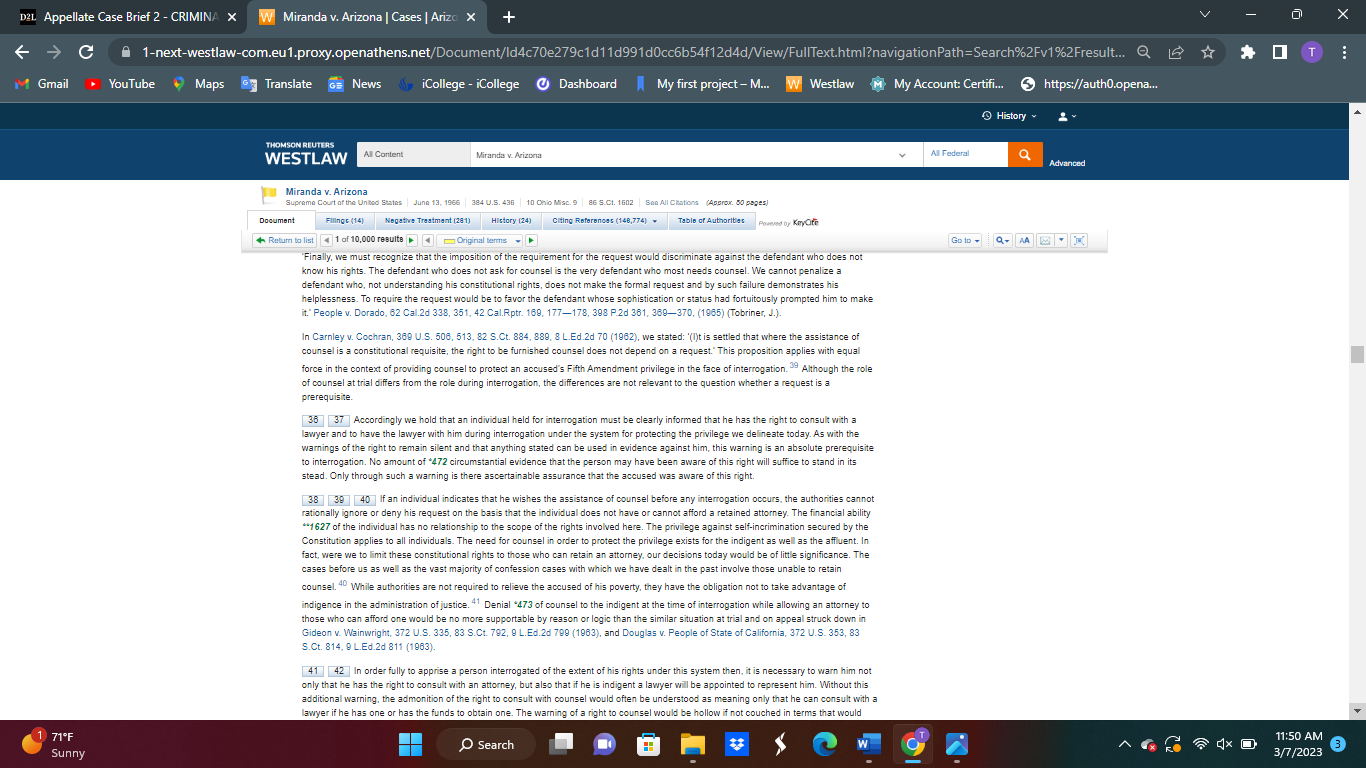
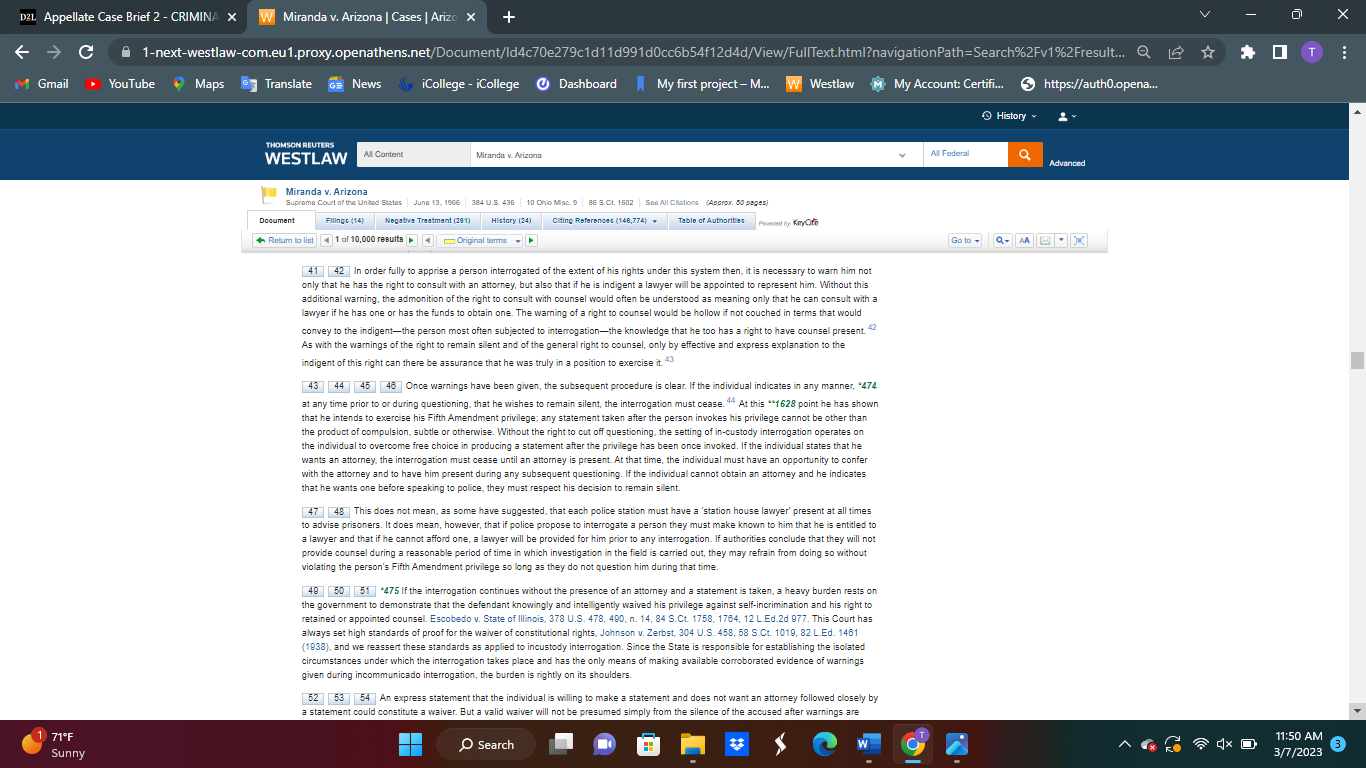
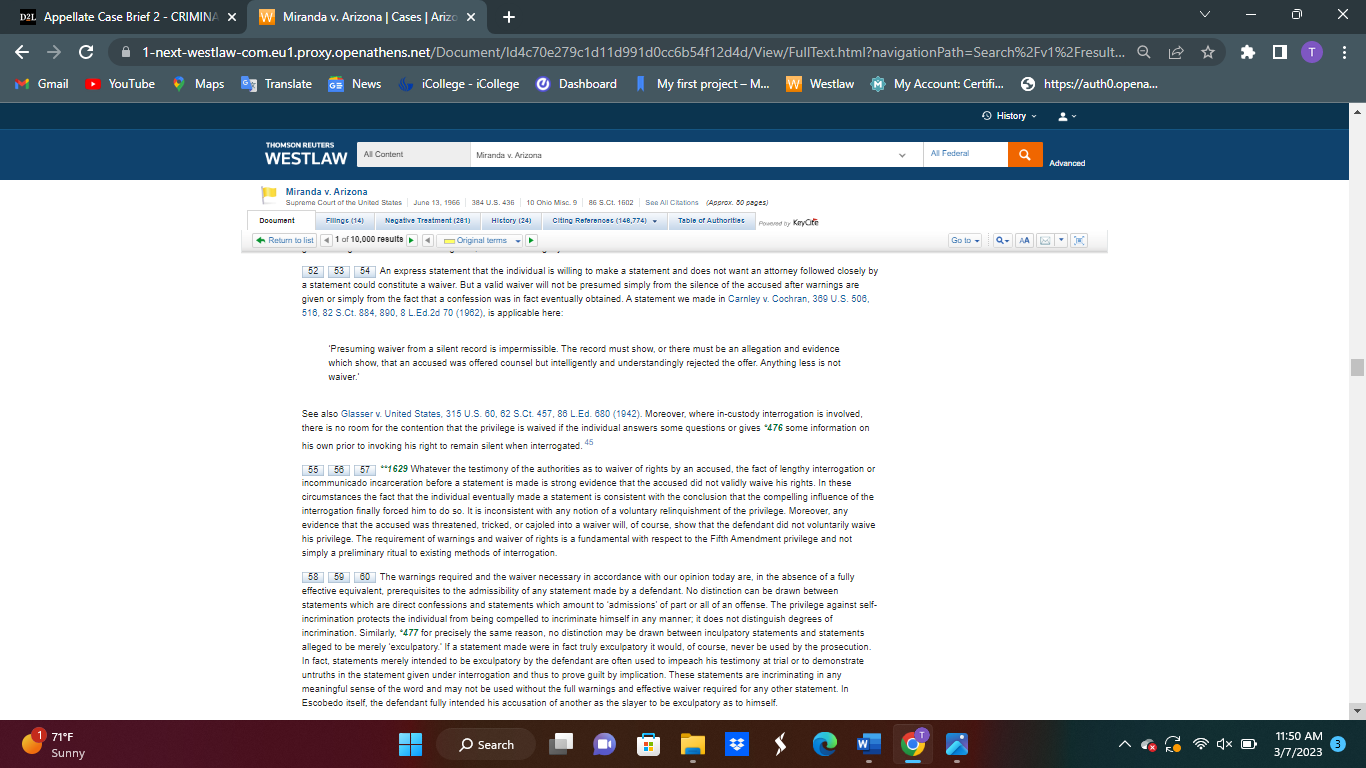
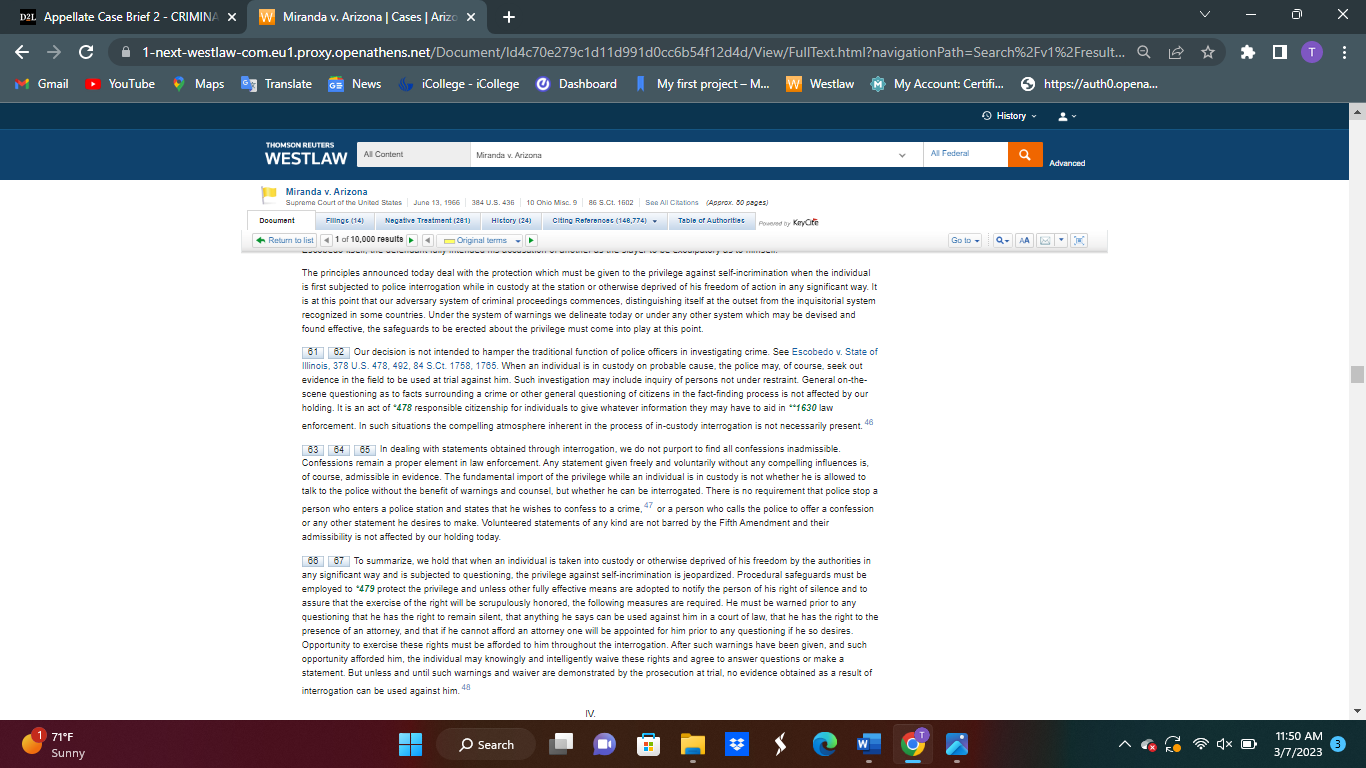
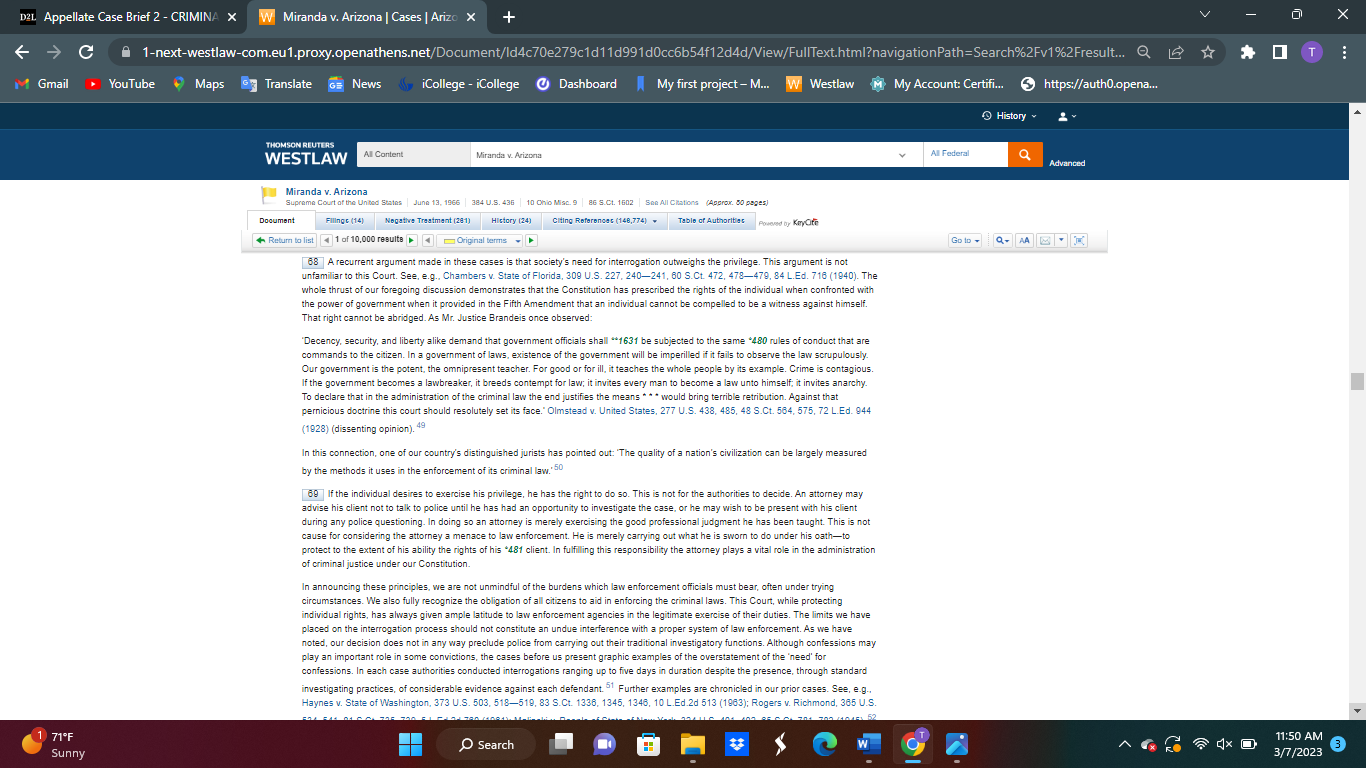
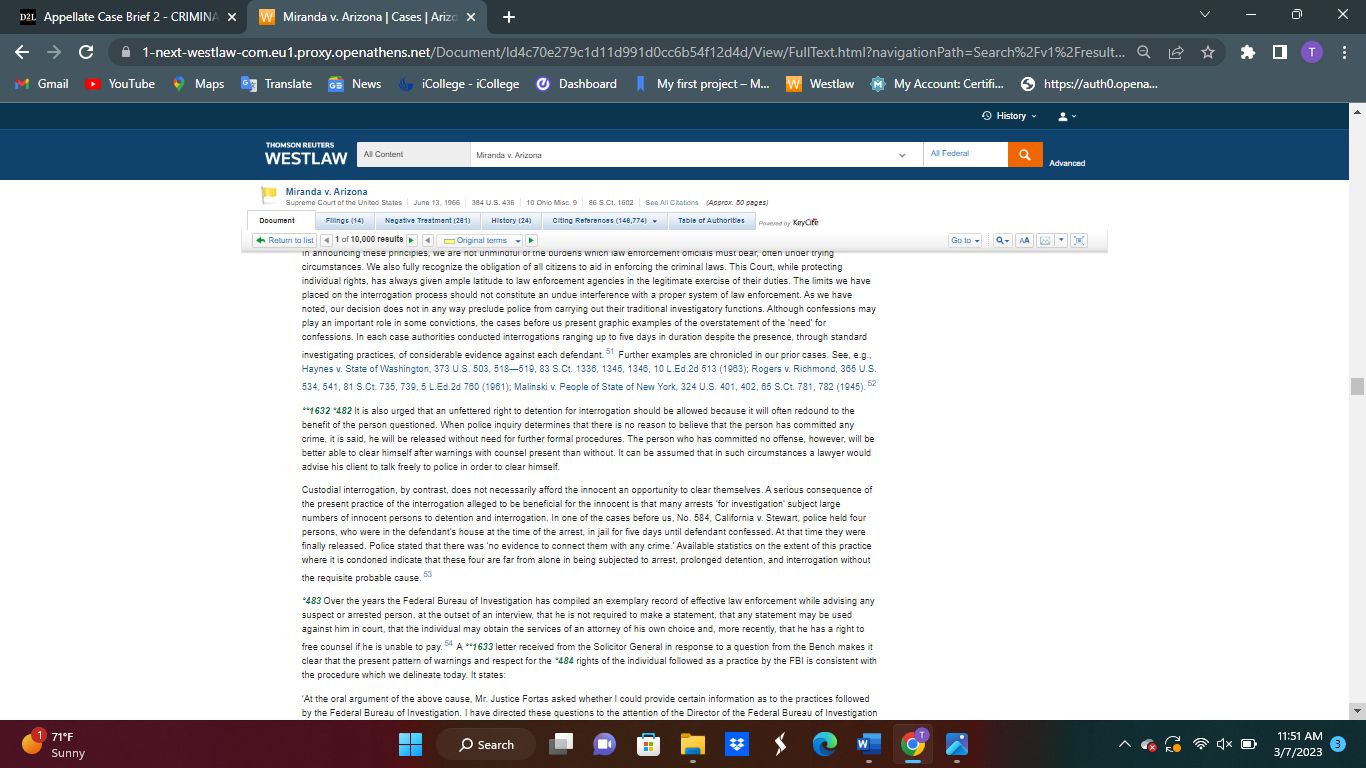

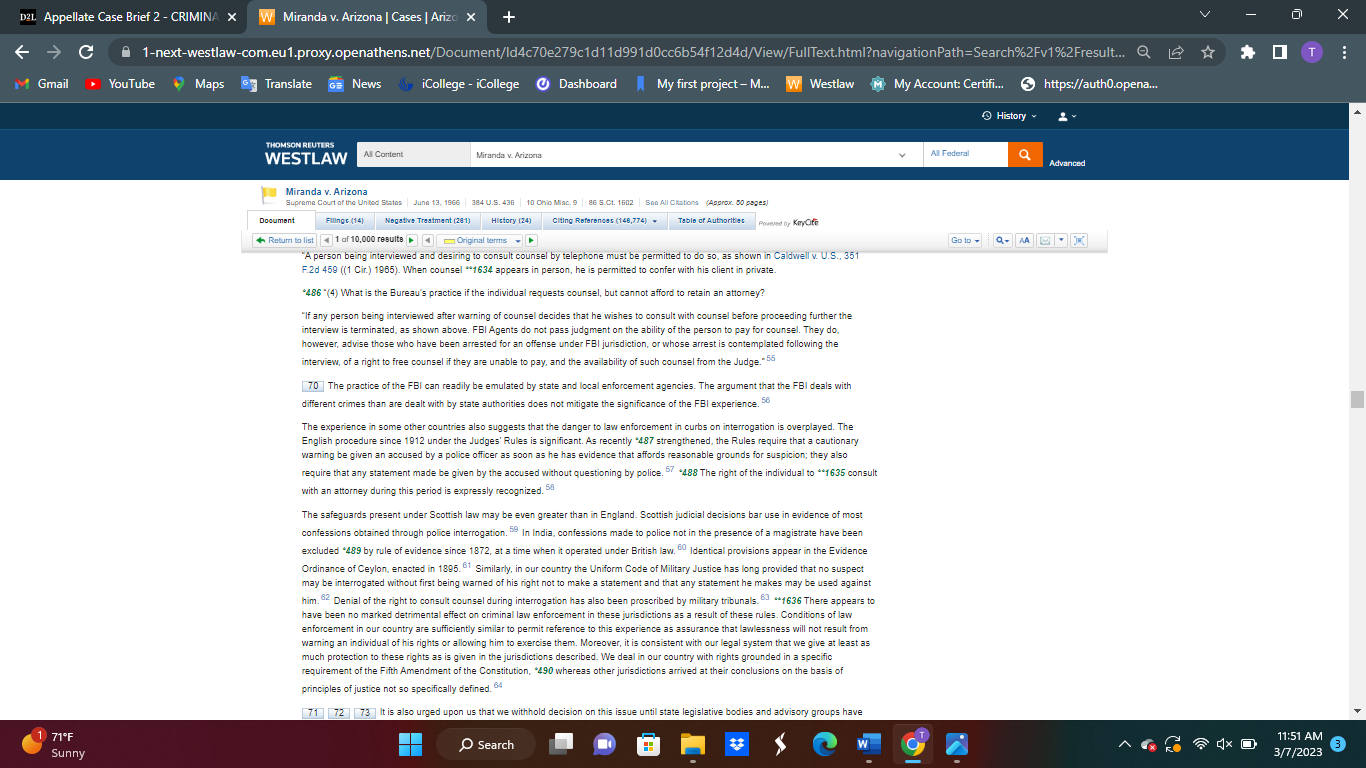
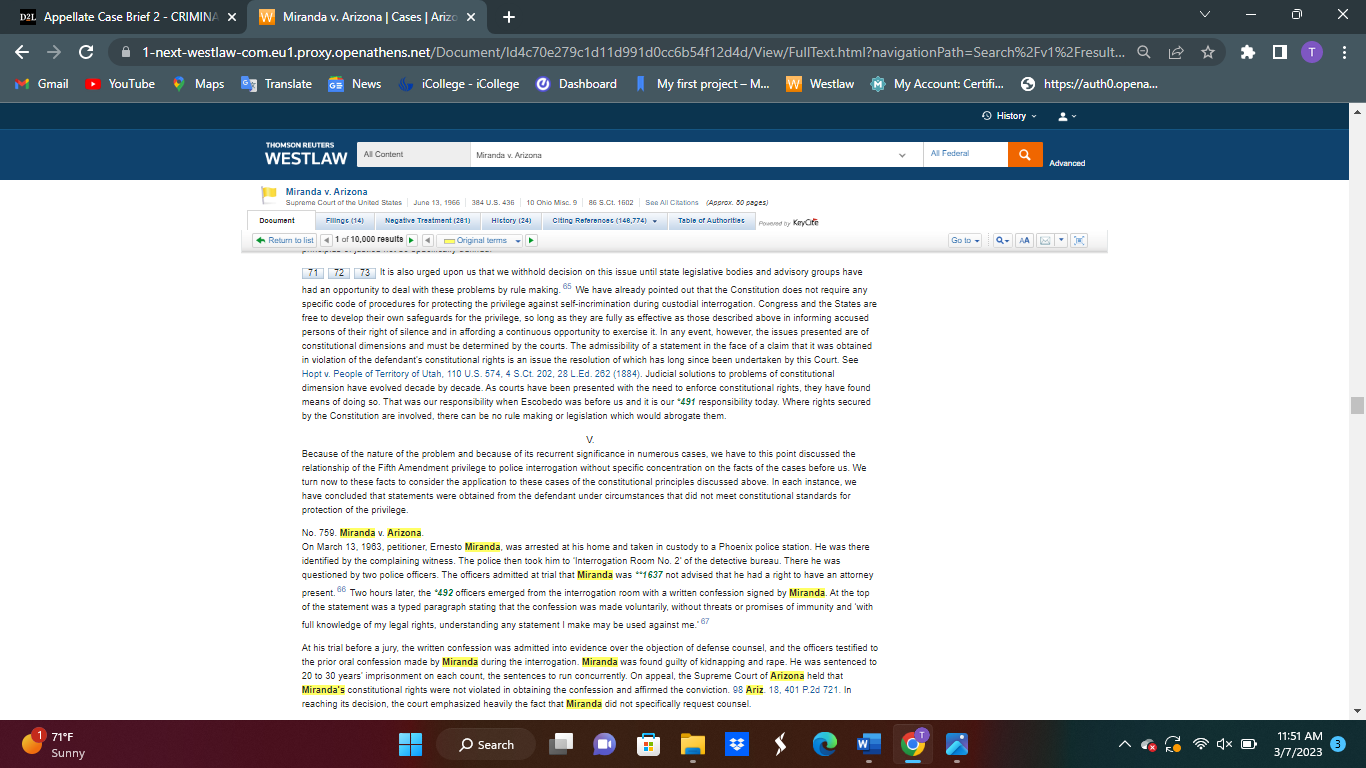
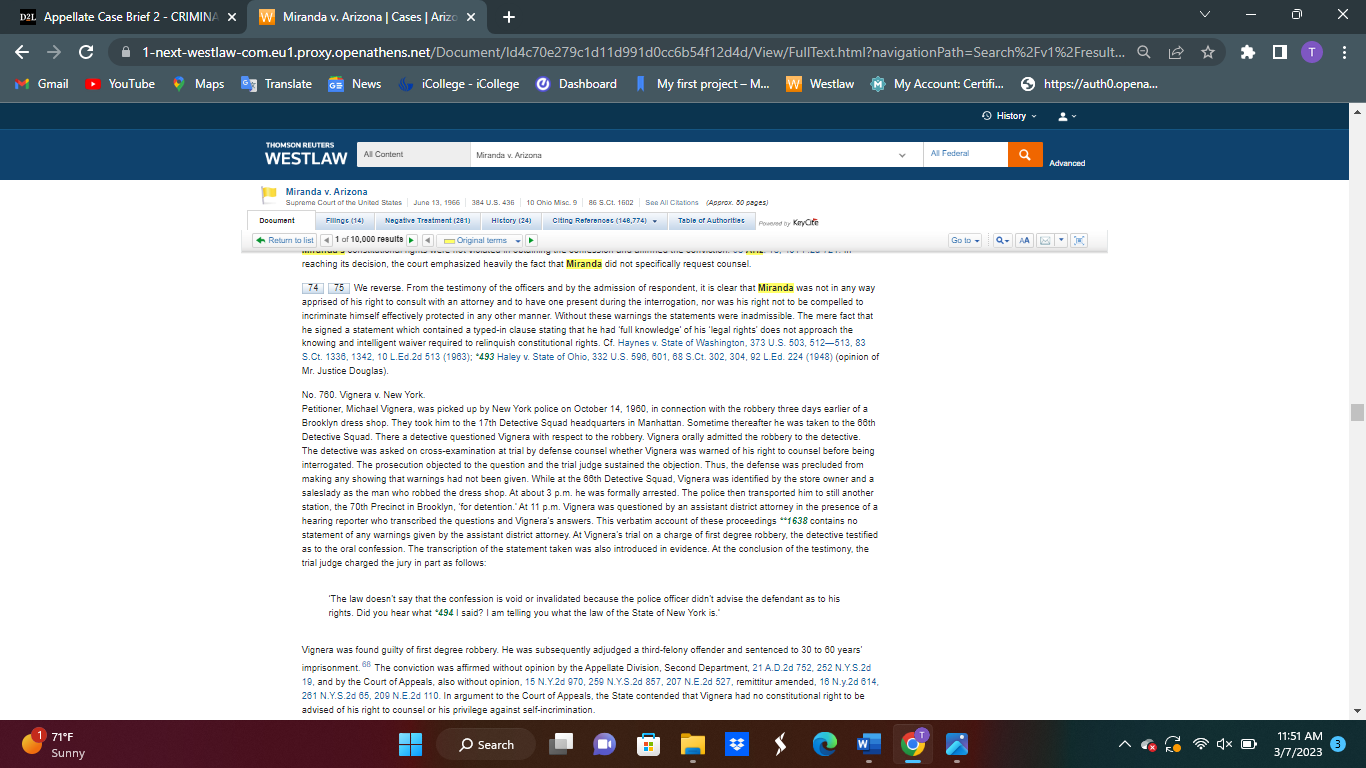
D21 Appellate Case Brief 2 - CRIMINA X W Miranda v. Arizona | Cases | Arizo X + X 1-next-westlaw-com.eu1.proxy.openathens.net/Document/Id4c70e279c1d11d991dOcc6b54f12d4d/View/FullText.html?navigationPath=Search%2Fv1%2Fresult... Q #0 T M Gmail YouTube Maps Translate = News iCollege - iCollege @ Dashboard / My first project-M... W Westlaw M My Account: Certifi... Original terms - GotD - Q- AA + 3 West Headnotes (82) Change View 1 Federal Courts Criminal matters Certiorari was granted in cases involving admissibility of defendants' statements to police to explore some facets of problems of applying privilege against self-incriminating to in-custody interrogation and to give concrete constitutional guidelines for law enforcement agencies and courts to follow. 265 Cases that cite this headnote 2 Criminal Law Right of Defendant to Counsel Self-Incriminatingture and purpose of privilege Constitutional rights to assistance of counsel and protection against self-incriminating were secured for ages to come and designed to approach immortality as nearly as human institutions can approach it. U.S.C.A. Const. Amends. 5. 6. 26 Cases that cite this headnote 3 Criminal Law Custodial interrogation in general Prosecution may not use statements, whether exculpatory or inculpatory. stemming from custodial interrogation of defendant unless it demonstrates use of procedural safeguards effective to secure privilege against self-incriminating.C.A. Const. Amend. 5. 4485 Cases that cite this headnote 4 Criminal Law What Constitutes Custody Criminal Law What Constitutes Interrogation Custodial interrogation". within rule limiting admissibility of statements stemming from such interrogation, means questioning initiated by law enforcement officers after person has been taken into custody or otherwise deprived of his freedom of action in any significant way. U.S.C.A.Const. Amend. 5. 5651 Cases that cite this headnote 71 F O Search W 11:42 AM 3 Sunny 3/7/2023D21 Appellate Case Brief 2 - CRIMINA X W Miranda v. Arizona | Cases | Arizo X + X 1-next-westlaw-com.eu1.proxy.openathens.net/Document/Id4c70e279c1d11d991dOcc6b54f12d4d/View/FullText.html?navigationPath=Search%2Fv1%2Fresult... Q #0 T M Gmail YouTube Maps Translate = News iCollege - iCollege @ Dashboard / My first project- M... W Westlaw M My Account: Certifi... Original terms GotD - Q- AA + 3 5 Criminal Law Right to remain silent Criminal Law Right to counse Criminal Law Use of statement Unless other fully effective means are devised to inform accused person of the right to silence and to assure continuous opportunity to exercise it, person must, before any questioning, be warned that he has right to remain silent, that any statement he does make may be used as evidence against him, and that he has right to presence of attorney, retained or appointed. U.S.C.A.Const. Amend. 5 1693 Cases that cite this headnote 6 Criminal Law Right to remain silent Criminal Law Counsel Criminal Law In general; right to appear pro se Defendant may waive effectuation of right to counsel and to remain silent, provided that waiver is made voluntarily, knowingly and intelligently. U.S.C.A.Const. Amends. 5, 8. 1602 Cases that cite this headnote 7 Criminal Law Counsel There can be no questioning if defendant indicates in any manner and at any stage of interrogation process that he wishes to consult with attorney before speaking. U.S.C.A. Const. Amend. 6. 437 Cases that cite this headnote 8 Criminal Law Right to remain silent Police may not question individual if he is alone and indicates in any manner that he does not wish to be interrogated. 172 Cases that cite this headnote 9 Criminal Law Counsel Mere fact that accused may have answered some questions or volunteered some statements on his own does not deprive him of ight to refrain from answering any further inquiries until he has consulted with attorney and thereafter consents to be questioned. 71 F 11:42 AM Search W 3 Sunny 3/7/2023D21 Appellate Case Brief 2 - CRIMINA X W Miranda v. Arizona | Cases | Arizo X + X 1-next-westlaw-com.eu1.proxy.openathens.net/Document/Id4c70e279c1d11d991dOcc6b54f12d4d/View/FullText.html?navigationPath=Search%2Fv1%2Fresult... Q T M Gmail YouTube Maps Translate = News iCollege - iCollege @ Dashboard / My first project- M... W Westlaw M My Account: Certifi... Original terms GotD - Q- AA . 172 Cases that cite this headnote 9 Criminal Law Counsel Mere fact that accused may have answered some questions or volunteered some statements on his own does not deprive him of ight to refrain from answering any further inquiries until he has consulted with attorney and thereafter consents to be questioned. U.S.C.A.Const. Amends. 5, 6. 267 Cases that cite this headnote 10 Criminal Law Coercion Criminal Law @ Force; physical abuse Coercion can be mental as well as physical and blood of accused is not the only hallmark of unconstitutional inquisition. U.S.C.A.Const. Amend. 5 36 Cases that cite this headnote 11 Criminal Law Coercion Incommunicado interrogation of individuals in police-dominated atmosphere, while not physical intimidation, is equally destructive of human dignity, and current practice is at odds with principle that individual may not be compelled to incriminate himself. U.S.C.A.Const. Amend. 5 347 Cases that cite this headnote 12 Self-Incriminatingture and purpose of privilege Privilege against self-incriminating part individual's substantive right to private enclave where he may lead private life. U.S.C.A.Const. Amend. 5. 8 Cases that cite this headnote 13 Self-Incriminatingture and purpose of privilege Constitutional foundation underlying privilege against self-incriminating is the respect a government, state or federal, must accord to dignity and integrity of its citizens. 29 Cases that cite this headnote 71 F W 11:42 AM O Search 3 Sunny 3/7/2023D21 Appellate Case Brief 2 - CRIMINA X W Miranda v. Arizona | Cases | Arizo X + X 1-next-westlaw-com.eu1.proxy.openathens.net/Document/Id4c70e279c1d11d991dOcc6b54f12d4d/View/FullText.html?navigationPath=Search%2Fv1%2Fresult... Q #0 T M Gmail YouTube Maps Translate = News iCollege - iCollege @ Dashboard / My first project- M... W Westlaw M My Account: Certifi... Original terms GotD - Q- AA . 14 Self-Incriminatingovernment compulsion in general Government seeking to punish individual must produce evidence against him by its own independent labors, rather than by cruel, simple expedient of compelling it from his own mouth. U.S.C.A.Const. Amend. 5. 60 Cases that cite this headnote 15 Self-Incriminatingture and purpose of privilege Privilege against self-incriminating is fulfilled only when person is guaranteed right to remain silent unless he chooses to speak in unfettered exercise of his own will. U.S.C A. Const. Amend. 5. 103 Cases that cite this headnote Self-IncriminatingGovernment compulsion in general Individual swept from familiar surroundings into police custody, surrounded by antagonistic forces and subjected to techniques of persuasion employed by police, cannot be otherwise than under compulsion to speak. U.S.C.A.Const. Amend. 5. 46 Cases that cite this headnote 17 Arrest Mode of Making Arrest When federal officials arrest individuals they must always comply with dictates of congressional legislation and cases thereunder. Fed.Rules Crim. Proc. rule 5(a). 18 U.S.C.A. 12 Cases that cite this headnote 18 Criminal Law Necessity of showing voluntary character Defendant's constitutional rights have been violated if his conviction is based, in whole or in part, on involuntary confession, regardless of its truth or falsity, even if there is ample evidence aside from confession to support conviction. 45 Cases that cite this headnote 19 Criminal Law Voluntariness Whether conviction was in federal or state court, defendant may secure post-conviction hearing based on alleged involuntary character of his confession, provided that he meets procedural requirements 71 F O Search W 11:42 AM 3 Sunny 3/7/2023D21 Appellate Case Brief 2 - CRIMINA X W Miranda v. Arizona | Cases | Arizo X + X 1-next-westlaw-com.eu1.proxy.openathens.net/Document/Id4c70e279c1d11d991dOcc6b54f12d4d/View/FullText.html?navigationPath=Search%2Fv1%2Fresult... Q #0 T M Gmail YouTube Maps Translate = News iCollege - iCollege @ Dashboard / My first project- M... W Westlaw M My Account: Certifi... Original terms Go ID - Q- AA . 20 Criminal Law Coercion Voluntariness doctrine in state cases encompasses all interrogation practices which are likely to exert such pressure upon Individual as to disable him from making free and rational choice. U.S.C.A. Const. Amend. 5. 86 Cases that cite this headnote 21 Criminal Law Absence or denial of counsel Criminal Law Consultation with counsel; privacy Independent of any other constitutional proscription, preventing attorney from consulting with client is violation of Sixth Amendment right to assistance of counsel and excludes any statement obtained in its wake. U.S.C.A. Const. Amend. 6. 126 Cases that cite this headnote 22 Criminal Law @ Absence or denial of counsel Presence of counsel in cases presented would have been adequate protective device necessary to make process of police interrogation conform to dictates of privilege; his presence would have insured that statements made in government-established atmosphere were not product of compulsion. U.S.C.A. Const. Amends. 5. 6. 64 Cases that cite this headnote 23 Self-Incriminatingture and purpose of privilege Fifth Amendment privilege is available outside of criminal court proceedings and serves to protect persons in all settings in which their freedom of action is curtailed from being compelled to incriminate themselves. U.S.C.A.Const. Amend. 5. 82 Cases that cite this headnote 24 Criminal Law Form and sufficiency Criminal Law Effect of Invocation Self-Incriminatingcessity To combat pressures in in-custody interrogation and to permit full opportunity to exercise privilege against self-incriminatin accused must be adequately and effectively apprised of his rights and exercise of these rights must be fully honored U.S.C.A.Const. Amend. 5. 71 F 11:42 AM O Search W 3 Sunny 3/7/2023D21 Appellate Case Brief 2 - CRIMINA X W Miranda v. Arizona | Cases | Arizo X + X 1-next-westlaw-com.eu1.proxy.openathens.net/Document/Id4c70e279c1d11d991dOcc6b54f12d4d/View/FullText.html?navigationPath=Search%2Fv1%2Fresult... Q #0 T M Gmail YouTube Maps Translate = News iCollege - iCollege @ Dashboard / My first project- M... W Westlaw M My Account: Certifi... Original terms Go ID - Q- AA . 25 Criminal Law Right to remain silent If person in custody is to be subjected to interrogation, he must first be informed in clear and unequivocal terms that he has right to remain silent, as threshold requirement for intelligent decision as to its exercise, as absolute prerequisite in overcoming inherent pressures of interrogation atmosphere, and to show that interrogators are prepared to recognize privilege should accused choose to exercise it. U.S.C.A.Const. Amend. 5. 453 Cases that cite this headnote 26 Criminal Law Right to remain silent Awareness of right to remain silent is threshold requirement for intelligent decision as to its exercise. U.S.C.A.Const. Amend. 5. 102 Cases that cite this headnote 27 Criminal Law Right to remain silent It is impermissible to penalize individual for exercising his Fifth Amendment privilege when he is under police custodial interrogation. U.S.C.A.Const. Amend. 5. 332 Cases that cite this headnote 28 Criminal Law Silence Criminal Law Statements asserting constitutional rights Prosecution may not use at trial fact that defendant stood mute or claimed his privilege in face of accusation. 621 Cases that cite this headnote 29 Criminal Law Right to remain silent Whatever background of person interrogated, warning at time of interrogation as to availability of right to remain silent is indispensable to overcome pressures of in-custody interrogation and to insure that individual knows that he is free to exercise privilege at that point and time. U.S.C.A. Const. Amend. 5. 515 Cases that cite this headnote 30 Criminal Law Right to remain silent 71 F O Search W 11:42 AM 3 Sunny 3/7/2023D21 Appellate Case Brief 2 - CRIMINA X W Miranda v. Arizona | Cases | Arizo X + X 1-next-westlaw-com.eu1.proxy.openathens.net/Document/Id4c70e279c1d11d991dOcc6b54f12d4d/View/FullText.html?navigationPath=Search%2Fv1%2Fresult... Q #0 T M Gmail YouTube Maps Translate = News iCollege - iCollege @ Dashboard / My first project- M... W Westlaw M My Account: Certifi... Original terms GotD - Q- AA + 3 30 Criminal Law Right to remain silent Criminal Law Use of statement Warning of right to remain silent, as prerequisite to in-custody interrogation, must be accompanied by explanation that anything said can and will be used against individual; warning is needed to make accused aware not only of privilege but of consequences of foregoing it and also serves to make him more acutely aware that he is faced with phase of adversary system. U.S.C.A.Const. Amend. 5. 687 Cases that cite this headnote 31 Criminal Law Counsel in General Right to have counsel present at interrogation is indispensable to protection of Fifth Amendment privilege. U.S.C.A.Const. Amend. 5. 239 Cases that cite this headnote 32 Criminal Law @ Counsel in General Need for counsel to protect Fifth Amendment privilege comprehends not merely right to consult with counsel prior to questioning but also to have counsel present during any questioning if defendant so desires. U.S.C.A. Const. Amends. 5, 6. 181 Cases that cite this headnote 33 Criminal Law Counsel Criminal Law Counsel Preinterrogation request for lawyer affirmatively secures accused's right to have one, but his failure to ask for lawyer does not constitute waiver. U.S.C.A.Const. Amend. 5. 108 Cases that cite this headnote 34 Criminal Law Counsel No effective waiver of right to counsel during interrogation can be recognized unless specifically made after warnings as to rights have been given. U.S.C A.Const Amend. 5. 175 Cases that cite this headnote 71 F O Search W 11:43 AM 3 Sunny 3/7/2023D21 Appellate Case Brief 2 - CRIMINA X W Miranda v. Arizona | Cases | Arizo X + X 1-next-westlaw-com.eu1.proxy.openathens.net/Document/Id4c70e279c1d11d991dOcc6b54f12d4d/View/FullText.html?navigationPath=Search%2Fv1%2Fresult... Q #0 T M Gmail YouTube Maps Translate = News iCollege - iCollege @ Dashboard / My first project- M... W Westlaw M My Account: Certifi... Original terms Go ID - Q- AA . 35 Criminal Law Counsel in General Proposition that right to be furnished counsel does not depend upon request applies with equal force in context of providing counsel to protect accused's Fifth Amendment privilege in face of interrogation. U.S.C.A. Const. Amend. 5. 8 Cases that cite this headnote 36 Criminal Law Right to counsel Individual held for interrogation must be clearly informed that he has right to consult with lawyer and to have lawyer with him during interrogation, to protect Fifth Amendment privilege. U.S.C.A.Const. Amend. 5. 207 Cases that cite this headnote 37 Criminal Law Right to counsel Warning as to right to consult lawyer and have lawyer present during interrogation is absolute prerequisite to interrogation, and no amount of circumstantial evidence that person may have been aware of this right will suffice to stand in its stead. U.S.C.A.Const. Amend. 5. 142 Cases that cite this headnote 38 Criminal Law Counsel If individual indicates that he wishes assistance of counsel before interrogation occurs. authorities cannot rationally ignore or deny request on basis that individual does not have or cannot afford retained attorney. 154 Cases that cite this headnote 39 Self-Incriminatingture and purpose of privilege Privilege against self-incriminatingapplies to all individuals. U.S.C.A.Const. Amend. 5. 95 Cases that cite this headnote 40 Criminal Law Indigence With respect to affording assistance of counsel, while authorities are not required to relieve accused of his poverty, they have obligation not to take advantage of indigence in administration of justice. U.S.C.A.Const. Amend. 6. 71 F O Search W 11:43 AM 3 Sunny 3/7/2023D21 Appellate Case Brief 2 - CRIMINA X W Miranda v. Arizona | Cases | Arizo X + X 1-next-westlaw-com.eu1.proxy.openathens.net/Document/Id4c70e279c1d11d991dOcc6b54f12d4d/View/FullText.html?navigationPath=Search%2Fv1%2Fresult... Q T M Gmail YouTube Maps Translate = News iCollege - iCollege @ Dashboard / My first project- M... W Westlaw M My Account: Certifi... Original terms - Go ID - Q- AA + 3 46 Criminal Law Counsel If individual states that he wants attorney, interrogation must cease until attorney is present; at that time. individual must have opportunity to confer with attorney and to have him present during any subsequent questioning. U.S.C.A. Const. Amends. 5. 6. 466 Cases that cite this headnote 47 Criminal Law Right to counsel Criminal Law Counsel in General While each police station need not have "station house lawyer" present at all times to advise prisoners, if police propose to interrogate person they must make known to him that he is entitled to lawyer and that if he cannot afford one, lawyer will be provided for him prior to any interrogation. U.S.C.A.Const. Amend. 5. 828 Cases that cite this headnote 48 Self-Incriminatingreliminary proceedings If authorities conclude that they will not provide counsel during reasonable period of time in which investigation in field is carried but, they may refrain from doing so without violating person's Fifth Amendment privilege so long as they do not question him during that time. U.S.C.A. Const. Amend. 5. 147 Cases that cite this headnote 49 Criminal Law Waiver of rights If interrogation continues without presence of attorney and statement is taken, government has heavy burden to demonstrate that defendant knowingly and intelligently waived his privilege against self-incriminatingand his right to retained or appointed counsel. U.S.C.A.Const. Amend. 5. 3056 Cases that cite this headnote 50 Criminal Law Waiver of rights High standards of proof for waiver of constitutional rights apply to in-custody interrogation. 169 Cases that cite this headnote 71 F Search W 11:43 AM 3 Sunny 3/7/2023D21 Appellate Case Brief 2 - CRIMINA X W Miranda v. Arizona | Cases | Arizo X + X 1-next-westlaw-com.eu1.proxy.openathens.net/Document/Id4c70e279c1d11d991dOcc6b54f12d4d/View/FullText.html?navigationPath=Search%2Fv1%2Fresult... Q #0 T M Gmail YouTube Maps Translate = News iCollege - iCollege @ Dashboard / My first project- M... W Westlaw M My Account: Certifi... Original terms Go ID - Q- AA + 3 169 Cases that cite this headnote 51 Criminal Law @ Waiver of rights State properly has burden to demonstrate knowing and intelligent waiver of privilege against self-incriminatingand right to counsel, with respect to incommunicado interrogation, since state is responsible for establishing isolated circumstances under which interrogation takes place and has only means of making available corroborated evidence of warnings given. 1455 Cases that cite this headnote 52 Criminal Law Right to remain silent Criminal Law Counsel Criminal Law Waiver of rights Express statement that defendant is willing to make statement and does not want attorney, followed closely by statement, could constitute waiver, but valid waiver will not be presumed simply from silence of accused after warnings are given or simply from fact that confession was in fact eventually obtained 1168 Cases that cite this headnote 53 Criminal Law Capacity and requisites in general Criminal Law @ Presumptions as to waiver, burden of proof Presuming waiver from silent record is impermissible, and record must show, or there must be allegations and evidence, that accused was offered counsel but intelligently and understandingly rejected offer. 83 Cases that cite this headnote 54 Criminal Law @ Right to remain silent Where in-custody interrogation is involved, there is no room for contention that privilege is waived if individual answers some questions or gives some information on his own before invoking right to remain silent when interrogated. U.S.C.A. Const. Amend. 5. 2065 Cases that cite this headnote 55 Criminal Law Form and sufficiency in general 71 F Search W 11:43 AM 3 Sunny 3/7/2023D21 Appellate Case Brief 2 - CRIMINA X W Miranda v. Arizona | Cases | Arizo X + X 1-next-westlaw-com.eu1.proxy.openathens.net/Document/Id4c70e279c1d11d991dOcc6b54f12d4d/View/FullText.html?navigationPath=Search%2Fv1%2Fresult... Q #0 T M Gmail YouTube Maps Translate = News iCollege - iCollege @ Dashboard / My first project- M... W Westlaw M My Account: Certifi... Original terms GotD - Q- AA . 55 Criminal Law Form and sufficiency in general Fact of lengthy interrogation or incommunicado incarceration before statement is made is strong evidence that accused did not validly waive rights. U.S.C.A.Const. Amend. 5. 148 Cases that cite this headnote Self-Incriminatingariness Any evidence that accused was threatened, tricked, or cajoled into waiver will show that he did not voluntarily waive privilege to remain silent. U.S.C.A.Const. Amend. 5 109 Cases that cite this headnote 57 Criminal Law Necessity in general Criminal Law Necessity Requirement of warnings and waiver of right is fundamental with respect to Fifth Amendment privilege and not simply preliminary ritual to existing methods of interrogation. 60 Cases that cite this headnote 58 Criminal Law Necessity in general Criminal Law Necessity Warnings or waiver with respect to Fifth Amendment rights are, in absence of wholly effective equivalent, prerequisites to admissibility of any statement made by a defendant, regardless of whether statements are direct confessions, admissions of part or all of offense, or merely "exculpatory". U.S.C.A.Const. Amend. 5. 2567 Cases that cite this headnote 59 Self-Incriminatingture and purpose of privilege Privilege against self-incriminating protects individual from being compelled to incriminate himself in any manner; it does not distinguish degrees of incriminatin 67 Cases that cite this headnote 71 F O Search W 11:43 AM 3 Sunny 3/7/2023D21 Appellate Case Brief 2 - CRIMINA X W Miranda v. Arizona | Cases | Arizo X + X 1-next-westlaw-com.eu1.proxy.openathens.net/Document/Id4c70e279c1d11d991dOcc6b54f12d4d/View/FullText.html?navigationPath=Search%2Fv1%2Fresult... Q T M Gmail YouTube Maps Translate = News iCollege - iCollege @ Dashboard / My first project- M... W Westlaw M My Account: Certifi... Original terms Go ID - Q- AA . 60 Criminal Law Necessity in general Criminal Law Necessity Statements merely intended to be exculpatory by defendant, but used to impeach trial testimony or to demonstrate untruth in statements given under interrogation, are incriminating and may not be used without full warnings and effective waiver required for any other statement. U.S.C.A.Const. Amend. 5. 1749 Cases that cite this headnote 61 Criminal Law Intervention of Public Officers When individual is in custody on probable cause, police may seek out evidence in field to be used at trial against him, and may make inquiry of persons not under restraint. 06 Cases that cite this headnote 62 Criminal Law Warnings Criminal Law Necessity Rules relating to warnings and waiver in connection with statements taken in police interrogation do not govern general on-the- scene questioning as to facts surrounding crime or other general questioning of citizens in fact-finding process. U.S.C.A.Const. Amend. 5. 6370 Cases that cite this headnote 63 Criminal Law Statements, Confessions, and Admissions by or on Behalf of Accused Confessions remain a proper element in law enforcement. 44 Cases that cite this headnote 64 Criminal Law Necessity of showing voluntary character Any statement given freely and voluntarily without compelling influences is admissible. 490 Cases that cite this headnote 71 F O Search W 11:43 AM 3 Sunny 3/7/2023D21 Appellate Case Brief 2 - CRIMINA X W Miranda v. Arizona | Cases | Arizo X + X 1-next-westlaw-com.eu1.proxy.openathens.net/Document/Id4c70e279c1d11d991dOcc6b54f12d4d/View/FullText.html?navigationPath=Search%2Fv1%2Fresult... Q #0 T M Gmail YouTube Maps Translate = News iCollege - iCollege @ Dashboard / My first project- M... W Westlaw M My Account: Certifi... Original terms GotD - Q- AA + 3 65 Criminal Law Necessity of showing voluntary character Criminal Law What constitutes voluntary statement, admission, or confession Volunteered statements of any kind are not barred by Fifth Amendment; there is no requirement that police stop person who enters police station and states that he wishes to confess a crime or a person who calls police to offer confession or any other statements he desires to make. U.S.C.A. Const. Amend. 5. 599 Cases that cite this headnote 66 Criminal Law Statements, Confessions, and Admissions by or on Behalf of Accused Criminal Law Custodial interrogation in general When individual is taken into custody or otherwise deprived of his freedom by authorities in any significant way and is subjected to questioning, privilege against self-incriminatingis jeopardized, and procedural safeguards must be employed to protect privilege. U.S.C.A.Const. Amend. 5. 1500 Cases that cite this headnote 67 Criminal Law Right to remain silent Criminal Law Right to counsel Criminal Law Use of statement Criminal Law Invocation of Rights Criminal Law Form and sufficiency in general Unless other fully effective means are adopted to notify accused in custody or otherwise deprived of freedom of his right of silence and to assure that exercise of right will be scrupulously honored, he must be warned before questioning that he has right to remain silent, that anything he says can be used against him in court, and that he has right to presence of attorney and to have attorney appointed before questioning if he cannot afford one: opportunity to exercise these rights must be afforded to him throughout interrogation; after such warnings have been given and opportunity afforded, accused may knowingly and intelligently waive rights and agree to answer questions or make statements, but unless and until such warnings and waiver are demonstrated by prosecution at trial, no evidence obtained as a result of interrogation can be used against him. U.S.C.A. Const. Amends. 5, 6. 8228 Cases that cite this headnote 71 F O Search W 11:43 AM 3 Sunny 3/7/2023D21 Appellate Case Brief 2 - CRIMINA X W Miranda v. Arizona | Cases | Arizo X + X 1-next-westlaw-com.eu1.proxy.openathens.net/Document/Id4c70e279c1d11d991dOcc6b54f12d4d/View/FullText.html?navigationPath=Search%2Fv1%2Fresult... Q #0 T M Gmail YouTube Maps Translate = News iCollege - iCollege @ Dashboard / My first project- M... W Westlaw M My Account: Certifi... Original terms Go ID = Q- AA . 6228 Cases that cite this headnote 68 Self-Incriminatingture and purpose of privilege Fifth Amendment provision that individual cannot be compelled to be witness against himself cannot be abridged. U.S.C.A.Const. Amend. 5 243 Cases that cite this headnote 69 Criminal Law @ Right of Defendant to Counsel In fulfilling responsibility to protect rights of client, attorney plays vital role in administration of criminal justice. U.S.C.A.Const. Amend. 6. 17 Cases that cite this headnote 70 Criminal Law Counsel Interviewing agent must exercise his judgment in determining whether individual waives right to counsel, but standard for waiver is high and ultimate responsibility for resolving constitutional question lies with courts 242 Cases that cite this headnote 71 Criminal Law Custodial interrogation in general Constitution does not require any specific code of procedures for protecting privilege against self-incriminatingduring custodial interrogation, and Congress and states are free to develop their own safeguards for privilege, so long as they are fully as effective as those required by court. U.S.C.A.Const. Amend. 5. 1764 Cases that cite this headnote 72 Constitutional Law Necessity of Determination Issues of admissibility of statements taken during custodial interrogation were of constitutional dimension and must be determined by courts. 374 Cases that cite this headnote 73 Administrative Law and Procedure Compliance with constitution or law in general 71 F Search W 11:43 AM 3 Sunny 3/7/2023D21 Appellate Case Brief 2 - CRIMINA X W Miranda v. Arizona | Cases | Arizo X + X 1-next-westlaw-com.eu1.proxy.openathens.net/Document/Id4c70e279c1d11d991dOcc6b54f12d4d/View/FullText.html?navigationPath=Search%2Fv1%2Fresult... Q #0 T M Gmail YouTube Maps Translate = News iCollege - iCollege @ Dashboard / My first project- M... W Westlaw M My Account: Certifi... Original terms Go ID - Q- AA + 3 73 Administrative Law and Procedure Compliance with constitution or law in general Constitutional Law @ Statutory abrogation of constitutional right Where rights secured by Constitution are involved, there can be no rule making or legislation which would abrogate them. 71 Cases that cite this headnote 74 Constitutional Law Particular cases Criminal Law Right to counse Statements taken by police in incommunicado interrogation were inadmissible in state prosecution, where defendant had not been in any way apprised of his right to consult with attorney or to have one present during interrogation, and his Fifth Amendment right not to be compelled to incriminate himself was not effectively protected in any other manner, even though he signed statement which contained typed in clause that he had full knowledge of his legal rights. U.S.C.A. Const. Amends. 5, 6. 2809 Cases that cite this headnote 75 Criminal Law Right to remain silent Criminal Law Counsel Mere fact that interrogated defendant signed statement which contained typed in clause stating that he had full knowledge of his legal rights did not approach knowing and intelligent waiver required to relinquish constitutional rights to counsel and privilege against self-incriminatin 1084 Cases that cite this headnote 76 Constitutional Law Particular cases Criminal Law Right to remain silent Criminal Law Right to counsel State defendant's oral confession obtained during incommunicado interrogation was inadmissible where he had not been warned of any of his rights before questioning, and thus was not effectively apprised of Fifth Amendment privilege or right to have counsel present. U.S.C.A.Const. Amends. 5, 6. 2147 Cases that cite this headnote 71 F O Search W 11:43 AM 3 Sunny 3/7/2023D21 Appellate Case Brief 2 - CRIMINA X W Miranda v. Arizona | Cases | Arizo X + X 1-next-westlaw-com.eu1.proxy.openathens.net/Document/Id4c70e279c1d11d991dOcc6b54f12d4d/View/FullText.html?navigationPath=Search%2Fv1%2Fresult... Q #0 T M Gmail YouTube Maps Translate = News iCollege - iCollege @ Dashboard / My first project- M... W Westlaw M My Account: Certifi... Original terms Go ID - Q- AA . 2147 Cases that cite this headnote 77 Criminal Law Effect of Prior Illegality Confessions obtained by federal agents in incommunicado interrogation were not admissible in federal prosecution, although federal agents gave warning of defendant's right to counsel and to remain silent, where defendant had been arrested by state authorities who detained and interrogated him for lengthy period, both at night and the following morning, without giving warning. and confessions were obtained after some two hours of questioning by federal agents in same police station. U.S.C.A. Const Amends. 5, 6. 2625 Cases that cite this headnote 78 Criminal Law @ Confessions, declarations, and admissions Defendant's failure to object to introduction of his confession at trial was not a waiver of claim of constitutional inadmissibility, and did not preclude Supreme Court's consideration of issue. where trial was held prior to decision in Escobedo v. Illinois. 910 Cases that cite this headnote 79 Criminal Law Effect of Prior Illegality Federal agents' giving of warning alone was not sufficient to protect defendant's Fifth Amendment privilege where federal interrogation was conducted immediately following state interrogation in same police station and in same compelling circumstances, after state interrogation in which no warnings were given, so that federal agents were beneficiaries of pressure applied by local in-custody interrogation; however, law enforcement authorities are not necessarily precluded from questioning any individual who has been held for period of time by other authorities and interrogated by them without appropriate warning- 3132 Cases that cite this headnote 80 Federal Courts Review of state courts California Supreme Court decision directing that state defendant be retried was final judgment, from which state could appeal to federal Supreme Court, since in event defendant were successful in obtaining acquittal on retrial state would have no appeal. 28 U.S.C.A. $ 1257(3). 76 Cases that cite this headnote 81 Criminal Law Reception of evidence 71 F 11:44 AM O Search W 3 Sunny 3/7/2023D21 Appellate Case Brief 2 - CRIMINA X W Miranda v. Arizona | Cases | Arizo X + X 1-next-westlaw-com.eu1.proxy.openathens.net/Document/Id4c70e279c1d11d991dOcc6b54f12d4d/View/FullText.html?navigationPath=Search%2Fv1%2Fresult... Q #0 T M Gmail YouTube Maps Translate = News iCollege - iCollege @ Dashboard / My first project- M... W Westlaw M My Account: Certifi... Original terms Go to - Q- AA . applied by local in-custody interrogation; however, law enforcement authorities are not necessarily precluded from questioning any individual who has been held for period of time by other authorities and interrogated by them without appropriate warning. 3132 Cases that cite this headnote 80 Federal Courts Review of state courts California Supreme Court decision directing that state defendant be retried was final judgment, from which state could appeal to federal Supreme Court, since in event defendant were successful in obtaining acquittal on retrial state would have no appeal. 28 U.S.C.A. $ 1257(3). 76 Cases that cite this headnote 81 Criminal Law Reception of evidence In dealing with custodial interrogation, court will not presume that defendant has been effectively apprised of rights and that his privilege against self-incriminating has been adequately safeguarded on record that does not show that any warnings have been given or that any effective alternative has been employed, nor can knowing and intelligent waiver of those rights be assumed on silent record. U.S.C.A.Const. Amend. 5. 767 Cases that cite this headnote 82 Constitutional Law Particular cases Criminal Law Necessity in general Criminal Law Particular cases Criminal Law Necessity State defendant's inculpatory statement obtained in incommunicado interrogation was inadmissible as obtained in violation of Fifth Amendment privilege where record did not specifically disclose whether defendant had been advised of his rights, he was interrogated on nine separate occasions over five days' detention, and record was silent as to waiver. U.S.C.A.Const. Amend. 5. 11178 Cases that cite this headnote Attorneys and Law Firms *1609 No. 750: 71 F O Search W 11:44 AM 3 Sunny 3/7/2023D21 Appellate Case Brief 2 - CRIMINA X W Miranda v. Arizona | Cases | Arizo X + X 1-next-westlaw-com.eu1.proxy.openathens.net/Document/Id4c70e279c1d11d991dOcc6b54f12d4d/View/FullText.html?navigationPath=Search%2Fv1%2Fresult... Q #0 T M Gmail YouTube Maps Translate = News iCollege - iCollege @ Dashboard / My first project- M... W Westlaw M My Account: Certifi... Original terms Go ID - Q- AA . at vite this neaurole Attorneys and Law Firms *1609 No. 750 *438 John J. Flynn, Phoenix, Ariz., for petitioner. Gary K. Nelson, Phoenix, Ariz., for respondent. Telford Taylor, New York City, for State of New York, as amicus curise, by special leave of Court. (Also in Nos. 584, 760, 761 and 762) Duane R. Nedrud, for National District Attorneys Ass'n, as amicus curiae. by special leave of Court. (Also in Nos. 780, 782 and 584) No. 760: Victor M. Earle, III, New York City, for petitioner. William I. Siegel, Brooklyn, for respondent. No. 761: F. Conger Fawcett, San Francisco, Cal., for petitioner. Sol. Gen. Thurgood Marshall, for respondent. No. 584: Gorden Ringer, Los Angeles, Cal., for petitioner. William A. Norris, Los Angeles, Cal., for respondent. Opinion *439 Mr. Chief Justice WARREN delivered the opinion of the Court. The cases before us raise questions which go to the roots of our concepts of American criminal jurisprudence: the restraints society must observe consistent with the Federal Constitution in prosecuting individuals for crime. More specifically, we deal with the admissibility of statements obtained from an individual who is subjected to custodial police interrogation and the necessity for procedures which assure that 71 F 11:44 AM Search W 3 Sunny 3/7/2023D21 Appellate Case Brief 2 - CRIMINA X W Miranda v. Arizona | Cases | Arizo X + X 1-next-westlaw-com.eu1.proxy.openathens.net/Document/Id4c70e279c1d11d991dOcc6b54f12d4d/View/FullText.html?navigationPath=Search%2Fv1%2Fresult... Q #0 T M Gmail YouTube Maps Translate = News iCollege - iCollege @ Dashboard / My first project- M... W Westlaw M My Account: Certifi... Original terms Go to - Q- AA + 3 Opinion $439 Mr. Chief Justice WARREN delivered the opinion of the Court. The cases before us raise questions which go to the roots of our concepts of American criminal jurisprudence: the restraints society must observe consistent with the Federal Constitution in prosecuting individuals for crime. More specifically, we deal with the admissibility of statements obtained from an individual who is subjected to custodial police interrogation and the necessity for procedures which assure that the individual is accorded his privilege under the Fifth Amendment to the Constitution not to be compelled to incriminate himself. *440 We dealt with certain phases of this problem recently in *1610 Escobedo v. State of Illinois, 378 U.S. 478, 84 S.Ct. 1758, 12 L.Ed.2d 977 (1964). There, as in the four cases before us, law enforcement officials took the defendant into custody and interrogated him in a police station for the purpose of obtaining a confession. The police did not effectively advise him of his right to remain silent or of his right to consult with his attorney. Rather, they confronted him with an alleged accomplice who accused him of having perpetrated a murder. When the defendant denied the accusation and said 'I didn't shoot Manuel, you did it," they handcuffed him and took him to an interrogation room. There, while handcuffed and standing, he was questioned for four hours until he confessed. During this interrogation, the police denied his request to speak to his attorney, and they prevented his retained attorney. who had come to the police station, from consulting with him. At his trial, the State, over his objection, introduced the confession against him. We held that the statements thus made were constitutionally inadmissible. 1 This case has been the subject of judicial interpretation and spirited legal debate since it was decided two years ago. Both state and federal courts, in assessing its implications, have arrived at varying conclusions. ' A wealth of scholarly material has been written tracing its ramifications and underpinnings.
Step by Step Solution
There are 3 Steps involved in it

Get step-by-step solutions from verified subject matter experts