Question: I need help with question 1 and 2 Question 1 If the recovery time is 7 days and assuming not everyone gets sick on the

I need help with question 1 and 2
I need help with question 1 and 2 Question 1 IfI need help with question 1 and 2 Question 1 If
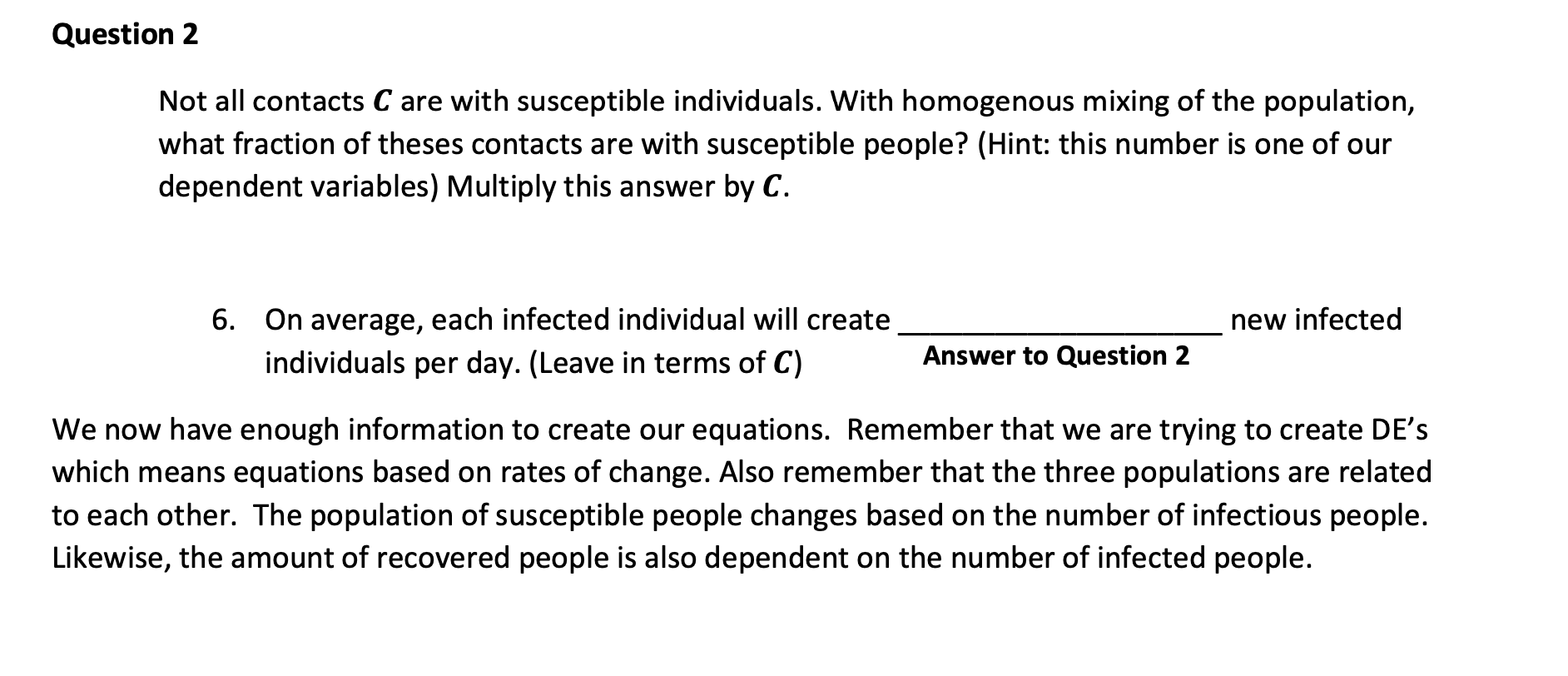
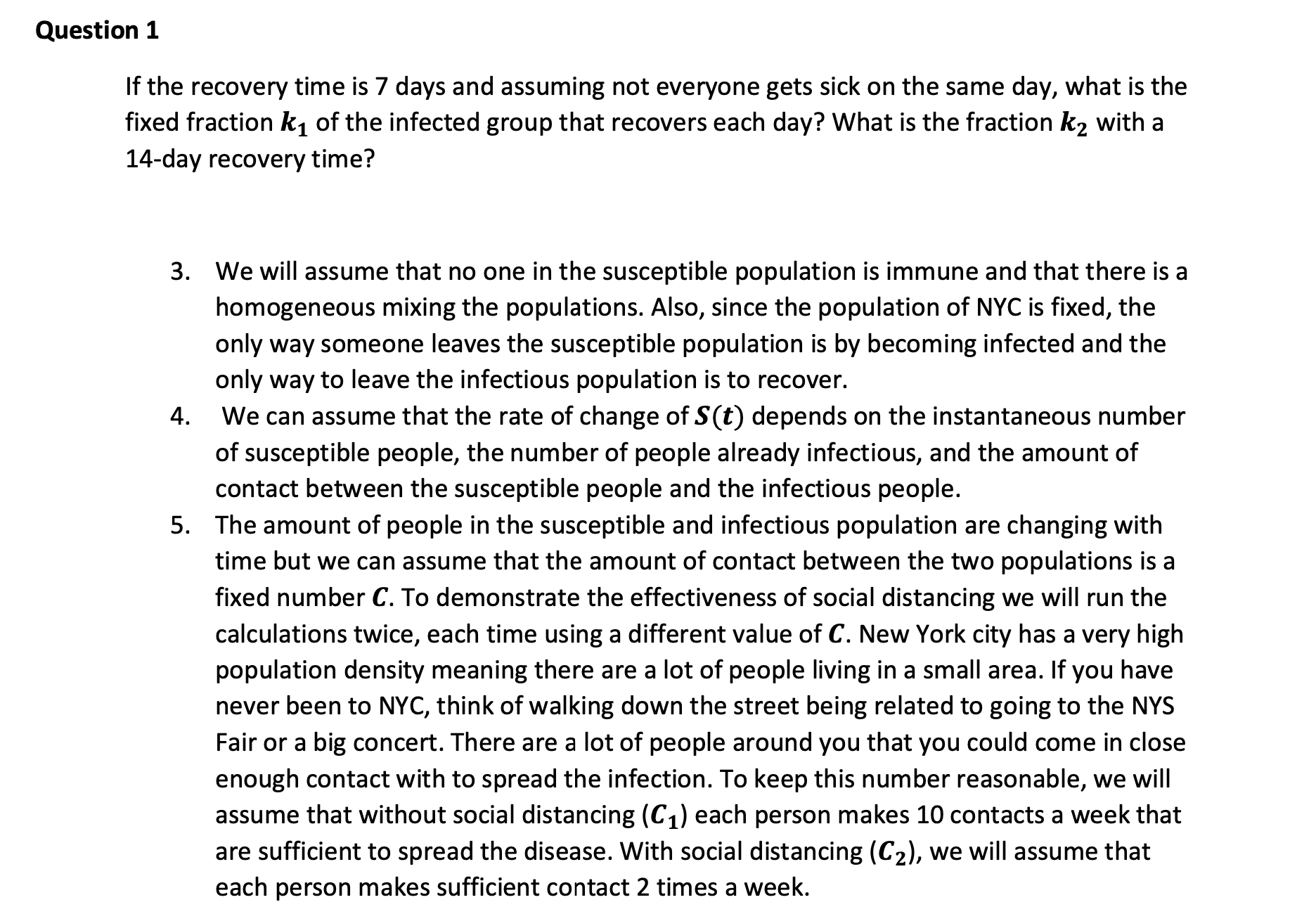
Question 1 If the recovery time is 7 days and assuming not everyone gets sick on the same day, what is the fixed fraction k1 of the infected group that recovers each day? What is the fraction k2 with a 14-day recovery time? 3. We will assume that no one in the susceptible population is immune and that there is a homogeneous mixing the populations. Also, since the population of NYC is fixed, the only way someone leaves the susceptible population is by becoming infected and the only way to leave the infectious population is to recover. 4. We can assume that the rate of change ofS(t) depends on the instantaneous number of susceptible people, the number of people already infectious, and the amount of contact between the susceptible people and the infectious people. 5. The amount of people in the susceptible and infectious population are changing with time but we can assume that the amount of contact between the two populations is a fixed number C. To demonstrate the effectiveness of social distancing we will run the calculations twice, each time using a different value of C. New York city has a very high population density meaning there are a lot of people living in a small area. If you have never been to NYC, think of walking down the street being related to going to the NYS Fair or a big concert. There are a lot of people around you that you could come in close enough contact with to spread the infection. To keep this number reasonable, we will assume that without social distancing (Cl) each person makes 10 contacts a week that are sufficient to spread the disease. With social distancing (6;), we will assume that each person makes sufficient contact 2 times a week. Question 2 Not all contacts C are with susceptible individuals. With homogenous mixing of the population, what fraction of theses contacts are with susceptible people? (Hint: this number is one of our dependent variables) Multiply this answer by C. 6. On average, each infected individual will create new infected individuals per day. (Leave in terms of C ) Answer t Question 2 We now have enough information to create our equations. Remember that we are trying to create DE's which means equations based on rates of change. Also remember that the three populations are related to each other. The population of susceptible people changes based on the number of infectious people. Likewise, the amount of recovered people is also dependent on the number of infected people

Step by Step Solution

There are 3 Steps involved in it

1 Expert Approved Answer
Step: 1 Unlock blur-text-image

Question Has Been Solved by an Expert!

Get step-by-step solutions from verified subject matter experts

Step: 2 Unlock
Step: 3 Unlock

Students Have Also Explored These Related Mathematics Questions!