





Question: I need help with question 3 Problems. 511 7. Describe the different capacity based options used in aggregate planning and their implications for a company.

I need help with question 3 I need help with question 3 Problems. 511 7.
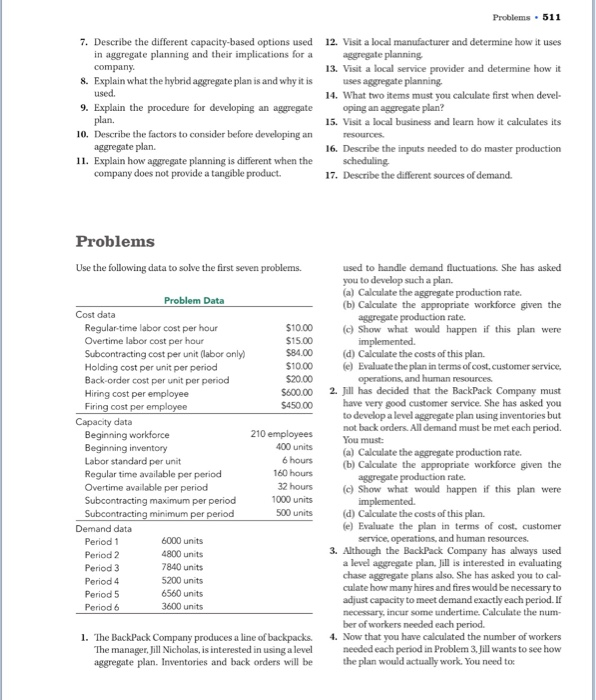
Problems. 511 7. Describe the different capacity based options used in aggregate planning and their implications for a company. 8. Explain what the hybrid aggregate plan is and why it is used. 9. Explain the procedure for developing an aggregate 12. Visit a local manufacturer and determine how it uses aggregate planning 13. Visit a local service provider and determine how it uses aggregate planning 14. What two items must you calculate first when devel- oping an aggregate plan? 15. Visit a local business and learn how it calculates its resources. 16. Describe the inputs needed to do master production scheduling 17. Describe the different sources of demand. plan. 10. Describe the factors to consider before developing an aggregate plan. 11. Explain how aggregate planning is different when the company does not provide a tangible product. Problems Use the following data to solve the first seven problems. Problem Data Cost data Regular-time labor cost per hour $10.00 Overtime labor cost per hour $15.00 Subcontracting cost per unit (labor only) $84.00 Holding cost per unit per period $10.00 Back-order cost per unit per period $20.00 Hiring cost per employee $600.00 Firing cost per employee $450.00 Capacity data Beginning workforce 210 employees Beginning inventory 400 units Labor standard per unit 6 hours Regular time available per period 160 hours Overtime available per period 32 hours Subcontracting maximum per period 1000 units Subcontracting minimum per period 500 units Demand data Period 1 6000 units Period 2 4800 units Period 3 7840 units Period 4 5200 units Period 5 6560 units Period 6 3600 units used to handle demand fluctuations. She has asked you to develop such a plan. (a) Calculate the aggregate production rate. (b) Calculate the appropriate workforce given the aggregate production rate. @ Show what would happen if this plan were implemented. (d) Calculate the costs of this plan. le) Evaluate the plan in terms of cost.customer service. operations, and human resources 2. Jill has decided that the BackPack Company must have very good customer service. She has asked you to develop a level aggregate plan using inventories but not back orders. All demand must be met each period. You must: (a) Calculate the aggregate production rate. (b) Calculate the appropriate workforce given the aggregate production rate. @ Show what would happen if this plan were implemented (d) Calculate the costs of this plan. (e) Evaluate the plan in terms of cost. customer service, operations, and human resources. 3. Although the BackPack Company has always used a level aggregate plan. Jull is interested in evaluating chase aggregate plans also. She has asked you to cal- culate how many hires and fires would be necessary to adjust capacity to meet demand exactly each period. If necessary, incur some undertime. Calculate the num- ber of workers needed each period. 4. Now that you have calculated the number of workers needed each period in Problem 3. Jill wants to see how the plan would actually work. You need to 1. The BackPack Company produces a line of backpacks. The manager, Jill Nicholas, is interested in using a level aggregate plan. Inventories and back orders will be

Step by Step Solution

There are 3 Steps involved in it

1 Expert Approved Answer
Step: 1 Unlock blur-text-image

Question Has Been Solved by an Expert!

Get step-by-step solutions from verified subject matter experts

Step: 2 Unlock
Step: 3 Unlock

Students Have Also Explored These Related General Management Questions!