







Question: I need help with question number 5 & 6 Assignment: Let's Try to Solve the Model Each firm in a monopolistically competitive industry faces the
I need help with question number 5 & 6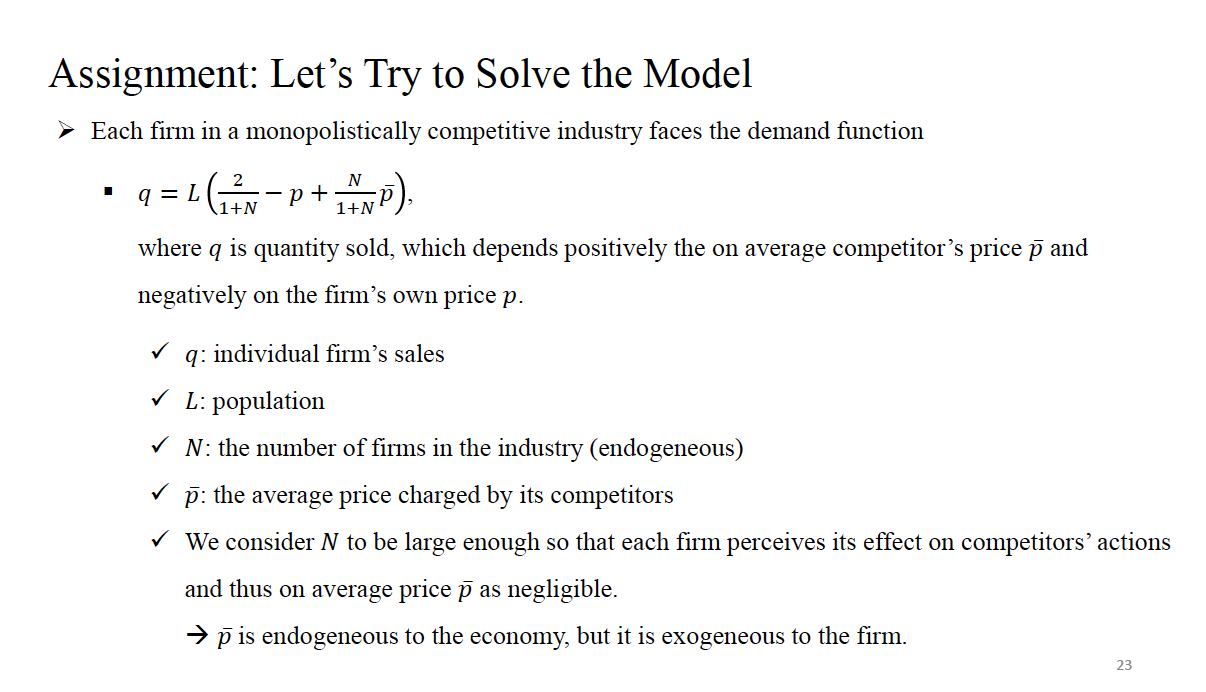
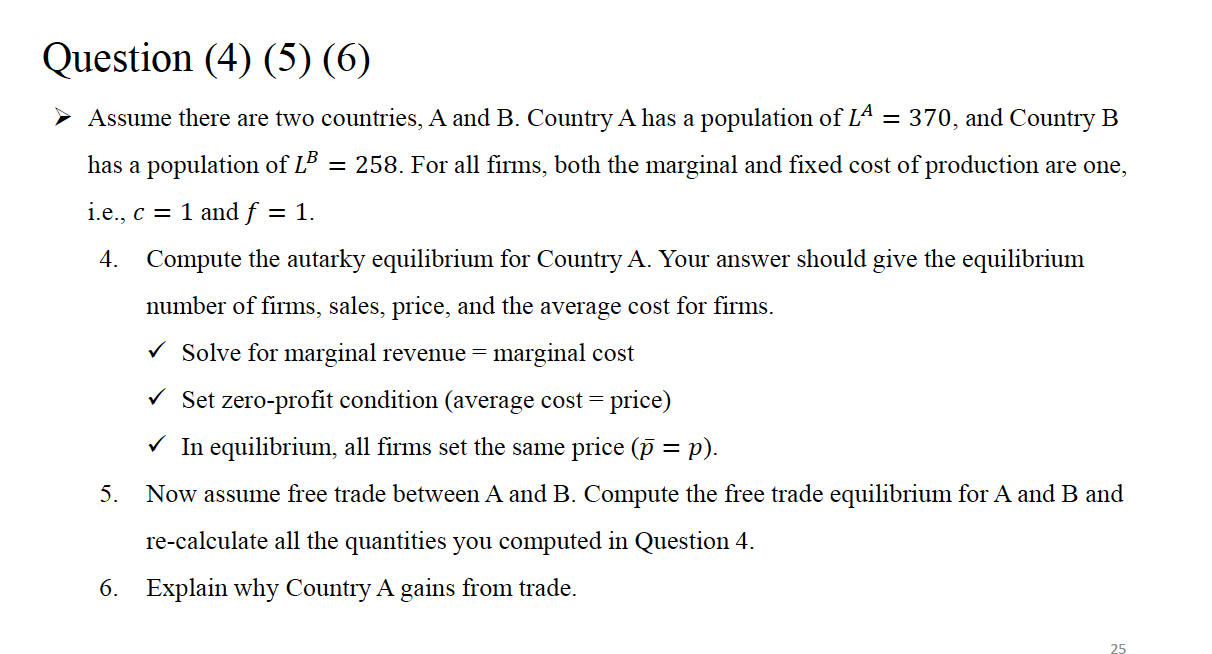
Assignment: Let's Try to Solve the Model Each firm in a monopolistically competitive industry faces the demand function - q=L(1+N2p+1+NNp) where q is quantity sold, which depends positively the on average competitor's price p and negatively on the firm's own price p. q : individual firm's sales L: population N : the number of firms in the industry (endogeneous) p : the average price charged by its competitors We consider N to be large enough so that each firm perceives its effect on competitors' actions and thus on average price p as negligible. p is endogeneous to the economy, but it is exogeneous to the firm. 23 Assume there are two countries, A and B. Country A has a population of LA=370, and Country B has a population of LB=258. For all firms, both the marginal and fixed cost of production are one, i.e., c=1 and f=1. 4. Compute the autarky equilibrium for Country A. Your answer should give the equilibrium number of firms, sales, price, and the average cost for firms. Solve for marginal revenue = marginal cost Set zero-profit condition (average cost = price) In equilibrium, all firms set the same price (p=p). 5. Now assume free trade between A and B. Compute the free trade equilibrium for A and B and re-calculate all the quantities you computed in Question 4. 6. Explain why Country A gains from trade. Assignment: Let's Try to Solve the Model Each firm in a monopolistically competitive industry faces the demand function - q=L(1+N2p+1+NNp) where q is quantity sold, which depends positively the on average competitor's price p and negatively on the firm's own price p. q : individual firm's sales L: population N : the number of firms in the industry (endogeneous) p : the average price charged by its competitors We consider N to be large enough so that each firm perceives its effect on competitors' actions and thus on average price p as negligible. p is endogeneous to the economy, but it is exogeneous to the firm. 23 Assume there are two countries, A and B. Country A has a population of LA=370, and Country B has a population of LB=258. For all firms, both the marginal and fixed cost of production are one, i.e., c=1 and f=1. 4. Compute the autarky equilibrium for Country A. Your answer should give the equilibrium number of firms, sales, price, and the average cost for firms. Solve for marginal revenue = marginal cost Set zero-profit condition (average cost = price) In equilibrium, all firms set the same price (p=p). 5. Now assume free trade between A and B. Compute the free trade equilibrium for A and B and re-calculate all the quantities you computed in Question 4. 6. Explain why Country A gains from trade
Step by Step Solution
There are 3 Steps involved in it

Get step-by-step solutions from verified subject matter experts
 Study Help