



Question: I need help with questions one through seven on the analysis and questions one and two on the follow up. A OLLLLLPHY131 2) Explain why
I need help with questions one through seven on the analysis and questions one and two on the follow up.
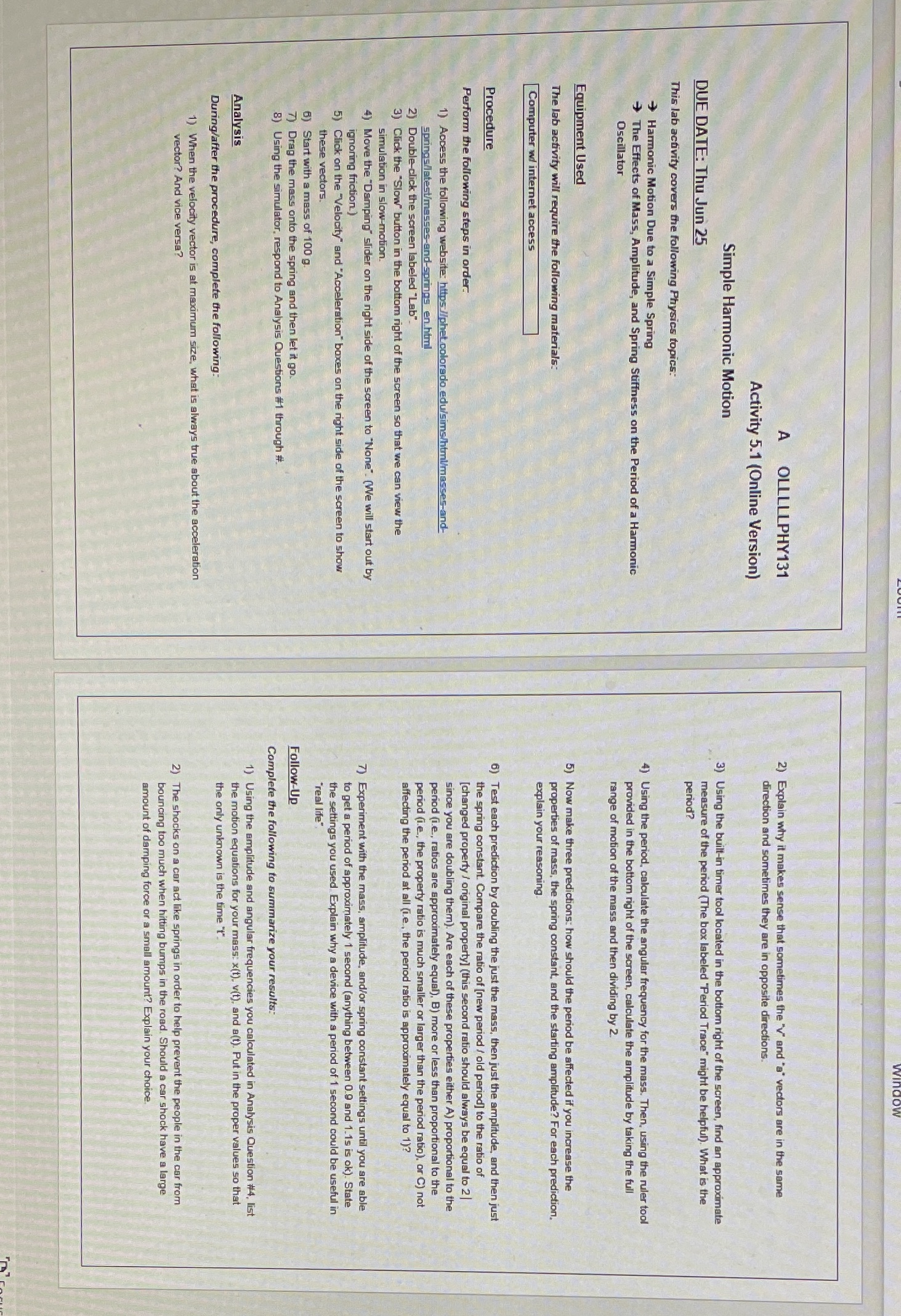
A OLLLLLPHY131 2) Explain why it makes sense that sometimes the "v" and "a" vectors are in the same Activity 5.1 (Online Version) direction and sometimes they are in opposite directions. Simple Harmonic Motion 3) Using the built-in timer tool located in the bottom right of the screen, find an approximate DUE DATE: Thu Jun 25 measure of the period (The box labeled "Period Trace" might be helpful). What is the period? This lab activity covers the following Physics topics: - Harmonic Motion Due to a Simple Spring The Effects of Mass, Amplitude, and Spring Stiffness on the Period of a Harmonic 4) Using the period, calculate the angular frequency for the mass. Then, using the ruler tool Oscillator provided in the bottom right of the screen, calculate the amplitude by taking the full range of motion of the mass and then dividing by 2. Equipment Used 5) Now make three predictions: how should the period be affected if you increase the The lab activity will require the following materials: properties of mass, the spring constant, and the starting amplitude? For each prediction. Computer wi internet access explain your reasoning. Procedure 6) Test each prediction by doubling the just the mass, then just the amplitude, and then just the spring constant. Compare the ratio of [new period / old period] to the ratio of Perform the following steps in order. [changed property / original property] (this second ratio should always be equal to 2 | ) Access the following website: https://phet.colorado edu/sims/html/masses-and- since you are doubling them). Are each of these properties either A) proportional to the springs/latest/masses-and-springs en.html period (i.e., ratios are approximately equal), B) more or less than proportional to the Double-click the screen labeled "Lab". period (i.e., the property ratio is much smaller or larger than the period ratio), or C) not 3) Click the "Slow" button in the bottom right of the screen so that we can view the affecting the period at all (Le., the period ratio is approximately equal to 1)? simulation in slow-motion. 4) Move the "Damping" slider on the right side of the screen to "None". (We will start out by ignoring friction) 7) Experiment with the mass, amplitude, and/or spring constant settings until you are able 5) Click on the "Velocity" and "Acceleration" boxes on the right side of the screen to show to get a period of approximately 1 second (anything between 0.9 and 1.1s is ok). State the settings you used Explain why a device with a period of 1 second could be useful in these vectors. real life". 6) Start with a mass of 100 g. 7) Drag the mass onto the spring and then let it go. Follow-Up 8) Using the simulator, respond to Analysis Questions #1 through #. Complete the following to summarize your results: 1) Using the amplitude and angular frequencies you calculated in Analysis Question #4, list Analysis the motion equations for your mass: x(1). v(t), and a(t). Put in the proper values so that During/after the procedure, complete the following: the only unknown is the time "t. 1) When the velocity vector is at maximum size, what is always true about the acceleration vector? And vice versa? 2) The shocks on a cor act like springs in order to help prevent the people in the car from bouncing too much when hitting bumps in the road. Should a car shock have a large amount of damping force or a small amount? Explain your choice
Step by Step Solution
There are 3 Steps involved in it

Get step-by-step solutions from verified subject matter experts