







Question: I need help with section 5 Analysis, with the explanations of questions from 1-5. Lab: Equipotential Lines 1 Goal . To map the equipotential lines
I need help with section 5 Analysis, with the explanations of questions from 1-5.
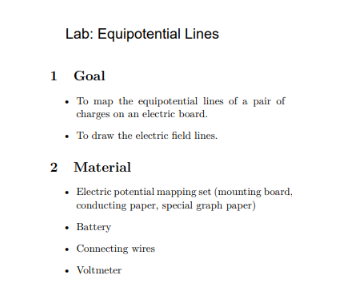
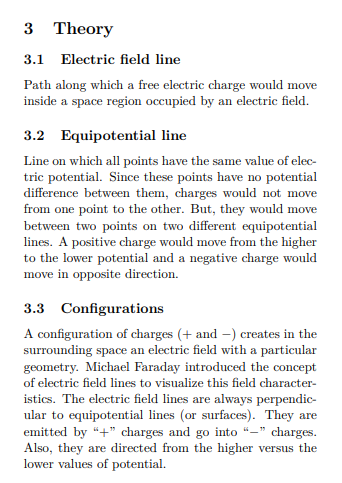
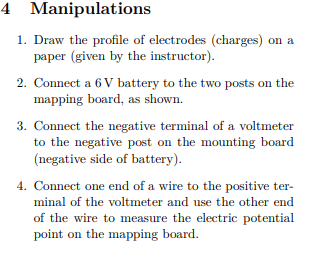
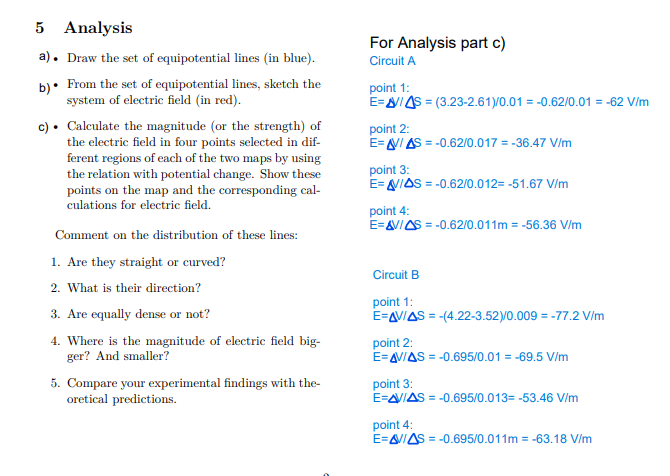
Lab: Equipotential Lines 1 Goal . To map the equipotential lines of a pair of charges on an electric board. . To draw the electric field lines. 2 Material . Electric potential mapping set (mounting board. conducting paper, special graph paper) . Battery . Connecting wires . Voltmeter3 Theory 3.1 Electric field line Path along which a free electric charge would move inside a space region occupied by an electric field. 3.2 Equipotential line Line on which all points have the same value of elec- tric potential. Since these points have no potential difference between them, charges would not move from one point to the other. But, they would move between two points on two different equipotential lines. A positive charge would move from the higher to the lower potential and a negative charge would move in opposite direction. 3.3 Configurations A configuration of charges (+ and -) creates in the surrounding space an electric field with a particular geometry. Michael Faraday introduced the concept of electric field lines to visualize this field character- istics. The electric field lines are always perpendic ular to equipotential lines (or surfaces). They are emitted by "+" charges and go into "-" charges. Also, they are directed from the higher versus the lower values of potential.4 Manipulations 1. Draw the profile of electrodes (charges) on a paper (given by the instructor). 2. Connect a 6 V battery to the two posts on the mapping board, as shown. 3. Connect the negative terminal of a voltmeter to the negative post on the mounting board (negative side of battery). 4. Connect one end of a wire to the positive ter- minal of the voltmeter and use the other end of the wire to measure the electric potential point on the mapping board.5 Analysis For Analysis part c) a) . Draw the set of equipotential lines (in blue). Circuit A b) . From the set of equipotential lines, sketch the point 1: system of electric field (in red). E=A//4S = (3.23-2.61)/0.01 = -0.62/0.01 = -62 V/m c) . Calculate the magnitude (or the strength) of point 2: the electric field in four points selected in dif- E= AV/ 4S = -0.62/0.017 = -36.47 V/m ferent regions of each of the two maps by using the relation with potential change. Show these point 3: points on the map and the corresponding cal- E= AV/OS = -0.62/0.012= -51.67 V/m culations for electric field. point 4: E=AV/CS = -0.62/0.011m = -56.36 V/m Comment on the distribution of these lines: 1. Are they straight or curved? Circuit B 2. What is their direction? point 1: 3. Are equally dense or not? E=4WAS = -(4.22-3.52)/0.009 = -77.2 V/m 4. Where is the magnitude of electric field big- point 2: ger? And smaller? E=AVAS = -0.695/0.01 = -69.5 V/m 5. Compare your experimental findings with the- point 3: oretical predictions. E=WVWAS = -0.695/0.013= -53.46 V/m point 4: E=W//S = -0.695/0.011m = -63.18 V/m
Step by Step Solution
There are 3 Steps involved in it

Get step-by-step solutions from verified subject matter experts
 Study Help