







Question: LAB PHY-12 S2022 ELECTROSTATICS Last Name: First Name: Date: ABSTRACT The objective of this experiment is to gain the knowledge and understanding of how charges
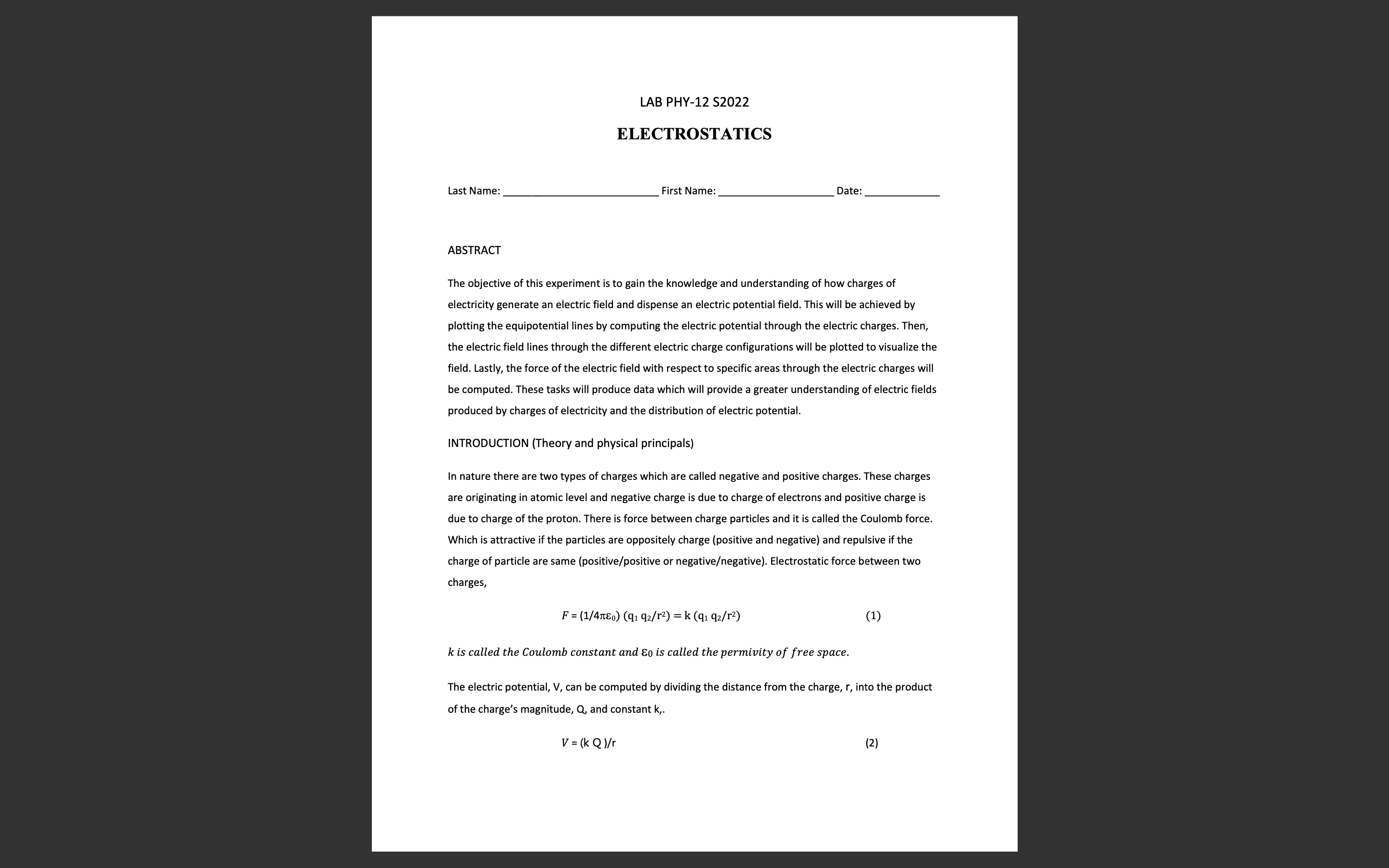
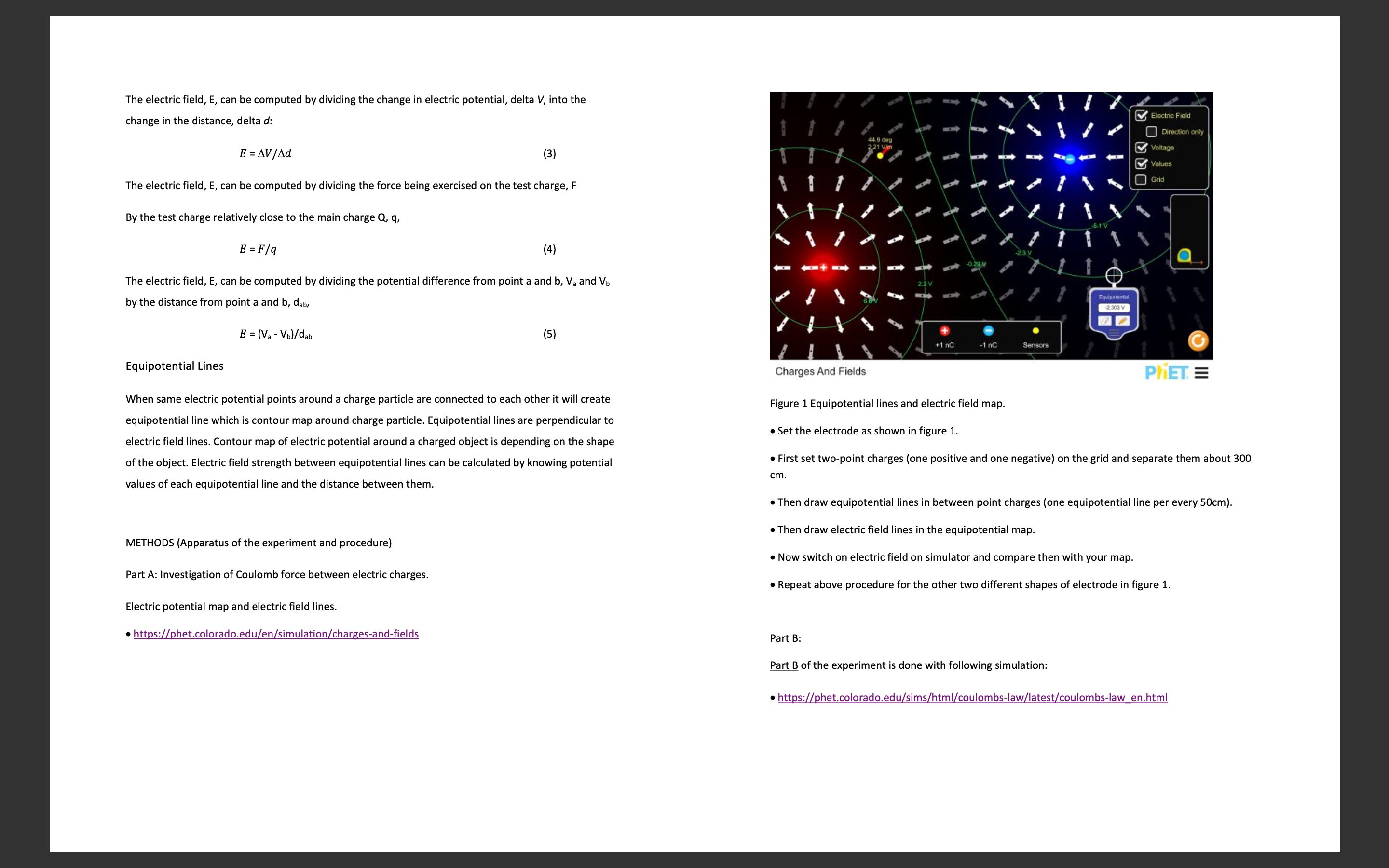
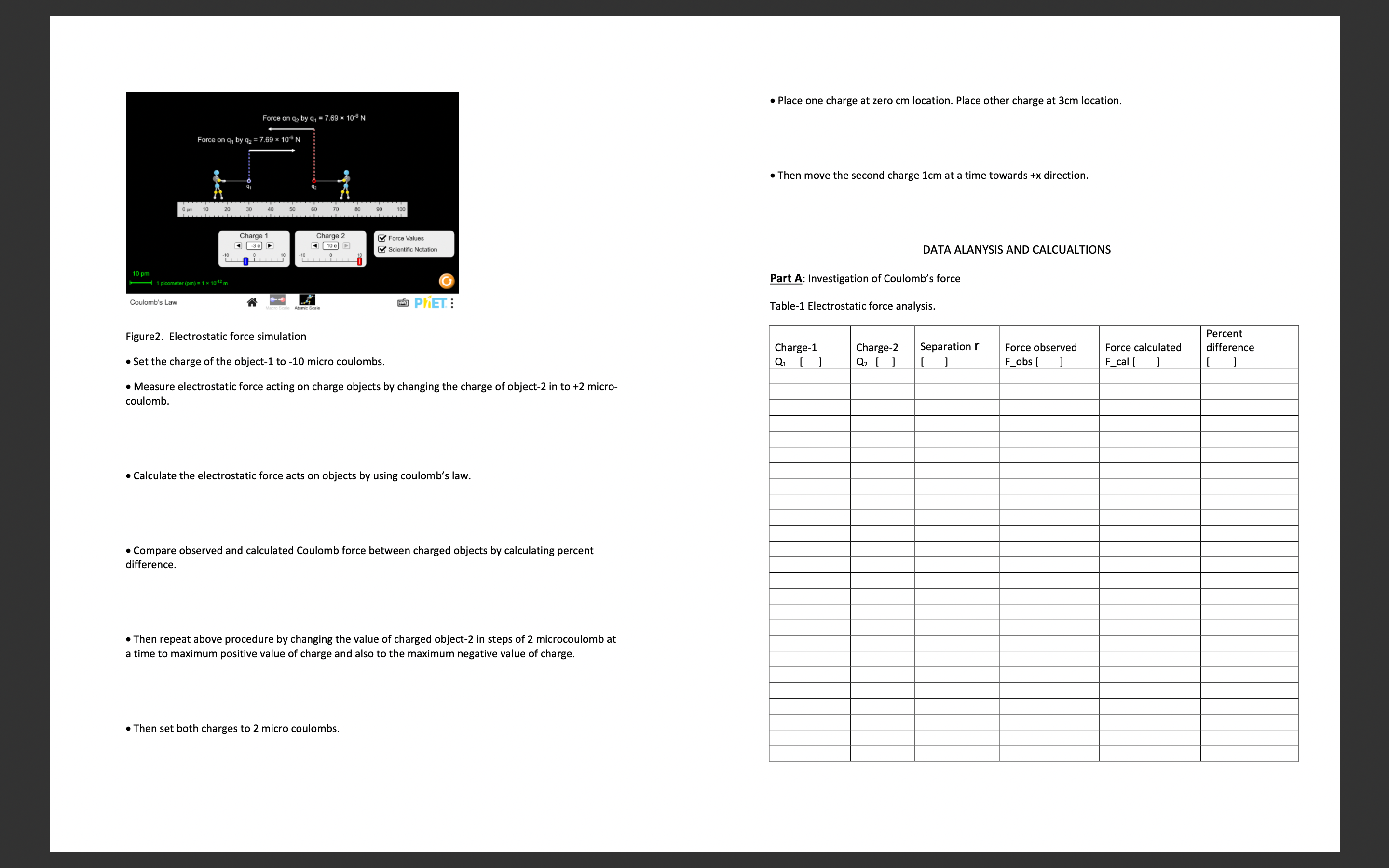

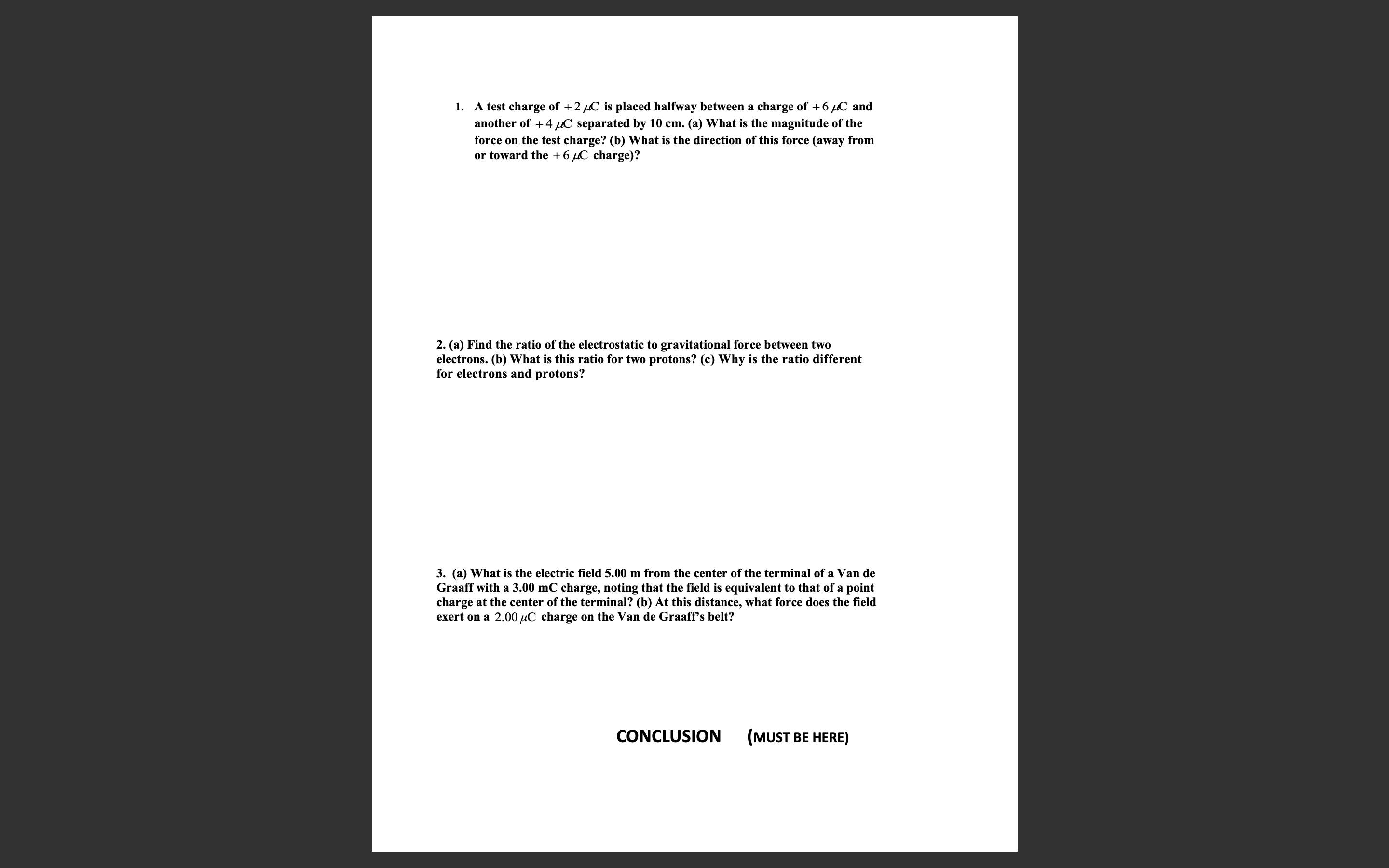
LAB PHY-12 S2022 ELECTROSTATICS Last Name: First Name: Date: ABSTRACT The objective of this experiment is to gain the knowledge and understanding of how charges of electricity generate an electric field and dispense an electric potential field. This will be achieved by plotting the equipotential lines by computing the electric potential through the electric charges. Then, the electric field lines through the different electric charge configurations will be plotted to visualize the field. Lastly, the force of the electric field with respect to specific areas through the electric charges will be computed. These tasks will produce data which will provide a greater understanding of electric fields produced by charges of electricity and the distribution of electric potential. INTRODUCTION (Theory and physical principals) In nature there are two types of charges which are called negative and positive charges. These charges are originating in atomic level and negative charge is due to charge of electrons and positive charge is due to charge of the proton. There is force between charge particles and it is called the Coulomb force. Which is attractive if the particles are oppositely charge (positive and negative) and repulsive if the charge of particle are same (positive/positive or negativeegative). Electrostatic force between two charges, F = (1/4neo) (q1 q2/r2) = k (q1 92/12) (1) k is called the Coulomb constant and Eo is called the permivity of free space. The electric potential, V, can be computed by dividing the distance from the charge, r, into the product of the charge's magnitude, Q, and constant k,. V = ( k Q ) /r (2)The electric field, E, can be computed by dividing the change in electric potential, delta V, into the change in the distance, delta d: Electric Field Direction only E = AV/Ad (3) Voltage Values Grid The electric field, E, can be computed by dividing the force being exercised on the test charge, F By the test charge relatively close to the main charge Q, q, E = F/q (4) O The electric field, E, can be computed by dividing the potential difference from point a and b, Va and Vb by the distance from point a and b, dab -2.303 E = (Va - Vb)/dab (5) + +1 nc -1 nc Sensors Equipotential Li Charges And Fields PHET. When same electric potential points around a charge particle are connected to each other it will create Figure 1 Equipotential lines and electric field map. equipotential line which is contour map around charge particle. Equipotential lines are perpendicular to . Set the electrode as shown in figure 1. electric field lines. Contour map of electric potential around a charged object is depending on the shape of the object. Electric field strength between equipotential lines can be calculated by knowing potential . First set two-point charges (one positive and one negative) on the grid and separate them about 300 cm. values of each equipotential line and the distance between them. . Then draw equipotential lines in between point charges (one equipotential line per every 50cm). . Then draw electric field lines in the equipotential map. METHODS (Apparatus of the experiment and procedure) . Now switch on electric field on simulator and compare then with your map. Part A: Investigation of Coulomb force between electric charges. . Repeat above procedure for the other two different shapes of electrode in figure 1. Electric potential map and electric field lines. . https:/phet.colorado.edu/en/simulation/charges-and-fields Part B: Part B of the experiment is done with following simulation: . https://phet.colorado.edu/sims/html/coulombs-law/latest/coulombs-law en.htmla Place one charge at zero cm location. Place other charge at 3cm location, 0 Then move the second charge 1cm at a time towards +x direction. DATA ALANYSIS AND CALCUALTIONS Part A: Investigation of Coulomb's force Table1 Electrostatic force analysis Figurezt Electrostatic force simulation Percent (Shanta-1 Charse-Z Separation r Force observed Force calculated difference oSet the charge of [he object-1 to -10 micro coulombs. Q; [ ] Q; [ ] [ ] F_obs[ ] F_cal[ I [ ] 0 Measure electrostatic force acting on charge objects by changing the charge of object-2 in to +2 micro coulomb. c Calculate the electrostatic force acts on objecu by using coulomb's Iawt c Compare observed and calculated Coulomb force between charged objects by calculating percent difference I Then repeat above procedure by changing the value of charged abject-2 in steps of 2 microcoulomb at a time to maximum positive value of charge and also to the maximum negative value of charge. c Then set both charges to 2 micro coulombs. In Excel: Make graph of F\". vs (141; for table-1. Then discuss the behavior of the graph in terms of Coulomb's law. Make graph of F\". vs R for table-1. Then discuss the behavior of the graph in terms of Coulomb's law. Part B of the experiment is done with following simulation: httoszllwww.compadre.org/thslets/electromagnetism/ele Z.cfm Explore the Effect of Multiple Charges. A positive test charge is shown in the animation. You can add positive and/or negative charges. All charges are added to the middle of the animation so you must drag each newly added charge to a new location, When you push play, the test charge will move under the inuence of the forces from the other charges. Note that the test charges are movable due to the net force of all other "dragable" charges. The dragable charges that you add are \"NAILED" into position where you leave them. a. Add one positive charge. Describe and explain the motion ofthe test charge. i. Make sure you compare what happens to force or acceleration as time passes (or as the test charge gets further away). I). How can you tell from its motion that the test charge experiences a force, but that the force decreases as the test charge moves away from the positive charge? c. What do you predict the motion will be if the positive charge is replaced by a negative charge? (.1. Clear the screen and try it. Was your prediction correct? e. How can you congure two charges of the same sign and keep the test charge stationary? Describe your configuration. Sketch what you think this conguration should look like, and include information about distances of the test charge from the other charges. Alter sketching try to set up your conguration. Make sure you wait a long time to see if you can establish this \"equilibrium\" condition. Can you? 1. A test charge of +2 A: is placed hallway between a charge of + 6 .15 and another of +4 IE separated by 10 cm. (a) What is the magnitude of the force on the test charge? (b) What is the direction of this force (away from or toward the +6 ,1: charge)? 2. (a) Find the ratio of the electrostatic to gravitational force between two electrons. (b) What is this ratio for two protons? (0) Why is the ratio different for electrons and protons? 3. (a) What is the electric eld 5400 In from the center of the terminal of a Van de Graaff with a 3.00 mC charge, noting that the field is equivalent to that of a point charge at the center of the terminal? (b) At this distance, what force does the eld exert on a 2.00 pC charge on the Van de Graal'l's belt'! CONCLUSION (MUST BE HERE)
Step by Step Solution
There are 3 Steps involved in it

Get step-by-step solutions from verified subject matter experts
 Study Help