







Question: I need help with the 2 questions below please. Executive Summary One to two paragraphs in length 1. On cover page of the report Briefly
I need help with the 2 questions below please.
Executive Summary One to two paragraphs in length
1. On cover page of the report Briefly identify the major problems facing the manager/key person.
2. Summarize the recommended plan of action and include a brief justification of the recommended plan.
If our side source is used please leave APA citation.
Thank you
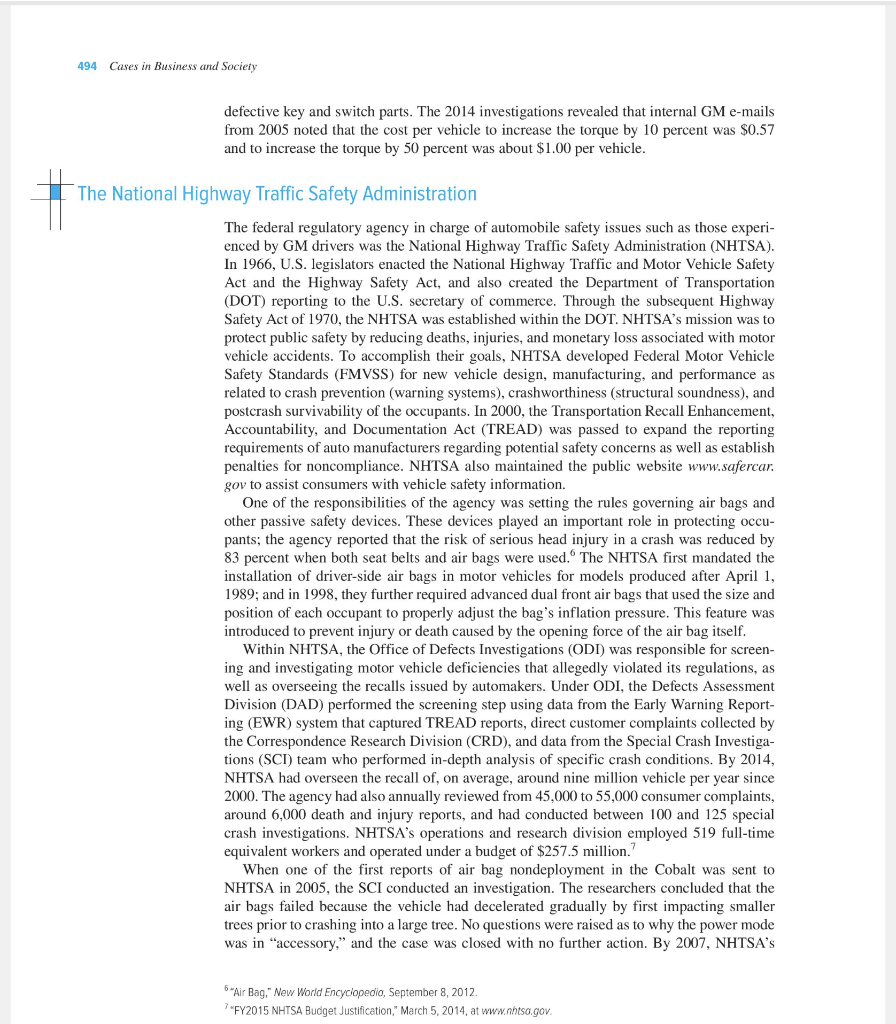
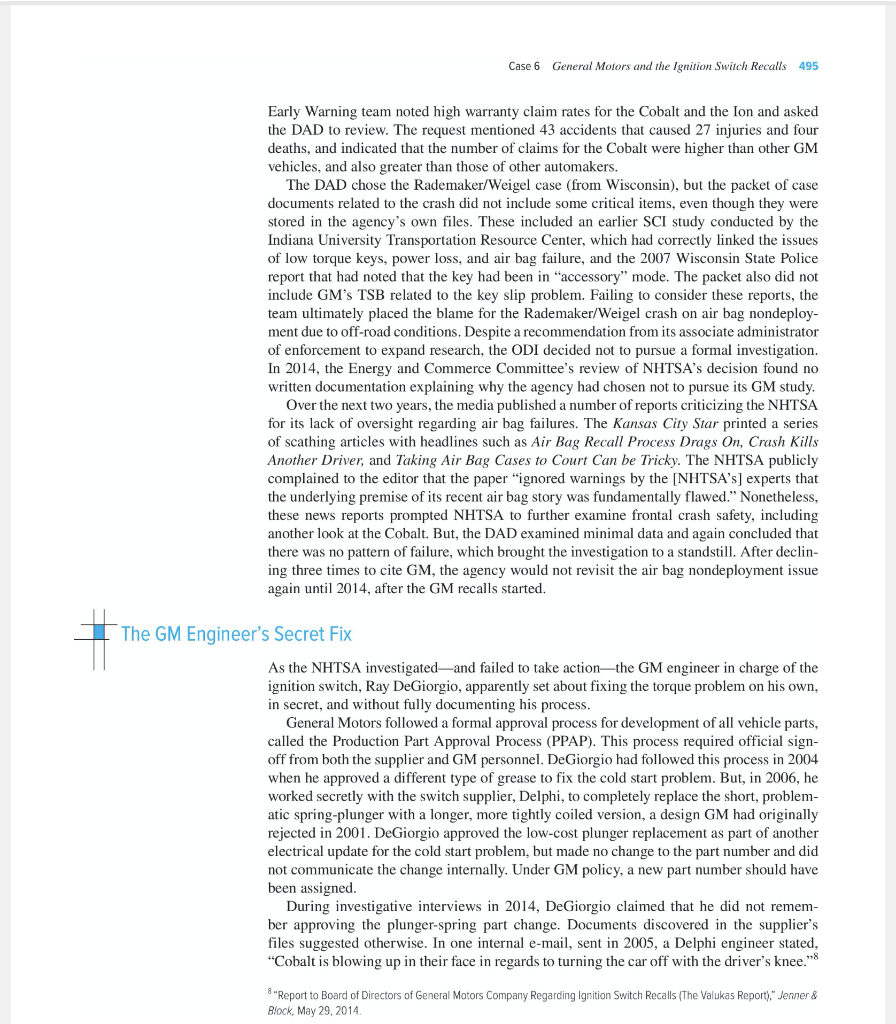
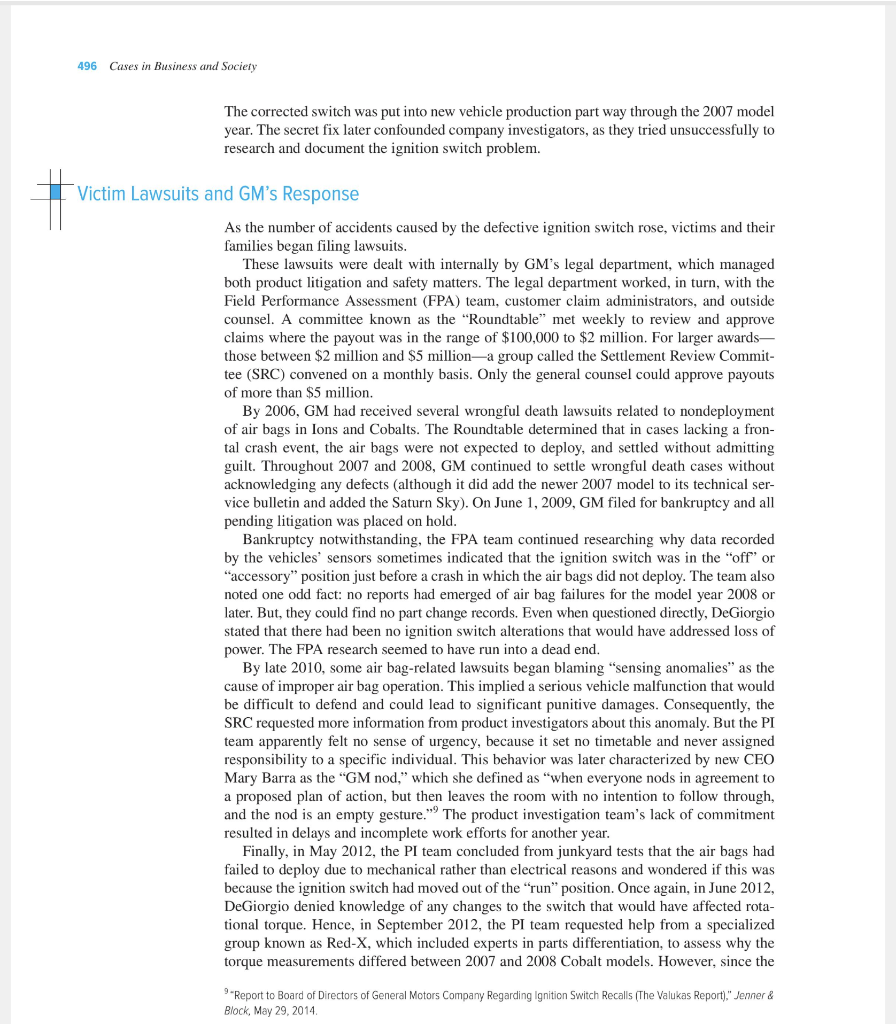
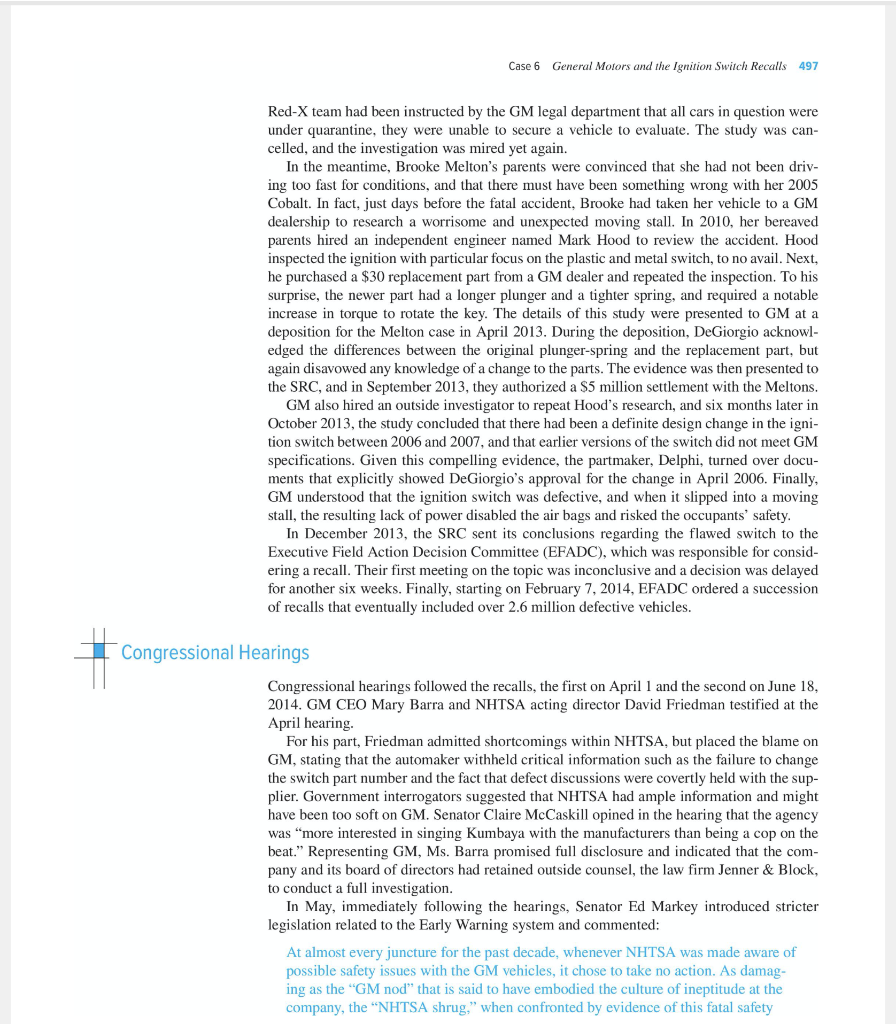
Justice Department. By May 2014, 47 accidents and more than a dozen fatalities had been linked to the ignition switch defect. But many questions regarding the decade-long delay in repairing the defective part remained unanswered. General Motors was America's largest automaker with a 2014 profit of \$2.8 billion, 21,000 dealerships, and a workforce of over 200,000 across six continents. GM produced several well-known brands including Chevrolet (Chevy), Buick, GMC, Cadillac, Saturn, Saab, Pontiac, Oldsmobile, and Hummer. Founded in 1908 by William "Billy" Durant, the company motto was "a car for every purse and purpose." GM was known for innovative styling, exemplified by models such as the 1953 Chevrolet Corvette and the 1959 Cadillac El Dorado. Over several decades, GM repeatedly changed with the times, enjoying a run of successes. During WWII, GM diverted 100 percent of its manufacturing to the production of $12 billion worth of airplanes, trucks, and tanks for the war effort. In the 1970s, GM responded to rising gasoline prices with engines that ran on unleaded fuel, offered air bags for protection, and introduced the first emission-reducing catalytic converter. In the 1980s, GM added Saab and Hummer to its product line and expanded its global footprint through joint ventures with China and India. GM partnered with Toyota in the NUMMI joint venture in the 1990s to cocreate trucks and SUV's that satisfied emerging consumer demand. By the mid-2000s, GM's push for innovation led to the development of the Chevy Volt, one of the first electric vehicles, as well as the concept of a hybrid vehicle that switched from electric to gasoline. Still, GM was not as agile as the German, Japanese, and Korean automakers and began to lose market share, especially in fuel-efficient vehicles. The recession and credit crisis of 2008 significantly undermined GM's operating budget, and the firm, along with its financial arm GMAC, agreed to a government bailout. On June 1, 2009, the old General Motors Corporation filed for bankruptcy and transferred most of its assets to the new General Motors Company, whose major shareholders included the U.S. and Canadian governments and the United Auto Workers (UAW) medical trust fund. The new owners replaced thenCEO Rick Wagoner with Fritz Henderson, who was then almost immediately dismissed in favor of the chairman of the board, Ed Whitacre. They also demanded increased fuel efficiency levels to compete with foreign automakers, and required the firm to streamline restructured GMAC into Ally Financial. The company became profitable once again by the end of 2009. In 2010, Whitacre stepped down and Dan Akerson became the CEO until Mary Barra, a 35-year veteran of GM and the first female CEO in the auto industry, took over in January 2014. The bailout, which also included Chrysler Motors, ended in December 2014 with a net loss to taxpayers of $9.2 billion, with only $1.3 billion attributed to Chrysler. Justification for the bailout hinged on the "too big to fail" concept, as the auto industry had contributed 3.6 percent of the total U.S. Gross Domestic Product (GDP), and every additional 30 percent decline in auto sales meant a corresponding 1 percent decline in GDP. 1 in Defect The ignition switch at the center of the recall was first introduced in the late 1990s. Between 1997 and 2001, GM designed a new low-current switch, formally named the 1 "Auto Industry Bailout (GM, Ford, Chrysler)," About.com, February 6, 2015. 492 Cases in Business and Society Discrete Logic Ignition Switch (DLIS). Concurrently, GM implemented cost-saving manufacturing efficiencies through a baseline design, called a platform, which allowed the use of common parts across vehicle makes, models, and production years. The Delta Platform included the Saturn Ion, Chevrolet Cobalt, Chevrolet HHR, and the Pontiac G5, and the Kappa Platform included the Saturn Sky and Pontiac Solstice. The recalled ignition switch, a part shared across the Delta and Kappa platforms, was embedded in the steering column and had four positions. The driver turned the key to "start" (technically referred to as "crank") to turn on the engine, and once started, the key automatically toggled into the "run" position to indicate that the vehicle had power. When the key was moved to "accessory," the system signaled an engine shutdown, which turned off the air bags, power steering, and power brakes, and left only small electrical features, like the radio, operable. In the "off" or "lock" position, the switch cut power to all vehicle functions. Inside the ignition switch, a plunger cap and coiled spring unit that fit into a small groove called a "detent" kept the key in the selected mode. The driver applied enough pressure, or torque, to move the key between positions. The longer the plunger and more tightly coiled the spring, the harder it was to shift key slots. The DLIS ignition switches were manufactured for GM by another company, Eaton Corporation (acquired by Delphi Mechatronics in 2001). GM's switch specifications recommended a target amount of pressure that a driver would have to apply to toggle the key from "run" to "accessory." But, as early as 1999 , the parts manufacturer reported that prototype switches did not meet GM's specifications. Subsequent mechanical tests conducted by Delphi in 2001-2002 also showed that switches within every sample set had a "torque problem," tending to slip out of position when inadvertently jostled. Despite the test failures, the GM engineer in charge of the part authorized production of the switch in 2002, signing his approval e-mail as "Ray (tired of the switch from hell) DeGiorgio." DeGiorgio's decision was based on Delphi's advice that a fix for the torque problem, such as a longer plunger, would take time, add costs, and could compromise the switch's electrical components, which he had already redesigned several times. The GM engineer apparently believed that the torque issue did not pose a safety problem, because he later told an investigator that he had "no awareness that the below-specification torque would have an impact on the safe operation of the car." 2 However, this was not the case. The ignition switch defect compromised safety because if the car lost power while in motion, as a result of the key slipping out of position, it went into what was called a moving stall. Drivers in a moving stall would be less able to navigate the car because they no longer had access to power steering or braking (although they retained manual control). Then, if an accident occurred, the air bags would not deploy, because they no longer had power. GM used special sensors to control the air bag system. To avoid accidental inflation, the sensors were programmed to shut down when the ignition switch moved to the "off" or "accessory" position. All GM vehicles in the Delta and Kappa platforms used the same air bag sensor systems. The First Indications of a Problem and GM's Response The 2003 Saturn Ion was the first GM vehicle to roll off the assembly line with the DLIS switch. Within the first year of its release, the Ion had logged over 200 warranty incidents related to its ignition switch. The two most common problems were the car stalling while 2 Report to Board of Directors of General Motors Company Regarding Ignition Switch Recalls (The Valukas Report)," Jenner \& Block, May 29, 2014. in motion because the key slipped out of position, and the car refusing to start under cold weather conditions. DeGiorgio, still in charge of the ignition switch, focused on finding a fix for the latter problem. In 2004, he approved use of a different type of grease within the ignition to resolve most of the nonstart issues. Despite several reports of moving stalls issued by both internal GM test teams and external drivers; however, company engineers made no effort to correct the key slippage problem. Nonetheless, in February 2005, GM released a warning message to dealers, referred to as Preliminary Information, which identified possible stalls as a problem and suggested that drivers remove unnecessary items from the key ring to avoid weighing down the key and inadvertently knocking the ignition out of the "run" position. One such message stated that "there is potential for the driver to inadvertently turn off the ignition due to low key ignition cylinder torque/effort. The concern is more likely to occur if the driver is short and has a large heavy key chain.." 33 Presumably, a short driver would be more likely to move the seat forward, increasing the risk of jostling the key with his/her knee or leg. One month later, however, GM's related internal issue tracking report was closed with no action taken. In 2014, an investigative review of the decision to close the report without a fix disclosed significant finger-pointing within the organization. During repeated fact-finding interviews, GM managers folded their arms, hands together, and pointed their fingers outward in a gesture that suggested someone else was responsible; this behavior became known as the "GM salute." By June 2005, the company had received multiple customer complaints about moving stalls in the Cobalt and the Solstice, which triggered a new non-safety-related defect report. This time, engineers recommended a plug that reduced the size of the key slot. This solution was sent out to dealers as an updated Preliminary Information notice. But, even after this bulletin was released, complaints kept piling up, and several negative news articles decried the problem and GM's inadequate response. For example, journalist Gary Heller reported in The Daily Item, a Pennsylvania newspaper, "Unplanned engine shutdowns happened four times during a hard-driving test [of the Chevy Cobalt] last week.... I never encountered anything like this in 37 years of driving, and I hope I never do again." This quote was later picked up by The New York Times. 4 As a direct result of the negative press, GM's Product Investigations (PI) team conducted tests that reproduced the moving stalls. In spite of these results, the PI team recommended the release of a Technical Service Bulletin (TSB) to dealers rather than a recall. The TSB applied to the 2005-06 Chevy Cobalt, 2006 Chevy HHR, 2005-06 Pontiac Pursuit, 2006 Pontiac Solstice, and the 2003-06 Saturn Ion. The bulletin repeated the message used in the Preliminary Information notice, including the key insert fix, with one notable difference: the word "stall" was removed from the text. During investigative interviews, GM quality manager Steve Oakley later stated that the term "stall" was not typically used in bulletins because it might sound like a safety issue and cause NHTSA to question why the company did not issue a recall. Oakley also revealed that he did not want to "push hard on safety issues" because the previous quality manager, Courtland Kelley, was demoted-allegedly due to a failed 2003 whistle-blowing lawsuit over a leaky fuel line in the Chevy Trailblazer. 5 The TSB provided a solution for any customer who complained, but did not address switch defects in the production of new vehicles. When GM was unable to resolve price and quality disputes with their supplier of keys, they cancelled the plan to use a key designed with a small hole instead of a wide slot and continued to build new cars with the same 3 "Engine Stalls, Loss of Electrical Systems, and No DTCs LSJ phantom #PIC3421," General Motors, February 28, 2005. 4 "Making a Case for Ignitions That Don't Need Keys, The New York Times, June 19, 2005. 5 "How GM Silenced a Whistle-Blower," Bloomberg Business, June 18, 2014. defective key and switch parts. The 2014 investigations revealed that internal GM e-mails from 2005 noted that the cost per vehicle to increase the torque by 10 percent was $0.57 and to increase the torque by 50 percent was about $1.00 per vehicle. hway Traffic Safety Administration The federal regulatory agency in charge of automobile safety issues such as those experienced by GM drivers was the National Highway Traffic Safety Administration (NHTSA). In 1966, U.S. legislators enacted the National Highway Traffic and Motor Vehicle Safety Act and the Highway Safety Act, and also created the Department of Transportation (DOT) reporting to the U.S. secretary of commerce. Through the subsequent Highway Safety Act of 1970, the NHTSA was established within the DOT. NHTSA's mission was to protect public safety by reducing deaths, injuries, and monetary loss associated with motor vehicle accidents. To accomplish their goals, NHTSA developed Federal Motor Vehicle Safety Standards (FMVSS) for new vehicle design, manufacturing, and performance as related to crash prevention (warning systems), crashworthiness (structural soundness), and postcrash survivability of the occupants. In 2000 , the Transportation Recall Enhancement, Accountability, and Documentation Act (TREAD) was passed to expand the reporting requirements of auto manufacturers regarding potential safety concerns as well as establish penalties for noncompliance. NHTSA also maintained the public website www.safercar. gov to assist consumers with vehicle safety information. One of the responsibilities of the agency was setting the rules governing air bags and other passive safety devices. These devices played an important role in protecting occupants; the agency reported that the risk of serious head injury in a crash was reduced by 83 percent when both seat belts and air bags were used. 6 The NHTSA first mandated the installation of driver-side air bags in motor vehicles for models produced after April 1 , 1989; and in 1998, they further required advanced dual front air bags that used the size and position of each occupant to properly adjust the bag's inflation pressure. This feature was introduced to prevent injury or death caused by the opening force of the air bag itself. Within NHTSA, the Office of Defects Investigations (ODI) was responsible for screening and investigating motor vehicle deficiencies that allegedly violated its regulations, as well as overseeing the recalls issued by automakers. Under ODI, the Defects Assessment Division (DAD) performed the screening step using data from the Early Warning Reporting (EWR) system that captured TREAD reports, direct customer complaints collected by the Correspondence Research Division (CRD), and data from the Special Crash Investigations (SCI) team who performed in-depth analysis of specific crash conditions. By 2014, NHTSA had overseen the recall of, on average, around nine million vehicle per year since 2000 . The agency had also annually reviewed from 45,000 to 55,000 consumer complaints, around 6,000 death and injury reports, and had conducted between 100 and 125 special crash investigations. NHTSA's operations and research division employed 519 full-time equivalent workers and operated under a budget of $257.5 million. 7 When one of the first reports of air bag nondeployment in the Cobalt was sent to NHTSA in 2005, the SCI conducted an investigation. The researchers concluded that the air bags failed because the vehicle had decelerated gradually by first impacting smaller trees prior to crashing into a large tree. No questions were raised as to why the power mode was in "accessory," and the case was closed with no further action. By 2007, NHTSA's " "Air Bag," New Worid Encyciopedio, September 8, 2012. 3 "FY2015 NHTSA Budget Justification," March 5, 2014, at wwwnhtsa.gov. Early Warning team noted high warranty claim rates for the Cobalt and the Ion and asked the DAD to review. The request mentioned 43 accidents that caused 27 injuries and four deaths, and indicated that the number of claims for the Cobalt were higher than other GM vehicles, and also greater than those of other automakers. The DAD chose the Rademaker/Weigel case (from Wisconsin), but the packet of case documents related to the crash did not include some critical items, even though they were stored in the agency's own files. These included an earlier SCI study conducted by the Indiana University Transportation Resource Center, which had correctly linked the issues of low torque keys, power loss, and air bag failure, and the 2007 Wisconsin State Police report that had noted that the key had been in "accessory" mode. The packet also did not include GM's TSB related to the key slip problem. Failing to consider these reports, the team ultimately placed the blame for the Rademaker/Weigel crash on air bag nondeployment due to off-road conditions. Despite a recommendation from its associate administrator of enforcement to expand research, the ODI decided not to pursue a formal investigation. In 2014, the Energy and Commerce Committee's review of NHTSA's decision found no written documentation explaining why the agency had chosen not to pursue its GM study. Over the next two years, the media published a number of reports criticizing the NHTSA for its lack of oversight regarding air bag failures. The Kansas City Star printed a series of scathing articles with headlines such as Air Bag Recall Process Drags On, Crash Kills Another Driver, and Taking Air Bag Cases to Court Can be Tricky. The NHTSA publicly complained to the editor that the paper "ignored warnings by the [NHTSA's] experts that the underlying premise of its recent air bag story was fundamentally flawed."' Nonetheless, these news reports prompted NHTSA to further examine frontal crash safety, including another look at the Cobalt. But, the DAD examined minimal data and again concluded that there was no pattern of failure, which brought the investigation to a standstill. After declining three times to cite GM, the agency would not revisit the air bag nondeployment issue again until 2014, after the GM recalls started. r's Secret Fix As the NHTSA investigated-and failed to take action-the GM engineer in charge of the ignition switch, Ray DeGiorgio, apparently set about fixing the torque problem on his own, in secret, and without fully documenting his process. General Motors followed a formal approval process for development of all vehicle parts, called the Production Part Approval Process (PPAP). This process required official signoff from both the supplier and GM personnel. DeGiorgio had followed this process in 2004 when he approved a different type of grease to fix the cold start problem. But, in 2006, he worked secretly with the switch supplier, Delphi, to completely replace the short, problematic spring-plunger with a longer, more tightly coiled version, a design GM had originally rejected in 2001. DeGiorgio approved the low-cost plunger replacement as part of another electrical update for the cold start problem, but made no change to the part number and did not communicate the change internally. Under GM policy, a new part number should have been assigned. During investigative interviews in 2014, DeGiorgio claimed that he did not remember approving the plunger-spring part change. Documents discovered in the supplier's files suggested otherwise. In one internal e-mail, sent in 2005, a Delphi engineer stated, "Cobalt is blowing up in their face in regards to turning the car off with the driver's knee." 8 8 "Report to Board of Directors of General Motors Company Regarding Ignition Switch Recalls (The Valukas Reporti," Jenner \& Biock, May 29, 2014. The corrected switch was put into new vehicle production part way through the 2007 model year. The secret fix later confounded company investigators, as they tried unsuccessfully to research and document the ignition switch problem. and GM's Response As the number of accidents caused by the defective ignition switch rose, victims and their families began filing lawsuits. These lawsuits were dealt with internally by GM's legal department, which managed both product litigation and safety matters. The legal department worked, in turn, with the Field Performance Assessment (FPA) team, customer claim administrators, and outside counsel. A committee known as the "Roundtable" met weekly to review and approve claims where the payout was in the range of $100,000 to $2 million. For larger awardsthose between $2 million and $5 million-a group called the Settlement Review Committee (SRC) convened on a monthly basis. Only the general counsel could approve payouts of more than $5 million. By 2006, GM had received several wrongful death lawsuits related to nondeployment of air bags in Ions and Cobalts. The Roundtable determined that in cases lacking a frontal crash event, the air bags were not expected to deploy, and settled without admitting guilt. Throughout 2007 and 2008, GM continued to settle wrongful death cases without acknowledging any defects (although it did add the newer 2007 model to its technical service bulletin and added the Saturn Sky). On June 1, 2009, GM filed for bankruptcy and all pending litigation was placed on hold. Bankruptcy notwithstanding, the FPA team continued researching why data recorded by the vehicles' sensors sometimes indicated that the ignition switch was in the 'off' or "accessory" position just before a crash in which the air bags did not deploy. The team also noted one odd fact: no reports had emerged of air bag failures for the model year 2008 or later. But, they could find no part change records. Even when questioned directly, DeGiorgio stated that there had been no ignition switch alterations that would have addressed loss of power. The FPA research seemed to have run into a dead end. By late 2010, some air bag-related lawsuits began blaming "sensing anomalies" as the cause of improper air bag operation. This implied a serious vehicle malfunction that would be difficult to defend and could lead to significant punitive damages. Consequently, the SRC requested more information from product investigators about this anomaly. But the PI team apparently felt no sense of urgency, because it set no timetable and never assigned responsibility to a specific individual. This behavior was later characterized by new CEO Mary Barra as the "GM nod," which she defined as "when everyone nods in agreement to a proposed plan of action, but then leaves the room with no intention to follow through, and the nod is an empty gesture." ,9 The product investigation team's lack of commitment resulted in delays and incomplete work efforts for another year. Finally, in May 2012, the PI team concluded from junkyard tests that the air bags had failed to deploy due to mechanical rather than electrical reasons and wondered if this was because the ignition switch had moved out of the "run" position. Once again, in June 2012 , DeGiorgio denied knowledge of any changes to the switch that would have affected rotational torque. Hence, in September 2012, the PI team requested help from a specialized group known as Red-X, which included experts in parts differentiation, to assess why the torque measurements differed between 2007 and 2008 Cobalt models. However, since the 9 "Report to Board of Directors of General Motors Company Regarding Ignition Switch Recalls (The Valukas Report)," Jenner \& Block, May 29, 2014. Red- X team had been instructed by the GM legal department that all cars in question were under quarantine, they were unable to secure a vehicle to evaluate. The study was cancelled, and the investigation was mired yet again. In the meantime, Brooke Melton's parents were convinced that she had not been driving too fast for conditions, and that there must have been something wrong with her 2005 Cobalt. In fact, just days before the fatal accident, Brooke had taken her vehicle to a GM dealership to research a worrisome and unexpected moving stall. In 2010, her bereaved parents hired an independent engineer named Mark Hood to review the accident. Hood inspected the ignition with particular focus on the plastic and metal switch, to no avail. Next, he purchased a $30 replacement part from a GM dealer and repeated the inspection. To his surprise, the newer part had a longer plunger and a tighter spring, and required a notable increase in torque to rotate the key. The details of this study were presented to GM at a deposition for the Melton case in April 2013. During the deposition, DeGiorgio acknowledged the differences between the original plunger-spring and the replacement part, but again disavowed any knowledge of a change to the parts. The evidence was then presented to the SRC, and in September 2013, they authorized a \$5 million settlement with the Meltons. GM also hired an outside investigator to repeat Hood's research, and six months later in October 2013, the study concluded that there had been a definite design change in the ignition switch between 2006 and 2007, and that earlier versions of the switch did not meet GM specifications. Given this compelling evidence, the partmaker, Delphi, turned over documents that explicitly showed DeGiorgio's approval for the change in April 2006. Finally, GM understood that the ignition switch was defective, and when it slipped into a moving stall, the resulting lack of power disabled the air bags and risked the occupants' safety. In December 2013, the SRC sent its conclusions regarding the flawed switch to the Executive Field Action Decision Committee (EFADC), which was responsible for considering a recall. Their first meeting on the topic was inconclusive and a decision was delayed for another six weeks. Finally, starting on February 7, 2014, EFADC ordered a succession of recalls that eventually included over 2.6 million defective vehicles. earings Congressional hearings followed the recalls, the first on April 1 and the second on June 18 , 2014. GM CEO Mary Barra and NHTSA acting director David Friedman testified at the April hearing. For his part, Friedman admitted shortcomings within NHTSA, but placed the blame on GM, stating that the automaker withheld critical information such as the failure to change the switch part number and the fact that defect discussions were covertly held with the supplier. Government interrogators suggested that NHTSA had ample information and might have been too soft on GM. Senator Claire McCaskill opined in the hearing that the agency was "more interested in singing Kumbaya with the manufacturers than being a cop on the beat." Representing GM, Ms. Barra promised full disclosure and indicated that the company and its board of directors had retained outside counsel, the law firm Jenner \& Block, to conduct a full investigation. In May, immediately following the hearings, Senator Ed Markey introduced stricter legislation related to the Early Warning system and commented: At almost every juncture for the past decade, whenever NHTSA was made aware of possible safety issues with the GM vehicles, it chose to take no action. As damaging as the "GM nod" that is said to have embodied the culture of ineptitude at the company, the "NHTSA shrug," when confronted by evidence of this fatal safetyStep by Step Solution
There are 3 Steps involved in it
1 Expert Approved Answer
Step: 1 Unlock

Question Has Been Solved by an Expert!
Get step-by-step solutions from verified subject matter experts
Step: 2 Unlock
Step: 3 Unlock
 Study Help