Question: i need help with these 1. Define the Problem: Describe the type of case and what problem(s) or issue(s) should be the focus for your
i need help with these
1. Define the Problem: Describe the type of case and what problem(s) or issue(s) should be the focus for your analysis.
2.List any outside concepts that can be applied: Write down any principles, frameworks or theories that can be applied to this case.
3. List relevant qualitative data: evidence related to or based on the quality or character of something.
4.List relevant quantitative data: evidence related to or based on the amount or number of something.
5.Describe the results of your analysis: What evidence have you accumulated that supports one interpretation over another.
6.Describe alternative actions: List and prioritize possible recommendations or actions that come out of your analysis.
7.Describe your preferred action plan: Write a clear statement of what you would recommend including short, medium and long-term steps to be carried out.
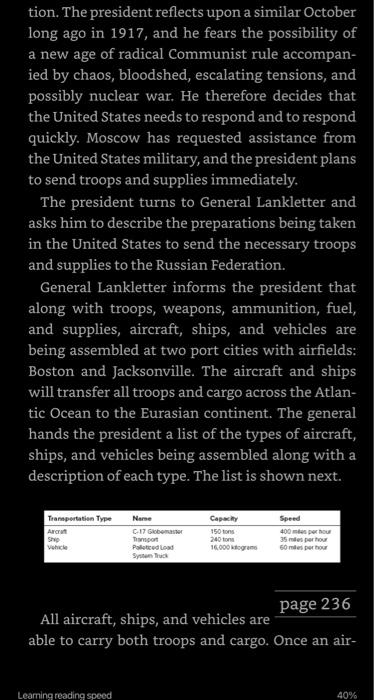
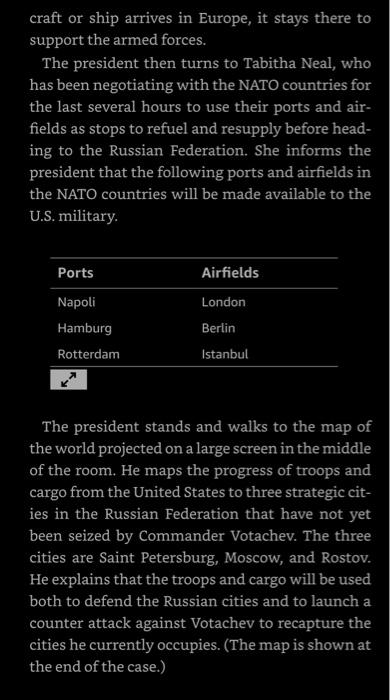
Commander Votachev steps into the cold October night and deeply inhales the smoke from his cig- arette, savoring its warmth. He surveys the de- struction surrounding him-shattered windows, burning buildings, torn roadsand smiles. His two years of work training revolutionaries east of the Ural Mountains has proven successful; his troops now occupy seven strategically important cities in the Russian Federation: Kazan, Perm, Ye- katerinburg, Ufa, Samara, Saratov, and Orenburg. His siege is not yet over, however. He looks to the west. Given the political and economic confusion in the Russian Federation at this time, he knows that his troops will be able to conquer Saint Petersburg and Moscow shortly. Commander Votachev will then be able to rule with the wis- dom and control exhibited by his communist pre- decessors Lenin and Stalin. Across the Pacific Ocean, a meeting of the top security and foreign policy advisors of the United States is in progress at the White House. The president has recently been briefed about the communist revolution masterminded by Com- mander Votachev and is determining a plan of ac- tion. The president reflects upon a similar October long ago in 1917, and he fears the possibility of a new age of radical Communist rule accompan- ied by chaos, bloodshed, escalating tensions, and possibly nuclear war. He therefore decides that the United States needs to respond and to respond quickly. Moscow has requested assistance from the United States military, and the president plans to send troops and supplies immediately. The president turns to General Lankletter and asks him to describe the preparations being taken in the United States to send the necessary troops and supplies to the Russian Federation. General Lankletter informs the president that along with troops, weapons, ammunition, fuel, and supplies, aircraft, ships, and vehicles are being assembled at two port cities with airfields: Boston and Jacksonville. The aircraft and ships will transfer all troops and cargo across the Atlan- tic Ocean to the Eurasian continent. The general hands the president a list of the types of aircraft, ships, and vehicles being assembled along with a description of each type. The list is shown next. Capacity Transportation Type Shp Vehicle Norne C-17 bom Ton Paleted Load Speed 400 m per hour 35 les perto 60 mes per how 16.000 ogrom page 236 All aircraft, ships, and vehicles are able to carry both troops and cargo. Once an air- Leaming reading speed 40% craft or ship arrives in Europe, it stays there to support the armed forces. The president then turns to Tabitha Neal, who has been negotiating with the NATO countries for the last several hours to use their ports and air- fields as stops to refuel and resupply before head- ing to the Russian Federation. She informs the president that the following ports and airfields in the NATO countries will be made available to the U.S. military. Ports Airfields London Napoli Hamburg Rotterdam Berlin Istanbul The president stands and walks to the map of the world projected on a large screen in the middle of the room. He maps the progress of troops and cargo from the United States to three strategic cit- ies in the Russian Federation that have not yet been seized by Commander Votachev. The three cities are Saint Petersburg, Moscow, and Rostov. He explains that the troops and cargo will be used both to defend the Russian cities and to launch a counter attack against Votachev to recapture the cities he currently occupies. (The map is shown at the end of the case.) The president also explains that all Globe- masters and transports leave Boston or Jackson- ville. All transports that have traveled across the Atlantic must dock at one of the NATO ports to un- load. Palletized load system trucks brought over in the transports will then carry all troops and ma- terials unloaded from the ships at the NATO ports to the three strategic Russian cities not yet seized by Votachev. All Globemasters that have traveled across the Atlantic must land at one of the NATO airfields for refueling. The planes will then carry all troops and cargo from the NATO airfields to the three Russian cities









 Study Help