Question: I need help with this pls Write a three page paper on the recent Eric Garner issue. You may want to think about to what
I need help with this pls
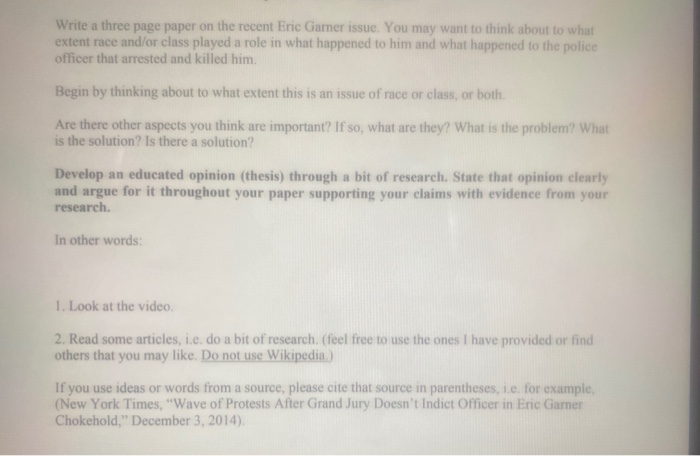
Write a three page paper on the recent Eric Garner issue. You may want to think about to what extent race and/or class played a role in what happened to him and what happened to the police officer that arrested and killed him.
Begin by thinking about to what extent this is an issue of race or class, or both.
Are there other aspects you think are important? If so, what are they? What is the problem? What is the solution? Is there a solution?
Develop an educated opinion (thesis) through a bit of research. State that opinion clearly and argue for it throughout your paper supporting your claims with evidence from your research.
In other words:
1. Read some articles, i.e. do a bit of research. (Do not use Wikipedia.)
If you use ideas or words from a source, please cite that source in parentheses, i.e. for example, (New York Times, Wave of Protests After Grand Jury Doesnt Indict Officer in Eric Garner Chokehold, December 3, 2014).
2.Develop a thesis, i.e. your informed opinion. What is your opinion on what happened to Eric Garner? Why do you have that opinion?
3. Write a 3 page paper with your thesis in BOLD in the first paragraph.
4.Paper should be NO LESS that 3 pages with a title, 1 inch margins, 12 point Times New
Roman font, double-spaced.
To get you started:
Please find several articles from the New York Times attached that discuss not only the Gardner event, but also race in U.S.
pls which subject do you think is that
Here are the instructions and the article. Write a three page paper on the recent Eric Garner issue. You may want to think about to what extent race and/or class played a role in what happened to him and what happened to the police officer that arrested and killed him.
Begin by thinking about to what extent this is an issue of race or class, or both.
Are there other aspects you think are important? If so, what are they? What is the problem? What is the solution? Is there a solution?
Develop an educated opinion (thesis) through a bit of research. State that opinion clearly and argue for it throughout your paper supporting your claims with evidence from your research.
In other words:
2. Read some articles, i.e. do a bit of research. ( Do not use Wikipedia.)
If you use ideas or words from a source, please cite that source in parentheses, i.e. for example, (New York Times, Wave of Protests After Grand Jury Doesnt Indict Officer in Eric Garner Chokehold, December 3, 2014).
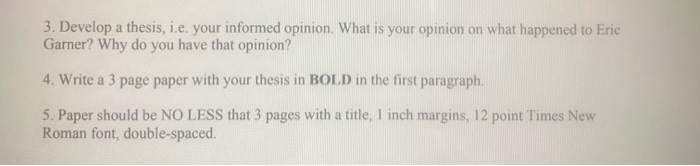
3. Develop a thesis, i.e. your informed opinion. What is your opinion on what happened to Eric Garner? Why do you have that opinion?
4. Write a 3 page paper with your thesis in BOLD in the first paragraph.
5. Paper should be NO LESS that 3 pages with a title, 1 inch margins, 12 point Times New
Roman font, double-spaced.
Please find several articles from the New York Times attached that discuss not only the Gardner event, but also race in U.S. You may feel free to use any source
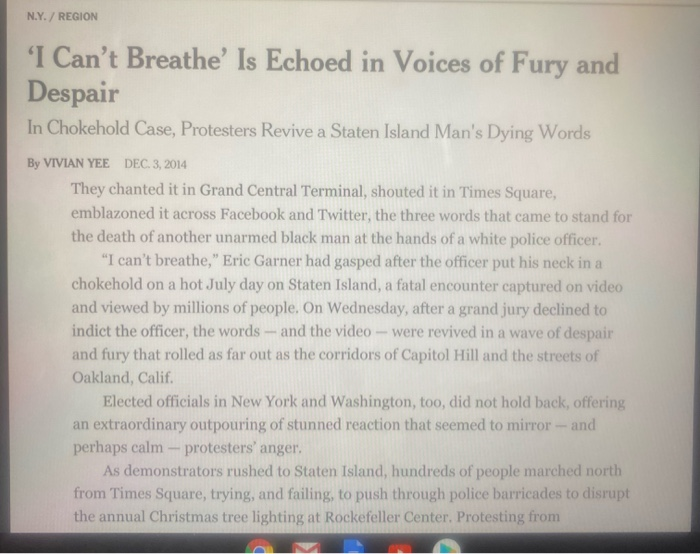
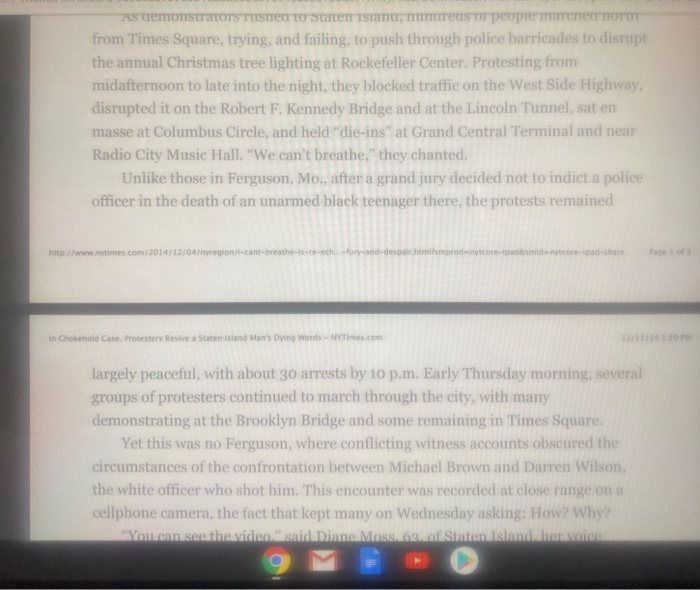
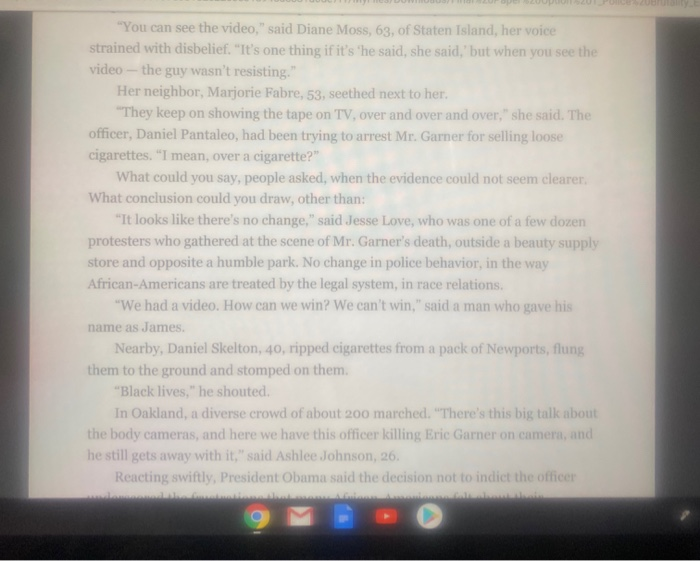
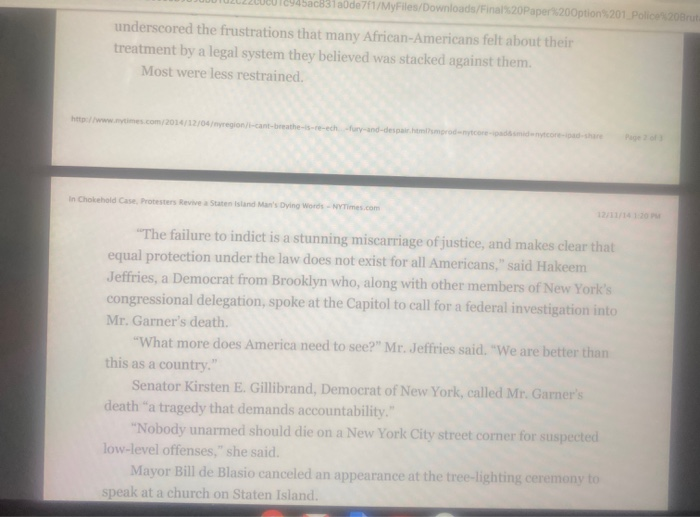
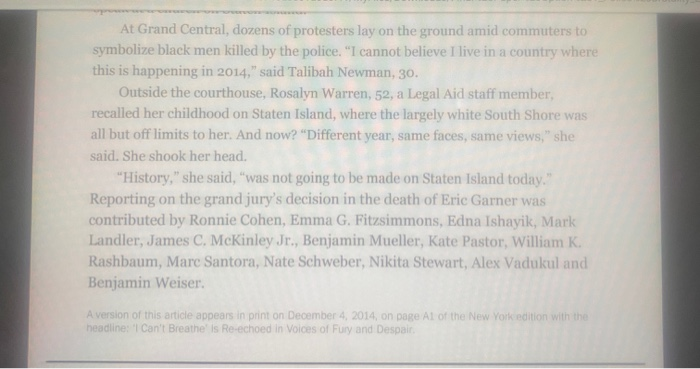
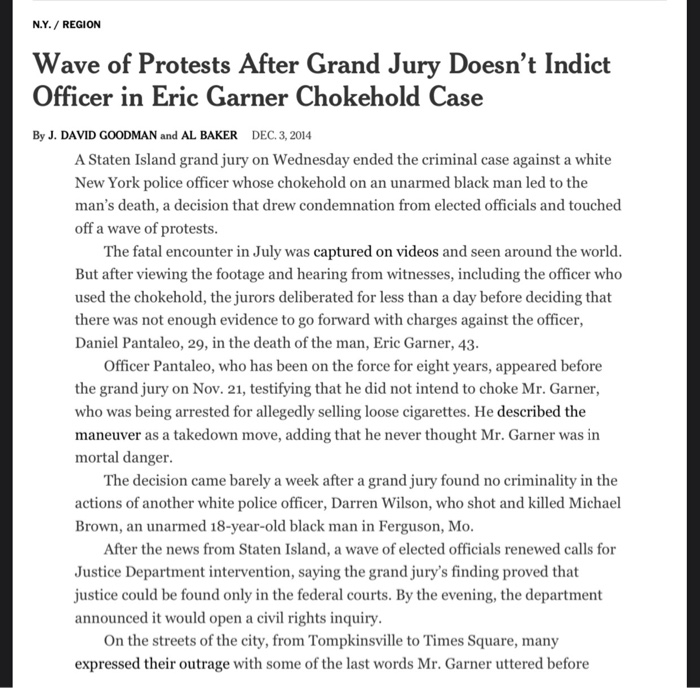
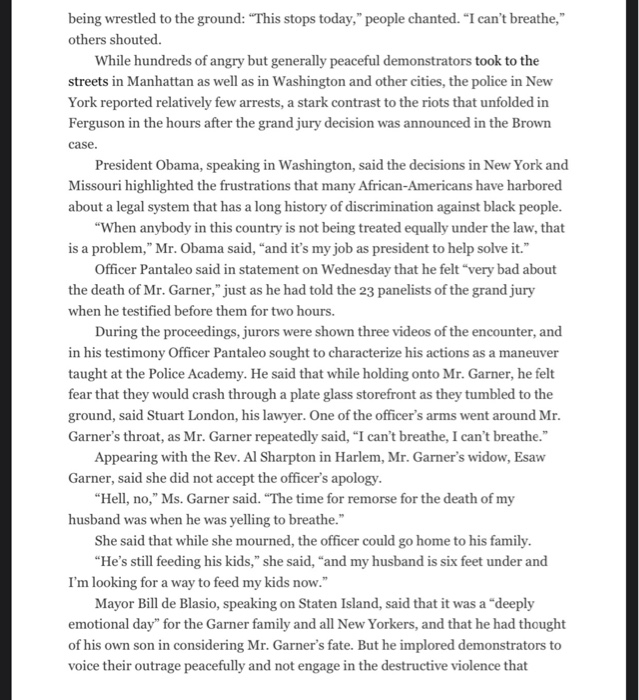
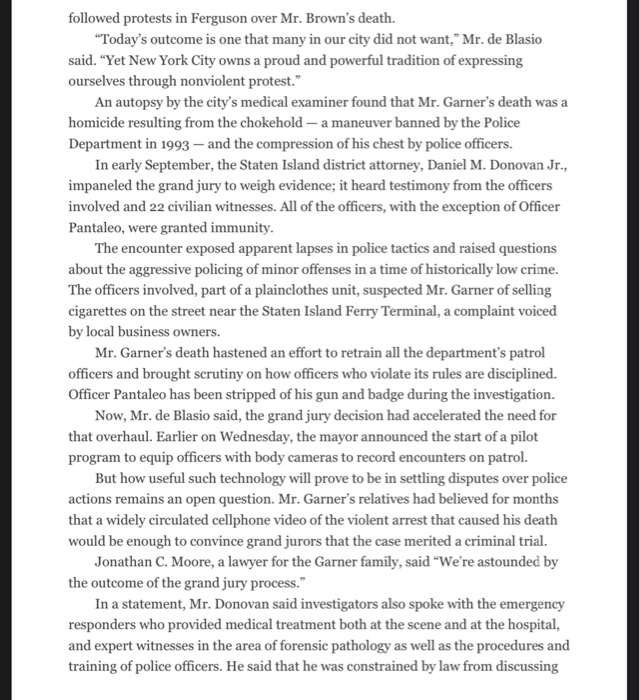
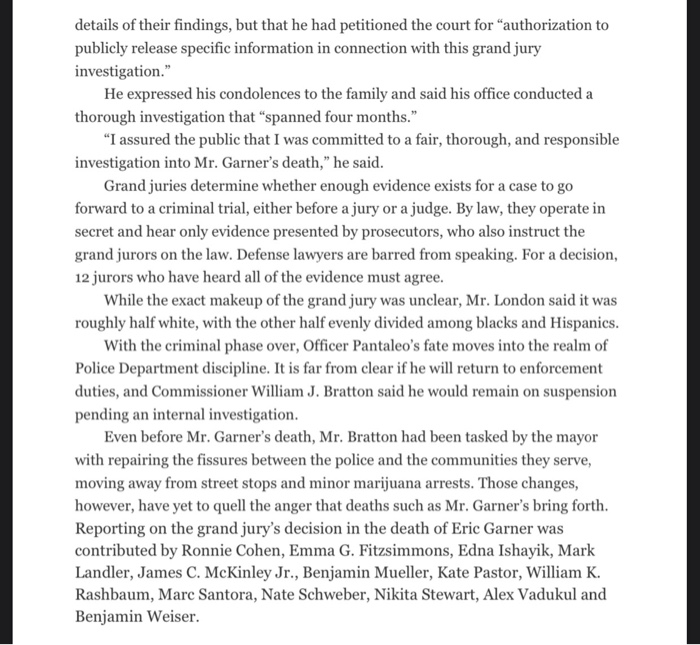
Write a three page paper on the recent Eric Garner issue. You may want to think about to what extent race and/or class played a role in what happened to him and what happened to the police officer that arrested and killed him Begin by thinking about to what extent this is an issue of race or class, or both Are there other aspects you think are important? If so, what are they? What is the problem? What is the solution? Is there a solution? Develop an educated opinion (thesis) through a bit of research. State that opinion clearly and argue for it throughout your paper supporting your claims with evidence from your research. In other words: 1. Look at the video 2. Read some articles, i.e. do a bit of research. (feel free to use the ones I have provided or find others that you may like. Do not use Wikipedia) If you use ideas or words from a source, please cite that source in parentheses, i.e. for example, (New York Times, "Wave of Protests After Grand Jury Doesn't Indict Officer in Eric Gamer Chokehold," December 3, 2014). 3. Develop a thesis, i.e. your informed opinion. What is your opinion on what happened to Eric Garner? Why do you have that opinion? 4. Write a 3 page paper with your thesis in BOLD in the first paragraph, 5. Paper should be NO LESS that 3 pages with a title, 1 inch margins, 12 point Times New Roman font, double-spaced. Please find several articles from the New York Times attached that discuss not only the Gardner event, but also race in U.S. You may feel free to use any or all of theses sources or find your own I have put these sources in this document in no particular order, and note not all of them deal directly with the Gamer event (some deal with race more generally). N.Y. / REGION 'I Can't Breathe' Is Echoed in Voices of Fury and Despair In Chokehold Case, Protesters Revive a Staten Island Man's Dying Words By VIVIAN YEE DEC. 3, 2014 They chanted it in Grand Central Terminal, shouted it in Times Square, emblazoned it across Facebook and Twitter, the three words that came to stand for the death of another unarmed black man at the hands of a white police officer, "I can't breathe," Eric Garner had gasped after the officer put his neck in a chokehold on a hot July day on Staten Island, a fatal encounter captured on video and viewed by millions of people. On Wednesday, after a grand jury declined to indict the officer, the words - and the video -- were revived in a wave of despair and fury that rolled as far out as the corridors of Capitol Hill and the streets of Oakland, Calif. Elected officials in New York and Washington, too, did not hold back, offering an extraordinary outpouring of stunned reaction that seemed to mirror - and perhaps calm - protesters' anger. As demonstrators rushed to Staten Island, hundreds of people marched north from Times Square, trying, and failing to push through police barricades to disrupt the annual Christmas tree lighting at Rockefeller Center. Protesting from As demonstrators rute to staren sana, namreas or peopre marche tror from Times Square, trying, and failing to push through police barricades to disrupt the annual Christmas tree lighting at Rockefeller Center. Protesting from midafternoon to late into the night, they blocked traffic on the West Side Highway, disrupted it on the Robert F. Kennedy Bridge and at the Lincoln Tunnel, sat en masse at Columbus Circle, and held "die-ins" at Grand Central Terminal and near Radio City Music Hall. "We can't breathe," they chanted. Unlike those in Ferguson, Mo., after a grand jury decided not to indict a police officer in the death of an unarmed black teenager there, the protests remained http://www.avtimes.com/2014/12/04yregion/l-cant-breathe-is-re-ech fury-and-despair hemoliemprodunvtcore-ipadesmid-nvicore-load-share Portor in Chokehold Case Protesters Revive a Staten Island Man's Dying Words - NYTimes.com 12/11/14120 largely peaceful, with about 30 arrests by 10 p.m. Early Thursday morning, several groups of protesters continued to march through the city, with many demonstrating at the Brooklyn Bridge and some remaining in Times Square, Yet this was no Ferguson, where conflicting witness accounts obscured the circumstances of the confrontation between Michael Brown and Darren Wilson the white officer who shot him. This encounter was recorded at close range on a cellphone camera, the fact that kept many on Wednesday asking: How? Why? Yomon see the video snid Dinne Moss. 62. of Sinten Island, her ! "You can see the video," said Diane Moss, 63, of Staten Island, her voice strained with disbelief. "It's one thing if it's 'he said, she said,' but when you see the video - the guy wasn't resisting." Her neighbor, Marjorie Fabre, 53, seethed next to her. "They keep on showing the tape on TV, over and over and over," she said. The officer, Daniel Pantaleo, had been trying to arrest Mr. Garner for selling loose cigarettes. "I mean, over a cigarette?" What could you say, people asked, when the evidence could not seem clearer. What conclusion could you draw, other than: "It looks like there's no change," said Jesse Love, who was one of a few dozen protesters who gathered at the scene of Mr. Garner's death, outside a beauty supply store and opposite a humble park. No change in police behavior, in the way African-Americans are treated by the legal system, in race relations. "We had a video. How can we win? We can't win," said a man who gave his name as James Nearby, Daniel Skelton, 40, ripped cigarettes from a pack of Newports, flung them to the ground and stomped on them. "Black lives," he shouted. In Oakland, a diverse crowd of about 200 marched, "There's this big talk about the body cameras, and here we have this officer killing Eric Garner on camera, and he still gets away with it," said Ashlee Johnson, 26. Reacting swiftly, President Obama said the decision not to indict the officer W a 0de71/MyFiles/Downloads/Final 20Paper 200ption 201 Polic2080 underscored the frustrations that many African-Americans felt about their treatment by a legal system they believed was stacked against them. Most were less restrained. wwws.com/2014/12/04/region/cant-breathe- s chafuyand-despairsmoder m ico in Chokehold Case Protesters Revive Staten Island Man's Dying words - NYTimes.com "The failure to indict is a stunning miscarriage of justice, and makes clear that equal protection under the law does not exist for all Americans," said Hakeem Jeffries, a Democrat from Brooklyn who, along with other members of New York's congressional delegation, spoke at the Capitol to call for a federal investigation into Mr. Garner's death. "What more does America need to see?" Mr. Jeffries said. "We are better than this as a country. Senator Kirsten E. Gillibrand, Democrat of New York, called Mr. Garner's death "a tragedy that demands accountability." "Nobody unarmed should die on a New York City street corner for suspected low-level offenses," she said. Mayor Bill de Blasio canceled an appearance at the tree-lighting ceremony to speak at a church on Staten Island. At Grand Central, dozens of protesters lay on the ground amid commuters to symbolize black men killed by the police. "I cannot believe I live in a country where this is happening in 2014," said Talibah Newman, 30. Outside the courthouse, Rosalyn Warren, 52, a Legal Aid staff member, recalled her childhood on Staten Island, where the largely white South Shore was all but off limits to her. And now? "Different year, same faces, same views," she said. She shook her head. "History," she said, "was not going to be made on Staten Island today." Reporting on the grand jury's decision in the death of Eric Garner was contributed by Ronnie Cohen, Emma G. Fitzsimmons, Edna Ishayik, Mark Landler, James C. McKinley Jr., Benjamin Mueller, Kate Pastor, William K. Rashbaum, Marc Santora, Nate Schweber, Nikita Stewart, Alex Vadukul and Benjamin Weiser A version of this article appears in print on December 4, 2014, on page Al of the New York edition with the headline: "I Can't Breathe'ls Re-echoed in Voices of Fury and Despair. N.Y. / REGION Wave of Protests After Grand Jury Doesn't Indict Officer in Eric Garner Chokehold Case By J. DAVID GOODMAN and AL BAKER DEC. 3, 2014 A Staten Island grand jury on Wednesday ended the criminal case against a white New York police officer whose chokehold on an unarmed black man led to the man's death, a decision that drew condemnation from elected officials and touched off a wave of protests. The fatal encounter in July was captured on videos and seen around the world. But after viewing the footage and hearing from witnesses, including the officer who used the chokehold, the jurors deliberated for less than a day before deciding that there was not enough evidence to go forward with charges against the officer, Daniel Pantaleo, 29, in the death of the man, Eric Garner, 43. Officer Pantaleo, who has been on the force for eight years, appeared before the grand jury on Nov. 21, testifying that he did not intend to choke Mr. Garner, who was being arrested for allegedly selling loose cigarettes. He described the maneuver as a takedown move, adding that he never thought Mr. Garner was in mortal danger. The decision came barely a week after a grand jury found no criminality in the actions of another white police officer, Darren Wilson, who shot and killed Michael Brown, an unarmed 18-year-old black man in Ferguson, Mo. After the news from Staten Island, a wave of elected officials renewed calls for Justice Department intervention, saying the grand jury's finding proved that justice could be found only in the federal courts. By the evening, the department announced it would open a civil rights inquiry. On the streets of the city, from Tompkinsville to Times Square, many expressed their outrage with some of the last words Mr. Garner uttered before being wrestled to the ground: "This stops today," people chanted. "I can't breathe," others shouted. While hundreds of angry but generally peaceful demonstrators took to the streets in Manhattan as well as in Washington and other cities, the police in New York reported relatively few arrests, a stark contrast to the riots that unfolded in Ferguson in the hours after the grand jury decision was announced in the Brown case. President Obama, speaking in Washington, said the decisions in New York and Missouri highlighted the frustrations that many African-Americans have harbored about a legal system that has a long history of discrimination against black people. "When anybody in this country is not being treated equally under the law, that is a problem," Mr. Obama said, "and it's my job as president to help solve it." Officer Pantaleo said in statement on Wednesday that he felt "very bad about the death of Mr. Garner," just as he had told the 23 panelists of the grand jury when he testified before them for two hours. During the proceedings, jurors were shown three videos of the encounter, and in his testimony Officer Pantaleo sought to characterize his actions as a maneuver taught at the Police Academy. He said that while holding onto Mr. Garner, he felt fear that they would crash through a plate glass storefront as they tumbled to the ground, said Stuart London, his lawyer. One of the officer's arms went around Mr. Garner's throat, as Mr. Garner repeatedly said, "I can't breathe, I can't breathe." Appearing with the Rev. Al Sharpton in Harlem, Mr. Garner's widow, Esaw Garner, said she did not accept the officer's apology. "Hell, no," Ms. Garner said. "The time for remorse for the death of my husband was when he was yelling to breathe." She said that while she mourned, the officer could go home to his family. "He's still feeding his kids," she said, "and my husband is six feet under and I'm looking for a way to feed my kids now." Mayor Bill de Blasio, speaking on Staten Island, said that it was a "deeply emotional day" for the Garner family and all New Yorkers, and that he had thought of his own son in considering Mr. Garner's fate. But he implored demonstrators to voice their outrage peacefully and not engage in the destructive violence that followed protests in Ferguson over Mr. Brown's death. "Today's outcome is one that many in our city did not want," Mr. de Blasio said. Yet New York City owns a proud and powerful tradition of expressing ourselves through nonviolent protest." An autopsy by the city's medical examiner found that Mr. Garner's death was a homicide resulting from the chokehold -a maneuver banned by the Police Department in 1993 - and the compression of his chest by police officers. In early September, the Staten Island district attorney, Daniel M. Donovan Jr., impaneled the grand jury to weigh evidence; it heard testimony from the officers involved and 22 civilian witnesses. All of the officers, with the exception of Officer Pantaleo, were granted immunity. The encounter exposed apparent lapses in police tactics and raised questions about the aggressive policing of minor offenses in a time of historically low crime. The officers involved, part of a plainclothes unit, suspected Mr. Garner of selling cigarettes on the street near the Staten Island Ferry Terminal, a complaint voiced by local business owners. Mr. Garner's death hastened an effort to retrain all the department's patrol officers and brought scrutiny on how officers who violate its rules are disciplined. Officer Pantaleo has been stripped of his gun and badge during the investigation. Now, Mr. de Blasio said, the grand jury decision had accelerated the need for that overhaul. Earlier on Wednesday, the mayor announced the start of a pilot program to equip officers with body cameras to record encounters on patrol. But how useful such technology will prove to be in settling disputes over police actions remains an open question. Mr. Garner's relatives had believed for months that a widely circulated cellphone video of the violent arrest that caused his death would be enough to convince grand jurors that the case merited a criminal trial. Jonathan C. Moore, a lawyer for the Garner family, said "We're astounded by the outcome of the grand jury process." In a statement, Mr. Donovan said investigators also spoke with the emergency responders who provided medical treatment both at the scene and at the hospital, and expert witnesses in the area of forensic pathology as well as the procedures and training of police officers. He said that he was constrained by law from discussing details of their findings, but that he had petitioned the court for "authorization to publicly release specific information in connection with this grand jury investigation." He expressed his condolences to the family and said his office conducted a thorough investigation that "spanned four months." "I assured the public that I was committed to a fair, thorough, and responsible investigation into Mr. Garner's death," he said. Grand juries determine whether enough evidence exists for a case to go forward to a criminal trial, either before a jury or a judge. By law, they operate in secret and hear only evidence presented by prosecutors, who also instruct the grand jurors on the law. Defense lawyers are barred from speaking. For a decision, 12 jurors who have heard all of the evidence must agree. While the exact makeup of the grand jury was unclear, Mr. London said it was roughly half white, with the other half evenly divided among blacks and Hispanics. With the criminal phase over, Officer Pantaleo's fate moves into the realm of Police Department discipline. It is far from clear if he will return to enforcement duties, and Commissioner William J. Bratton said he would remain on suspension pending an internal investigation. Even before Mr. Garner's death, Mr. Bratton had been tasked by the mayor with repairing the fissures between the police and the communities they serve, moving away from street stops and minor marijuana arrests. Those changes, however, have yet to quell the anger that deaths such as Mr. Garner's bring forth. Reporting on the grand jury's decision in the death of Eric Garner was contributed by Ronnie Cohen, Emma G. Fitzsimmons, Edna Ishayik, Mark Landler, James C. McKinley Jr., Benjamin Mueller, Kate Pastor, William K. Rashbaum, Marc Santora, Nate Schweber, Nikita Stewart, Alex Vadukul and Benjamin Weiser. A version of this article appears in print on December 4, 2014, on page A1 of the New York edition with the headline: New York Officer Facing No Charges in Chokehold Case. Wave of Protests After Grand Jury Doesn't Indict Officer in Eric Garner Chokehold Case By J. DAVID GOODMAN and AL BAKER DEC. 3, 2014 A Staten Island grand jury on Wednesday ended the criminal case against a white New York police officer whose chokehold on an unarmed black man led to the man's death, a decision that drew condemnation from elected officials and touched off a wave of protests. The fatal encounter in July was captured on videos and seen around the world. But after viewing the footage and hearing from witnesses, including the officer who used the chokehold, the jurors deliberated for less than a day before deciding that there was not enough evidence to go forward with charges against the officer, Daniel Pantaleo, 29, in the death of the man, Eric Garner, 43. Officer Pantaleo, who has been on the force for eight years, appeared before the grand jury on Nov. 21, testifying that he did not intend to choke Mr. Garner, who was being arrested for allegedly selling loose cigarettes. He described the maneuver as a takedown move, adding that he never thought Mr. Garner was in mortal danger. The decision came barely a week after a grand jury found no criminality in the actions of another white police officer, Darren Wilson, who shot and killed Michael Brown, an unarmed 18-year-old black man in Ferguson, Mo. After the news from Staten Island, a wave of elected officials renewed calls for Justice Department intervention, saying the grand jury's finding proved that justice could be found only in the federal courts. By the evening, the department announced it would open a civil rights inquiry. On the streets of the city, from Tompkinsville to Times Square, many expressed their outrage with some of the last words Mr. Garner uttered before being wrestled to the ground: "This stops today," people chanted. "I can't breathe," others shouted. While hundreds of angry but generally peaceful demonstrators took to the streets in Manhattan as well as in Washington and other cities, the police in New York reported relatively few arrests, a stark contrast to the riots that unfolded in Ferguson in the hours after the grand jury decision was announced in the Brown case. President Obama, speaking in Washington, said the decisions in New York and Missouri highlighted the frustrations that many African-Americans have harbored about a legal system that has a long history of discrimination against black people. "When anybody in this country is not being treated equally under the law, that is a problem," Mr. Obama said, "and it's my job as president to help solve it." Officer Pantaleo said in statement on Wednesday that he felt "very bad about the death of Mr. Garner," just as he had told the 23 panelists of the grand jury when he testified before them for two hours. During the proceedings, jurors were shown three videos of the encounter, and in his testimony Officer Pantaleo sought to characterize his actions as a maneuver taught at the Police Academy. He said that while holding onto Mr. Garner, he felt fear that they would crash through a plate glass storefront as they tumbled to the ground, said Stuart London, his lawyer. One of the officer's arms went around Mr. Garner's throat, as Mr. Garner repeatedly said, "I can't breathe, I can't breathe." Appearing with the Rev. Al Sharpton in Harlem, Mr. Garner's widow, Esaw Garner, said she did not accept the officer's apology. "Hell, no," Ms. Garner said. "The time for remorse for the death of my husband was when he was yelling to breathe." She said that while she mourned, the officer could go home to his family. "He's still feeding his kids," she said, "and my husband is six feet under and I'm looking for a way to feed my kids now." Mayor Bill de Blasio, speaking on Staten Island, said that it was a "deeply emotional day" for the Garner family and all New Yorkers, and that he had thought of his own son in considering Mr. Garner's fate. But he implored demonstrators to voice their outrage peacefully and not engage in the destructive violence that followed protests in Ferguson over Mr. Brown's death. "Today's outcome is one that many in our city did not want," Mr. de Blasio said. Yet New York City owns a proud and powerful tradition of expressing ourselves through nonviolent protest." An autopsy by the city's medical examiner found that Mr. Garner's death was a homicide resulting from the chokehold -a maneuver banned by the Police Department in 1993 - and the compression of his chest by police officers. In early September, the Staten Island district attorney, Daniel M. Donovan Jr., impaneled the grand jury to weigh evidence; it heard testimony from the officers involved and 22 civilian witnesses. All of the officers, with the exception of Officer Pantaleo, were granted immunity. The encounter exposed apparent lapses in police tactics and raised questions about the aggressive policing of minor offenses in a time of historically low crime. The officers involved, part of a plainclothes unit, suspected Mr. Garner of selling cigarettes on the street near the Staten Island Ferry Terminal, a complaint voiced by local business owners. Mr. Garner's death hastened an effort to retrain all the department's patrol officers and brought scrutiny on how officers who violate its rules are disciplined. Officer Pantaleo has been stripped of his gun and badge during the investigation. Now, Mr. de Blasio said, the grand jury decision had accelerated the need for that overhaul. Earlier on Wednesday, the mayor announced the start of a pilot program to equip officers with body cameras to record encounters on patrol. But how useful such technology will prove to be in settling disputes over police actions remains an open question. Mr. Garner's relatives had believed for months that a widely circulated cellphone video of the violent arrest that caused his death would be enough to convince grand jurors that the case merited a criminal trial. Jonathan C. Moore, a lawyer for the Garner family, said "We're astounded by the outcome of the grand jury process." In a statement, Mr. Donovan said investigators also spoke with the emergency responders who provided medical treatment both at the scene and at the hospital, and expert witnesses in the area of forensic pathology as well as the procedures and training of police officers. He said that he was constrained by law from discussing details of their findings, but that he had petitioned the court for "authorization to publicly release specific information in connection with this grand jury investigation." He expressed his condolences to the family and said his office conducted a thorough investigation that "spanned four months." "I assured the public that I was committed to a fair, thorough, and responsible investigation into Mr. Garner's death," he said. Grand juries determine whether enough evidence exists for a case to go forward to a criminal trial, either before a jury or a judge. By law, they operate in secret and hear only evidence presented by prosecutors, who also instruct the grand jurors on the law. Defense lawyers are barred from speaking. For a decision, 12 jurors who have heard all of the evidence must agree. While the exact makeup of the grand jury was unclear, Mr. London said it was roughly half white, with the other half evenly divided among blacks and Hispanics. With the criminal phase over, Officer Pantaleo's fate moves into the realm of Police Department discipline. It is far from clear if he will return to enforcement duties, and Commissioner William J. Bratton said he would remain on suspension pending an internal investigation. Even before Mr. Garner's death, Mr. Bratton had been tasked by the mayor with repairing the fissures between the police and the communities they serve, moving away from street stops and minor marijuana arrests. Those changes, however, have yet to quell the anger that deaths such as Mr. Garner's bring forth. Reporting on the grand jury's decision in the death of Eric Garner was contributed by Ronnie Cohen, Emma G. Fitzsimmons, Edna Ishayik, Mark Landler, James C. McKinley Jr., Benjamin Mueller, Kate Pastor, William K. Rashbaum, Marc Santora, Nate Schweber, Nikita Stewart, Alex Vadukul and Benjamin Weiser. Write a three page paper on the recent Eric Garner issue. You may want to think about to what extent race and/or class played a role in what happened to him and what happened to the police officer that arrested and killed him Begin by thinking about to what extent this is an issue of race or class, or both Are there other aspects you think are important? If so, what are they? What is the problem? What is the solution? Is there a solution? Develop an educated opinion (thesis) through a bit of research. State that opinion clearly and argue for it throughout your paper supporting your claims with evidence from your research. In other words: 1. Look at the video 2. Read some articles, i.e. do a bit of research. (feel free to use the ones I have provided or find others that you may like. Do not use Wikipedia) If you use ideas or words from a source, please cite that source in parentheses, i.e. for example, (New York Times, "Wave of Protests After Grand Jury Doesn't Indict Officer in Eric Gamer Chokehold," December 3, 2014). 3. Develop a thesis, i.e. your informed opinion. What is your opinion on what happened to Eric Garner? Why do you have that opinion? 4. Write a 3 page paper with your thesis in BOLD in the first paragraph, 5. Paper should be NO LESS that 3 pages with a title, 1 inch margins, 12 point Times New Roman font, double-spaced. Please find several articles from the New York Times attached that discuss not only the Gardner event, but also race in U.S. You may feel free to use any or all of theses sources or find your own I have put these sources in this document in no particular order, and note not all of them deal directly with the Gamer event (some deal with race more generally). N.Y. / REGION 'I Can't Breathe' Is Echoed in Voices of Fury and Despair In Chokehold Case, Protesters Revive a Staten Island Man's Dying Words By VIVIAN YEE DEC. 3, 2014 They chanted it in Grand Central Terminal, shouted it in Times Square, emblazoned it across Facebook and Twitter, the three words that came to stand for the death of another unarmed black man at the hands of a white police officer, "I can't breathe," Eric Garner had gasped after the officer put his neck in a chokehold on a hot July day on Staten Island, a fatal encounter captured on video and viewed by millions of people. On Wednesday, after a grand jury declined to indict the officer, the words - and the video -- were revived in a wave of despair and fury that rolled as far out as the corridors of Capitol Hill and the streets of Oakland, Calif. Elected officials in New York and Washington, too, did not hold back, offering an extraordinary outpouring of stunned reaction that seemed to mirror - and perhaps calm - protesters' anger. As demonstrators rushed to Staten Island, hundreds of people marched north from Times Square, trying, and failing to push through police barricades to disrupt the annual Christmas tree lighting at Rockefeller Center. Protesting from As demonstrators rute to staren sana, namreas or peopre marche tror from Times Square, trying, and failing to push through police barricades to disrupt the annual Christmas tree lighting at Rockefeller Center. Protesting from midafternoon to late into the night, they blocked traffic on the West Side Highway, disrupted it on the Robert F. Kennedy Bridge and at the Lincoln Tunnel, sat en masse at Columbus Circle, and held "die-ins" at Grand Central Terminal and near Radio City Music Hall. "We can't breathe," they chanted. Unlike those in Ferguson, Mo., after a grand jury decided not to indict a police officer in the death of an unarmed black teenager there, the protests remained http://www.avtimes.com/2014/12/04yregion/l-cant-breathe-is-re-ech fury-and-despair hemoliemprodunvtcore-ipadesmid-nvicore-load-share Portor in Chokehold Case Protesters Revive a Staten Island Man's Dying Words - NYTimes.com 12/11/14120 largely peaceful, with about 30 arrests by 10 p.m. Early Thursday morning, several groups of protesters continued to march through the city, with many demonstrating at the Brooklyn Bridge and some remaining in Times Square, Yet this was no Ferguson, where conflicting witness accounts obscured the circumstances of the confrontation between Michael Brown and Darren Wilson the white officer who shot him. This encounter was recorded at close range on a cellphone camera, the fact that kept many on Wednesday asking: How? Why? Yomon see the video snid Dinne Moss. 62. of Sinten Island, her ! "You can see the video," said Diane Moss, 63, of Staten Island, her voice strained with disbelief. "It's one thing if it's 'he said, she said,' but when you see the video - the guy wasn't resisting." Her neighbor, Marjorie Fabre, 53, seethed next to her. "They keep on showing the tape on TV, over and over and over," she said. The officer, Daniel Pantaleo, had been trying to arrest Mr. Garner for selling loose cigarettes. "I mean, over a cigarette?" What could you say, people asked, when the evidence could not seem clearer. What conclusion could you draw, other than: "It looks like there's no change," said Jesse Love, who was one of a few dozen protesters who gathered at the scene of Mr. Garner's death, outside a beauty supply store and opposite a humble park. No change in police behavior, in the way African-Americans are treated by the legal system, in race relations. "We had a video. How can we win? We can't win," said a man who gave his name as James Nearby, Daniel Skelton, 40, ripped cigarettes from a pack of Newports, flung them to the ground and stomped on them. "Black lives," he shouted. In Oakland, a diverse crowd of about 200 marched, "There's this big talk about the body cameras, and here we have this officer killing Eric Garner on camera, and he still gets away with it," said Ashlee Johnson, 26. Reacting swiftly, President Obama said the decision not to indict the officer W a 0de71/MyFiles/Downloads/Final 20Paper 200ption 201 Polic2080 underscored the frustrations that many African-Americans felt about their treatment by a legal system they believed was stacked against them. Most were less restrained. wwws.com/2014/12/04/region/cant-breathe- s chafuyand-despairsmoder m ico in Chokehold Case Protesters Revive Staten Island Man's Dying words - NYTimes.com "The failure to indict is a stunning miscarriage of justice, and makes clear that equal protection under the law does not exist for all Americans," said Hakeem Jeffries, a Democrat from Brooklyn who, along with other members of New York's congressional delegation, spoke at the Capitol to call for a federal investigation into Mr. Garner's death. "What more does America need to see?" Mr. Jeffries said. "We are better than this as a country. Senator Kirsten E. Gillibrand, Democrat of New York, called Mr. Garner's death "a tragedy that demands accountability." "Nobody unarmed should die on a New York City street corner for suspected low-level offenses," she said. Mayor Bill de Blasio canceled an appearance at the tree-lighting ceremony to speak at a church on Staten Island. At Grand Central, dozens of protesters lay on the ground amid commuters to symbolize black men killed by the police. "I cannot believe I live in a country where this is happening in 2014," said Talibah Newman, 30. Outside the courthouse, Rosalyn Warren, 52, a Legal Aid staff member, recalled her childhood on Staten Island, where the largely white South Shore was all but off limits to her. And now? "Different year, same faces, same views," she said. She shook her head. "History," she said, "was not going to be made on Staten Island today." Reporting on the grand jury's decision in the death of Eric Garner was contributed by Ronnie Cohen, Emma G. Fitzsimmons, Edna Ishayik, Mark Landler, James C. McKinley Jr., Benjamin Mueller, Kate Pastor, William K. Rashbaum, Marc Santora, Nate Schweber, Nikita Stewart, Alex Vadukul and Benjamin Weiser A version of this article appears in print on December 4, 2014, on page Al of the New York edition with the headline: "I Can't Breathe'ls Re-echoed in Voices of Fury and Despair. N.Y. / REGION Wave of Protests After Grand Jury Doesn't Indict Officer in Eric Garner Chokehold Case By J. DAVID GOODMAN and AL BAKER DEC. 3, 2014 A Staten Island grand jury on Wednesday ended the criminal case against a white New York police officer whose chokehold on an unarmed black man led to the man's death, a decision that drew condemnation from elected officials and touched off a wave of protests. The fatal encounter in July was captured on videos and seen around the world. But after viewing the footage and hearing from witnesses, including the officer who used the chokehold, the jurors deliberated for less than a day before deciding that there was not enough evidence to go forward with charges against the officer, Daniel Pantaleo, 29, in the death of the man, Eric Garner, 43. Officer Pantaleo, who has been on the force for eight years, appeared before the grand jury on Nov. 21, testifying that he did not intend to choke Mr. Garner, who was being arrested for allegedly selling loose cigarettes. He described the maneuver as a takedown move, adding that he never thought Mr. Garner was in mortal danger. The decision came barely a week after a grand jury found no criminality in the actions of another white police officer, Darren Wilson, who shot and killed Michael Brown, an unarmed 18-year-old black man in Ferguson, Mo. After the news from Staten Island, a wave of elected officials renewed calls for Justice Department intervention, saying the grand jury's finding proved that justice could be found only in the federal courts. By the evening, the department announced it would open a civil rights inquiry. On the streets of the city, from Tompkinsville to Times Square, many expressed their outrage with some of the last words Mr. Garner uttered before being wrestled to the ground: "This stops today," people chanted. "I can't breathe," others shouted. While hundreds of angry but generally peaceful demonstrators took to the streets in Manhattan as well as in Washington and other cities, the police in New York reported relatively few arrests, a stark contrast to the riots that unfolded in Ferguson in the hours after the grand jury decision was announced in the Brown case. President Obama, speaking in Washington, said the decisions in New York and Missouri highlighted the frustrations that many African-Americans have harbored about a legal system that has a long history of discrimination against black people. "When anybody in this country is not being treated equally under the law, that is a problem," Mr. Obama said, "and it's my job as president to help solve it." Officer Pantaleo said in statement on Wednesday that he felt "very bad about the death of Mr. Garner," just as he had told the 23 panelists of the grand jury when he testified before them for two hours. During the proceedings, jurors were shown three videos of the encounter, and in his testimony Officer Pantaleo sought to characterize his actions as a maneuver taught at the Police Academy. He said that while holding onto Mr. Garner, he felt fear that they would crash through a plate glass storefront as they tumbled to the ground, said Stuart London, his lawyer. One of the officer's arms went around Mr. Garner's throat, as Mr. Garner repeatedly said, "I can't breathe, I can't breathe." Appearing with the Rev. Al Sharpton in Harlem, Mr. Garner's widow, Esaw Garner, said she did not accept the officer's apology. "Hell, no," Ms. Garner said. "The time for remorse for the death of my husband was when he was yelling to breathe." She said that while she mourned, the officer could go home to his family. "He's still feeding his kids," she said, "and my husband is six feet under and I'm looking for a way to feed my kids now." Mayor Bill de Blasio, speaking on Staten Island, said that it was a "deeply emotional day" for the Garner family and all New Yorkers, and that he had thought of his own son in considering Mr. Garner's fate. But he implored demonstrators to voice their outrage peacefully and not engage in the destructive violence that followed protests in Ferguson over Mr. Brown's death. "Today's outcome is one that many in our city did not want," Mr. de Blasio said. Yet New York City owns a proud and powerful tradition of expressing ourselves through nonviolent protest." An autopsy by the city's medical examiner found that Mr. Garner's death was a homicide resulting from the chokehold -a maneuver banned by the Police Department in 1993 - and the compression of his chest by police officers. In early September, the Staten Island district attorney, Daniel M. Donovan Jr., impaneled the grand jury to weigh evidence; it heard testimony from the officers involved and 22 civilian witnesses. All of the officers, with the exception of Officer Pantaleo, were granted immunity. The encounter exposed apparent lapses in police tactics and raised questions about the aggressive policing of minor offenses in a time of historically low crime. The officers involved, part of a plainclothes unit, suspected Mr. Garner of selling cigarettes on the street near the Staten Island Ferry Terminal, a complaint voiced by local business owners. Mr. Garner's death hastened an effort to retrain all the department's patrol officers and brought scrutiny on how officers who violate its rules are disciplined. Officer Pantaleo has been stripped of his gun and badge during the investigation. Now, Mr. de Blasio said, the grand jury decision had accelerated the need for that overhaul. Earlier on Wednesday, the mayor announced the start of a pilot program to equip officers with body cameras to record encounters on patrol. But how useful such technology will prove to be in settling disputes over police actions remains an open question. Mr. Garner's relatives had believed for months that a widely circulated cellphone video of the violent arrest that caused his death would be enough to convince grand jurors that the case merited a criminal trial. Jonathan C. Moore, a lawyer for the Garner family, said "We're astounded by the outcome of the grand jury process." In a statement, Mr. Donovan said investigators also spoke with the emergency responders who provided medical treatment both at the scene and at the hospital, and expert witnesses in the area of forensic pathology as well as the procedures and training of police officers. He said that he was constrained by law from discussing details of their findings, but that he had petitioned the court for "authorization to publicly release specific information in connection with this grand jury investigation." He expressed his condolences to the family and said his office conducted a thorough investigation that "spanned four months." "I assured the public that I was committed to a fair, thorough, and responsible investigation into Mr. Garner's death," he said. Grand juries determine whether enough evidence exists for a case to go forward to a criminal trial, either before a jury or a judge. By law, they operate in secret and hear only evidence presented by prosecutors, who also instruct the grand jurors on the law. Defense lawyers are barred from speaking. For a decision, 12 jurors who have heard all of the evidence must agree. While the exact makeup of the grand jury was unclear, Mr. London said it was roughly half white, with the other half evenly divided among blacks and Hispanics. With the criminal phase over, Officer Pantaleo's fate moves into the realm of Police Department discipline. It is far from clear if he will return to enforcement duties, and Commissioner William J. Bratton said he would remain on suspension pending an internal investigation. Even before Mr. Garner's death, Mr. Bratton had been tasked by the mayor with repairing the fissures between the police and the communities they serve, moving away from street stops and minor marijuana arrests. Those changes, however, have yet to quell the anger that deaths such as Mr. Garner's bring forth. Reporting on the grand jury's decision in the death of Eric Garner was contributed by Ronnie Cohen, Emma G. Fitzsimmons, Edna Ishayik, Mark Landler, James C. McKinley Jr., Benjamin Mueller, Kate Pastor, William K. Rashbaum, Marc Santora, Nate Schweber, Nikita Stewart, Alex Vadukul and Benjamin Weiser. A version of this article appears in print on December 4, 2014, on page A1 of the New York edition with the headline: New York Officer Facing No Charges in Chokehold Case. Wave of Protests After Grand Jury Doesn't Indict Officer in Eric Garner Chokehold Case By J. DAVID GOODMAN and AL BAKER DEC. 3, 2014 A Staten Island grand jury on Wednesday ended the criminal case against a white New York police officer whose chokehold on an unarmed black man led to the man's death, a decision that drew condemnation from elected officials and touched off a wave of protests. The fatal encounter in July was captured on videos and seen around the world. But after viewing the footage and hearing from witnesses, including the officer who used the chokehold, the jurors deliberated for less than a day before deciding that there was not enough evidence to go forward with charges against the officer, Daniel Pantaleo, 29, in the death of the man, Eric Garner, 43. Officer Pantaleo, who has been on the force for eight years, appeared before the grand jury on Nov. 21, testifying that he did not intend to choke Mr. Garner, who was being arrested for allegedly selling loose cigarettes. He described the maneuver as a takedown move, adding that he never thought Mr. Garner was in mortal danger. The decision came barely a week after a grand jury found no criminality in the actions of another white police officer, Darren Wilson, who shot and killed Michael Brown, an unarmed 18-year-old black man in Ferguson, Mo. After the news from Staten Island, a wave of elected officials renewed calls for Justice Department intervention, saying the grand jury's finding proved that justice could be found only in the federal courts. By the evening, the department announced it would open a civil rights inquiry. On the streets of the city, from Tompkinsville to Times Square, many expressed their outrage with some of the last words Mr. Garner uttered before being wrestled to the ground: "This stops today," people chanted. "I can't breathe," others shouted. While hundreds of angry but generally peaceful demonstrators took to the streets in Manhattan as well as in Washington and other cities, the police in New York reported relatively few arrests, a stark contrast to the riots that unfolded in Ferguson in the hours after the grand jury decision was announced in the Brown case. President Obama, speaking in Washington, said the decisions in New York and Missouri highlighted the frustrations that many African-Americans have harbored about a legal system that has a long history of discrimination against black people. "When anybody in this country is not being treated equally under the law, that is a problem," Mr. Obama said, "and it's my job as president to help solve it." Officer Pantaleo said in statement on Wednesday that he felt "very bad about the death of Mr. Garner," just as he had told the 23 panelists of the grand jury when he testified before them for two hours. During the proceedings, jurors were shown three videos of the encounter, and in his testimony Officer Pantaleo sought to characterize his actions as a maneuver taught at the Police Academy. He said that while holding onto Mr. Garner, he felt fear that they would crash through a plate glass storefront as they tumbled to the ground, said Stuart London, his lawyer. One of the officer's arms went around Mr. Garner's throat, as Mr. Garner repeatedly said, "I can't breathe, I can't breathe." Appearing with the Rev. Al Sharpton in Harlem, Mr. Garner's widow, Esaw Garner, said she did not accept the officer's apology. "Hell, no," Ms. Garner said. "The time for remorse for the death of my husband was when he was yelling to breathe." She said that while she mourned, the officer could go home to his family. "He's still feeding his kids," she said, "and my husband is six feet under and I'm looking for a way to feed my kids now." Mayor Bill de Blasio, speaking on Staten Island, said that it was a "deeply emotional day" for the Garner family and all New Yorkers, and that he had thought of his own son in considering Mr. Garner's fate. But he implored demonstrators to voice their outrage peacefully and not engage in the destructive violence that followed protests in Ferguson over Mr. Brown's death. "Today's outcome is one that many in our city did not want," Mr. de Blasio said. Yet New York City owns a proud and powerful tradition of expressing ourselves through nonviolent protest." An autopsy by the city's medical examiner found that Mr. Garner's death was a homicide resulting from the chokehold -a maneuver banned by the Police Department in 1993 - and the compression of his chest by police officers. In early September, the Staten Island district attorney, Daniel M. Donovan Jr., impaneled the grand jury to weigh evidence; it heard testimony from the officers involved and 22 civilian witnesses. All of the officers, with the exception of Officer Pantaleo, were granted immunity. The encounter exposed apparent lapses in police tactics and raised questions about the aggressive policing of minor offenses in a time of historically low crime. The officers involved, part of a plainclothes unit, suspected Mr. Garner of selling cigarettes on the street near the Staten Island Ferry Terminal, a complaint voiced by local business owners. Mr. Garner's death hastened an effort to retrain all the department's patrol officers and brought scrutiny on how officers who violate its rules are disciplined. Officer Pantaleo has been stripped of his gun and badge during the investigation. Now, Mr. de Blasio said, the grand jury decision had accelerated the need for that overhaul. Earlier on Wednesday, the mayor announced the start of a pilot program to equip officers with body cameras to record encounters on patrol. But how useful such technology will prove to be in settling disputes over police actions remains an open question. Mr. Garner's relatives had believed for months that a widely circulated cellphone video of the violent arrest that caused his death would be enough to convince grand jurors that the case merited a criminal trial. Jonathan C. Moore, a lawyer for the Garner family, said "We're astounded by the outcome of the grand jury process." In a statement, Mr. Donovan said investigators also spoke with the emergency responders who provided medical treatment both at the scene and at the hospital, and expert witnesses in the area of forensic pathology as well as the procedures and training of police officers. He said that he was constrained by law from discussing details of their findings, but that he had petitioned the court for "authorization to publicly release specific information in connection with this grand jury investigation." He expressed his condolences to the family and said his office conducted a thorough investigation that "spanned four months." "I assured the public that I was committed to a fair, thorough, and responsible investigation into Mr. Garner's death," he said. Grand juries determine whether enough evidence exists for a case to go forward to a criminal trial, either before a jury or a judge. By law, they operate in secret and hear only evidence presented by prosecutors, who also instruct the grand jurors on the law. Defense lawyers are barred from speaking. For a decision, 12 jurors who have heard all of the evidence must agree. While the exact makeup of the grand jury was unclear, Mr. London said it was roughly half white, with the other half evenly divided among blacks and Hispanics. With the criminal phase over, Officer Pantaleo's fate moves into the realm of Police Department discipline. It is far from clear if he will return to enforcement duties, and Commissioner William J. Bratton said he would remain on suspension pending an internal investigation. Even before Mr. Garner's death, Mr. Bratton had been tasked by the mayor with repairing the fissures between the police and the communities they serve, moving away from street stops and minor marijuana arrests. Those changes, however, have yet to quell the anger that deaths such as Mr. Garner's bring forth. Reporting on the grand jury's decision in the death of Eric Garner was contributed by Ronnie Cohen, Emma G. Fitzsimmons, Edna Ishayik, Mark Landler, James C. McKinley Jr., Benjamin Mueller, Kate Pastor, William K. Rashbaum, Marc Santora, Nate Schweber, Nikita Stewart, Alex Vadukul and Benjamin Weiser










 Study Help