







Question: I need help with this question 1. Let / be a positive integer. Consider the following experiment: Step 1. Draw a number M, randomly from
I need help with this question
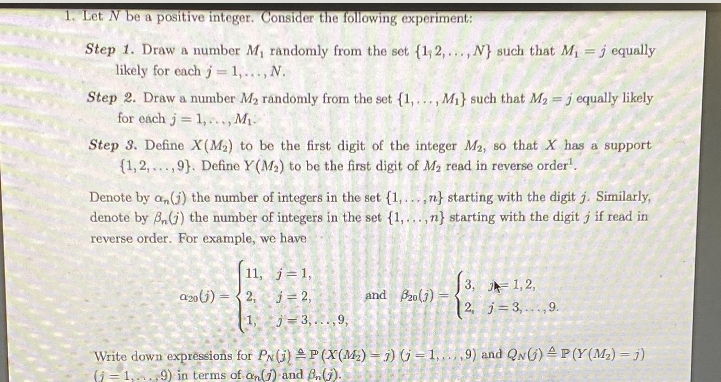
1. Let / be a positive integer. Consider the following experiment: Step 1. Draw a number M, randomly from the set {1, 2, ..., /} such that M, = j equally likely for each j = 1, ..., N. Step 2. Draw a number M2 randomly from the set {1, ..., Mi} such that My = / equally likely for each j = 1,.., MI Step 3. Define X(M,) to be the first digit of the integer M2, so that X has a support (1, 2, ...,9}. Define Y (M2) to be the first digit of My read in reverse order . Denote by a, (j) the number of integers in the set {1, . .., n} starting with the digit j. Similarly, denote by (7) the number of integers in the set {1, ..., n} starting with the digit j if read in reverse order. For example, we have 11, j = 1, 3. j 1,2, and #o()= 2, j = 3, .,9. J - 3,. ...9. Write down expressions for P(j) - P(X(M.) - i) () =1,. .. .9) and QNO) - P(Y (M,) = j) (i = 1. . . ..9) in terms of an(7) and A(j)
Step by Step Solution
There are 3 Steps involved in it

Get step-by-step solutions from verified subject matter experts
 Study Help