







Question: I need help with this. Submit an improved HashSet.java as described below (plus all the other extras you desire). The textbook provided Class for hashing
I need help with this.Submit an improved HashSet.java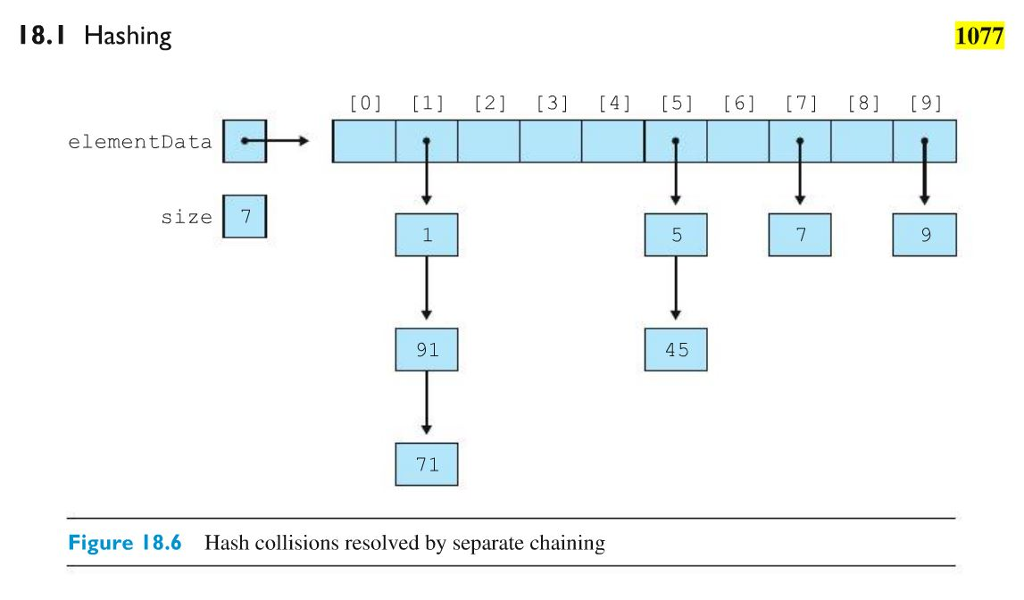 as described below (plus all the other extras you desire).
The textbook provided Class for hashing HashSet.java has a toString() that does NOT display the true structure of the Set.
Alternatively, I'd like to see what the author shows in our textbook:
Write a method (or more) in the provided HashSet.java that is called .toString2() which provides a String return that will print similar to above display. This means your return String will need spaces and line feeds to achieve the desired result. Keep your data left-justified under each index, and assume a fixed spacing of 10 char is enough for the display of each piece of data.
For the example shown above {1,91,71,5,45,7,9} has seven pieces of data, so adding a couple more elements will force it to re-hash and create a very different output.
public class HashSet {
private static final double MAX_LOAD_FACTOR = 0.75;
private HashEntry[] elementData;
private int size;
// Constructs an empty set.
@SuppressWarnings("unchecked")
public HashSet() {
elementData = new HashEntry[10];
size = 0;
}
// ADD METHODS HERE for exercise solutions:
// Adds the given element to this set, if it was not already
// contained in the set.
public void add(E value) {
if (!contains(value)) {
if (loadFactor() >= MAX_LOAD_FACTOR) {
rehash();
}
// insert new value at front of list
int bucket = hashFunction(value);
elementData[bucket] = new HashEntry(value, elementData[bucket]);
size++;
}
}
// Removes all elements from the set.
public void clear() {
for (int i = 0; i
elementData[i] = null;
}
size = 0;
}
// Returns true if the given value is found in this set.
public boolean contains(E value) {
int bucket = hashFunction(value);
HashEntry current = elementData[bucket];
while (current != null) {
if (current.data.equals(value)) {
return true;
}
current = current.next;
}
return false;
}
// Returns true if there are no elements in this queue.
public boolean isEmpty() {
return size == 0;
}
// Removes the given value if it is contained in the set.
// If the set does not contain the value, has no effect.
public void remove(E value) {
int bucket = hashFunction(value);
if (elementData[bucket] != null) {
// check front of list
if (elementData[bucket].data.equals(value)) {
elementData[bucket] = elementData[bucket].next;
size--;
} else {
// check rest of list
HashEntry current = elementData[bucket];
while (current.next != null && !current.next.data.equals(value)) {
current = current.next;
}
// if the element is found, remove it
if (current.next != null && current.next.data.equals(value)) {
current.next = current.next.next;
size--;
}
}
}
}
// Returns the number of elements in the queue.
public int size() {
return size;
}
// Returns a string representation of this queue, such as "[10, 20, 30]";
// The elements are not guaranteed to be listed in sorted order.
public String toString() {
String result = "[";
boolean first = true;
if (!isEmpty()) {
for (int i = 0; i
HashEntry current = elementData[i];
while (current != null) {
if (!first) {
result += ", ";
}
result += current.data;
first = false;
current = current.next;
}
}
}
return result + "]";
}
// Returns the preferred hash bucket index for the given value.
private int hashFunction(E value) {
return Math.abs(value.hashCode()) % elementData.length;
}
private double loadFactor() {
return (double) size / elementData.length;
}
// Resizes the hash table to twice its former size.
@SuppressWarnings("unchecked")
private void rehash() {
// replace element data array with a larger empty version
HashEntry[] oldElementData = elementData;
elementData = new HashEntry[2 * oldElementData.length];
size = 0;
// re-add all of the old data into the new array
for (int i = 0; i
HashEntry current = oldElementData[i];
while (current != null) {
add((E)current.data);
current = current.next;
}
}
}
// Represents a single value in a chain stored in one hash bucket.
@SuppressWarnings("hiding")
private class HashEntry {
public E data;
public HashEntry next;
@SuppressWarnings("unused")
public HashEntry(E data) {
this(data, null);
}
public HashEntry(E data, HashEntry next) {
this.data = data;
this.next = next;
}
}
}
I 8.I Hashing 1077 [0] [1] [2] 3 4 [5] [6] 7 [8] [9] element Data size 7 91 71 Figure 18.6 Hash collisions resolved by separate chaining I 8.I Hashing 1077 [0] [1] [2] 3 4 [5] [6] 7 [8] [9] element Data size 7 91 71 Figure 18.6 Hash collisions resolved by separate chainingStep by Step Solution
There are 3 Steps involved in it

Get step-by-step solutions from verified subject matter experts
 Study Help