Question: i need help with thos problem. please use excel to explain here are some more clear pics 14) fa PRE je M Product -VE p
i need help with thos problem. please use excel to explain
here are some more clear pics
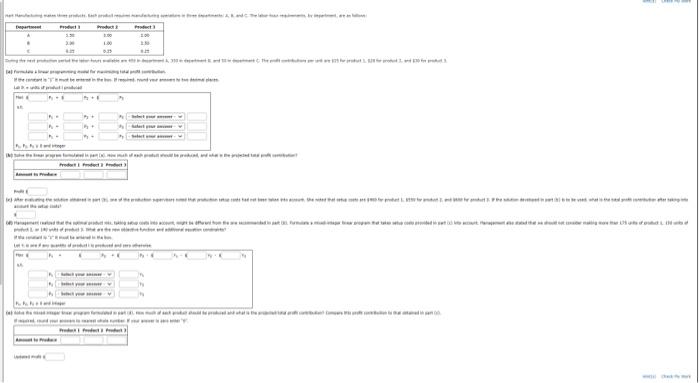
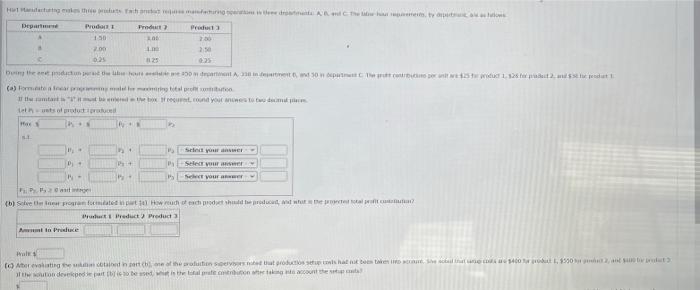
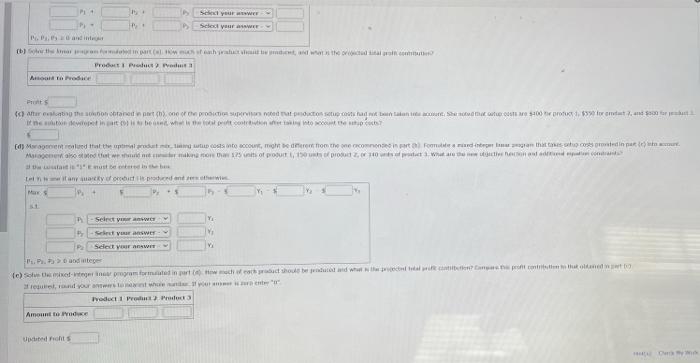
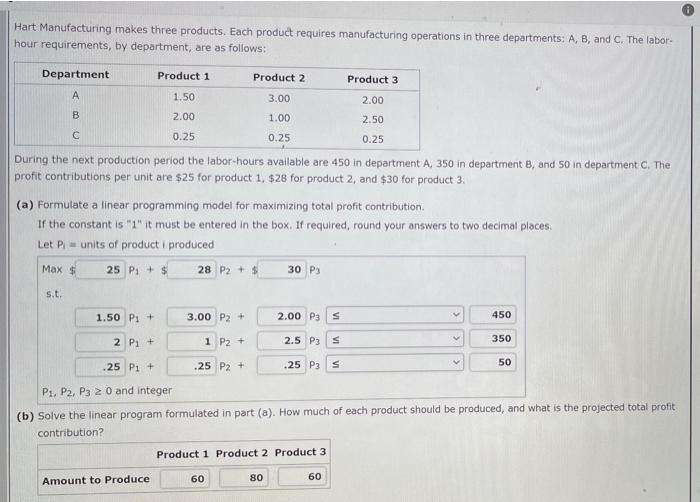
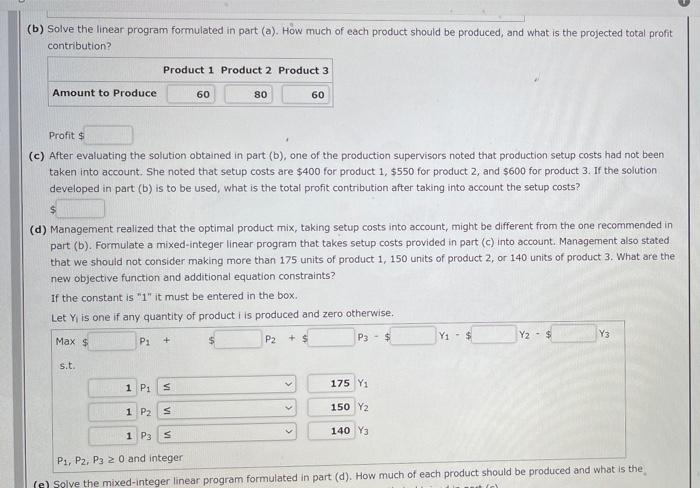
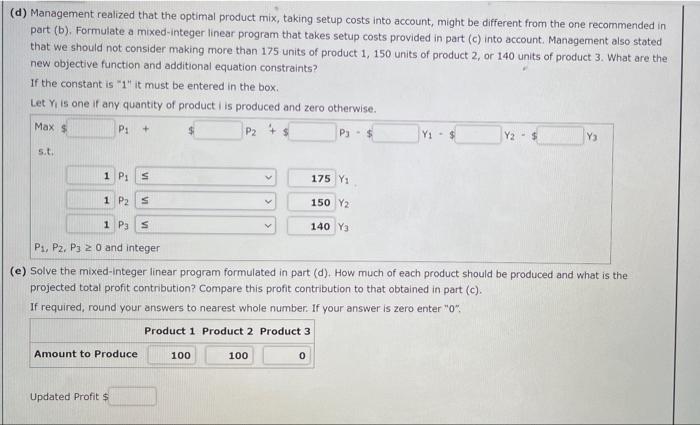
14) fa PRE je M Product -VE p Product de dy vendet e p Cy 1.00 Product 3 Alat into account f such pratade Kinga manga Hart Handachtig makes the prices. Each anstat res manfacturing pets teee drostmate And The han pemer, ty pasow Departmen Product 3 Prodan I 1:50 Product 7 3.00 2:30 2.00 4.00 2:50 0.25 8.25 4:25 buing the and production per the he hours are 250 department A, 338 in department, and 30 in department C The pr contributo per unit are $25 for product 1, $25 for pat and the product 1 (a) Formate a fear programming med forming tital proft ontribution If the amtart is it be endered c the box frecured, cound your ances to two decimal places letusts of product produced Ha S b St 1 51 Select your answer P+ Py Select your answer D+ N- 14 P Select your answer PPP 20 (b) Selve the near program formidated part 11 How ruch of each product should be produced, and what the projected total profit c Product Product Product 31 Ant to Produce Palks (c) Ater evaluating the sum obtained in part ch one of the production servers noted that productos sefup costs had not been taken Daure She said that une ca 1400 product L, $500 g 2, and so to product if the solution developed in part by ito be ased, set in the total prate contribution after taking into account the set PLA I Select your answer N Select your answer P. Pa, es and integ (b) the ar an fabed in part (e) How much of each gratuit had the praded, and what is the orccted sital groconut Product Product Produit Ansourt to Produce Prot 5 (c) after evaluating the acknon obtained in part (h), one of the production supervisors noted that production setup costs had not been taken to account. She noted that satu costs are $100 te product 1, $350 for omdat 7, and $000 for educ If the soution devoped in part 9) is to be used what is the total poft contribution after taking into account the upco (d) Management realed that the uporal product mo, tingutup costs into account, might be different from the one recommended in part ) Formubbe a mixed-integer margram that takes setup costs prosted in part (e) to . Marage also stated that we should not der making more than 125 units of product 1, 150 unts of product 2, or 140 unts of product 3. What are the new tectier hecon and added to condranda the start is "s" E must be entered in the bes Let it any quantity of product is produced and sees otherwis Max S %,+ Y$ Y S N St P Y Select your answer Select your answer B TV Select your answIT V Pa and integer P. P. P (e) solve the mixed-integer inear program formulated in part (How much of each product should be produced and what the procl total prife contbeton? Canpars the profit contribution to that obtained in t required, round your answers to nearest where if your enter"0" Product Product Product 3 Amount to Produce Updated Ficht S HD My Hart Manufacturing makes three products. Each product requires manufacturing operations in three departments: A, B, and C. The labor- hour requirements, by department, are as follows: Department Product 1 Product 2 Product 3 A 1.50 3.00 2.00 B 2.00 1.00 2.50 0.25 0.25 0.25 During the next production period the labor-hours available are 450 in department A, 350 in department B, and 50 in department C. The profit contributions per unit are $25 for product 1, $28 for product 2, and $30 for product 3. (a) Formulate a linear programming model for maximizing total profit contribution. If the constant is "1" it must be entered in the box. If required, round your answers to two decimal places. Let P units of product i produced 25 P + $ 28 P2 + $ 30 P3 Max $ s.t. 450 1.50 P + 3.00 P + 2 P+ 1 P2 + 2.00 P3 S 2.5 P3 S S 350 .25 P3 50 .25 P1+ .25 P + P1, P2, P3 2 0 and integer (b) Solve the linear program formulated in part (a). How much of each product should be produced, and what is the projected total profit contribution? Product 1 Product 2 Product 3 60 80 Amount to Produce 60 (b) Solve the linear program formulated in part (a). How much of each product should be produced, and what is the projected total profit contribution? Product 1 Product 2 Product 3 Amount to Produce 60 80 60 Profit $ (c) After evaluating the solution obtained in part (b), one of the production supervisors noted that production setup costs had not been taken into account. She noted that setup costs are $400 for product 1, $550 for product 2, and $600 for product 3. If the solution developed in part (b) is to be used, what is the total profit contribution after taking into account the setup costs? $ (d) Management realized that the optimal product mix, taking setup costs into account, might be different from the one recommended in part (b). Formulate a mixed-integer linear program that takes setup costs provided in part (c) into account. Management also stated that we should not consider making more than 175 units of product 1, 150 units of product 2, or 140 units of product 3. What are the new objective function and additional equation constraints? If the constant is "1" it must be entered in the box.. Let Y, is one if any quantity of product i is produced and zero otherwise. Max $ P2 + $ Y - $ Y2 $ P3 $ P + Y3 s.t. JUKO 1 P S 175 Y 150 Y 1 P S 140 Y3 1 P3 S P1, P2, P3 2 0 and integer (e) Solve the mixed-integer linear program formulated in part (d). How much of each product should be produced and what is the (c) (d) Management realized that the optimal product mix, taking setup costs into account, might be different from the one recommended in part (b). Formulate a mixed-integer linear program that takes setup costs provided in part (c) into account. Management also stated that we should not consider making more than 175 units of product 1, 150 units of product 2, or 140 units of product 3. What are the new objective function and additional equation constraints? If the constant is "1" it must be entered in the box. Let Y, is one if any quantity of product i is produced and zero otherwise. P + P + Pj Y Y3 Max S s.t. 1 P S 175 Y 1 P2 S Y 150 Y2 Y 1 P3 S 140 Y3 P, P2, P320 and integer (e) Solve the mixed-integer linear program formulated in part (d). How much of each product should be produced and what is the projected total profit contribution? Compare this profit contribution to that obtained in part (c). If required, round your answers to nearest whole number. If your answer is zero enter "0". Product 1 Product 2 Product 3 Amount to Produce 100 100 0 Updated Profit $









 Study Help