







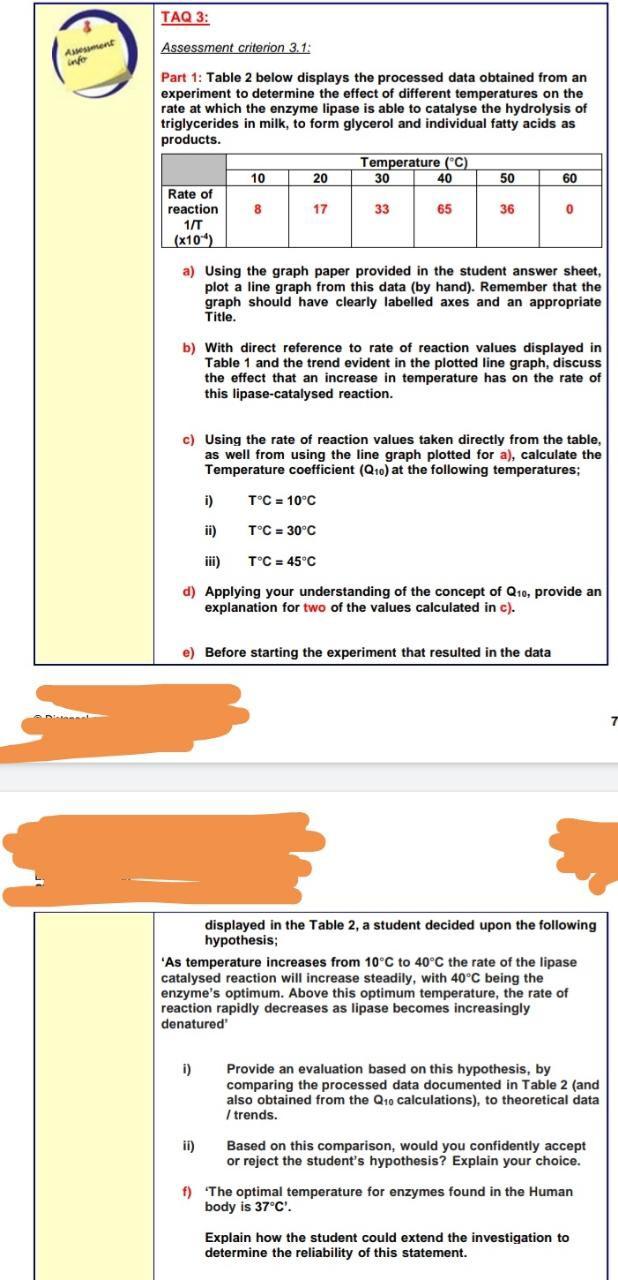
Question: i need part d e f only . solve in 60 mins i will give thumb up TAQ 3: Assement Assessment criterion 3.1: une Part
i need part d e f only . solve in 60 mins i will give thumb up
TAQ 3: Assement Assessment criterion 3.1: une Part 1: Table 2 below displays the processed data obtained from an experiment to determine the effect of different temperatures on the rate at which the enzyme lipase is able to catalyse the hydrolysis of triglycerides in milk, to form glycerol and individual fatty acids as products. Temperature (C) 10 20 30 40 50 60 Rate of reaction 8 8 17 33 65 36 0 1/T (x104) a) Using the graph paper provided in the student answer sheet, plot a line graph from this data (by hand). Remember that the graph should have clearly labelled axes and an appropriate Title. b) With direct reference to rate of reaction values displayed in Table 1 and the trend evident in the plotted line graph, discuss the effect that an increase in temperature has on the rate of this lipase-catalysed reaction. c) Using the rate of reaction values taken directly from the table, as well from using the line graph plotted for a), calculate the Temperature coefficient (Q10) at the following temperatures; i) TC = 10C ii) TC = 30C iii) TC = 45C d) Applying your understanding of the concept of Q10, provide an explanation for two of the values calculated in c). e) Before starting the experiment that resulted in the data 7 displayed in the Table 2, a student decided upon the following hypothesis; As temperature increases from 10C to 40C the rate of the lipase catalysed reaction will increase steadily, with 40C being the enzyme's optimum. Above this optimum temperature, the rate of reaction rapidly decreases as lipase becomes increasingly denatured' i) i Provide an evaluation based on this hypothesis, by comparing the processed data documented in Table 2 (and also obtained from the Q10 calculations), to theoretical data I trends. ii) Based on this comparison, would you confidently accept or reject the student's hypothesis? Explain your choice. f) 'The optimal temperature for enzymes found in the Human body is 37C'. Explain how the student could extend the investigation to determine the reliability of this statement
Step by Step Solution
There are 3 Steps involved in it

Get step-by-step solutions from verified subject matter experts
 Study Help