Question: i need q2 solution, its depends on q1 solution Problem 1 Thermoelectric module used for cooling is made of p-n couples made from Bi Te.
i need q2 solution, its depends on q1 solution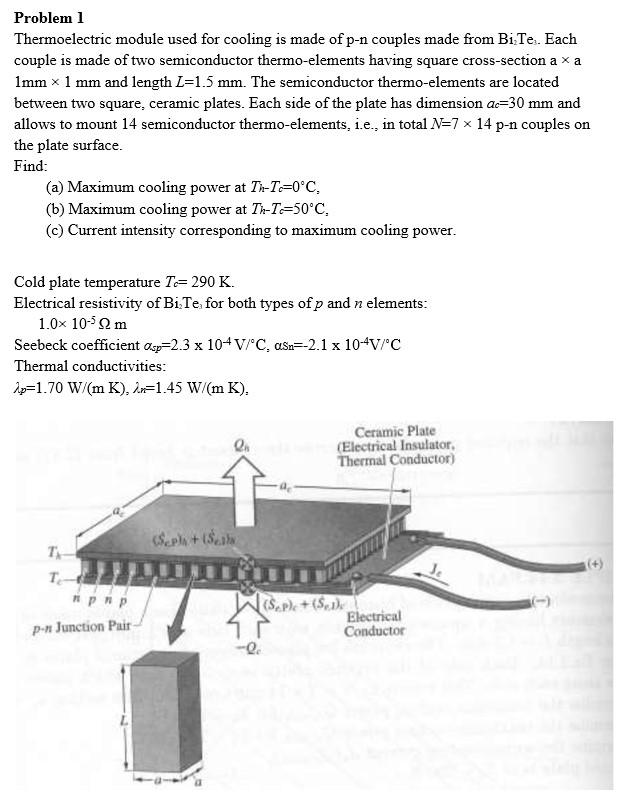
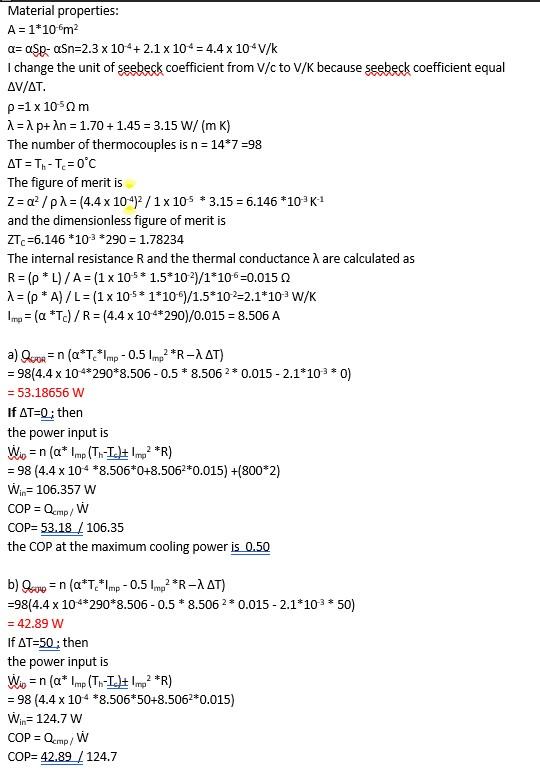
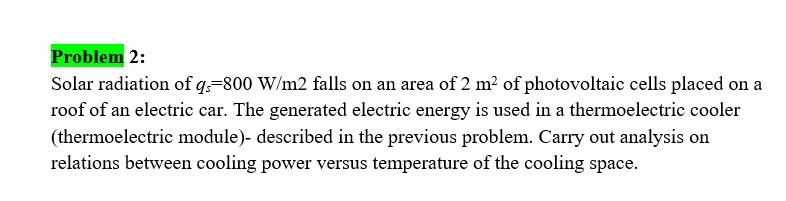
Problem 1 Thermoelectric module used for cooling is made of p-n couples made from Bi Te. Each couple is made of two semiconductor thermo-elements having square cross-section a xa 1mm x 1 mm and length L=1.5 mm. The semiconductor thermo-elements are located between two square, ceramic plates. Each side of the plate has dimension a=30 mm and allows to mount 14 semiconductor thermo-elements, i.e., in total N=7 x 14 p-n couples on the plate surface. Find: (a) Maximum cooling power at Th-T=0C, (b) Maximum cooling power at Th-T=50C, (c) Current intensity corresponding to maximum cooling power. Cold plate temperature To= 290 K. Electrical resistivity of Bi Te for both types of p and n elements: 1.0x 10-52 m Seebeck coefficient asp=2.3 x 10⁴V/Casn=-2.1 x 10-4V/C Thermal conductivities: hp=1.70 W/(mK), 2n=1.45 W/( mK). Ceramic Plate (Electrical Insulator, Thermal Conductor) Scpl+$.com TA TO PNP P-n Junction Pair (S.Ple+ (S1) Electrical Conductor - Material properties: A = 1*10m2 a=aSp- aSn=2.3 x 10⁴+ 2.1 x 104 = 4.4 x 10 V/k I change the unit of seebeck coefficient from V/c to V/K because seebeck coefficient equal AV/AT. p=1x 1050 m A = Ap+An = 1.70 +1.45 = 3.15 W/(mK) The number of thermocouples is n=14*7 =98 AT = T.-T = 0C The figure of merit is Z = a/p1 = (4.4 x 1042/1x 105 * 3.15 = 6.146 *10-K1 and the dimensionless figure of merit is ZTc=6.146 *103 * 290 = 1.78234 The internal resistance Rand the thermal conductance I are calculated as R=(p* L) / A = (1 x 105* 1.5*102/1*106=0.015 0 1 = (p* A) / L = (1 x 105* 1*10%)/1.5*102=2.1*10-W/K Imre = (a *Tc)/R = (4.4 x 104*290)/0.015 = 8.506 A = CHOR = a) Quoran (a*T*-0.5 Imp2*R-1 AT) 98(4.4 x 10 **290*8.506 -0.5 * 8.5062*0.015 - 2.1*10* * 0) = 53.18656 W If AT=0; then the power input is Wir = n (a* Imp(T.-L.) 192 *R) = 98 (4.4 x 10* *8.506*0+8.5062*0.015) +(800*2) Wio=106.357 W COP = Qemp/ COP= 53.18 / 106.35 the COP at the maximum cooling power is 0.50 b) cop = n (a*T,*Imp-0.5 m2*R-AT) =98(4.4 x 10**290*8.506 -0.5 * 8.506 2* 0.015 - 2.1*103 * 50) = 42.89 W If AT=50; then the power input is Wio = n (a* Imp (T--I Jt 12 *R) = 98 (4.4 x 104 *8.506*50+8.5062*0.015) Win= 124.7 W COP = w COP= 42.89 / 124.7 = Qemp/ Problem 2: Solar radiation of q;=800 W/m2 falls on an area of 2 m2 of photovoltaic cells placed on a roof of an electric car. The generated electric energy is used in a thermoelectric cooler (thermoelectric module)- described in the previous problem. Carry out analysis on relations between cooling power versus temperature of the cooling space. Problem 1 Thermoelectric module used for cooling is made of p-n couples made from Bi Te. Each couple is made of two semiconductor thermo-elements having square cross-section a xa 1mm x 1 mm and length L=1.5 mm. The semiconductor thermo-elements are located between two square, ceramic plates. Each side of the plate has dimension a=30 mm and allows to mount 14 semiconductor thermo-elements, i.e., in total N=7 x 14 p-n couples on the plate surface. Find: (a) Maximum cooling power at Th-T=0C, (b) Maximum cooling power at Th-T=50C, (c) Current intensity corresponding to maximum cooling power. Cold plate temperature To= 290 K. Electrical resistivity of Bi Te for both types of p and n elements: 1.0x 10-52 m Seebeck coefficient asp=2.3 x 10⁴V/Casn=-2.1 x 10-4V/C Thermal conductivities: hp=1.70 W/(mK), 2n=1.45 W/( mK). Ceramic Plate (Electrical Insulator, Thermal Conductor) Scpl+$.com TA TO PNP P-n Junction Pair (S.Ple+ (S1) Electrical Conductor - Material properties: A = 1*10m2 a=aSp- aSn=2.3 x 10⁴+ 2.1 x 104 = 4.4 x 10 V/k I change the unit of seebeck coefficient from V/c to V/K because seebeck coefficient equal AV/AT. p=1x 1050 m A = Ap+An = 1.70 +1.45 = 3.15 W/(mK) The number of thermocouples is n=14*7 =98 AT = T.-T = 0C The figure of merit is Z = a/p1 = (4.4 x 1042/1x 105 * 3.15 = 6.146 *10-K1 and the dimensionless figure of merit is ZTc=6.146 *103 * 290 = 1.78234 The internal resistance Rand the thermal conductance I are calculated as R=(p* L) / A = (1 x 105* 1.5*102/1*106=0.015 0 1 = (p* A) / L = (1 x 105* 1*10%)/1.5*102=2.1*10-W/K Imre = (a *Tc)/R = (4.4 x 104*290)/0.015 = 8.506 A = CHOR = a) Quoran (a*T*-0.5 Imp2*R-1 AT) 98(4.4 x 10 **290*8.506 -0.5 * 8.5062*0.015 - 2.1*10* * 0) = 53.18656 W If AT=0; then the power input is Wir = n (a* Imp(T.-L.) 192 *R) = 98 (4.4 x 10* *8.506*0+8.5062*0.015) +(800*2) Wio=106.357 W COP = Qemp/ COP= 53.18 / 106.35 the COP at the maximum cooling power is 0.50 b) cop = n (a*T,*Imp-0.5 m2*R-AT) =98(4.4 x 10**290*8.506 -0.5 * 8.506 2* 0.015 - 2.1*103 * 50) = 42.89 W If AT=50; then the power input is Wio = n (a* Imp (T--I Jt 12 *R) = 98 (4.4 x 104 *8.506*50+8.5062*0.015) Win= 124.7 W COP = w COP= 42.89 / 124.7 = Qemp/ Problem 2: Solar radiation of q;=800 W/m2 falls on an area of 2 m2 of photovoltaic cells placed on a roof of an electric car. The generated electric energy is used in a thermoelectric cooler (thermoelectric module)- described in the previous problem. Carry out analysis on relations between cooling power versus temperature of the cooling space









 Study Help