







Question: I need some help with the following: Let X = R . The lexicographic preference relation , is defined as x y if either x
I need some help with the following:
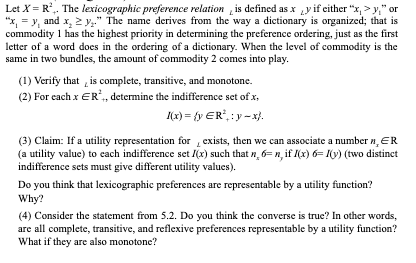
Let X = R . The lexicographic preference relation , is defined as x y if either "x > y" or 'x = y and x 2 y." The name derives from the way a dictionary is organized; that is commodity I has the highest priority in determining the preference ordering, just as the first letter of a word does in the ordering of a dictionary. When the level of commodity is the same in two bundles, the amount of commodity 2 comes into play. (1) Verify that is complete, transitive, and monotone. (2) For each x CR+, determine the indifference set of x. I(x) = PERRY-X). (3) Claim: If a utility representation for , exists, then we can associate a number n ER (a utility value) to cach indifference set /(x) such that n 6= n if ((x) 6= ((y) (two distinct indifference sets must give different utility values). Do you think that lexicographic preferences are representable by a utility function? Why? (4) Consider the statement from 5.2. Do you think the converse is true? In other words, are all complete, transitive, and reflexive preferences representable by a utility function? What if they are also monotone
Step by Step Solution
There are 3 Steps involved in it

Get step-by-step solutions from verified subject matter experts
 Study Help