







Question: A reactor was found not to be capable of meeting the treatment goal due apparently to short-circuiting in the reactor or hydraulic overloading. A
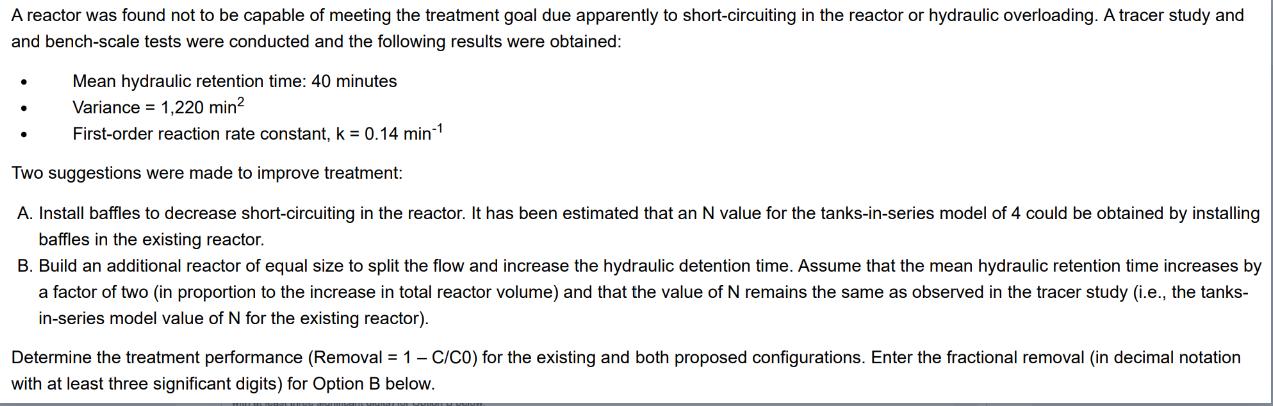
A reactor was found not to be capable of meeting the treatment goal due apparently to short-circuiting in the reactor or hydraulic overloading. A tracer study and and bench-scale tests were conducted and the following results were obtained: Mean hydraulic retention time: 40 minutes Variance = 1,220 min First-order reaction rate constant, k = 0.14 min- Two suggestions were made to improve treatment: A. Install baffles to decrease short-circuiting in the reactor. It has been estimated that an N value for the tanks-in-series model of 4 could be obtained by installing baffles in the existing reactor. B. Build an additional reactor of equal size to split the flow and increase the hydraulic detention time. Assume that the mean hydraulic retention time increases by a factor of two (in proportion to the increase in total reactor volume) and that the value of N remains the same as observed in the tracer study (i.e., the tanks- in-series model value of N for the existing reactor). Determine the treatment performance (Removal = 1- C/CO) for the existing and both proposed configurations. Enter the fractional removal (in decimal notation with at least three significant digits) for Option B below.
Step by Step Solution
3.47 Rating (150 Votes )
There are 3 Steps involved in it
To determine the fractional removal R for Option B you can use the ... View full answer

Get step-by-step solutions from verified subject matter experts
 Study Help