







Question: 5. Effect of a force on a body depends upon (a) magnitude. (b) direction. (c) position or line of action. (d) all of the
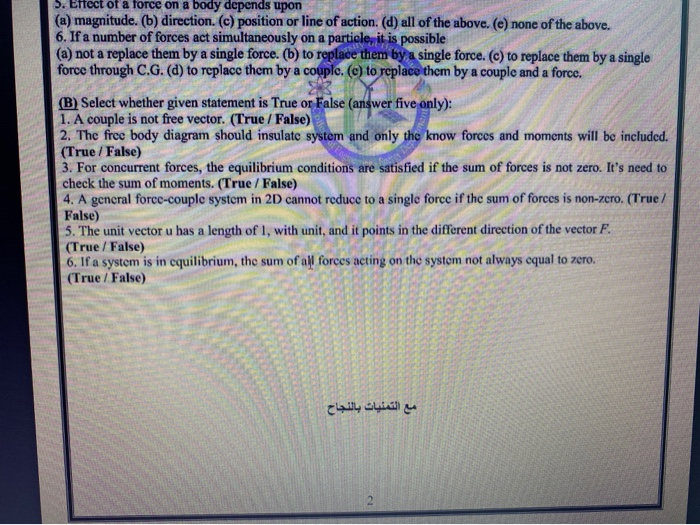
5. Effect of a force on a body depends upon (a) magnitude. (b) direction. (c) position or line of action. (d) all of the above. (e) none of the above. 6. If a number of forces act simultaneously on a particle, it is possible (a) not a replace them by a single force. (b) to replace them by a single force. (c) to replace them by a single force through C.G. (d) to replace them by a couple. (e) to replace them by a couple and a force. (B) Select whether given statement is True or False (answer five only): 1. A couple is not free vector. (True/False) 2. The free body diagram should insulate system and only the know forces and moments will be included. (True/False) 3. For concurrent forces, the equilibrium conditions are satisfied if the sum of forces is not zero. It's need to check the sum of moments. (True / False) 4. A general force-couple system in 2D cannot reduce to a single force if the sum of forces is non-zero. (True/ False) 5. The unit vec u has a length of 1, with unit, and it points in the different direction of the vector F. (True/False) 6. If a system is in equilibrium, the sum of all forces acting on the system not always equal to zero. (True/False)
Step by Step Solution
3.45 Rating (148 Votes )
There are 3 Steps involved in it
The detailed answer for the above question is provided below 1 A Magnitude Direction Position or Lin... View full answer

Get step-by-step solutions from verified subject matter experts
 Study Help