







Question: - I need the differences and similarities between these two tables and not less than 7 for each one and it is depend on Ethics
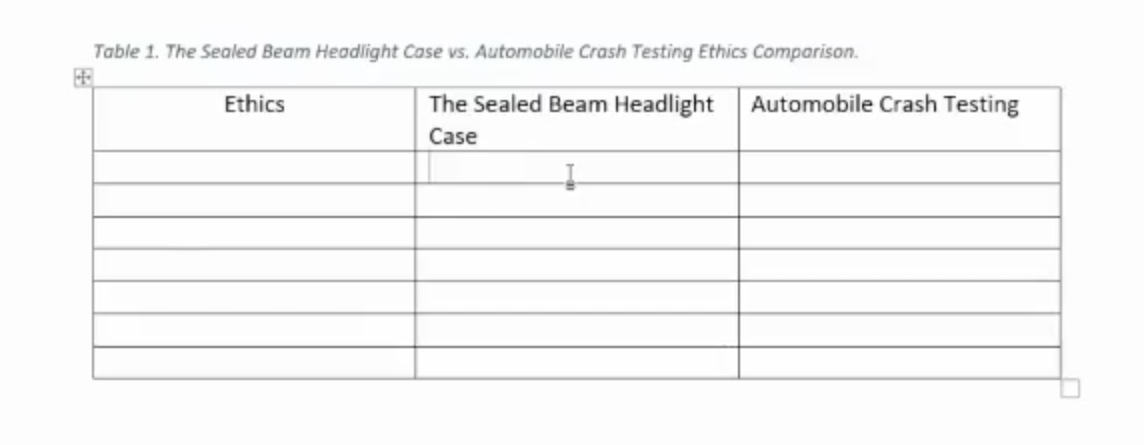
- I need the differences and similarities between these two tables and not less than 7 for each one and it is depend on Ethics course study so similarities and differences related to Ethics
- two tables one for differences and one for similarities and you can one write them in numbers 123... and. I will copy them
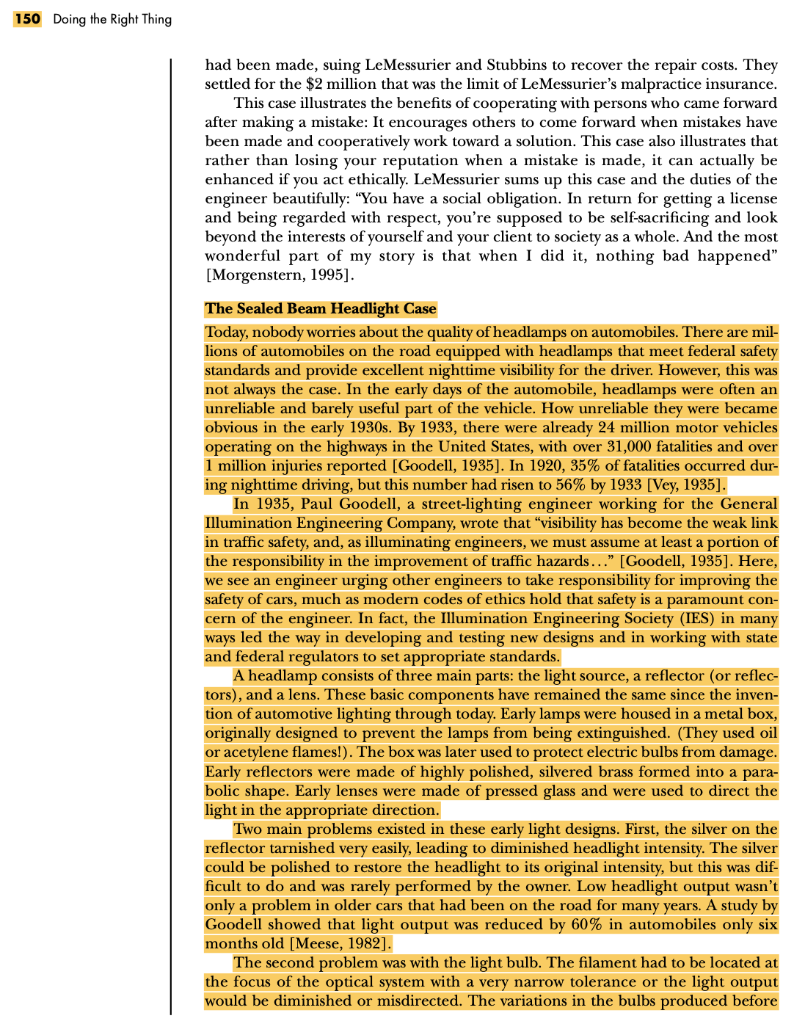
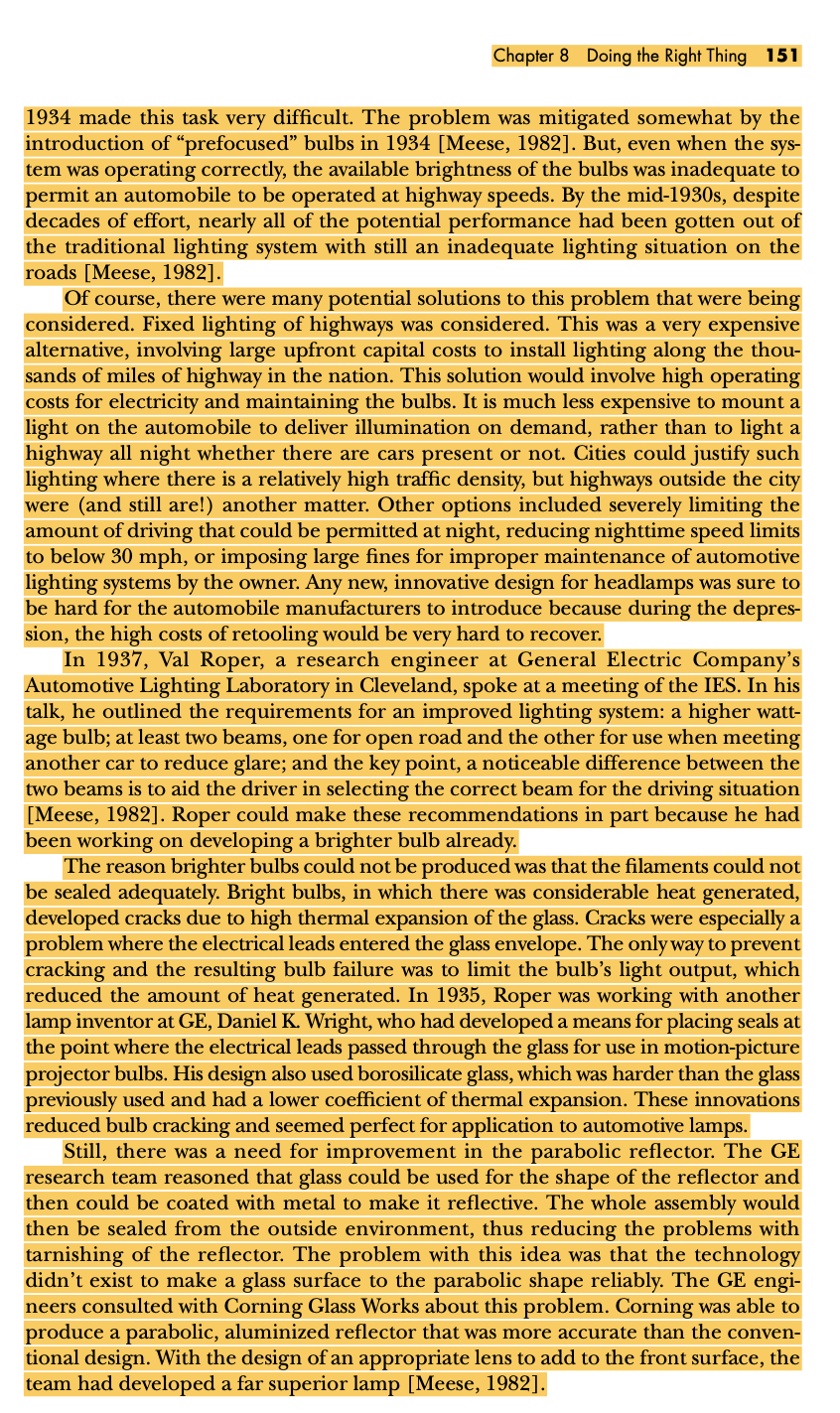
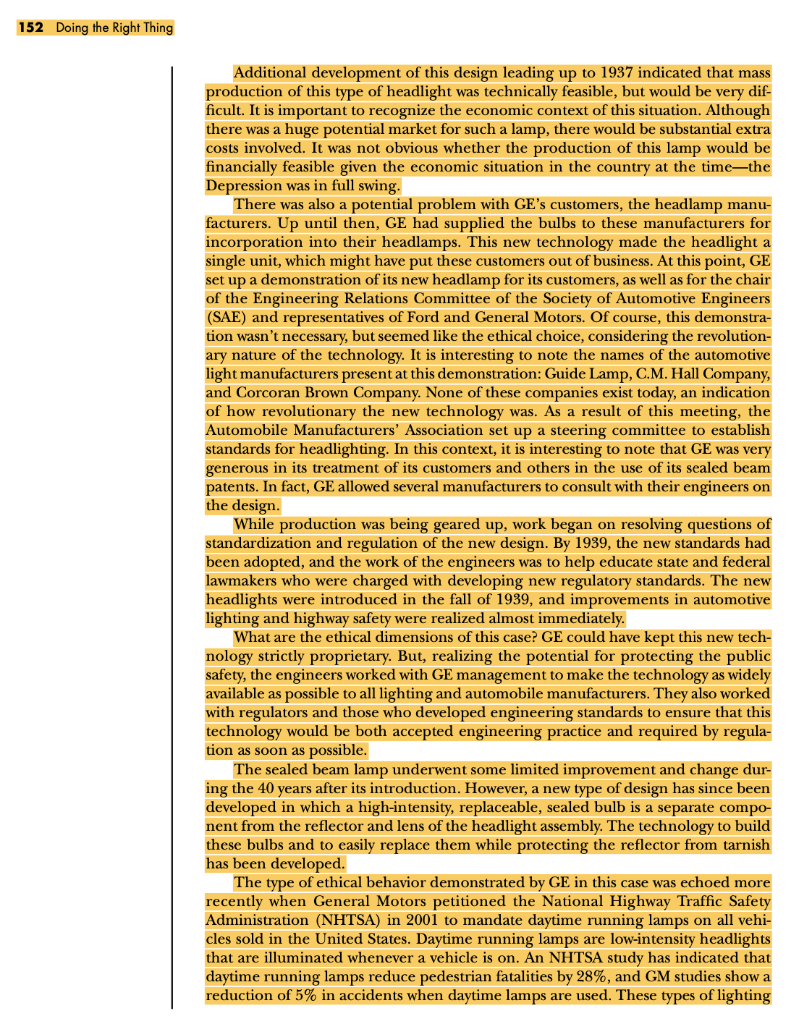
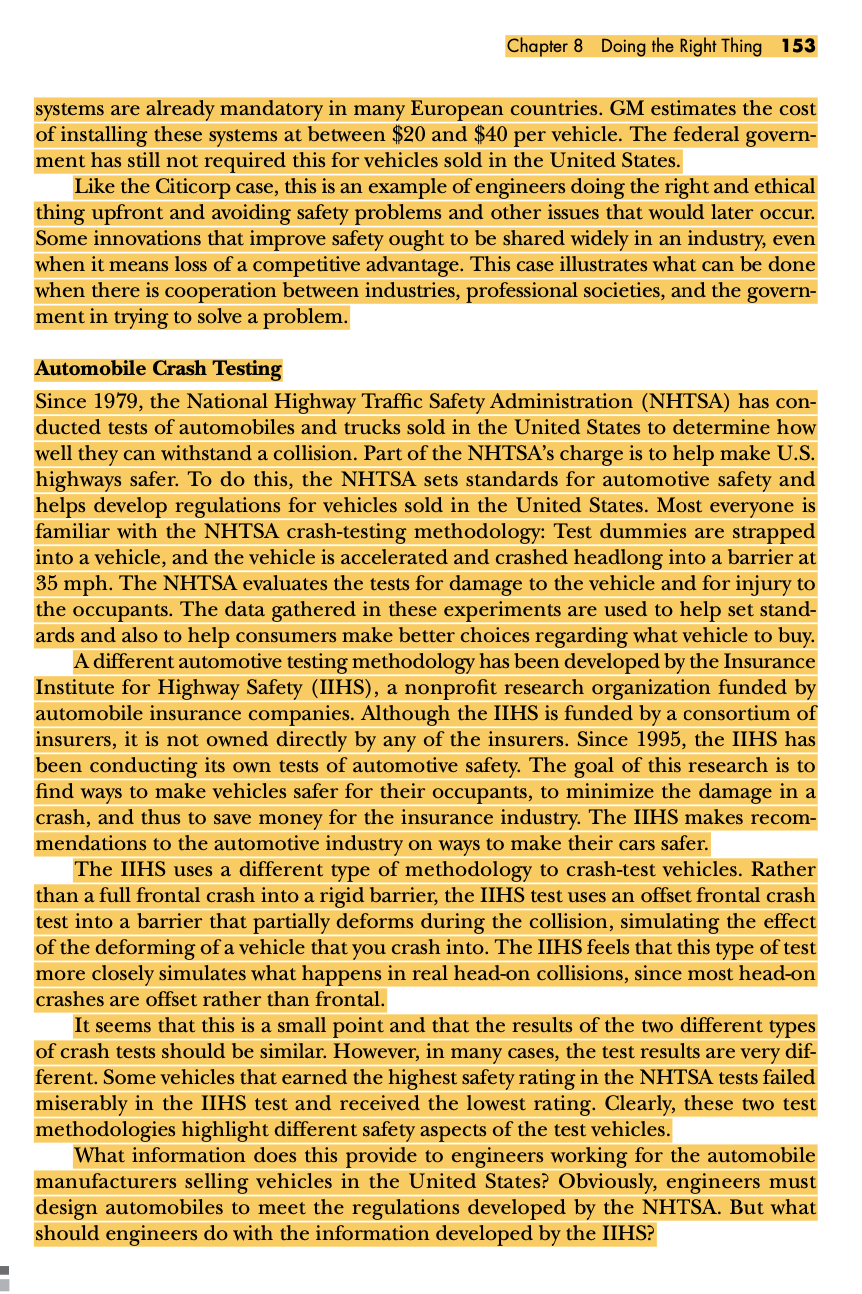
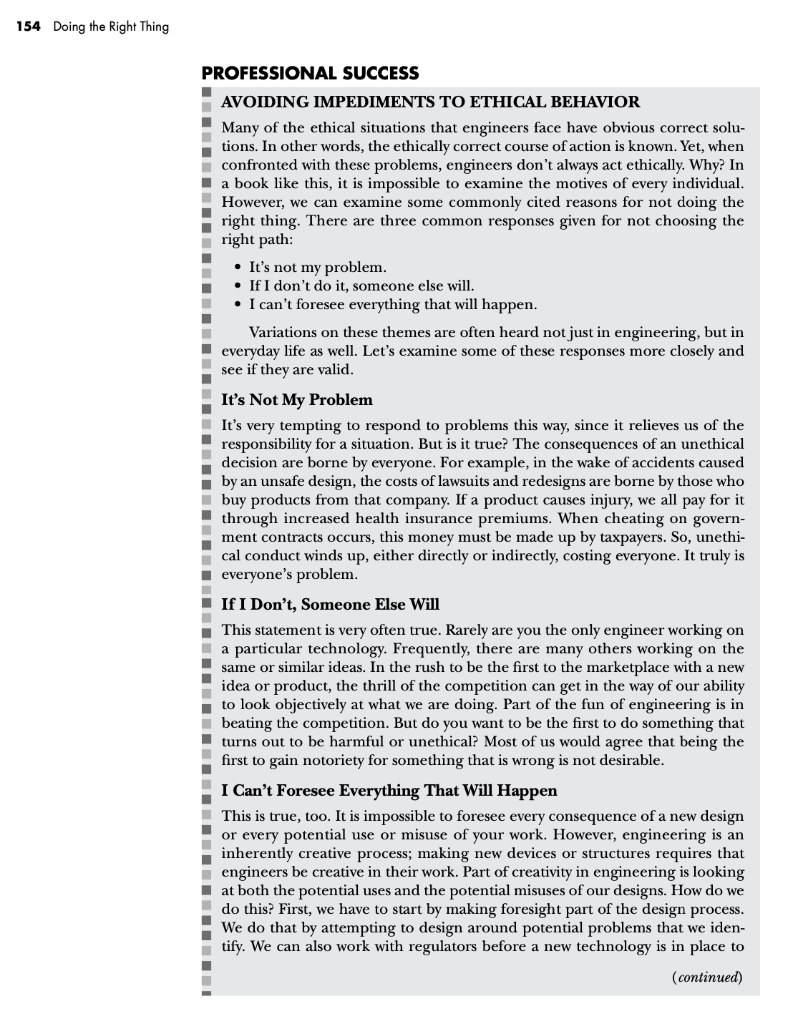
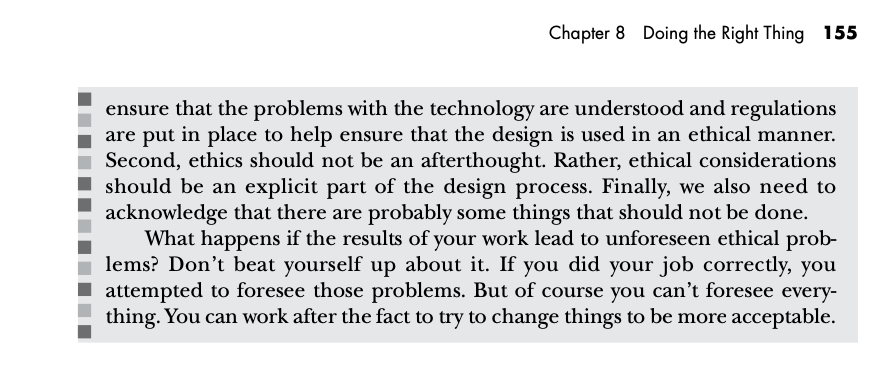
Table 1. The Sealed Beam Headlight Case vs. Automobile Crash Testing Ethics Comparison Ethics Automobile Crash Testing The Sealed Beam Headlight Case 1 150 Doing the Right Thing had been made, suing LeMessurier and Stubbins to recover the repair costs. They settled for the $2 million that was the limit of LeMessurier's malpractice insurance. This case illustrates the benefits of cooperating with persons who came forward after making a mistake: It encourages others to come forward when mistakes have been made and cooperatively work toward a solution. This case also illustrates that rather than losing your reputation when a mistake is made, it can actually be enhanced if you act ethically. LeMessurier sums up this case and the duties of the engineer beautifully: You have a social obligation. In return for getting a license and being regarded with respect, you're supposed to be self-sacrificing and look beyond the interests of yourself and your client to society as a whole. And the most wonderful part of my story is that when I did it, nothing bad happened" [Morgenstern, 1995). The Sealed Beam Headlight Case Today, nobody worries about the quality of headlamps on automobiles. There are mil- lions of automobiles on the road equipped with headlamps that meet federal safety standards and provide excellent nighttime visibility for the driver. However, this was not always the case. In the early days of the automobile, headlamps were often an unreliable and barely useful part of the vehicle. How unreliable they were became obvious in the early 1930s. By 1933, there were already 24 million motor vehicles operating on the highways in the United States, with over 31,000 fatalities and over 1 million injuries reported (Goodell, 1935). In 1920, 35% of fatalities occurred dur- ing nighttime driving, but this number had risen to 56% by 1933 [Vey, 1935). In 1935, Paul Goodell, a street-lighting engineer working for the General Illumination Engineering Company, wrote that "visibility has become the weak link in traffic safety, and, as illuminating engineers, we must assume at least a portion of the responsibility in the improvement of traffic hazards..." [Goodell, 1935]. Here, we see an engineer urging other engineers to take responsibility for improving the safety of cars, much as modern codes of ethics hold that safety is a paramount con- cern of the engineer. In fact, the Illumination Engineering Society (IES) in many ways led the way in developing and testing new designs and in working with state and federal regulators to set appropriate standards. A headlamp consists of three main parts: the light source, a reflector (or reflec- tors), and a lens. These basic components have remained the same since the inven- tion of automotive lighting through today. Early lamps were housed in a metal box, originally designed to prevent the lamps from being extinguished. (They used oil or acetylene flames!). The box was later used to protect electric bulbs from damage. Early reflectors were made of highly polished, silvered brass formed into a para- bolic shape. Early lenses were made of pressed glass and were used to direct the light in the appropriate direction. Two main problems existed in these early light designs. First, the silver on the reflector tarnished very easily, leading to diminished headlight intensity. The silver could be polished to restore the headlight to its original intensity, but this was dif- ficult to do and was rarely performed by the owner. Low headlight output wasn't only a problem in older cars that had been on the road for many years. A study by Goodell showed that light output was reduced by 60% in automobiles only six months old [Meese, 1982). The second problem was with the light bulb. The filament had to be located at the focus of the optical system with a very narrow tolerance or the light output would be diminished or misdirected. The variations in the bulbs produced before Chapter 8 Doing the Right Thing 151 1934 made this task very difficult. The problem was mitigated somewhat by the introduction of prefocused bulbs in 1934 [Meese, 1982). But, even when the sys- tem was operating correctly, the available brightness of the bulbs was inadequate to permit an automobile to be operated at highway speeds. By the mid-1930s, despite decades of effort, nearly all of the potential performance had been gotten out of the traditional lighting system with still an inadequate lighting situation on the roads [Meese, 1982). Of course, there were many potential solutions to this problem that were being considered. Fixed lighting of highways was considered. This was a very expensive alternative, involving large upfront capital costs to install lighting along the thou- sands of miles of highway in the nation. This solution would involve high operating costs for electricity and maintaining the bulbs. It is much less expensive to mount a light on the automobile to deliver illumination on demand, rather than to light a highway all night whether there are cars present or not. Cities could justify such lighting where there is a relatively high traffic density, but highways outside the city were (and still are!) another matter. Other options included severely limiting the amount of driving that could be permitted at night, reducing nighttime speed limits to below 30 mph, or imposing large fines for improper maintenance of automotive lighting systems by the owner. Any new, innovative design for headlamps was sure to be hard for the automobile manufacturers to introduce because during the depres- sion, the high costs of retooling would be very hard to recover. In 1937, Val Roper, a research engineer at General Electric Company's Automotive Lighting Laboratory in Cleveland, spoke at a meeting of the IES. In his talk, he outlined the requirements for an improved lighting system: a higher watt- age bulb; at least two beams, one for open road and the other for use when meeting another car to reduce glare; and the key point, a noticeable difference between the two beams is to aid the driver in selecting the correct beam for the driving situation [Meese, 1982]. Roper could make these recommendations in part because he had been working on developing a brighter bulb already. The reason brighter bulbs could not be produced was that the filaments could not be sealed adequately. Bright bulbs, in which there was considerable heat generated, developed cracks due to high thermal expansion of the glass. Cracks were especially a problem where the electrical leads entered the glass envelope. The only way to prevent cracking and the resulting bulb failure was to limit the bulb's light output, which reduced the amount of heat generated. In 1935, Roper was working with another lamp inventor at GE, Daniel K. Wright, who had developed a means for placing seals at the point where the electrical leads passed through the glass for use in motion picture projector bulbs. His design also used borosilicate glass, which was harder than the glass previously used and had a lower coefficient of thermal expansion. These innovations reduced bulb cracking and seemed perfect for application to automotive lamps. Still, there was a need for improvement in the parabolic reflector. The GE research team reasoned that glass could be used for the shape of the reflector and then could be coated with metal to make it reflective. The whole assembly would then be sealed from the outside environment, thus reducing the problems with tarnishing of the reflector. The problem with this idea was that the technology didn't exist to make a glass surface to the parabolic shape reliably. The GE engi- neers consulted with Corning Glass Works about this problem. Corning was able to produce a parabolic, aluminized reflector that was more accurate than the conven- tional design. With the design of an appropriate lens to add to the front surface, the team had developed a far superior lamp [Meese, 1982]. 152 Doing the Right Thing Additional development of this design leading up to 1937 indicated that mass production of this type of headlight was technically feasible, but would be very dif- ficult. It is important to recognize the economic context of this situation. Although there was a huge potential market for such a lamp, there would be substantial extra costs involved. It was not obvious whether the production of this lamp would be financially feasible given the economic situation in the country at the timethe Depression was in full swing. There was also a potential problem with GE's customers, the headlamp manu- facturers. Up until then, GE had supplied the bulbs to these manufacturers for incorporation into their headlamps. This new technology made the headlight a single unit, which might have put these customers out of business. At this point, GE set up a demonstration of its new headlamp for its customers, as well as for the chair of the Engineering Relations Committee of the Society of Automotive Engineers (SAE) and representatives of Ford and General Motors. Of course, this demonstra- tion wasn't necessary, but seemed like the ethical choice, considering the revolution- ary nature of the technology. It is interesting to note the names of the automotive light manufacturers present at this demonstration: Guide Lamp, C.M. Hall Company, and Corcoran Brown Company. None of these companies exist today, an indication of how revolutionary the new technology was. As a result of this meeting, the Automobile Manufacturers' Association set up a steering committee to establish standards for headlighting. In this context, it is interesting to note that GE was very generous in its treatment of its customers and others in the use of its sealed beam patents. In fact, GE allowed several manufacturers to consult with their engineers on the design. While production was being geared up, work began on resolving questions of standardization and regulation of the new design. By 1939, the new standards had been adopted, and the work of the engineers was to help educate state and federal lawmakers who were charged with developing new regulatory standards. The new headlights were introduced in the fall of 1939, and improvements in automotive lighting and highway safety were realized almost immediately. What are the ethical dimensions of this case? GE could have kept this new tech- nology strictly proprietary. But, realizing the potential for protecting the public safety, the engineers worked with GE management to make the technology as widely available as possible to all lighting and automobile manufacturers. They also worked with regulators and those who developed engineering standards to ensure that this technology would be both accepted engineering practice and required by regula- tion as soon as possible. The sealed beam lamp underwent some limited improvement and change dur- ing the 40 years after its introduction. However, a new type of design has since been developed in which a high-intensity, replaceable, sealed bulb is a separate compo- nent from the reflector and lens of the headlight assembly. The technology to build these bulbs and to easily replace them while protecting the reflector from tarnish has been developed. The type of ethical behavior demonstrated by GE in this case was echoed more recently when General Motors petitioned the National Highway Traffic Safety Administration (NHTSA) in 2001 to mandate daytime running lamps on all vehi- cles sold in the United States. Daytime running lamps are low-intensity headlights that are illuminated whenever a vehicle is on. An NHTSA study has indicated that daytime running lamps reduce pedestrian fatalities by 28%, and GM studies show a reduction of 5% in accidents when daytime lamps are used. These types of lighting Chapter 8 Doing the Right Thing 153 systems are already mandatory in many European countries. GM estimates the cost of installing these systems at between $20 and $40 per vehicle. The federal govern- ment has still not required this for vehicles sold in the United States. Like the Citicorp case, this is an example of engineers doing the right and ethical thing upfront and avoiding safety problems and other issues that would later occur. Some innovations that improve safety ought to be shared widely in an industry, even when it means loss of a competitive advantage. This case illustrates what can be done when there is cooperation between industries, professional societies, and the govern- ment in trying to solve a problem. Automobile Crash Testing Since 1979, the National Highway Traffic Safety Administration (NHTSA) has con- ducted tests of automobiles and trucks sold in the United States to determine how well they can withstand a collision. Part of the NHTSA's charge is to help make U.S. highways safer. To do this, the NHTSA sets standards for automotive safety and helps develop regulations for vehicles sold in the United States. Most everyone is familiar with the NHTSA crash-testing methodology: Test dummies are strapped into a vehicle, and the vehicle is accelerated and crashed headlong into a barrier at 35 mph. The NHTSA evaluates the tests for damage to the vehicle and for injury to the occupants. The data gathered in these experiments are used to help set stand- ards and also to help consumers make better choices regarding what vehicle to buy. A different automotive testing methodology has been developed by the Insurance Institute for Highway Safety (IIHS), a nonprofit research organization funded by automobile insurance companies. Although the IIHS is funded by a consortium of insurers, it is not owned directly by any of the insurers. Since 1995, the IIHS has been conducting its own tests of automotive safety. The goal of this research is to find ways to make vehicles safer for their occupants, to minimize the damage in a crash, and thus to save money for the insurance industry. The IIHS makes recom- mendations to the automotive industry on ways to make their cars safer. The IIHS uses a different type of methodology to crash-test vehicles. Rather than a full frontal crash into a rigid barrier, the IIHS test uses an offset frontal crash test into a barrier that partially deforms during the collision, simulating the effect of the deforming of a vehicle that you crash into. The IIHS feels that this type of test more closely simulates what happens in real head-on collisions, since most head-on crashes are offset rather than frontal. It seems that this is a small point and that the results of the two different types of crash tests should be similar. However, in many cases, the test results are very dif- ferent. Some vehicles that earned the highest safety rating in the NHTSA tests failed miserably in the IIHS test and received the lowest rating. Clearly, these two test methodologies highlight different safety aspects of the test vehicles. What information does this provide to engineers working for the automobile manufacturers selling vehicles in the United States? Obviously, engineers must design automobiles to meet the regulations developed by the NHTSA. But what should engineers do with the information developed by the IIHS? 154 Doing the Right Thing PROFESSIONAL SUCCESS AVOIDING IMPEDIMENTS TO ETHICAL BEHAVIOR Many of the ethical situations that engineers face have obvious correct solu- tions. In other words, the ethically correct course of action is known. Yet, when confronted with these problems, engineers don't always act ethically. Why? In a book like this, it is impossible to examine the motives of every individual. However, we can examine some commonly cited reasons for not doing the right thing. There are three common responses given for not choosing the right path: It's not my problem. If I don't do it, someone else will. I can't foresee everything that will happen. Variations on these themes are often heard not just in engineering, but in everyday life as well. Let's examine some of these responses more closely and see if they are valid. It's Not My Problem It's very tempting to respond to problems this way, since it relieves us of the . responsibility for a situation. But is it true? The consequences of an unethical decision are borne by everyone. For example, in the wake of accidents caused by an unsafe design, the costs of lawsuits and redesigns are borne by those who buy products from that company. If a product causes injury, we all pay for it through increased health insurance premiums. When cheating on govern- ment contracts occurs, this money must be made up by taxpayers. So, unethi- cal conduct winds up, either directly or indirectly, costing everyone. It truly is everyone's problem. If I Don't, Someone Else Will This statement is very often true. Rarely are you the only engineer working on a particular technology. Frequently, there are many others working on the same or similar ideas. In the rush to be the first to the marketplace with a new idea or product, the thrill of the competition can get in the way of our ability to look objectively at what we are doing. Part of the fun of engineering is in beating the competition. But do you want to be the first to do something that turns out to be harmful or unethical? Most of us would agree that being the first to gain notoriety for something that is wrong is not desirable. I Can't Foresee Everything That Will Happen This is true, too. It is impossible to foresee every consequence of a new design or every potential use or misuse of your work. However, engineering is an inherently creative process; making new devices or structures requires that engineers be creative in their work. Part of creativity in engineering is looking I at both the potential uses and the potential misuses of our designs. How do we do this? First, we have to start by making foresight part of the design process. We do that by attempting to design around potential problems that we iden- tify. We can also work with regulators before a new technology is in place to (continued) Chapter 8 Doing the Right Thing 155 ensure that the problems with the technology are understood and regulations are put in place to help ensure that the design is used in an ethical manner. Second, ethics should not be an afterthought. Rather, ethical considerations should be an explicit part of the design process. Finally, we also need to acknowledge that there are probably some things that should not be done. What happens if the results of your work lead to unforeseen ethical prob- lems? Don't beat yourself up about it. If you did your job correctly, you attempted to foresee those problems. But of course you can't foresee every- thing. You can work after the fact to try to change things to be more acceptable. Table 1. The Sealed Beam Headlight Case vs. Automobile Crash Testing Ethics Comparison Ethics Automobile Crash Testing The Sealed Beam Headlight Case 1 150 Doing the Right Thing had been made, suing LeMessurier and Stubbins to recover the repair costs. They settled for the $2 million that was the limit of LeMessurier's malpractice insurance. This case illustrates the benefits of cooperating with persons who came forward after making a mistake: It encourages others to come forward when mistakes have been made and cooperatively work toward a solution. This case also illustrates that rather than losing your reputation when a mistake is made, it can actually be enhanced if you act ethically. LeMessurier sums up this case and the duties of the engineer beautifully: You have a social obligation. In return for getting a license and being regarded with respect, you're supposed to be self-sacrificing and look beyond the interests of yourself and your client to society as a whole. And the most wonderful part of my story is that when I did it, nothing bad happened" [Morgenstern, 1995). The Sealed Beam Headlight Case Today, nobody worries about the quality of headlamps on automobiles. There are mil- lions of automobiles on the road equipped with headlamps that meet federal safety standards and provide excellent nighttime visibility for the driver. However, this was not always the case. In the early days of the automobile, headlamps were often an unreliable and barely useful part of the vehicle. How unreliable they were became obvious in the early 1930s. By 1933, there were already 24 million motor vehicles operating on the highways in the United States, with over 31,000 fatalities and over 1 million injuries reported (Goodell, 1935). In 1920, 35% of fatalities occurred dur- ing nighttime driving, but this number had risen to 56% by 1933 [Vey, 1935). In 1935, Paul Goodell, a street-lighting engineer working for the General Illumination Engineering Company, wrote that "visibility has become the weak link in traffic safety, and, as illuminating engineers, we must assume at least a portion of the responsibility in the improvement of traffic hazards..." [Goodell, 1935]. Here, we see an engineer urging other engineers to take responsibility for improving the safety of cars, much as modern codes of ethics hold that safety is a paramount con- cern of the engineer. In fact, the Illumination Engineering Society (IES) in many ways led the way in developing and testing new designs and in working with state and federal regulators to set appropriate standards. A headlamp consists of three main parts: the light source, a reflector (or reflec- tors), and a lens. These basic components have remained the same since the inven- tion of automotive lighting through today. Early lamps were housed in a metal box, originally designed to prevent the lamps from being extinguished. (They used oil or acetylene flames!). The box was later used to protect electric bulbs from damage. Early reflectors were made of highly polished, silvered brass formed into a para- bolic shape. Early lenses were made of pressed glass and were used to direct the light in the appropriate direction. Two main problems existed in these early light designs. First, the silver on the reflector tarnished very easily, leading to diminished headlight intensity. The silver could be polished to restore the headlight to its original intensity, but this was dif- ficult to do and was rarely performed by the owner. Low headlight output wasn't only a problem in older cars that had been on the road for many years. A study by Goodell showed that light output was reduced by 60% in automobiles only six months old [Meese, 1982). The second problem was with the light bulb. The filament had to be located at the focus of the optical system with a very narrow tolerance or the light output would be diminished or misdirected. The variations in the bulbs produced before Chapter 8 Doing the Right Thing 151 1934 made this task very difficult. The problem was mitigated somewhat by the introduction of prefocused bulbs in 1934 [Meese, 1982). But, even when the sys- tem was operating correctly, the available brightness of the bulbs was inadequate to permit an automobile to be operated at highway speeds. By the mid-1930s, despite decades of effort, nearly all of the potential performance had been gotten out of the traditional lighting system with still an inadequate lighting situation on the roads [Meese, 1982). Of course, there were many potential solutions to this problem that were being considered. Fixed lighting of highways was considered. This was a very expensive alternative, involving large upfront capital costs to install lighting along the thou- sands of miles of highway in the nation. This solution would involve high operating costs for electricity and maintaining the bulbs. It is much less expensive to mount a light on the automobile to deliver illumination on demand, rather than to light a highway all night whether there are cars present or not. Cities could justify such lighting where there is a relatively high traffic density, but highways outside the city were (and still are!) another matter. Other options included severely limiting the amount of driving that could be permitted at night, reducing nighttime speed limits to below 30 mph, or imposing large fines for improper maintenance of automotive lighting systems by the owner. Any new, innovative design for headlamps was sure to be hard for the automobile manufacturers to introduce because during the depres- sion, the high costs of retooling would be very hard to recover. In 1937, Val Roper, a research engineer at General Electric Company's Automotive Lighting Laboratory in Cleveland, spoke at a meeting of the IES. In his talk, he outlined the requirements for an improved lighting system: a higher watt- age bulb; at least two beams, one for open road and the other for use when meeting another car to reduce glare; and the key point, a noticeable difference between the two beams is to aid the driver in selecting the correct beam for the driving situation [Meese, 1982]. Roper could make these recommendations in part because he had been working on developing a brighter bulb already. The reason brighter bulbs could not be produced was that the filaments could not be sealed adequately. Bright bulbs, in which there was considerable heat generated, developed cracks due to high thermal expansion of the glass. Cracks were especially a problem where the electrical leads entered the glass envelope. The only way to prevent cracking and the resulting bulb failure was to limit the bulb's light output, which reduced the amount of heat generated. In 1935, Roper was working with another lamp inventor at GE, Daniel K. Wright, who had developed a means for placing seals at the point where the electrical leads passed through the glass for use in motion picture projector bulbs. His design also used borosilicate glass, which was harder than the glass previously used and had a lower coefficient of thermal expansion. These innovations reduced bulb cracking and seemed perfect for application to automotive lamps. Still, there was a need for improvement in the parabolic reflector. The GE research team reasoned that glass could be used for the shape of the reflector and then could be coated with metal to make it reflective. The whole assembly would then be sealed from the outside environment, thus reducing the problems with tarnishing of the reflector. The problem with this idea was that the technology didn't exist to make a glass surface to the parabolic shape reliably. The GE engi- neers consulted with Corning Glass Works about this problem. Corning was able to produce a parabolic, aluminized reflector that was more accurate than the conven- tional design. With the design of an appropriate lens to add to the front surface, the team had developed a far superior lamp [Meese, 1982]. 152 Doing the Right Thing Additional development of this design leading up to 1937 indicated that mass production of this type of headlight was technically feasible, but would be very dif- ficult. It is important to recognize the economic context of this situation. Although there was a huge potential market for such a lamp, there would be substantial extra costs involved. It was not obvious whether the production of this lamp would be financially feasible given the economic situation in the country at the timethe Depression was in full swing. There was also a potential problem with GE's customers, the headlamp manu- facturers. Up until then, GE had supplied the bulbs to these manufacturers for incorporation into their headlamps. This new technology made the headlight a single unit, which might have put these customers out of business. At this point, GE set up a demonstration of its new headlamp for its customers, as well as for the chair of the Engineering Relations Committee of the Society of Automotive Engineers (SAE) and representatives of Ford and General Motors. Of course, this demonstra- tion wasn't necessary, but seemed like the ethical choice, considering the revolution- ary nature of the technology. It is interesting to note the names of the automotive light manufacturers present at this demonstration: Guide Lamp, C.M. Hall Company, and Corcoran Brown Company. None of these companies exist today, an indication of how revolutionary the new technology was. As a result of this meeting, the Automobile Manufacturers' Association set up a steering committee to establish standards for headlighting. In this context, it is interesting to note that GE was very generous in its treatment of its customers and others in the use of its sealed beam patents. In fact, GE allowed several manufacturers to consult with their engineers on the design. While production was being geared up, work began on resolving questions of standardization and regulation of the new design. By 1939, the new standards had been adopted, and the work of the engineers was to help educate state and federal lawmakers who were charged with developing new regulatory standards. The new headlights were introduced in the fall of 1939, and improvements in automotive lighting and highway safety were realized almost immediately. What are the ethical dimensions of this case? GE could have kept this new tech- nology strictly proprietary. But, realizing the potential for protecting the public safety, the engineers worked with GE management to make the technology as widely available as possible to all lighting and automobile manufacturers. They also worked with regulators and those who developed engineering standards to ensure that this technology would be both accepted engineering practice and required by regula- tion as soon as possible. The sealed beam lamp underwent some limited improvement and change dur- ing the 40 years after its introduction. However, a new type of design has since been developed in which a high-intensity, replaceable, sealed bulb is a separate compo- nent from the reflector and lens of the headlight assembly. The technology to build these bulbs and to easily replace them while protecting the reflector from tarnish has been developed. The type of ethical behavior demonstrated by GE in this case was echoed more recently when General Motors petitioned the National Highway Traffic Safety Administration (NHTSA) in 2001 to mandate daytime running lamps on all vehi- cles sold in the United States. Daytime running lamps are low-intensity headlights that are illuminated whenever a vehicle is on. An NHTSA study has indicated that daytime running lamps reduce pedestrian fatalities by 28%, and GM studies show a reduction of 5% in accidents when daytime lamps are used. These types of lighting Chapter 8 Doing the Right Thing 153 systems are already mandatory in many European countries. GM estimates the cost of installing these systems at between $20 and $40 per vehicle. The federal govern- ment has still not required this for vehicles sold in the United States. Like the Citicorp case, this is an example of engineers doing the right and ethical thing upfront and avoiding safety problems and other issues that would later occur. Some innovations that improve safety ought to be shared widely in an industry, even when it means loss of a competitive advantage. This case illustrates what can be done when there is cooperation between industries, professional societies, and the govern- ment in trying to solve a problem. Automobile Crash Testing Since 1979, the National Highway Traffic Safety Administration (NHTSA) has con- ducted tests of automobiles and trucks sold in the United States to determine how well they can withstand a collision. Part of the NHTSA's charge is to help make U.S. highways safer. To do this, the NHTSA sets standards for automotive safety and helps develop regulations for vehicles sold in the United States. Most everyone is familiar with the NHTSA crash-testing methodology: Test dummies are strapped into a vehicle, and the vehicle is accelerated and crashed headlong into a barrier at 35 mph. The NHTSA evaluates the tests for damage to the vehicle and for injury to the occupants. The data gathered in these experiments are used to help set stand- ards and also to help consumers make better choices regarding what vehicle to buy. A different automotive testing methodology has been developed by the Insurance Institute for Highway Safety (IIHS), a nonprofit research organization funded by automobile insurance companies. Although the IIHS is funded by a consortium of insurers, it is not owned directly by any of the insurers. Since 1995, the IIHS has been conducting its own tests of automotive safety. The goal of this research is to find ways to make vehicles safer for their occupants, to minimize the damage in a crash, and thus to save money for the insurance industry. The IIHS makes recom- mendations to the automotive industry on ways to make their cars safer. The IIHS uses a different type of methodology to crash-test vehicles. Rather than a full frontal crash into a rigid barrier, the IIHS test uses an offset frontal crash test into a barrier that partially deforms during the collision, simulating the effect of the deforming of a vehicle that you crash into. The IIHS feels that this type of test more closely simulates what happens in real head-on collisions, since most head-on crashes are offset rather than frontal. It seems that this is a small point and that the results of the two different types of crash tests should be similar. However, in many cases, the test results are very dif- ferent. Some vehicles that earned the highest safety rating in the NHTSA tests failed miserably in the IIHS test and received the lowest rating. Clearly, these two test methodologies highlight different safety aspects of the test vehicles. What information does this provide to engineers working for the automobile manufacturers selling vehicles in the United States? Obviously, engineers must design automobiles to meet the regulations developed by the NHTSA. But what should engineers do with the information developed by the IIHS? 154 Doing the Right Thing PROFESSIONAL SUCCESS AVOIDING IMPEDIMENTS TO ETHICAL BEHAVIOR Many of the ethical situations that engineers face have obvious correct solu- tions. In other words, the ethically correct course of action is known. Yet, when confronted with these problems, engineers don't always act ethically. Why? In a book like this, it is impossible to examine the motives of every individual. However, we can examine some commonly cited reasons for not doing the right thing. There are three common responses given for not choosing the right path: It's not my problem. If I don't do it, someone else will. I can't foresee everything that will happen. Variations on these themes are often heard not just in engineering, but in everyday life as well. Let's examine some of these responses more closely and see if they are valid. It's Not My Problem It's very tempting to respond to problems this way, since it relieves us of the . responsibility for a situation. But is it true? The consequences of an unethical decision are borne by everyone. For example, in the wake of accidents caused by an unsafe design, the costs of lawsuits and redesigns are borne by those who buy products from that company. If a product causes injury, we all pay for it through increased health insurance premiums. When cheating on govern- ment contracts occurs, this money must be made up by taxpayers. So, unethi- cal conduct winds up, either directly or indirectly, costing everyone. It truly is everyone's problem. If I Don't, Someone Else Will This statement is very often true. Rarely are you the only engineer working on a particular technology. Frequently, there are many others working on the same or similar ideas. In the rush to be the first to the marketplace with a new idea or product, the thrill of the competition can get in the way of our ability to look objectively at what we are doing. Part of the fun of engineering is in beating the competition. But do you want to be the first to do something that turns out to be harmful or unethical? Most of us would agree that being the first to gain notoriety for something that is wrong is not desirable. I Can't Foresee Everything That Will Happen This is true, too. It is impossible to foresee every consequence of a new design or every potential use or misuse of your work. However, engineering is an inherently creative process; making new devices or structures requires that engineers be creative in their work. Part of creativity in engineering is looking I at both the potential uses and the potential misuses of our designs. How do we do this? First, we have to start by making foresight part of the design process. We do that by attempting to design around potential problems that we iden- tify. We can also work with regulators before a new technology is in place to (continued) Chapter 8 Doing the Right Thing 155 ensure that the problems with the technology are understood and regulations are put in place to help ensure that the design is used in an ethical manner. Second, ethics should not be an afterthought. Rather, ethical considerations should be an explicit part of the design process. Finally, we also need to acknowledge that there are probably some things that should not be done. What happens if the results of your work lead to unforeseen ethical prob- lems? Don't beat yourself up about it. If you did your job correctly, you attempted to foresee those problems. But of course you can't foresee every- thing. You can work after the fact to try to change things to be more acceptable
Step by Step Solution
There are 3 Steps involved in it
1 Expert Approved Answer
Step: 1 Unlock

Question Has Been Solved by an Expert!
Get step-by-step solutions from verified subject matter experts
Step: 2 Unlock
Step: 3 Unlock
 Study Help