







Question: i need the help in question 3 and 4 . thanks in advance Crocs: Guiding questions 1. What is Crocs overall strategy (product, markets, growth)
i need the help in question 3 and 4 .
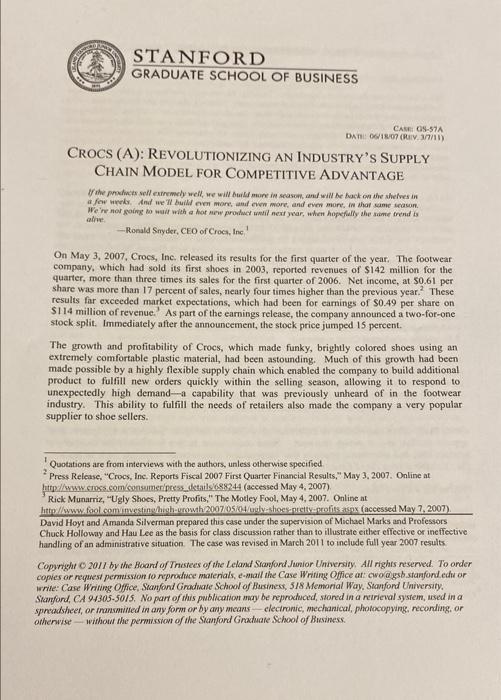
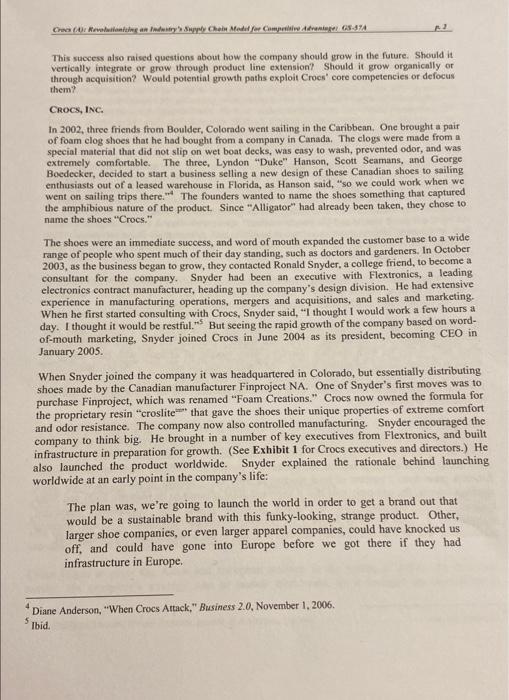
Crocs: Guiding questions 1. What is Crocs overall strategy (product, markets, growth) and what distinctive competencies is it built on? What are the company's customer target segments ? 2. How does Crocs distribution practice differ from the 'traditional practice'? What are the limitations of the traditional model? Why does this give Crocs a competitive advantage ? 3. How did the supply chain develop historically? 4. Analyze the company's supply chain model, its drivers, and its contribution to Crocs success. 5. What major 'lessons learned' in this case would you consider using in your own company, were you to start one? Why? - Aces STANFORD GRADUATE SCHOOL OF BUSINESS CAME: GS-57A DATE: 06/18/07 (REV. 3/7/11) CROCS (A): REVOLUTIONIZING AN INDUSTRY'S SUPPLY CHAIN MODEL FOR COMPETITIVE ADVANTAGE If the products sell extremely well, we will build more in season, and will be back on the shelves in a few weeks. And we'll build even more, and even more, and even more, in that same season. We're not going to wait with a hot new product until next year, when hopefully the same trend is alive. -Ronald Snyder, CEO of Crocs, Inc. On May 3, 2007, Crocs, Inc. released its results for the first quarter of the year. The footwear company, which had sold its first shoes in 2003, reported revenues of $142 million for the quarter, more than three times its sales for the first quarter of 2006. Net income, at $0.61 per share was more than 17 percent of sales, nearly four times higher than the previous year. These results far exceeded market expectations, which had been for earnings of $0.49 per share on $114 million of revenue. As part of the earnings release, the company announced a two-for-one stock split. Immediately after the announcement, the stock price jumped 15 percent. The growth and profitability of Crocs, which made funky, brightly colored shoes using an extremely comfortable plastic material, had been astounding. Much of this growth had been made possible by a highly flexible supply chain which enabled the company to build additional product to fulfill new orders quickly within the selling season, allowing it to respond to unexpectedly high demand-a capability that was previously unheard of in the footwear industry. This ability to fulfill the needs of retailers also made the company a very popular supplier to shoe sellers. Quotations are from interviews with the authors, unless otherwise specified 2 Press Release, "Crocs, Inc. Reports Fiscal 2007 First Quarter Financial Results," May 3, 2007. Online at http://www.cross.com/consumer/press_details/688244 (accessed May 4, 2007). Rick Munarriz, "Ugly Shoes, Pretty Profits," The Motley Fool, May 4, 2007. Online at http://www.fool.com/investing/high-growth 2007/05/04/ugly-shoes-pretty-profits aspx (accessed May 7, 2007). David Hoyt and Amanda Silverman prepared this case under the supervision of Michael Marks and Professors. Chuck Holloway and Hau Lee as the basis for class discussion rather than to illustrate either effective or ineffective handling of an administrative situation. The case was revised in March 2011 to include full year 2007 results. Copyright 2011 by the Board of Trustees of the Leland Stanford Junior University. All rights reserved. To order copies or request permission to reproduce materials, e-mail the Case Writing Office at: cwo@gsb.stanford.edu or write: Case Writing Office, Stanford Graduate School of Business, 518 Memorial Way, Stanford University, Stanford, CA 94305-5015. No part of this publication may be reproduced, stored in a retrieval system, used in a spreadsheet, or transmitted in any form or by any means-electronic, mechanical, photocopying, recording, or otherwise-without the permission of the Stanford Graduate School of Business. Crocs (A): Revolutionizing an Industry's Supply Chain Model for Competitive Advantage: GS-37A A This success also raised questions about how the company should grow in the future. Should it vertically integrate or grow through product line extension? Should it grow organically or through acquisition? Would potential growth paths exploit Crocs' core competencies or defocus them? CROCS, INC. In 2002, three friends from Boulder, Colorado went sailing in the Caribbean. One brought a pair of foam clog shoes that he had bought from a company in Canada. The clogs were made from a special material that did not slip on wet boat decks, was easy to wash, prevented odor, and was extremely comfortable. The three, Lyndon "Duke" Hanson, Scott Seamans, and George Boedecker, decided to start a business selling a new design of these Canadian shoes to sailing enthusiasts out of a leased warehouse in Florida, as Hanson said, "so we could work when we went on sailing trips there." e." The founders wanted to name the shoes something that captured the amphibious nature of the product. Since "Alligator" had already been taken, they chose to name the shoes "Crocs." The shoes were an immediate success, and word of mouth expanded the customer base to a wide range of people who spent much of their day standing, such as doctors and gardeners. In October 2003, as the business began to grow, they contacted Ronald Snyder, a college friend, to become a consultant for the company. Snyder had been an executive with Flextronics, a leading electronics contract manufacturer, heading up the company's design division. He had extensive experience in manufacturing operations, mergers and acquisitions, and sales and marketing. When he first started consulting with Crocs, Snyder said, "I thought I would work a few hours a day. I thought it would be restful." But seeing the rapid growth of the company based on word- of-mouth marketing, Snyder joined Crocs in June 2004 as its president, becoming CEO in January 2005. When Snyder joined the company it was headquartered in Colorado, but essentially distributing shoes made by the Canadian manufacturer Finproject NA. One of Snyder's first moves was to purchase Finproject, which was renamed "Foam Creations." Crocs now owned the formula for the proprietary resin "croslite" that gave the shoes their unique properties of extreme comfort and odor resistance. The company now also controlled manufacturing. Snyder encouraged the company to think big. He brought in a number of key executives from Flextronics, and built infrastructure in preparation for growth. (See Exhibit 1 for Crocs executives and directors.) He also launched the product worldwide. Snyder explained the rationale behind launching worldwide at an early point in the company's life: The plan was, we're going to launch the world in order to get a brand out that would be a sustainable brand with this funky-looking, strange product. Other, larger shoe companies, or even larger apparel companies, could have knocked us off, and could have gone into Europe before we got there if they had infrastructure in Europe. Diane Anderson, "When Crocs Attack," Business 2.0, November 1, 2006. 5 lbid
thanks in advance 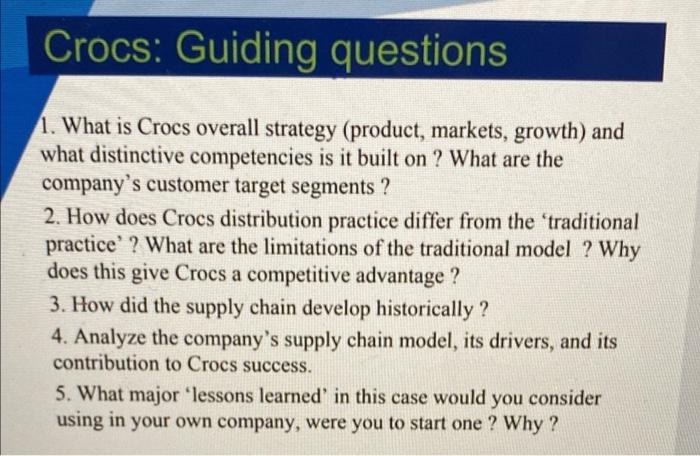
Step by Step Solution
There are 3 Steps involved in it
1 Expert Approved Answer
Step: 1 Unlock

Question Has Been Solved by an Expert!
Get step-by-step solutions from verified subject matter experts
Step: 2 Unlock
Step: 3 Unlock
 Study Help