Question: IF THE READINGS IS TOO BLURRY, please use YOUR PHONE. I WILL POST THE QUESTIONS DOWN BELOW: PLEASE READ THE READING BEFORE ANSWERING THE QUESTIONS!
IF THE READINGS IS TOO BLURRY, please use YOUR PHONE. I WILL POST THE QUESTIONS DOWN BELOW:
PLEASE READ THE READING BEFORE ANSWERING THE QUESTIONS! please answer all or the ones you can.
QUESTION 2- HOW HAS MICROSOFTS STARTEGY AND GOALS CHANGED IN RESPONSE TO TECHNOLOGY CHANGES, ESPECIALLY THE INTERNET?
QUESTION 3- HOW WAS MICROSOFT AN $11 BILLION COMPANY ABLE TO CHANGE ITS STRATEGY SO QUICKLY?
QUESTION 4- EXPLAIN THE MANAGEMENT STRUCTURE? WHY WOULD GATES ESTABLISH AN OFFICE OF THE PRESIDENT?
QUESTION 5- WHAT ARE THE LEGAL AND ETHICAL ISSUES FACING MICROSOFT?
HOW IS THE COMPANY RESPONDING TO THOSE ISSUES?
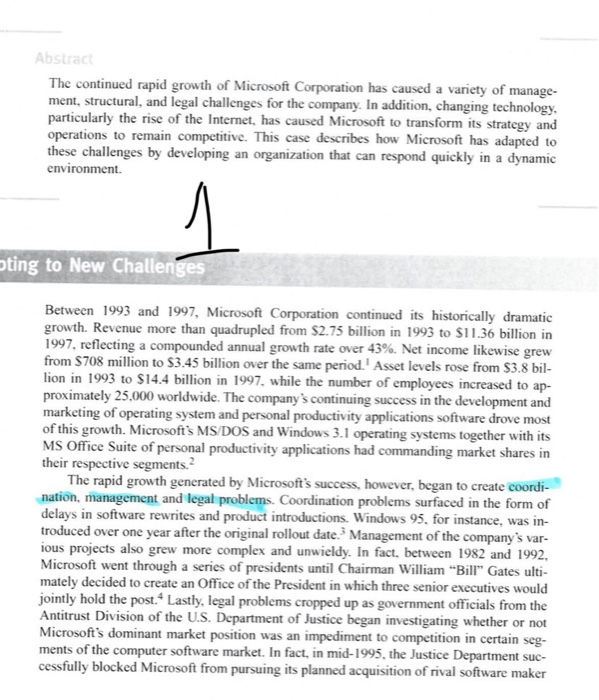
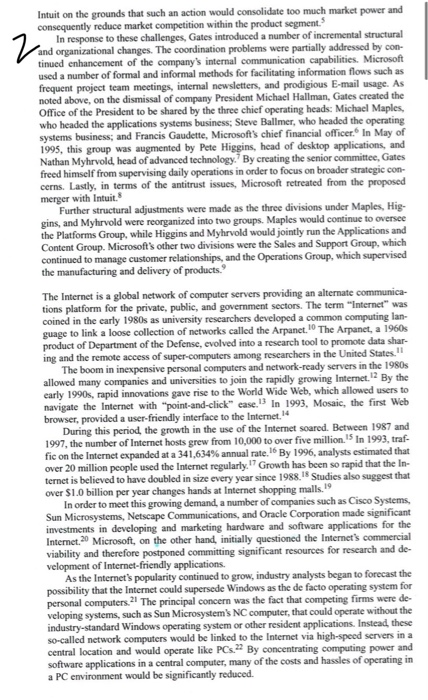
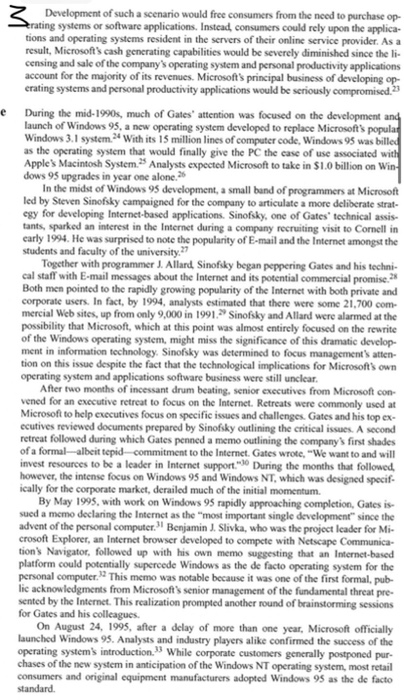
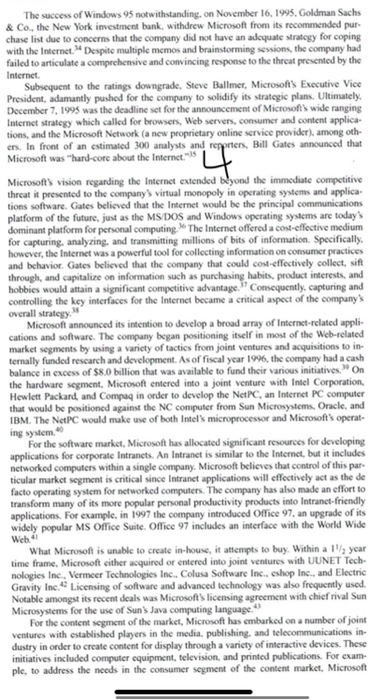
Abstract The continued rapid growth of Microsoft Corporation has caused a variety of manage- ment, structural, and legal challenges for the company. In addition, changing technology, particularly the rise of the Internet, has caused Microsoft to transform its strategy and operations to remain competitive. This case describes how Microsoft has adapted to these challenges by developing an organization that can respond quickly in a dynamic environment. pting to New Challenges Between 1993 and 1997, Microsoft Corporation continued its historically dramatic growth. Revenue more than quadrupled from $2.75 billion in 1993 to $11.36 billion in 1997, reflecting a compounded annual growth rate over 43%. Net income likewise grew from $708 million to $3.45 billion over the same period. Asset levels rose from $3.8 bil- lion in 1993 to $14.4 billion in 1997, while the number of employees increased to ap- proximately 25,000 worldwide. The company's continuing success in the development and marketing of operating system and personal productivity applications software drove most of this growth. Microsoft's MS/DOS and Windows 3.1 operating systems together with its MS Office Suite of personal productivity applications had commanding market shares in their respective segments.? The rapid growth generated by Microsoft's success, however, began to create coordi- nation, management and legal problems. Coordination problems surfaced in the form of delays in software rewrites and product introductions. Windows 95, for instance, was in- troduced over one year after the original rollout date. Management of the company's var- ious projects also grew more complex and unwieldy. In fact, between 1982 and 1992, Microsoft went through a series of presidents until Chairman William "Bill Gates ulti- mately decided to create an Office of the President in which three senior executives would jointly hold the post. Lastly, legal problems cropped up as government officials from the Antitrust Division of the U.S. Department of Justice began investigating whether or not Microsoft's dominant market position was an impediment to competition in certain seg- ments of the computer software market. In fact, in mid-1995, the Justice Department suc- cessfully blocked Microsoft from pursuing its planned acquisition of rival software maker 2 Intuit on the grounds that such an action would consolidate too much market power and consequently reduce market competition within the product segment. In response to these challenges, Gates introduced a number of incremental structural and organizational changes. The coordination problems were partially addressed by con- tinued enhancement of the company's internal communication capabilities. Microsoft used a number of formal and informal methods for facilitating information flows such as frequent project team meetings, internal newsletters, and prodigious E-mail usage. As noted above, on the dismissal of company President Michael Hallman, Gates created the Office of the President to be shared by the three chief operating heads: Michael Maples, who headed the applications systems business: Steve Ballmer, who headed the operating systems business, and Francis Gaudette, Microsoft's chief financial officer. In May of 1995, this group was augmented by Pete Higgins, head of desktop applications, and Nathan Myhrvold, head of advanced technology. By creating the senior committee, Gates freed himself from supervising daily operations in order to focus on broader strategic con- cerns. Lastly, in terms of the antitrust issues, Microsoft retreated from the proposed merger with Intuit. Further structural adjustments were made as the three divisions under Maples, Hig- gins, and Myhrvold were reorganized into two groups. Maples would continue to oversee the Platforms Group, while Higgins and Myhrvold would jointly run the Applications and Content Group. Microsoft's other two divisions were the Sales and Support Group, which continued to manage customer relationships, and the Operations Group, which supervised the manufacturing and delivery of products. The Internet is a global network of computer servers providing an alternate communica- tions platform for the private, public, and government sectors. The term "Internet" was coined in the early 1980s as university researchers developed a common computing lan- guage to link a loose collection of networks called the Arpanet. The Arpanet, a 1960s product of Department of the Defense, evolved into a research tool to promote data shar- ing and the remote access of super-computers among researchers in the United States." The boom in inexpensive personal computers and network-ready servers in the 1980s allowed many companies and universities to join the rapidly growing Internet. By the early 1990s, rapid innovations gave rise to the World Wide Web, which allowed users to navigate the Internet with "point-and-click" case. In 1993, Mosaic, the first Web browser, provided a user-friendly interface to the Internet. 14 During this period, the growth in the use of the Internet soared. Between 1987 and 1997, the number of Internet hosts grew from 10,000 to over five million. In 1993, traf- fic on the Internet expanded at a 341,634% annual rate.16 By 1996, analysts estimated that over 20 million people used the Internet regularly. Growth has been so rapid that the In- ternet is believed to have doubled in size every year since 1988. Studies also suggest that over $1.0 billion per year changes hands at Internet shopping malls 19 In order to meet this growing demand a number of companies such as Cisco Systems, Sun Microsystems, Netscape Communications, and Oracle Corporation made significant investments in developing and marketing hardware and software applications for the Internet. 20 Microsoft, on the other hand, initially questioned the Internet's commercial viability and therefore postponed committing significant resources for research and de- velopment of Internet-friendly applications. As the Internet's popularity continued to grow, industry analysts began to forecast the possibility that the Internet could supersede Windows as the de facto operating system for personal computers 21 The principal concern was the fact that competing firms were de- veloping systems, such as Sun Microsystem's NC computer, that could operate without the industry-standard Windows operating system or other resident applications. Instead, these so-called network computers would be linked to the Internet via high-speed servers in a central location and would operate like PCs. By concentrating computing power and software applications in a central computer, many of the costs and hassles of operating in a PC environment would be significantly reduced. 3 Development of such a scenario would free consumers from the need to purchase op- rating systems or software applications. Instead, consumers could rely upon the applica- tions and operating systems resident in the servers of their online service provider. As a result, Microsoft's cash generating capabilities would be severely diminished since the li censing and sale of the company's operating system and personal productivity applications account for the majority of its revenues. Microsoft's principal business of developing op erating systems and personal productivity applications would be seriously compromised. 23 e During the mid-1990s, much of Gates' attention was focused on the development and launch of Windows 95, a new operating system developed to replace Microsoft's popular Windows 3.1 system. With its 15 million lines of computer code, Windows 95 was billed as the operating system that would finally give the PC the case of use associated with Apple's Macintosh System. Analysts expected Microsoft to take in $10 billion on Win dows 95 upgrades in year one alone. 26 In the midst of Windows 95 development, a small band of programmers at Microsoft led by Steven Sinofsky campaigned for the company to articulate a more deliberate strat- egy for developing Internet-based applications. Sinofsky, one of Gates' technical assis tants, sparked an interest in the Internet during a company recruiting visit to Corell in early 1994. He was surprised to note the popularity of E-mail and the Internet amongst the students and faculty of the university ? Together with programmer. Allard, Sinofsky began peppering Gates and his techni- cal staff with E-mail messages about the Internet and its potential commercial promise 28 Both men pointed to the rapidly growing popularity of the Internet with both private and corporate users. In fact, by 1994, analysts estimated that there were some 21,700 com mercial Web sites, up from only 9,000 in 1991." Sinofsky and Allard were alarmed at the possibility that Microsoft, which at this point was almost entirely focused on the rewrite of the Windows operating system, might miss the significance of this dramatic develop ment in information technology, Sinofsky was determined to focus management's atten- tion on this issue despite the fact that the technological implications for Microsoft's own operating system and applications software business were still unclear. After two months of incessant drum beating, senior executives from Microsoft con vened for an executive retreat to focus on the Internet. Retreats were commonly used at Microsoft to help executives focus on specific issues and challenges. Gates and his top ex- ecutives reviewed documents prepared by Sinofsky outlining the critical issues. A second retreat followed during which Gates penned a memo outlining the company's first shades of a formal-albeit tepid-commitment to the Internet. Gates wrote, "We want to and will invest resources to be a leader in Internet support. During the months that followed, however, the intense focus on Windows 95 and Windows NT, which was designed specif. ically for the corporate market, derailed much of the initial momentum. By May 1995, with work on Windows 95 rapidly approaching completion, Gates is sued a memo declaring the Internet as the most important single development" since the advent of the personal computer. Benjamin J. Slivka, who was the project leader for Mi. crosoft Explorer, an Internet browser developed to compete with Netscape Communica- tion's Navigator, followed up with his own memo suggesting that an Internet-based platform could potentially supercede Windows as the de facto operating system for the personal computer. This memo was notable because it was one of the first formal, pub- lic acknowledgments from Microsoft's senior management of the fundamental threat pre- sented by the Internet . This realization prompted another round of brainstorming sessions for Gates and his colleagues. On August 24, 1995, after a delay of more than one year, Microsoft officially launched Windows 95. Analysts and industry players alike confirmed the success of the operating system's introduction. While corporate customers generally postponed pur chases of the new system in anticipation of the Windows NT operating system, most retail consumers and original equipment manufacturers adopted Windows 95 as the de facto standard The success of Windows 95 notwithstanding, on November 16, 1995. Goldman Sachs & Co, the New York investment bank, withdrew Microsoft from its recommended pur chase list due to concerns that the company did not have an adequate strategy for coping with the Internet. Despite multiple memos and brainstorming sessions, the company had failed to articulate a comprehensive and convincing response to the threat presented by the Internet Subsequent to the ratings downgrade. Steve Ballmer, Microsoft's Executive Vice President, adamantly pushed for the company to solidify its strategic plans. Ultimately, December 7, 1995 was the deadline set for the announcement of Microsoft wide ranging Internet strategy which called for browsers, Web servers, consumer and content applica tions, and the Microsoft Network (a new proprietary online service provider), among oth- ers. In front of an estimated 300 analysts and reporters, Bill Gates announced that Microsoft was "hard-core about the Internet." Microsoft's vision regarding the Internet extended beyond the immediate competitive threat it presented to the company's virtual monopoly in operating systems and applica tions software. Gates believed that the Internet would be the principal communications platform of the future, just as the MS DOS and Windows operating systems are today's dominant platform for personal computing. The Internet offered a cost-effective medium for capturing, analyzing, and transmitting millions of bits of information. Specifically, however, the Internet was a powerful tool for collecting information on consumer practices and behavior. Gates believed that the company that could cost-effectively collect, sift through, and capitalize on information such as purchasing habits, product interests, and hobbies would attain a significant competitive advantage. Consequently, capturing and controlling the key interfaces for the Internet became a critical aspect of the companys overall strategy Microsoft announced its intention to develop a broad array of Internet-related appli- cations and software. The company began positioning itself in most of the Web-related market segments by using a variety of tactics from joint ventures and acquisitions to in ternally funded research and development. As of fiscal year 1996, the company had a cash balance in excess of $8.0 billion that was available to fund their various initiatives. On the hardware segment, Microsoft entered into a joint venture with Intel Corporation, Hewlett Packard, and Compaq in order to develop the NetPC, an Internet PC computer that would be positioned against the NC computer from Sun Microsystems, Oracle, and IBM The NetPC would make use of both Intel's microprocessor and Microsoft operat ing system. For the software market, Microsoft has allocated significant resources for developing applications for corporate Intranets. An Intranet is similar to the Internet, but it includes networked computers within a single company. Microsoft believes that control of this par ticular market segment is critical since Intranet applications will effectively act as the de facto operating system for networked computers. The company has also made an effort to transform many of its more popular personal productivity products into Intranet-friendly applications. For example, in 1997 the company introduced Office 97. an upgrade of its widely popular MS Office Suite. Office 97 includes an interface with the World Wide Wich What Microsoft is unable to create in-house, it attempts to buy. Within a 1/2 year time frame, Microsoft either acquired or entered into joint ventures with UUNET Tech- nologies Inc. Vermeer Technologies Inc. Colusa Software Inc., cshop Inc., and Electric Gravity Inc. Licensing of software and advanced technology was also frequently used Notable amongst its recent deals was Microsoft licensing agreement with chief rival Sun Microsystems for the use of Sun's Java computing language For the content segment of the market, Microsoft has embarked on a number of joint ventures with established players in the media, publishing, and telecommunications in dustry in order to create content for display through a variety of interactive devices. These initiatives included computer equipment, television, and printed publications. For exam ple, to address the needs in the consumer segment of the content market. Microsoft worked with Dreamworks SKG to develop a line of 3-D computer games "Decamworks provided the creative talent for the venture while Microsoft furnished technical expertise Microsoft also has allocated a significant portion of its cash reserves to purchase fledgling content development firms. For the business segment of the content market, Microsoft' principal efforts focused on the development of MSNBC, a 24-hour business news chan- nel distributed both via cable networks and the Internet. MSNBC is a joint venture with General Electric's NBC television subsidiary While preparing the launch of Windows 95, Microsoft's programmers were also put ting the finishing touches on the company's new proprietary online service provider, the Microsoft Network (MSN). The principal business of an online service provider is to provide subscribers access to the Internet. America Online, CompuServe, and Prodigy were among the first companies to actively package and market Internet access Mi- crosoft began development of MSN in December 1992, in part due to the success of Amer- ica Online, which rapidly became the world's largest proprietary online service provider. Jeffrey Katzenberg. principal of Dreamworks SKG, noted. "I cannot think of one corpo ration that has had this kind of success and after 20 years, just stopped and decided to rein- vent itself from the ground up. What they are doing is decisive, quick, breathtaking. *** A Microsoft employee adds that Bill Gates has taken a booming S11 billion company with 25.000 employees and turned the "hattleship around as if it were a PT boat-50 Within a one-year period, Gates and his team achieved what many industry analyst said was impossible. Essentially, Microsoft took what was the world's largest and most prolific operating software and personal productivity application developer and trans formed it into a dominant Internet.focused company with significant ventures in the hard- ware, software, and content segments of the market. In fiscal year 1996, total sales revenues grew 46% from $5.96 billion in 1995 to $8.67 billion. Net income grew over 40% from $1.5 billion to $2.2 billion. Perhaps even more telling about the company fu- ture are its plans to dramatically raise its investment in new technologies. Over the next year alone, the company will deploy its financial resources to fund over $2.0 billion worth of research and development, which is almost half of the total 54.4 billion that it has spent over its 22-year history. Employment applications are still flooding in at a rate of 15,000 per month, giving Microsoft the enviable advantage of picking from the best and the brightest. 5 By packaging MSN together with Windows 95. Microsoft intended to create a system whose features would be samlessly blended together. While the product was delivered on schedule in November 1995, an antitrust investigation by the Justice Department ulti- mately forced the company to reassess its approach. The principal issue investigated by the government was whether Microsoft's packaging plan would constitute an unfair advantage over its competitors. While no formal charges were filed during the investigation, Mi- crosoft moved to adjust aspects of its original plan in order to address some of the gove ernment concerns In October 1997, Microsoft again came under government scrutiny for tying its Inter net browser, known as Internet Explorer (IE), to the upgraded version of Windows 95 The Justice Department sued Microsoft for "Trying to use its overwhelming dominance in computer operating systems to compete unfairly in the browser market. -5* Microsoft.com siders Windows 95 to be an integrated program, which means that a wide variety of fca- tures are built into the software. The company was requiring computer manufacturers to install IE as a condition of licensing Windows 95 on new PCS As such, computers that come with Windows 95 preinstalled would automatically have the le icon on the desktop, Further. is worn statements from computer manufacturers.. show exactly how Microsoft ruth lessly used its control over what appears on the PC desktop as the means to displace Netscape Navigator with its ownt Internet Explorer browser. Although end-users were free to adapt their desktops, the computer manufacturers had to cure, as a condition of 6. their Windows license, that when a machine was switched on for the first time the desktop had every icon on it that Microsoft decreed. Faced with the threat that they would lose their Windows license and thus their business if they removed the IE icon, PC makers all meekly fell into line. In December 1997, the government ordered Microsoft to offer PC manufacturers the choice of whether or not to include IE on the system. Microsoft responded by offering PC manufacturers two alternatives to the combined Windows and IE system: 1) an outdated version of Windows that predated IE, or 2) a version of Windows with IE disabled. The problem with the second option was that the software would not function properly with out IE fully activated. Neither option was accepted by any OEM manufacturers. The government was outraged by Microsoft's response. Since Windows is the de facto standard for operating systems, the government maintained that Microsoft was using its near-monopoly in operating system software to restrict competition in the market for In- temet browsing software, where its main competitor is Netscape Communications Corpo ration Microsoft, on the other hand, maintained that Windows and I had become a single integrated product. In addition, Microsoft feared that government interference would hamper the company's strategy of blending Internet capabilities into all of its new products 57 In addition to complaints from the government and Windows licensees, Microsoft's competitors in the software arena have actively voiced concerns about the company's growing market power. Both Netscape and Sun Microsystems have suggested that Mi- crosoft's aggressive tactics in the software marketplace border on the tyrannical."** Netscape, the current leader for Internet browsers with a 60% market share, has steadily been losing ground, and attributes its losses to Microsoft's policy of bundling IE with the Windows operating system. Until January 1998, Microsoft continued to insist that IE and Windows were so intri- cately integrated that Windows simply could not operate without IE. In order to avoid being found in contempt of court, however, Microsoft ultimately gave in to government demands by agreeing to make Windows available with the Internet browser icon hidden or partially removed from the computer desktop. A moderately knowledgeable consumer can casily install the icon on the desktop, Throughout the 1970s and 1980s, while in its infancy, Microsoft had no need to be con cerned with government matters. Rapidly increasing market power, however, has caused the government to pay attention to the now large corporation. While Gates maintains that he has done nothing more than remain responsive to consumer demands, the company's ability to influence industry standards has led to intense government scrutiny. Specifically, the Justice Department fears that Microsoft's control of industry standards could impede innovation, leaving competing technologies little chance to survive. Too much government interference, however, could have potentially devastating effects on Microsoft's strategy In 1996 Gates began to hire lobbyists, including Washington lawyer Jack Krumholtz, in order to defend his company against government attacks. "We've increased our politi- cal giving) efforts in response to the very concerted campaign by our competitors to use the government against us rather than to compete in the marketplace," says Krumholtz Until recently, the company made few political contributions and preferred to lobby in Washington through the Business Software Alliance an industry trade group whose mis- sion is to advocate free and open world trade for legitimate business software and its own law firm, Preston Gates Ellis & Rouvelas Meeds. Even Gates himself has begun to spend more time in government matters. Although he rarely visits Capitol Hill, Microsoft's chief executive has been inviting more and more politicians to both the company's corporate headquarters and his private home. Mi- crosoft has also increased its campaign contributions. In 1996, for example, the company donated $236,784 to candidates for office, as compared to only $105,484 just two years carlier. As Microsoft's market power has increased since its humble beginnings, the company's tremendous success has coincided with a shift in Gates image as a 'quintessential nerd' to one who uses brute force to dominate the marketplace, stifling innovation by con trolling industry standards. Indeed, "Microsoft has been able to crush competitors- eliminating competition and perhaps innovation, which could harm consumers. To fur- ther promote this negative image, it has been said that Microsoft has taken a "combative stance" in government courtroom confrontations, during which the company, usually so sure footed has appeared at times to be throwing a temper tantrum, picking fights with a Federal judge and the Justice Department. In a campaign beginning in March 1998, Bill Gates became a celebrity endorser for a line of golf clubs. The campaign consisted of a television commercial and print advertise- ment, and featured Gates as an enthusiastic new golf player. Gates added his role as an en- dorser to his resume at a time when he seems to be engaged in a frenetic series of activities intended to change perceptions of him as a rapacious cyber capitalist bent on dominating the information industry Corporate identity and brand image consultant Clay Timon commended the move, stating. "It will make (Gates) seem human after all. 65 In additional public relations activities, Gates paid tribute to the Wright brothers at Time magazine's 75th anniversary pact.presented a $640,000 gift to the New York Library, and visited a sixth grade class Microsoft Internet-focused strategy had dramatic implications for both the company and its employees. New product groups were formed and divisions were reorganized in order to focus on a variety of product initiatives. As previously noted Microsoft was organized into four main business groups: 1) the Platforms Products Group: 2) the Applications and Content Product Group: 3) the Sales and Support Group, and 4) the Operations Group.66 In February 1996, both the Platforms Products Group and the Applications and Content Product Group were reorganized in conjunction with company's efforts to enhance its in ternet capabilities. The Platforms Group, headed by Group Vice President Paul Maritz, was organized into three divisions: 1) the Personal and Business Systems Division (which develops and markets applications such as Windows 3.x, Windows 95, Windows NT, and the BackOf- fice applications, etc.); 2) the Consumer Devices and Public Networks Division (hand- held devices, set-top bones, etc.); and 3) the Internet Platforms Division (focusing on Web browsers, shell and multimedia technology, developer tools, online service commerce technology, etc.)67 The Applications and Content Product Group, run by Group Vice Presidents Nathan Myhrvold and Pete Higgins, was likewise reorganized into three divisions. The Desktop Applications Division focuses on personal productivity and consumer applications (e.g. Microsoft Office). The Interactive Media Division develops online and CD-ROM based versions of consumer and business software while overseeing development of content for MSN. The Advanced Technology and Research Division focuses on emerging technolo gies such as speech recognition and artificial intelligence." The Sales and Support Group, headed by EVP Ballmer, is responsible for "building long-term business relationships with customers. This group is structured to focus on three customer types: end users, organizations, and original cquipment manufacturers (OEMs). The Operations Group, headed by EVP and COO Bob Herbold, is responsible for managing business operations. This includes processing, manufacturing and delivering finished goods, licenses, subscriptions, and overall business planning." In reorganizing the Platforms Products Group and the Applications and Content Prod- uct Group, Microsoft was able to capitalize on its loosely structured team approach to soft- ware development. Teams of software developers and marketers frequently are used to develop specific software applications. Because the team concept is so pervasive, man agement was readily able to reshape both business groups by adding and eliminating prod- uct teams according to management's assessment of their strategic value. A variety of new units were created to focus on discrete aspects of the company's overall Internet strategy 8 Microsoft: Adapting to New Challenges 8 Microsoft was reorganized again in early 1998. The move placed three product groups under Paul Mafitz, Group Vice President for Platforms and Operations. The groups are: 1) Personal and Business Systems, 2) Consumer Platforms, and 3) Applications and Tools. The move also shifted responsibility for Internet Explorer into the Personal and Business Systems Group, which is the unit that develops and markets Windows. David Readerman, a financial analyst at Nationsbanc Montgomery Securities Inc., supports the move, stating that Internet Explorer is an integrated product. You better integrate the reporting respon- sibilities. The reorganization came less than one month after the company agreed to make Windows available without the Internet Explorer icon present on the desktop. Due to this timing, it has been said that the move is certain to raise eyebrows in light of the Microsoft Corporation's antitrust battle with the United States Government."72 Now that Microsoft represents the dominant force in the computer software industry, Bill Gates claims to have trouble comprehending the nature of the allegations being thrown at his company. He says that rivals should pay more attention to their own businesses and less time obsessing about Microsoft's competitive position. After all, the technology markets are fast paced, and there are no guarantees that Microsoft will remain the industry leader. In fact, it has been said that the Justice Department "faces an extraordinary challenge in keeping ... in step with the fast-changing Internet software market and Microsoft's quickly shifting tactics."73 Gates even cites the emergence of Netscape's Navigator and Sun Microsystem's Java programming language as evidence of the highly competitive and threatening nature of the industry. However, there is little opposition to the point that Mi- crosoft virtually owns the future of computing. In fact, it has been said that if Gates can extend Microsoft's dominance to the Internet browser realm, "the little software company he co-founded in 1975 could come to dominate the nexus of computing and communica- tions well into the 21st century."74









 Study Help