







Question: I need the Matlab code to make these parts work. In this problem set you will be building a simple integrate-and-fire neuron. You should assume
I need the Matlab code to make these parts work. 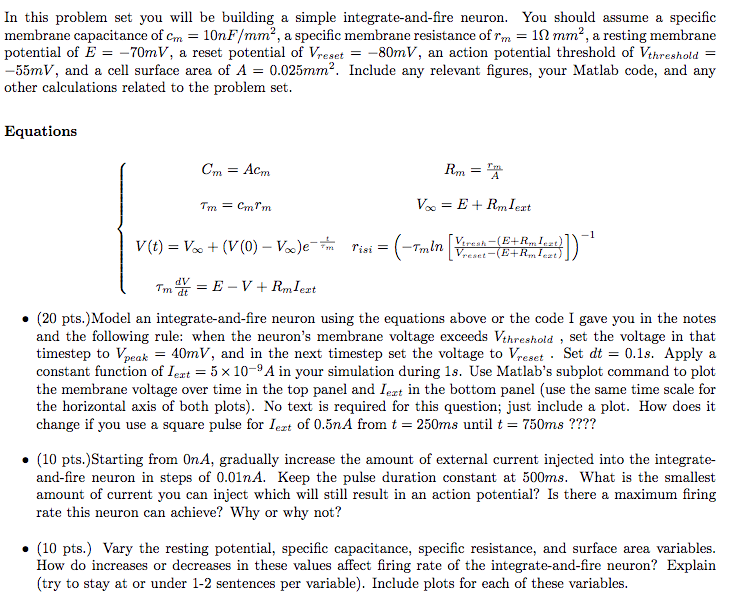
In this problem set you will be building a simple integrate-and-fire neuron. You should assume a specific membrane capacitance of cm10nF/mm2, a specific membrane resistance of rm-12 mm2, a resting membrane potential of E =-70mV, a reset potential of Vreet--80mV, an action potential threshold of Vinre hold- -55mV, and a cell surface area of A = 0.025mm2. Include any relevant figures. your Matlab code, and any other calculations related to the problem set Equations TmCmTm isi(_ . (20 pts.)Model an integrate-and-fire neuron using the equations above or the code I gave you in the notes and the following rule: when the neuron's membrane voltage exceeds Vthreshoid , set the voltage in that timestep to Vpeak 40mV, and in the next timestep set the voltage to Vreset constant function of Iert5 x 10-9A ii the membrane voltage over time in the top panel and lezt in the bottom panel (use the same time scale for the horizontal axis of both plots). No text is required for this question; just include a plot. How does it change if you use a square pulse for lezt of 0.5nA from t = 250ms until t = 750ms ???? Set dt0.1s. Apply a n your simulation during 1s. Use Matlab's subplot command to plot . (10 pts.)Starting from OnA, gradually increase the amount of external current injected into the integrate- and-fire neuron in steps of 0.01nA. Keep the pulse duration constant at 500ms. What is the smallest amount of current you can inject which will still result in an action potential? Is there a maximum firing rate this neuron can achieve? Why or why not? . (10 pts.) Vary the resting potential, specific capacitance, specific resistance, and surface area variables How do increases or decreases in these values affect firing rate of the integrate-and-fire neuron? Explain (try to stay at or under 1-2 sentences per variable). Include plots for each of these variables. In this problem set you will be building a simple integrate-and-fire neuron. You should assume a specific membrane capacitance of cm10nF/mm2, a specific membrane resistance of rm-12 mm2, a resting membrane potential of E =-70mV, a reset potential of Vreet--80mV, an action potential threshold of Vinre hold- -55mV, and a cell surface area of A = 0.025mm2. Include any relevant figures. your Matlab code, and any other calculations related to the problem set Equations TmCmTm isi(_ . (20 pts.)Model an integrate-and-fire neuron using the equations above or the code I gave you in the notes and the following rule: when the neuron's membrane voltage exceeds Vthreshoid , set the voltage in that timestep to Vpeak 40mV, and in the next timestep set the voltage to Vreset constant function of Iert5 x 10-9A ii the membrane voltage over time in the top panel and lezt in the bottom panel (use the same time scale for the horizontal axis of both plots). No text is required for this question; just include a plot. How does it change if you use a square pulse for lezt of 0.5nA from t = 250ms until t = 750ms ???? Set dt0.1s. Apply a n your simulation during 1s. Use Matlab's subplot command to plot . (10 pts.)Starting from OnA, gradually increase the amount of external current injected into the integrate- and-fire neuron in steps of 0.01nA. Keep the pulse duration constant at 500ms. What is the smallest amount of current you can inject which will still result in an action potential? Is there a maximum firing rate this neuron can achieve? Why or why not? . (10 pts.) Vary the resting potential, specific capacitance, specific resistance, and surface area variables How do increases or decreases in these values affect firing rate of the integrate-and-fire neuron? Explain (try to stay at or under 1-2 sentences per variable). Include plots for each of these variables
Step by Step Solution
There are 3 Steps involved in it

Get step-by-step solutions from verified subject matter experts
 Study Help