



Question: I need the separation scheme for this lab. I included the example given. Thank you! 3D EXPERIMENT 3 D Use of Extraction to Isolate a
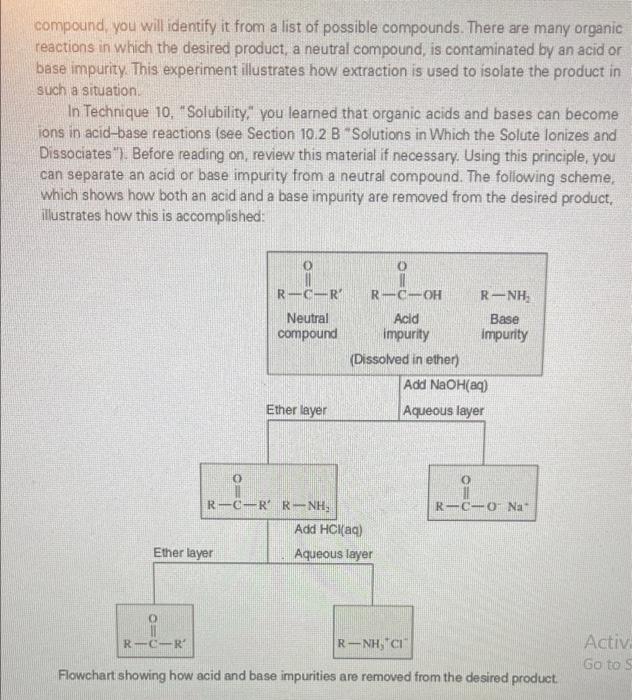
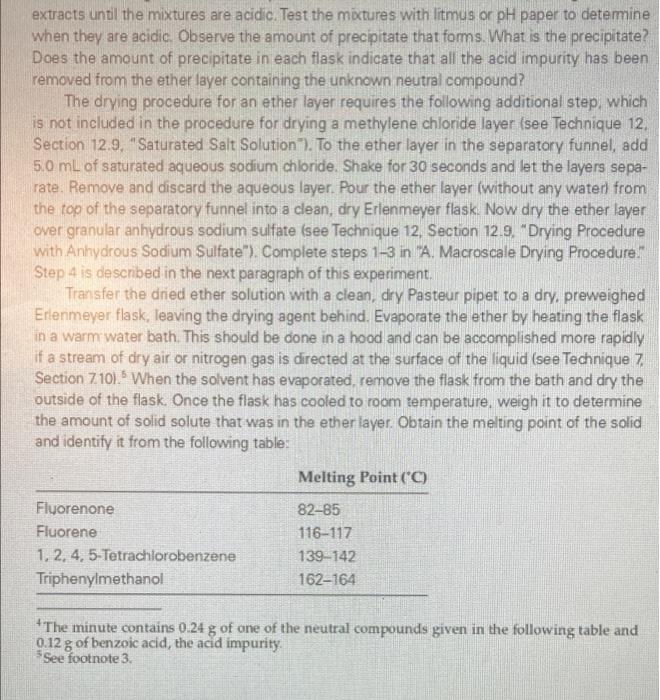
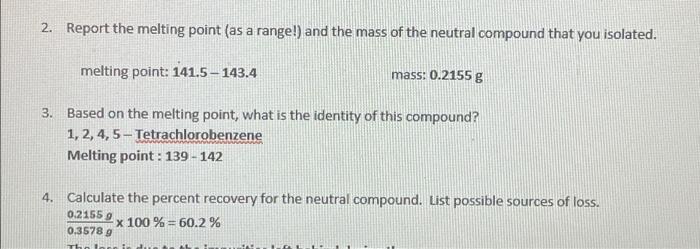
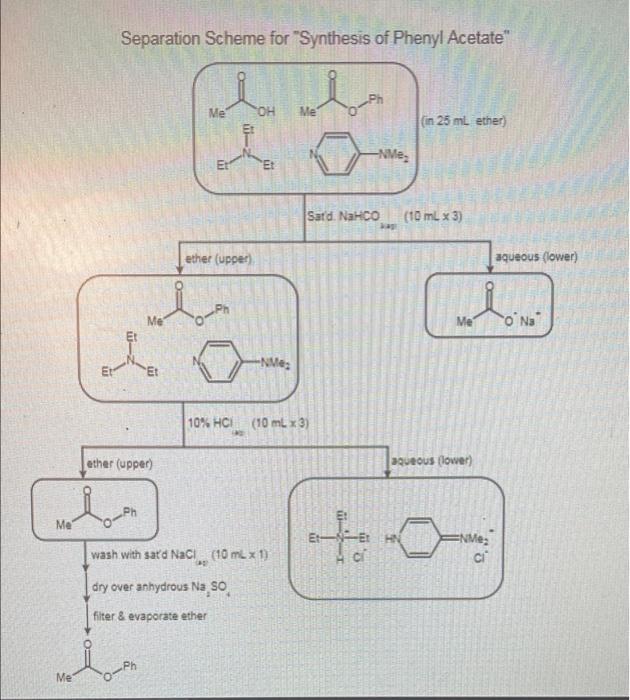
3D EXPERIMENT 3 D Use of Extraction to Isolate a Neutral Compound from a Mixture Containing an Acid or Base Impurity In this experiment, you will be given a solid sample containing an unknown neutral com- pound and an acid or base impurity. The goal is to remove the acid or base by extrac- tion and isolate the neutral compound. By determining the melting point of the neutral "The three mixtures will likely be (1) water and t-butyl chloride, 2) water and on-butyl bromide, and (3) n-butyl bromide and saturated aqueous sodium bromide. compound you will identify it from a list of possible compounds. There are many organic reactions in which the desired product, a neutral compound, is contaminated by an acid or base impurity. This experiment illustrates how extraction is used to isolate the product in such a situation In Technique 10,"Solubility," you learned that organic acids and bases can become ions in acid-base reactions (see Section 10.2 B Solutions in which the Solute lonizes and Dissociates"). Before reading on, review this material if necessary. Using this principle, you can separate an acid or base impurity from a neutral compound. The following scheme, which shows how both an acid and a base impurity are removed from the desired product, illustrates how this is accomplished: O R-C-R Neutral compound R-C-OH R-NH Acid Base impurity impurity (Dissolved in ether) Add NaOH(aq) Aqueous layer Ether layer RC-01 Na R-C-RR-NH, Add HCl(aq) Ether layer Aqueous layer RR R-NH, a Activ Gatos Flowchart showing how acid and base impurities are removed from the desired product. Flowchart showing how acid and base impurities are removed from the desired product The neutral compound can now be isolated by removing the water dissolved in the ether and evaporating the ether. Because ether dissolves a relatively large quantity of water (15%), the water must be removed in two steps. In the first step, the ether solution is mixed with a saturated aqueous NaCl solution. Most of the water in the ether layer will be transferred to the aqueous layer in this step (see Technique 12. Section 12.9). Finally, the remainder of the water is removed by drying the ether layer over anhydrous sodium sulfate. The neutral com- pound can then be isolated by evaporating the ether. In most organic experiments that use a separation scheme such as this, it would be necessary to perform a crystallization step to purify the neutral compound. In this experiment however the neutral compound should be sufficiently pure at this point to identify it by melting point The organic solvent used in this experiment is ether Recall that the full name for ether is diethyl ether. Because ether is less dense than water this experiment will give you prac- tice in performing extractions where the nonpolar solvent is less dense than water. The following procedure provides instruction on removing an acid impurity from a neu- tral compound and isolating the neutral compound. It contains an additional step that is not normally part of this kind of separation scheme: The aqueous layers from each extraction are Go segregated and acidified with aqueous HCl. The purpose of this step is to verify that the acid impurity has been removed completely from the ether layer. In the Optional Exercise, the sample contains a neutral compound with a base impurity; however, a detailed procedure is not given If you are assigned this exercise, you must create a procedure by using the princi- ples discussed in this introduction and by studying the following procedure for isolating the neutral compound from an acid impurity Isolating a Neutral Compound from a Mixture Containing an Acid Impurity. Add 0.36 g of an un- known mixture to a screw-cap centrifuge tube. Add 10.0 mL of ether to the tube and cap it. Shake the tube until all the solid dissolves completely. Transfer this solution to a 125-mL separatory funnel. Add 5.0 mL of 10 M NaOH to the separatory funnel and shake for 30 seconds, using the same procedure described in Part A Let the layers separate. Remove the bottom (aqueous) layer and place this in an Erlenmeyer flask labeled "Ist NaOH extract." Add another 5.0-ml. portion of 1.0 M NaOH to the funnel and shake for 30 seconds. When the layers have sepa rated, remove the aqueous layer and put it in an Erlenmeyer flask labeled "2nd NaOH extract." While stirring, add 6 M HCl dropwise to each of the two test flasks containing the NaOH extracts until the mixtures are acidic. Test the mixtures with litmus or pH paper to determine when they are acidic. Observe the amount of precipitate that forms. What is the precipitate? Does the amount of precipitate in each flask indicate that all the acid impurity has been removed from the ether layer containing the unknown neutral compound? The drying procedure for an ether layer requires the following additional step, which is not included in the procedure for drying a methylene chloride layer (see Technique 12, Section 12.9. "Saturated Sait Solution"). To the ether layer in the separatory funnel, add 5.0 mL of saturated aqueous sodium chloride. Shake for 30 seconds and let the layers sepa- rate. Remove and discard the aqueous layer. Pour the ether layer (without any water from the top of the separatory funnel into a clean, dry Erlenmeyer flask. Now dry the ether layer over granular anhydrous sodium sulfate (see Technique 12, Section 12.9. "Drying Procedure with Anhydrous Sodium Sulfate"). Complete steps 13 in "A. Macroscale Drying Procedure." Step 4 is described in the next paragraph of this experiment. Transfer the dried ether solution with a clean, dry Pasteur pipet to a dry, preweighed Erlenmeyer flask, leaving the drying agent behind Evaporate the ether by heating the flask in a warm water bath. This should be done in a hood and can be accomplished more rapidly extracts until the mixtures are acidic. Test the mixtures with litmus or pH paper to determine when they are acidic. Observe the amount of precipitate that foms. What is the precipitate? Does the amount of precipitate in each flask indicate that all the acid impurity has been removed from the ether layer containing the unknown neutral compound? The drying procedure for an ether layer requires the following additional step, which is not included in the procedure for drying a methylene chloride layer (see Technique 12 Section 12.9. "Saturated Salt Solution"). To the ether layer in the separatory funnel, add 5.0 mL of saturated aqueous sodium chloride. Shake for 30 seconds and let the layers sepa- rate. Remove and discard the aqueous layer. Pour the ether layer (without any water from the top of the separatory funnel into a clean, dry Erlenmeyer flask. Now dry the ether layer over ular anhydrous sodium sulfate (see Technique 12, Section 12.9. "Drying Procedure with Anhydrous Sodium Sulfate"). Complete steps 1-3 in "A. Macroscale Drying Procedure." Step 4 is described in the next paragraph of this experiment. Transfer the dried ether solution with a clean, dry Pasteur pipet to a dry, preweighed Erlenmeyer flask, leaving the drying agent behind. Evaporate the ether by heating the flask in a warm water bath. This should be done in a hood and can be accomplished more rapidly if a stream of dry air or nitrogen gas is directed at the surface of the liquid (see Technique 7. Section 710). When the solvent has evaporated, remove the flask from the bath and dry the outside of the flask. Once the flask has cooled to room temperature, weigh it to determine the amount of solid solute that was in the ether layer. Obtain the melting point of the solid and identify it from the following table: Melting Point (C) Fluorenone 82-85 Fluorene 116-117 1, 2, 4, 5-Tetrachlorobenzene 139-142 Triphenylmethanol 162-164 *The minute contains 0.24 g of one of the neutral compounds given in the following table and 0.12 g of benzoic acid, the acid impurity See footnote 3 2. Report the melting point (as a range!) and the mass of the neutral compound that you isolated. melting point: 141.5- 143.4 mass: 0.2155 g 3. Based on the melting point, what is the identity of this compound? 1, 2, 4,5-Tetrachlorobenzene Melting point : 139-142 4. Calculate the percent recovery for the neutral compound. List possible sources of loss. 0.2155 g x 100 %= 60.2% 0.35789 TH Separation Scheme for "Synthesis of Phenyl Acetate" Me OH Me in 25 ml ether) -NME Satd. NaHCO (10 mL x 3) ether (upper) aqueous (lower) Coin Me Me O -Ne: Et 10% HC! (10 mL *3) ether (upper) aqueous (lower) Me ENME ci wash with satd Nach (10 mx 1 dry over anhydrous Na so filter & evaporate ether Ph Me
Step by Step Solution
There are 3 Steps involved in it

Get step-by-step solutions from verified subject matter experts