







Question: PLEASE HELP WITH THE QUESTIONS BELOW ASAP WILL UPVOTE Extraction of caffeine from tea Learning objectives 1. To recall correct procedures for accurate weighing and
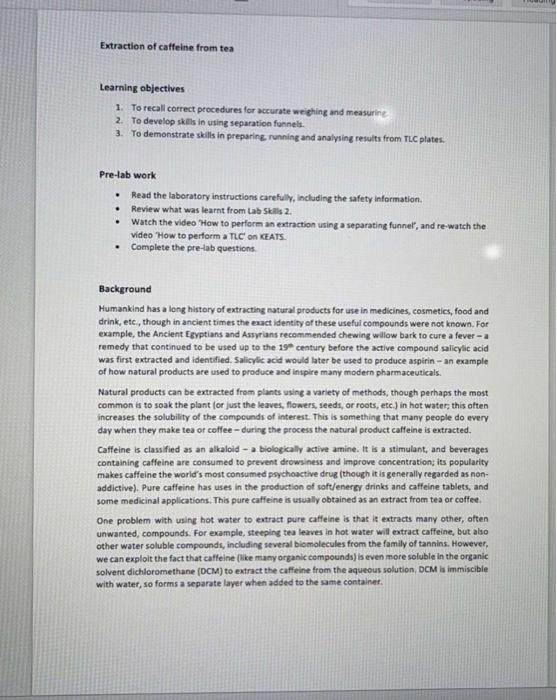
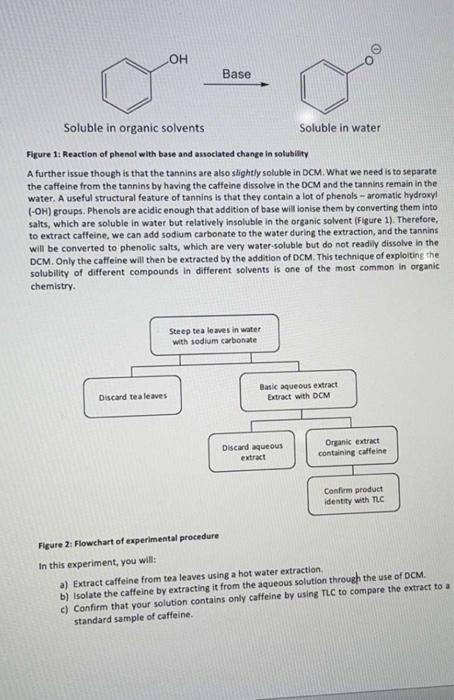
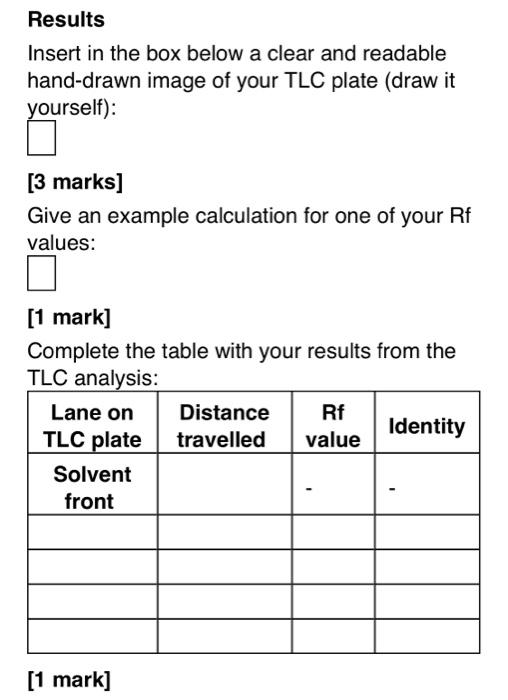
Extraction of caffeine from tea Learning objectives 1. To recall correct procedures for accurate weighing and measurine 2. To develop skills in using separation funnels. 3. To demonstrate skills in preparing, running and analysing results from TLC plates. Pre-lab work . . . Read the laboratory instructions carefully, including the safety Information. Review what was learnt from Lab Skills 2. Watch the video 'How to perform an extraction using a separating funnel, and re-watch the video 'How to perform a TLC on KEATS. Complete the pre-tab questions Background Humankind has a long history of extracting natural products for use in medicines, cosmetics, food and drink, etc., though in ancient times the exact identity of these useful compounds were not known. For example, the Ancient Egyptians and Assyrians recommended chewing willow bark to cure a fever - a remedy that continued to be used up to the 19 century before the active compound salicylic acid was first extracted and identified. Salicylic acid would later be used to produce aspirin-- an example of how natural products are used to produce and inspire many modern pharmaceuticals Natural products can be extracted from plants using a variety of methods, though perhaps the most common is to soak the plant (or just the leaves, flowers, seeds, ar roots, etc.) in hot water, this often increases the solubility of the compounds of interest. This is something that many people do every day when they make tea or coffee - during the process the natural product caffeine is extracted. Caffeine is classified as an alkaloid - biologically active amine. It is a stimulant, and beverages containing caffeine are consumed to prevent drowsiness and improve concentration; its popularity makes caffeine the world's most consumed psychoactive drug (though it is generally regarded as non- addictive). Pure caffeine has uses in the production of soft/energy drinks and caffeine tablets, and some medicinal applications. This pure caffeine is usually obtained as an extract from tea or coffee. One problem with using hot water to extract pure caffeine is that it extracts many other, often unwanted, compounds. For example, steeping tea leaves in hot water will extract caffeine, but also other water soluble compounds, including several biomolecules from the family of tannins. However, we can exploit the fact that caffeine (like many organic compounds) is even more soluble in the organic solvent dichloromethane (DCM) to extract the caffeine from the aqueous solution DCM is immiscible with water, so forms a separate layer when added to the same container, OH Base Soluble in organic solvents Soluble in water Figure 1: Reaction of phenol with base and associated change in solubility A further issue though is that the tannins are also slightly soluble in DCM. What we need is to separate the caffeine from the tannins by having the caffeine dissolve in the DCM and the tannins remain in the water. A useful structural feature of tannins is that they contain a lot of phenols - aromatic hydroxyl (-OH) groups, Phenols are acidic enough that addition of base will ionise them by converting them into salts, which are soluble in water but relatively insoluble in the organic solvent (Figure 1). Therefore, to extract caffeine, we can add sodium carbonate to the water during the extraction, and the tannins will be converted to phenolic salts, which are very water-soluble but do not readily dissolve in the DCM. Only the caffeine will then be extracted by the addition of DCM. This technique of exploiting the solubility of different compounds in different solvents is one of the most common in organic chemistry Steep tea leaves in water with sodium carbonate Basic aqueous extract Extract with DCM Discard tea leaves Discard aqueous extract Organic extract containing caffeine Conform product identity with TLC Figure 2: Flowchart of experimental procedure In this experiment, you will: a) Extract caffeine from tea leaves using a hot water extraction b) Isolate the caffeine by extracting it from the aqueous solution through the use of DCM c) Confirm that your solution contains only caffeine by using TLC to compare the extract to a standard sample of caffeine. Aim of the experiment: [2 marks] Introduction Describe how TLC can be used as a method for confirming the identity of a compound. What is the limitation of this method? [2 marks] Method Write the scientific method for the extraction of caffeine from tea. [3 marks] 214 Results Insert in the box below a clear and readable hand-drawn image of your TLC plate (draw it yourself): [3 marks] Give an example calculation for one of your Rf values: [1 mark] Complete the table with your results from the TLC analysis: Lane on Distance Rf Identity TLC plate travelled value Solvent front [1 mark] Discussion Segment of a tannin A segment of one of the tannins found in tea is show above. Describe, in your own words, how the addition of sodium carbonate prevented tannins from being extracted into the DCM layer during extraction. Use the structure given to draw the reaction that occurred to help illustrate your answer (either as a scanned hand-drawn scheme or one produced using chemical drawing software): [2 marks] What do the Rf values you obtained show about the success of the extraction process?
Step by Step Solution
There are 3 Steps involved in it

Get step-by-step solutions from verified subject matter experts
 Study Help