Question: I need these ansewered please no hand writing 1. 2. 3. What Is Your Current Salary? SED For eons it's been standard operating procedure to

I need these ansewered please no hand writing
1.
2.
3.
I need these ansewered please no hand writing 1.
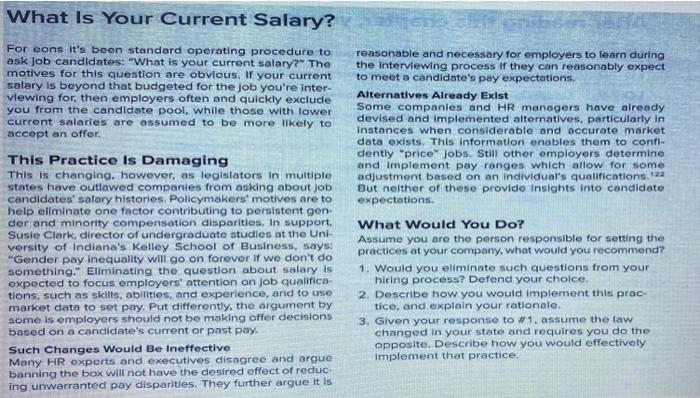
What Is Your Current Salary? SED For eons it's been standard operating procedure to ask job candidates: "What is your current salary?" The motives for this question are obvious. If your current salary is beyond that budgeted for the job you're inter- viewing for, then employers often and quickly exclude you from the candidate pool, while those with lower current salaries are assumed to be more likely to accept an offer. This Practice Is Damaging This is changing, however, as legislators in multiple states have outlawed companies from asking about job candidates' salary histories Policymakers' motives are to help eliminato one factor contributing to persistent gen- der and minority compensation disparities. In support. Susie Clark, director of undergraduate studies at the Uni versity of Indiana's Kolley School of Business, says: "Gender pay inequality will go on forever if we don't do something." Eliminating the question about salary is expected to focus employers' attention on Job qualifica tions, such as skills, abilities, and experience, and to use market data to set pay. Put differently, the argument by some is employers should not be making offer decisions based on a candidate's current or past pay. Such Changes Would Be Ineffective Many HR experts and executives disagree and argue banning the box will not have the desired effect of reduc ing unwarranted pay disparities. They further argue it is reasonable and necessary for employers to learn during the interviewing process if they can reasonably expect to meet a candidate's pay expectations. Alternatives Already exist Some companies and HR managers have already devised and implemented alternatives, particularly in instances when considerable and accurate market dota exists. This Information enables them to confi- dently "price" Jobs. Still other employers determine and Implement pay ranges which allow for some adjustment based on an individual's qualifications, taa But neither of these provide insights into candidato expectations. What Would You Do? Assume you are the person responsible for setting the practices at your company, what would you recommend? 1. Would you eliminate such questions from your hiring process? Defend your choice. 2. Describe how you would implement this prac tice, and explain your rationale. 3. Given your response to #1. assume the law changed in your state and requires you do the opposite. Describe how you would effectively implement that practice

Step by Step Solution

There are 3 Steps involved in it

1 Expert Approved Answer
Step: 1 Unlock blur-text-image

Question Has Been Solved by an Expert!

Get step-by-step solutions from verified subject matter experts

Step: 2 Unlock
Step: 3 Unlock

Students Have Also Explored These Related General Management Questions!