Question: I need to make the Implementation part, it has to be a page long, this is a few ideas i had Assignment 4 - House
I need to make the Implementation part, it has to be a page long, this is a few ideas i had
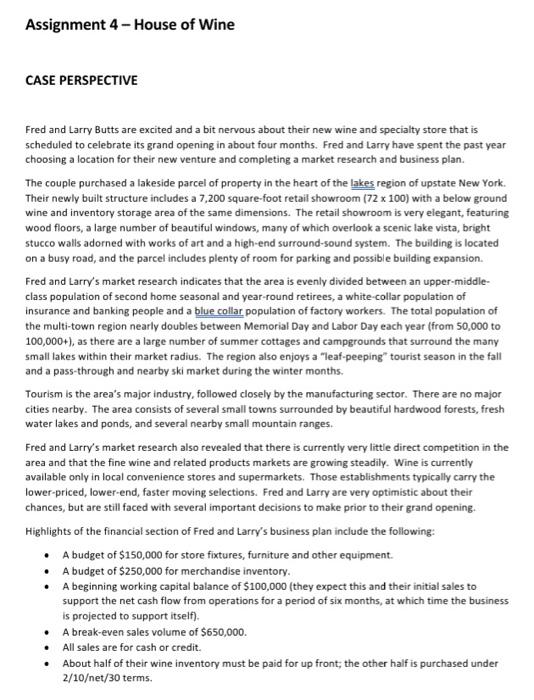
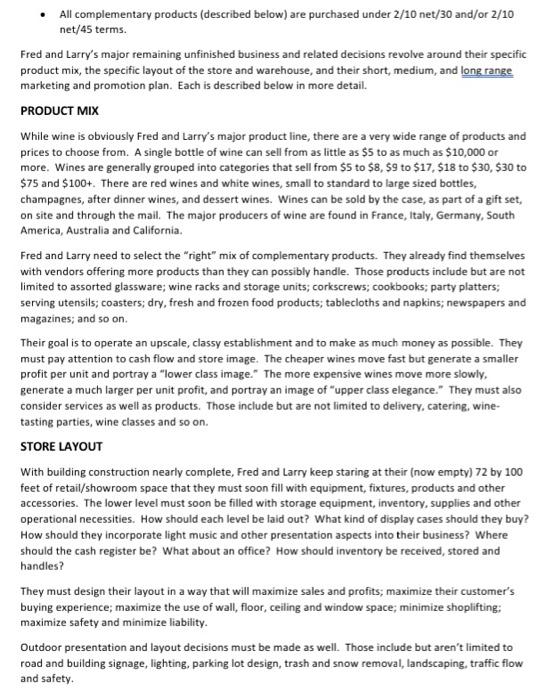
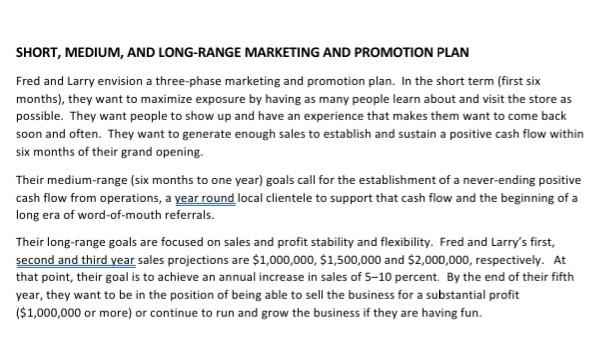
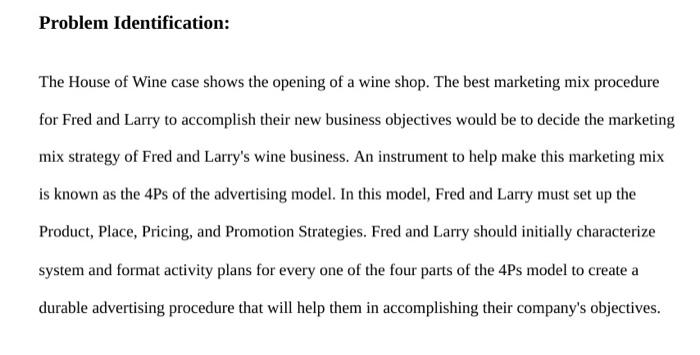
Assignment 4 - House of Wine CASE PERSPECTIVE Fred and Larry Butts are excited and a bit nervous about their new wine and specialty store that is scheduled to celebrate its grand opening in about four months. Fred and Larry have spent the past year choosing a location for their new venture and completing a market research and business plan. The couple purchased a lakeside parcel of property in the heart of the lakes region of upstate New York. Their newly built structure includes a 7,200 square-foot retail showroom (72 x 100) with a below ground wine and inventory storage area of the same dimensions. The retail showroom is very elegant, featuring wood floors, a large number of beautiful windows, many of which overlook a scenic lake vista, bright stucco walls adorned with works of art and a high-end surround sound system. The building is located on a busy road, and the parcel includes plenty of room for parking and possible building expansion Fred and Larry's market research indicates that the area is evenly divided between an upper-middle- class population of second home seasonal and year-round retirees, a white collar population of insurance and banking people and a blue collar population of factory workers. The total population of the multi-town region nearly doubles between Memorial Day and Labor Day each year (from 50,000 to 100,000+), as there are a large number of summer cottages and campgrounds that surround the many small lakes within their market radius. The region also enjoys a "leaf-peeping" tourist season in the fall and a pass-through and nearby ski market during the winter months. Tourism is the area's major industry, followed closely by the manufacturing sector. There are no major cities nearby. The area consists of several small towns surrounded by beautiful hardwood forests, fresh water lakes and ponds, and several nearby small mountain ranges. Fred and Larry's market research also revealed that there is currently very little direct competition in the area and that the fine wine and related products markets are growing steadily. Wine is currently available only in local convenience stores and supermarkets. Those establishments typically carry the lower-priced, lower-end, faster moving selections. Fred and Larry are very optimistic about their chances, but are still faced with several important decisions to make prior to their grand opening. Highlights of the financial section of Fred and Larry's business plan include the following: A budget of $150,000 for store fixtures, furniture and other equipment. A budget of $250,000 for merchandise inventory. A beginning working capital balance of $100,000 (they expect this and their initial sales to support the net cash flow from operations for a period of six months, at which time the business is projected to support itself) A break-even sales volume of $650,000. All sales are for cash or credit. About half of their wine inventory must be paid for up front; the other half is purchased under 2/10et/30 terms. . . All complementary products (described below) are purchased under 2/10 net/30 and/or 2/10 net/45 terms. Fred and Larry's major remaining unfinished business and related decisions revolve around their specific product mix, the specific layout of the store and warehouse, and their short, medium, and long range marketing and promotion plan. Each is described below in more detail. PRODUCT MIX While wine is obviously Fred and Larry's major product line, there are a very wide range of products and prices to choose from. A single bottle of wine can sell from as little as $5 to as much as $10,000 or more. Wines are generally grouped into categories that sell from $5 to $8, 59 to $17, 518 to $30, $30 to $75 and $100+. There are red wines and white wines, small to standard to large sized bottles, champagnes, after dinner wines, and dessert wines. Wines can be sold by the case, as part of a gift set, on site and through the mail. The major producers of wine are found in France, Italy, Germany, South America, Australia and California. Fred and Larry need to select the "right" mix of complementary products. They already find themselves with vendors offering more products than they can possibly handle. Those products include but are not limited to assorted glassware; wine racks and storage units; corkscrews; cookbooks; party platters; serving utensils, coasters; dry, fresh and frozen food products; tablecloths and napkins; newspapers and magazines, and so on. Their goal is to operate an upscale, classy establishment and to make as much money as possible. They must pay attention to cash flow and store image. The cheaper wines move fast but generate a smaller profit per unit and portray a "lower class image. The more expensive wines move more slowly. generate a much larger per unit profit, and portray an image of "upper class elegance." They must also consider services as well as products. Those include but are not limited to delivery, catering, wine- tasting parties, wine classes and so on. STORE LAYOUT With building construction nearly complete, Fred and Larry keep staring at their (now empty) 72 by 100 feet of retail/showroom space that they must soon fill with equipment, fixtures, products and other accessories. The lower level must soon be filled with storage equipment, inventory, supplies and other operational necessities. How should each level be laid out? What kind of display cases should they buy? How should they incorporate light music and other presentation aspects into their business? Where should the cash register be? What about an office? How should inventory be received, stored and handles? They must design their layout in a way that will maximize sales and profits; maximize their customer's buying experience; maximize the use of wall, floor, ceiling and window space; minimize shoplifting; maximize safety and minimize liability. Outdoor presentation and layout decisions must be made as well. Those include but aren't limited to road and building signage, lighting, parking lot design, trash and snow removal, landscaping, traffic flow and safety. SHORT, MEDIUM, AND LONG-RANGE MARKETING AND PROMOTION PLAN Fred and Larry envision a three-phase marketing and promotion plan. In the short term (first six months), they want to maximize exposure by having as many people learn about and visit the store as possible. They want people to show up and have an experience that makes them want to come back soon and often. They want to generate enough sales to establish and sustain a positive cash flow within six months of their grand opening. Their medium-range (six months to one year) goals call for the establishment of a never-ending positive cash flow from operations, a year round local clientele to support that cash flow and the beginning of a long era of word-of-mouth referrals. Their long-range goals are focused on sales and profit stability and flexibility. Fred and Larry's first, second and third year sales projections are $1,000,000 $1,500,000 and $2,000,000, respectively. At that point, their goal is to achieve an annual increase in sales of 5-10 percent. By the end of their fifth year, they want to be in the position of being able to sell the business for a substantial profit ($1,000,000 or more) or continue to run and grow the business if they are having fun. Problem Identification: The House of Wine case shows the opening of a wine shop. The best marketing mix procedure for Fred and Larry to accomplish their new business objectives would be to decide the marketing mix strategy of Fred and Larry's wine business. An instrument to help make this marketing mix is known as the 4Ps of the advertising model. In this model, Fred and Larry must set up the Product, Place, Pricing, and Promotion Strategies. Fred and Larry should initially characterize system and format activity plans for every one of the four parts of the 4Ps model to create a durable advertising procedure that will help them in accomplishing their company's objectives. Recommendations There are many thoughts on how we can begin to execute things contrastingly but effectively in our organizations and brands while remembering the 4Ps of promoting. As business visionaries expecting to adjust to the steadily changing requests of our market, we can attempt to apply a methodology that will really benefit us by not simply zeroing in on place, product, price, and promotion however rather on the thoughts of availability, point of view, arrangements and changes, qualities and instruction, and amusement and commitment. What's more, ideally, by being available to these important changes, we can set our brands and organizations toward development and progress. This model helps you decide how to bring another product to market. It can also be used to test existing marketing strategies. If you are considering a new or existing transaction, follow the steps below to characterize and evolve your marketing mix. The 4P model can be used when arranging another business, evaluating a current transaction, or trying to streamline a transaction with a group of stakeholders. You can also use it to test your current marketing strategy. By identifying and organizing the components of the marketing mix, companies can make productive marketing decisions at all levels. These decisions help the company: develop its quality and overcome its shortcomings. Become more aggressive and versatile in his market. The four Ps of marketing is often referred to as the marketing mix. These are important components involved in decent or management marketing and are basically interrelated. Thinking about these components is one way to get closer to your overall marketing strategy Implementation The suggested implementation would be to figure out a better opening date after the renovation works are completed. A better layout that makes a wine shop unique from other wine shops may also bring new customers especially foreign customers. Meeting customer expectations on wines and structure is also an impletion to prioritize in such a business atmosphere









 Study Help