







Question: I need to read the case study and answer questions 1 through 4 with a lot of detail. please help thank youu In response to
I need to read the case study and answer questions 1 through 4 with a lot of detail. please help thank youu
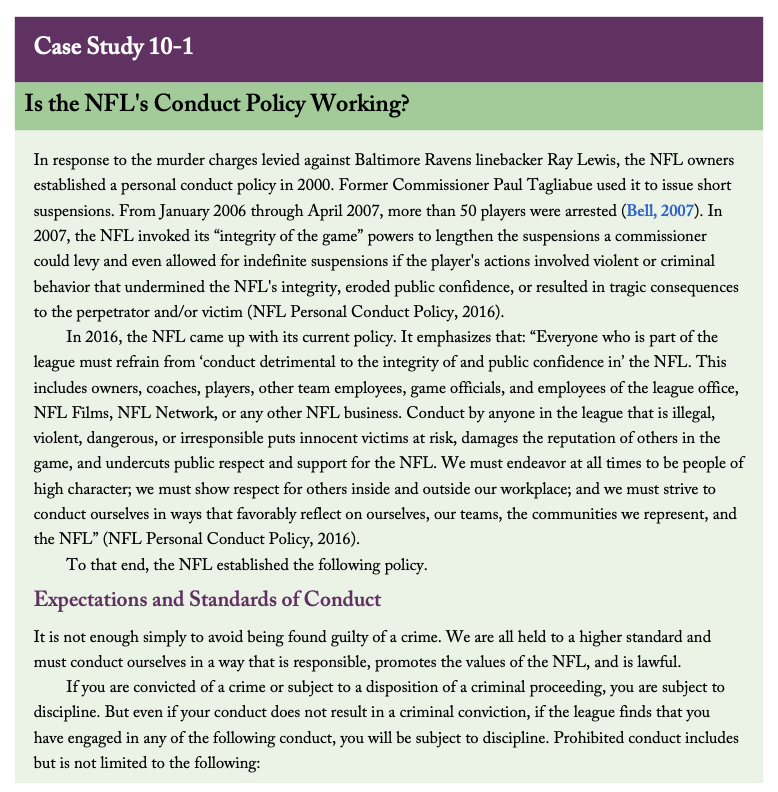
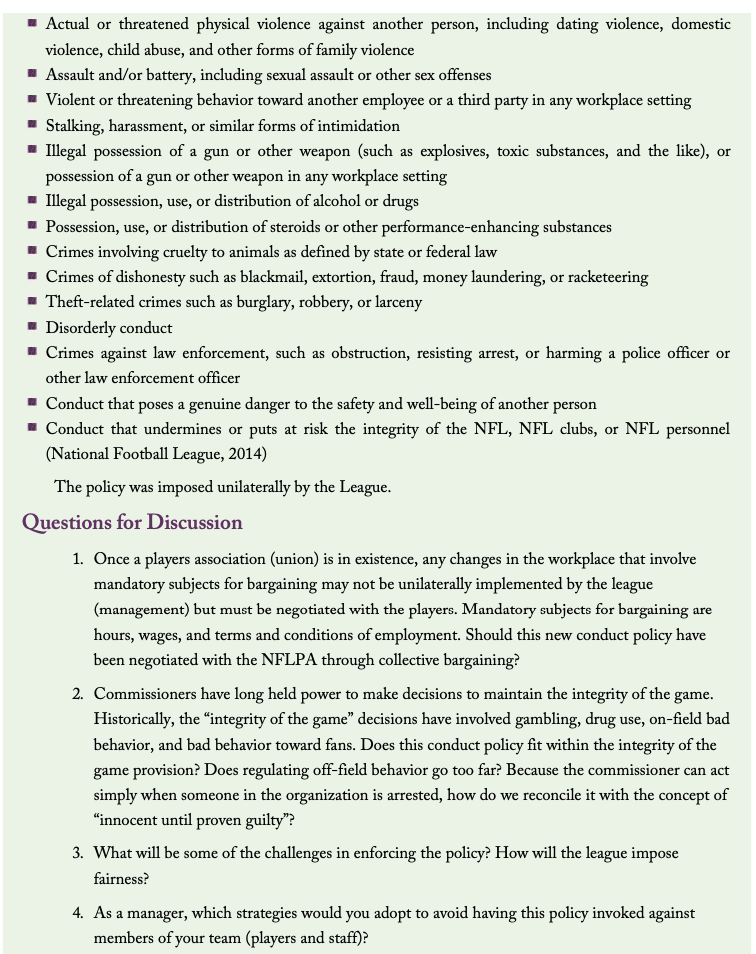
In response to the murder charges levied against Baltimore Ravens linebacker Ray Lewis, the NFL owners established a personal conduct policy in 2000. Former Commissioner Paul Tagliabue used it to issue short suspensions. From January 2006 through April 2007, more than 50 players were arrested (Bell, 2007). In 2007, the NFL invoked its "integrity of the game" powers to lengthen the suspensions a commissioner could levy and even allowed for indefinite suspensions if the player's actions involved violent or criminal behavior that undermined the NFL's integrity, eroded public confidence, or resulted in tragic consequences to the perpetrator and/or victim (NFL Personal Conduct Policy, 2016). In 2016, the NFL came up with its current policy. It emphasizes that: "Everyone who is part of the league must refrain from 'conduct detrimental to the integrity of and public confidence in' the NFL. This includes owners, coaches, players, other team employees, game officials, and employees of the league office, NFL Films, NFL Network, or any other NFL business. Conduct by anyone in the league that is illegal, violent, dangerous, or irresponsible puts innocent victims at risk, damages the reputation of others in the game, and undercuts public respect and support for the NFL. We must endeavor at all times to be people of high character; we must show respect for others inside and outside our workplace; and we must strive to conduct ourselves in ways that favorably reflect on ourselves, our teams, the communities we represent, and the NFL" (NFL Personal Conduct Policy, 2016). To that end, the NFL established the following policy. Expectations and Standards of Conduct It is not enough simply to avoid being found guilty of a crime. We are all held to a higher standard and must conduct ourselves in a way that is responsible, promotes the values of the NFL, and is lawful. If you are convicted of a crime or subject to a disposition of a criminal proceeding, you are subject to discipline. But even if your conduct does not result in a criminal conviction, if the league finds that you have engaged in any of the following conduct, you will be subject to discipline. Prohibited conduct includes but is not limited to the following: - Actual or threatened physical violence against another person, including dating violence, domestic violence, child abuse, and other forms of family violence - Assault and/or battery, including sexual assault or other sex offenses - Violent or threatening behavior toward another employee or a third party in any workplace setting - Stalking, harassment, or similar forms of intimidation - Illegal possession of a gun or other weapon (such as explosives, toxic substances, and the like), or possession of a gun or other weapon in any workplace setting - Illegal possession, use, or distribution of alcohol or drugs - Possession, use, or distribution of steroids or other performance-enhancing substances - Crimes involving cruelty to animals as defined by state or federal law - Crimes of dishonesty such as blackmail, extortion, fraud, money laundering, or racketeering - Theft-related crimes such as burglary, robbery, or larceny - Disorderly conduct - Crimes against law enforcement, such as obstruction, resisting arrest, or harming a police officer or other law enforcement officer - Conduct that poses a genuine danger to the safety and well-being of another person - Conduct that undermines or puts at risk the integrity of the NFL, NFL clubs, or NFL personnel (National Football League, 2014) The policy was imposed unilaterally by the League. Questions for Discussion 1. Once a players association (union) is in existence, any changes in the workplace that involve mandatory subjects for bargaining may not be unilaterally implemented by the league (management) but must be negotiated with the players. Mandatory subjects for bargaining are hours, wages, and terms and conditions of employment. Should this new conduct policy have been negotiated with the NFLPA through collective bargaining? 2. Commissioners have long held power to make decisions to maintain the integrity of the game. Historically, the "integrity of the game" decisions have involved gambling, drug use, on-field bad behavior, and bad behavior toward fans. Does this conduct policy fit within the integrity of the game provision? Does regulating off-field behavior go too far? Because the commissioner can act simply when someone in the organization is arrested, how do we reconcile it with the concept of "innocent until proven guilty"? 3. What will be some of the challenges in enforcing the policy? How will the league impose fairness? 4. As a manager, which strategies would you adopt to avoid having this policy invoked against members of your team (players and staff)
Step by Step Solution
There are 3 Steps involved in it

Get step-by-step solutions from verified subject matter experts
 Study Help