



Question: I need to see the math worked out to understand the problem. For question 1. Decision Tree Use for Production Capacity Determination at Toyota Motor
I need to see the math worked out to understand the problem.
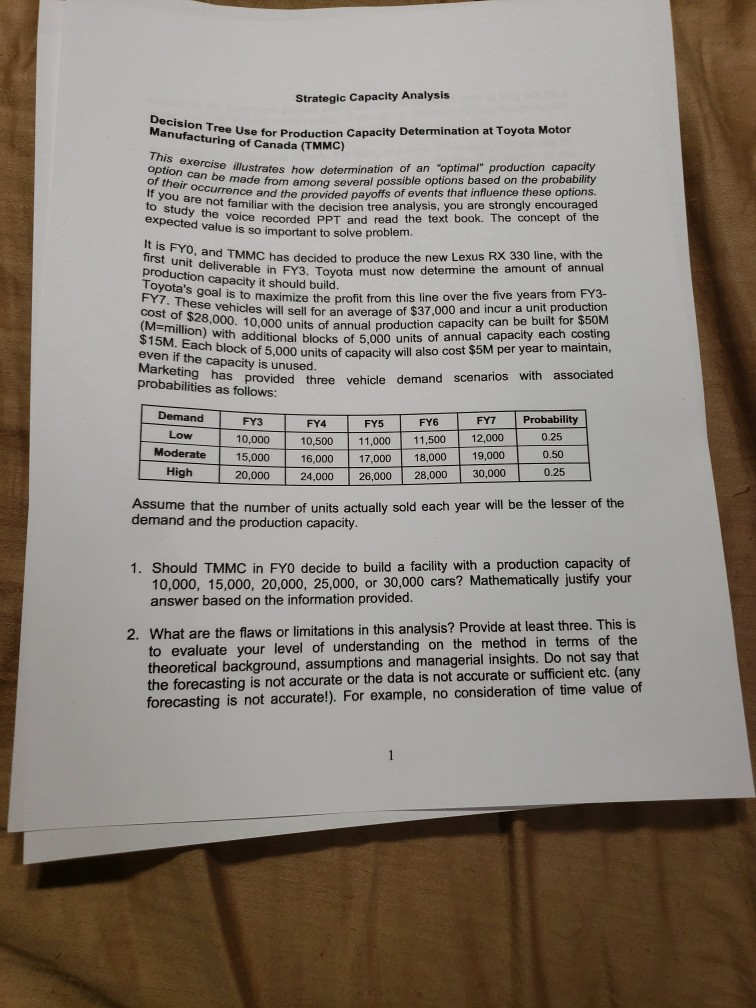
For question 1.
Decision Tree Use for Production Capacity Determination at Toyota Motor It is FYO, and TMMC has decided to produce the new Lexus RX 330 line, with the Toyota's goal is to maximize the profit from this line over the five years from FY3- FY7. These vehicles will sell for an average of $37,000 and incur a unit production cost of $28.000. 10,000 units of annual production capacity can be built for $50M (M=million) with additional blocks of 5,000 units of annual capacity each costing Strategic Capacity Analysis Manufacturing of Canada (TMMC) Opis, exorcise illustrates how determination of an "optimal" production capacity * you are not familiar with the videos on Yoete analysis, you are strongly encouraged of their occurrence and the provided alots of events that influence these options to study the voice recorde de decisiand read the text book. The concept of the expected value is so important to solve problem. production capacity it should build. even if the capacity is unused. Marketing has provided three vehicle demand scenarios with associated probabilities as follows: Demand Low Moderate High FY3 10,000 15,000 20,000 FY4 10,500 16,000 24,000 FYS 11,000 17,000 26,000 FY6 11,500 18.000 28,000 FY7 12,000 19,000 30,000 Probability 0.25 0.50 0.25 Assume that the number of units actually sold each year will be the lesser of the demand and the production capacity. 1. Should TMMC in FYO decide to build a facility with a production capacity of 10,000, 15,000, 20,000, 25,000, or 30,000 cars? Mathematically justify your answer based on the information provided. 2. What are the flaws or limitations in this analysis? Provide at least three. This is to evaluate your level of understanding on the method in terms of the theoretical background, assumptions and managerial insights. Do not say that the forecasting is not accurate or the data is not accurate or sufficient etc. (any forecasting is not accurate!). For example, no consideration of time value of 1Step by Step Solution
There are 3 Steps involved in it
1 Expert Approved Answer
Step: 1 Unlock

Question Has Been Solved by an Expert!
Get step-by-step solutions from verified subject matter experts
Step: 2 Unlock
Step: 3 Unlock