Question: I need to write how my technical writing course and my collaborations in my group was? the format has to be in Memo. in my
I need to write how my technical writing course and my collaborations in my group was? the format has to be in Memo.
in my assignment in group did the conclusion and some revision
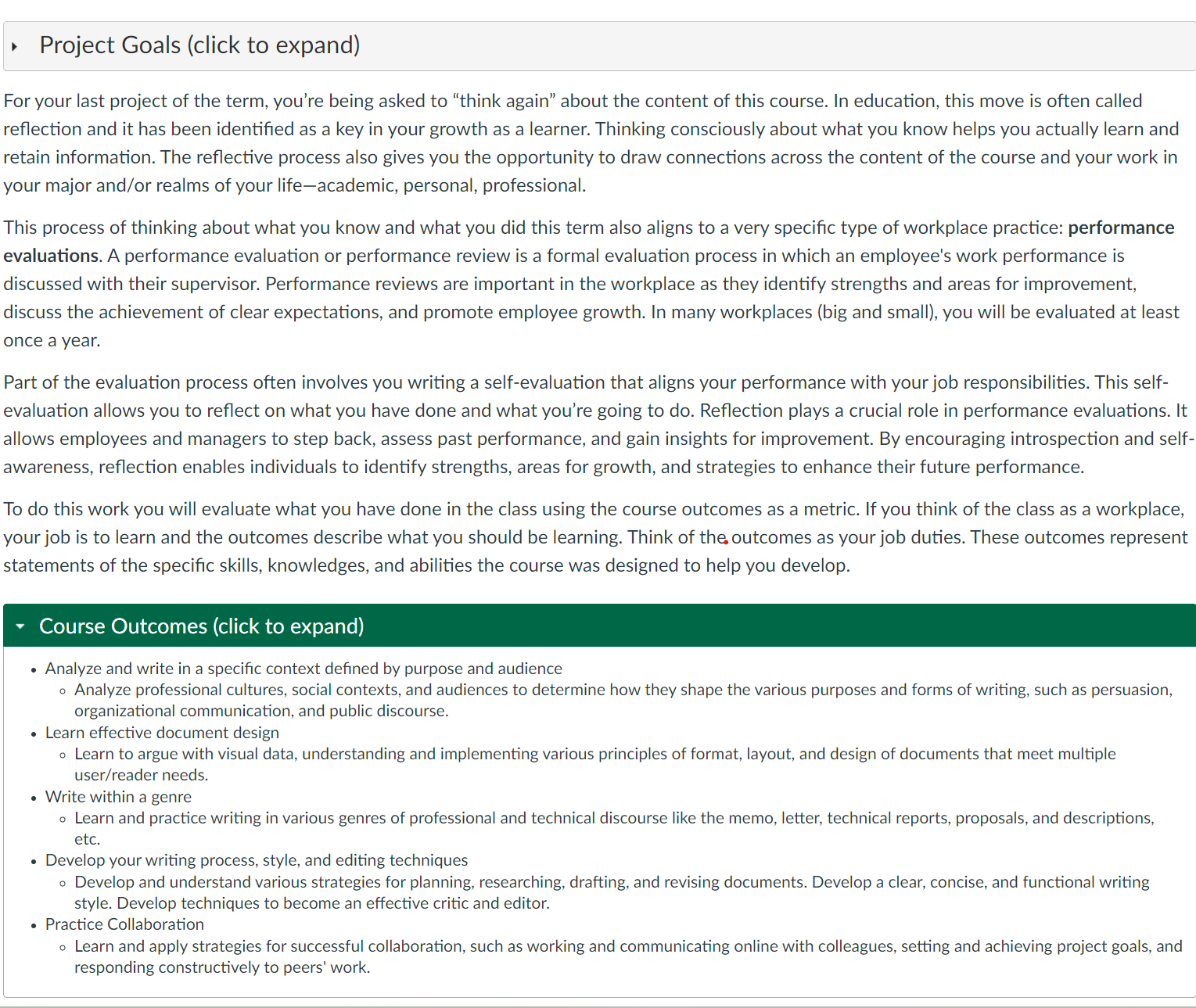
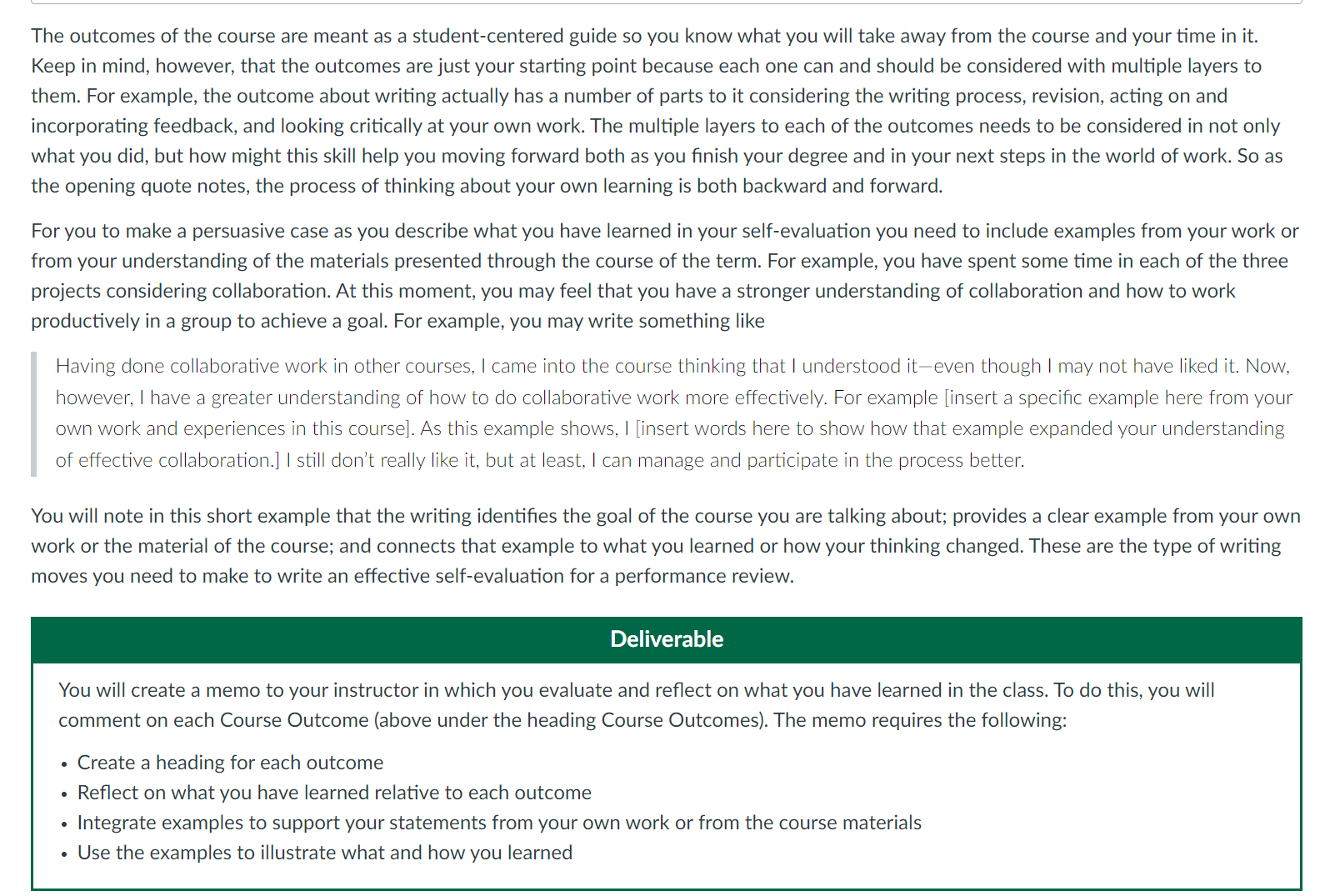
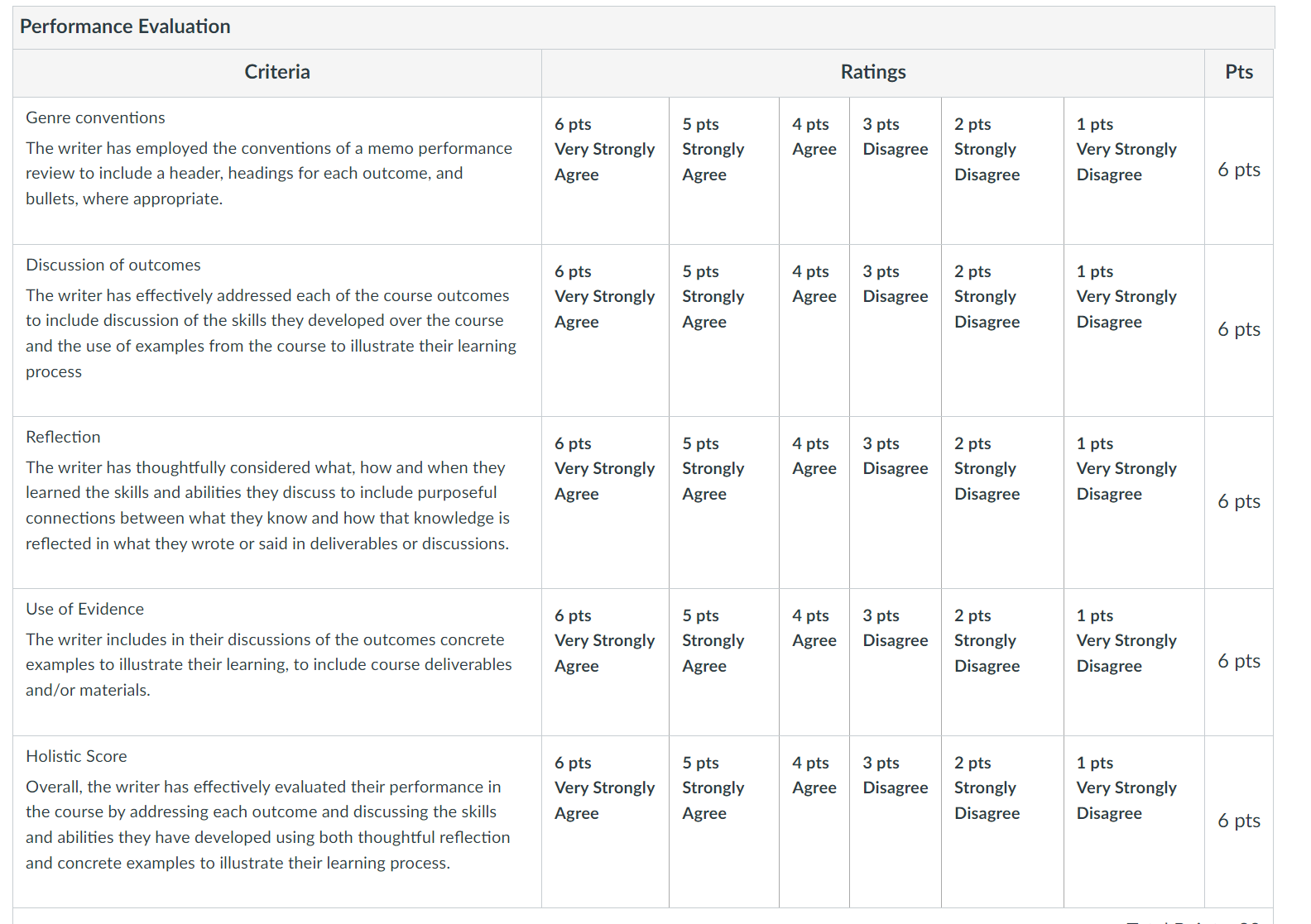
Project Goals (click to expand) For your last project of the term, you're being asked to \"think again\" about the content of this course. In education, this move is often called reflection and it has been identified as a key in your growth as a learner. Thinking consciously about what you know helps you actually learn and retain information. The reflective process also gives you the opportunity to draw connections across the content of the course and your work in your major and/or realms of your lifeacademic, personal, professional. This process of thinking about what you know and what you did this term also aligns to a very specific type of workplace practice: performance evaluations. A performance evaluation or performance review is a formal evaluation process in which an employee's work performance is discussed with their supervisor. Performance reviews are important in the workplace as they identify strengths and areas for improvement, discuss the achievement of clear expectations, and promote employee growth. In many workplaces (big and small), you will be evaluated at least once a year. Part of the evaluation process often involves you writing a self-evaluation that aligns your performance with your job responsibilities. This self- evaluation allows you to reflect on what you have done and what you're going to do. Reflection plays a crucial role in performance evaluations. It allows employees and managers to step back, assess past performance, and gain insights for improvement. By encouraging introspection and self- awareness, reflection enables individuals to identify strengths, areas for growth, and strategies to enhance their future performance. To do this work you will evaluate what you have done in the class using the course outcomes as a metric. If you think of the class as a workplace, your job is to learn and the outcomes describe what you should be learning. Think of the, outcomes as your job duties. These outcomes represent statements of the specific skills, knowledges, and abilities the course was designed to help you develop. ~ Course Outcomes (click to expand) Analyze and write in a specific context defined by purpose and audience o Analyze professional cultures, social contexts, and audiences to determine how they shape the various purposes and forms of writing, such as persuasion, organizational communication, and public discourse. Learn effective document design o Learn to argue with visual data, understanding and implementing various principles of format, layout, and design of documents that meet multiple user/reader needs. Write within a genre o Learn and practice writing in various genres of professional and technical discourse like the memo, letter, technical reports, proposals, and descriptions, etc. Develop your writing process, style, and editing technigues o Develop and understand various strategies for planning, researching, drafting, and revising documents. Develop a clear, concise, and functional writing style. Develop techniques to become an effective critic and editor. Practice Collaboration o Learn and apply strategies for successful collaboration, such as working and communicating online with colleagues, setting and achieving project goals, and responding constructively to peers' work. The outcomes of the course are meant as a student-centered guide so you know what you will take away from the course and your time in it. Keep in mind, however, that the outcomes are just your starting point because each one can and should be considered with multiple layers to them. For example, the outcome about writing actually has a number of parts to it considering the writing process, revision, acting on and incorporating feedback, and looking critically at your own work. The multiple layers to each of the outcomes needs to be considered in not only what you did, but how might this skill help you moving forward both as you finish your degree and in your next steps in the world of work. So as the opening quote notes, the process of thinking about your own learning is both backward and forward. For you to make a persuasive case as you describe what you have learned in your self-evaluation you need to include examples from your work or from your understanding of the materials presented through the course of the term. For example, you have spent some time in each of the three projects considering collaboration. At this moment, you may feel that you have a stronger understanding of collaboration and how to work productively in a group to achieve a goal. For example, you may write something like Having done collaborative work in other courses, | came into the course thinking that | understood iteven though | may not have liked it. Now, however, | have a greater understanding of how to do collaborative work more effectively. For example [insert a specific example here from your own work and experiences in this course]. As this example shows, | [insert words here to show how that example expanded your understanding of effective collaboration.] | still don't really like it, but at least. | can manage and participate in the process better. You will note in this short example that the writing identifies the goal of the course you are talking about; provides a clear example from your own work or the material of the course; and connects that example to what you learned or how your thinking changed. These are the type of writing moves you need to make to write an effective self-evaluation for a performance review. Deliverable You will create a memo to your instructor in which you evaluate and reflect on what you have learned in the class. To do this, you will comment on each Course Qutcome (above under the heading Course Outcomes). The memo requires the following: Create a heading for each outcome Reflect on what you have learned relative to each outcome Integrate examples to support your statements from your own work or from the course materials Use the examples to illustrate what and how you learned Performance Evaluation Criteria Ratings Pts Genre conventions 6 pts 5 pts 4 pts 3 pts 2 pts 1 pts The writer has employed the conventions of a memo performance Very Strongly Strongly Agree Disagree Strongly Very Strongly Agree Agree Disagree Disagree 6 pts review to include a header, headings for each outcome, and bullets, where appropriate. Discussion of outcomes 6 pts 5 pts 4 pts 3 pts 2 pts 1 pts The writer has effectively addressed each of the course outcomes Very Strongly Strongly Agree Disagree Strongly Very Strongly to include discussion of the skills they developed over the course Agree Agree Disagree Disagree 6 pts and the use of examples from the course to illustrate their learning process Reflection 6 pts 5 pts 4 pts 3 pts 2 pts 1 pts The writer has thoughtfully considered what, how and when they Very Strongly Strongly Agree Disagree Strongly Very Strongly learned the skills and abilities they discuss to include purposeful Agree Agree Disagree Disagree 6 pts connections between what they know and how that knowledge is reflected in what they wrote or said in deliverables or discussions. Use of Evidence 6 pts 5 pts 4 pts 3 pts 2 pts 1 pts The writer includes in their discussions of the outcomes concrete Very Strongly Strongly Agree Disagree Strongly Very Strongly Agree Disagree 6 pts examples to illustrate their learning, to include course deliverables Agree Disagree and/or materials. Holistic Score 6 pts 5 pts 4 pts 3 pts 2 pts 1 pts Overall, the writer has effectively evaluated their performance in Very Strongly Strongly Agree Disagree Strongly Very Strongly the course by addressing each outcome and discussing the skills Agree Agree Disagree Disagree 6 pts and abilities they have developed using both thoughtful reflection and concrete examples to illustrate their learning process
Step by Step Solution
There are 3 Steps involved in it
1 Expert Approved Answer
Step: 1 Unlock
Question Has Been Solved by an Expert!
Get step-by-step solutions from verified subject matter experts
Step: 2 Unlock
Step: 3 Unlock
Students Have Also Explored These Related Business Writing Questions!









 Study Help