







Question: I. Objectives: 1. Solve simple problem on uniformly accelerated motion including free-fall. 2. Used formulas in uniformly accelerated motion in performing outdoor activities. 3. Perform
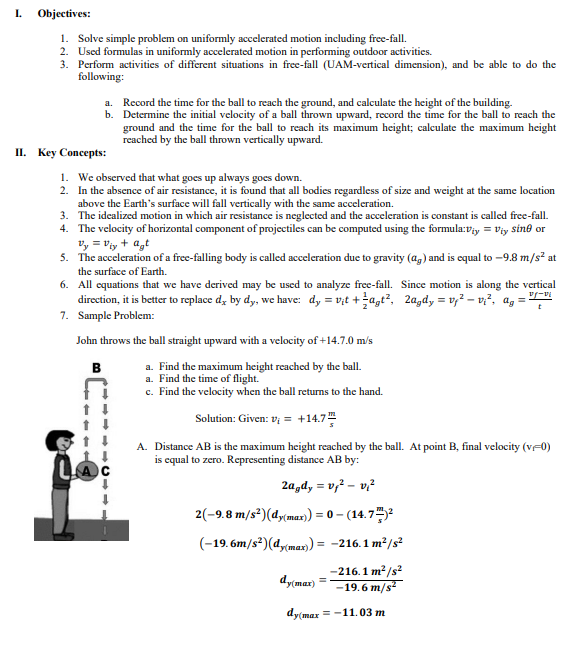
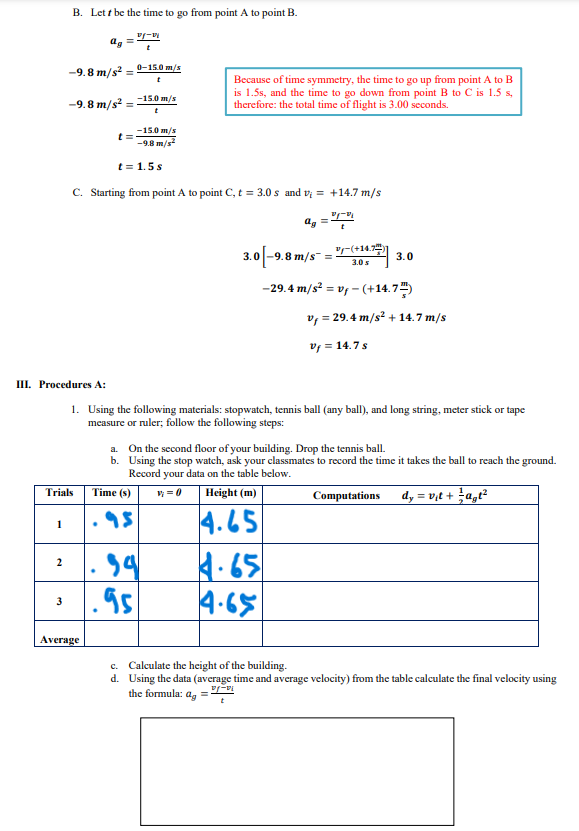
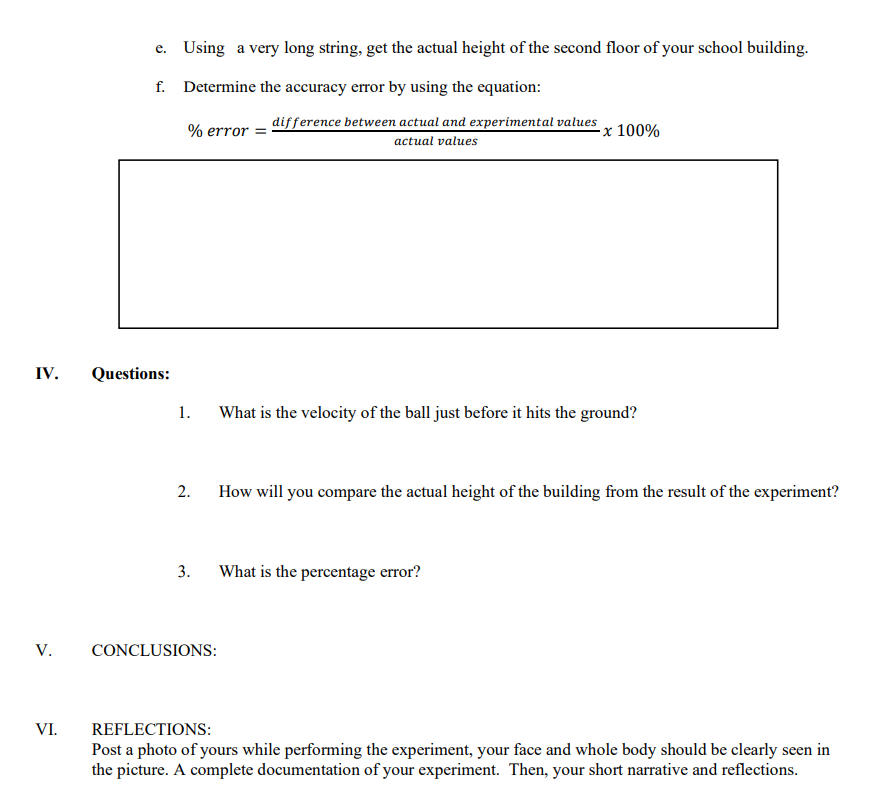
I. Objectives: 1. Solve simple problem on uniformly accelerated motion including free-fall. 2. Used formulas in uniformly accelerated motion in performing outdoor activities. 3. Perform activities of different situations in free-fall (UAM-vertical dimension), and be able to do the following: a. Record the time for the ball to reach the ground, and calculate the height of the building. b. Determine the initial velocity of a ball thrown upward, record the time for the ball to reach the ground and the time for the ball to reach its maximum height; calculate the maximum height reached by the ball thrown vertically upward. II. Key Concepts: 1. We observed that what goes up always goes down. 2. In the absence of air resistance, it is found that all bodies regardless of size and weight at the same location above the Earth's surface will fall vertically with the same acceleration. 3. The idealized motion in which air resistance is neglected and the acceleration is constant is called free-fall. 4. The velocity of horizontal component of projectiles can be computed using the formula:Viy = Vry sind or Vy =Viy + agt The acceleration of a free-falling body is called acceleration due to gravity (a,) and is equal to -9.8 m/s at the surface of Earth. 6. All equations that we have derived may be used to analyze free-fall. Since motion is along the vertical direction, it is better to replace dy by dy, we have: dy = Vit + zagt?, 2agdy =v,? -v;], d, =Yr-W 7. Sample Problem: John throws the ball straight upward with a velocity of + 14.7.0 m/'s B a. Find the maximum height reached by the ball. a. Find the time of flight. c. Find the velocity when the ball returns to the hand. Solution: Given: v, = +14.7 A. Distance AB is the maximum height reached by the ball. At point B. final velocity (v/0) is equal to zero. Representing distance AB by: 2agdy = v/2 - v2 2(-9.8 m/s=)(dy(mar)) = 0 - (14.7")2 (-19.6m/s?)(dy(mar)) = -216.1 m-/$2 -216.1 m2/s2 dy(mar) = -19.6 m/$2 dy(max = -11.03 mB. Let f be the time to go from point A to point B. -9.8 m/$2 - 0-150 m/s Because of time symmetry, the time to go up from point A to B is 1.5s, and the time to go down from point B to C is 1.5 s, -9. 8 m/$2 - 15.0 m/s therefore: the total time of flight is 3.00 seconds. -15.0 m/s -9.8 m/s- t = 1.5s C. Starting from point A to point C, t = 3.0 s and v; = +14.7 m/s 3.0 -9.8 m/s- = (+14.7- 3.05 3.0 -29.4 m/s' = v/ - (+14.7") vy = 29.4 m/s' + 14.7 m/s W/ = 14.7s III. Procedures A: 1. Using the following materials: stopwatch, tennis ball (any ball), and long string, meter stick or tape measure or ruler; follow the following steps: On the second floor of your building. Drop the tennis ball. b. . Using the stop watch, ask your classmates to record the time it takes the ball to reach the ground. Record your data on the table below. Trials Time (s) 1 = 0 Height (m) Computations dy = vit + =agt2 . 95 4.65 2 4.65 3 95 4.65 Average C. Calculate the height of the building. d. Using the data (average time and average velocity) from the table calculate the final velocity using the formula: ag = 1- te. Using a very long string, get the actual height of the second floor of your school building. 1". Determine the accuracy error by using the equation: difference between actuai and experimen rat values % error = x 100% actual values IV. Questions: 1. What is the velocity of the ball just before it hits the ground? 2. How will you compare the actual height of the building from the result of the experiment? 3. What is the percentage error? V. CONCLUSIONS: VI. REFLECTIONS: Post a photo of yours while performing the experiment. your face and whole body should be clearly seen in the picture. A complete documentation of your experiment. Then, your short narrative and reections
Step by Step Solution
There are 3 Steps involved in it

Get step-by-step solutions from verified subject matter experts
 Study Help