







Question: I only need source code for the FCFS algorithm in C++, I have provided as much context as possible. If it is done in accordance
I only need source code for the FCFS algorithm in C++, I have provided as much context as possible. If it is done in accordance to the prompt I will be sure to leave a thumbs up. Thank you!
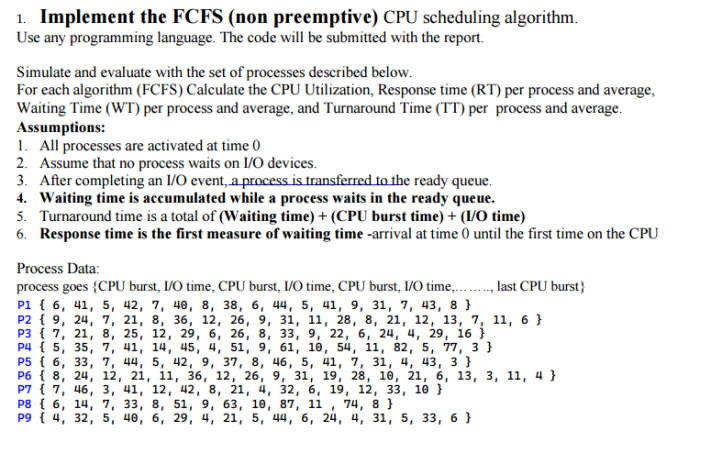
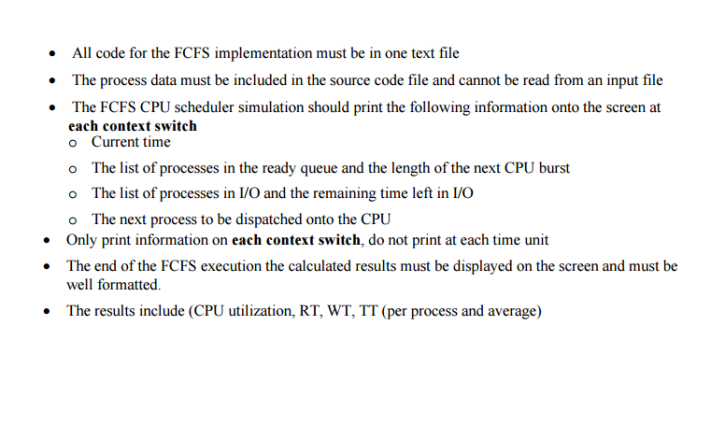
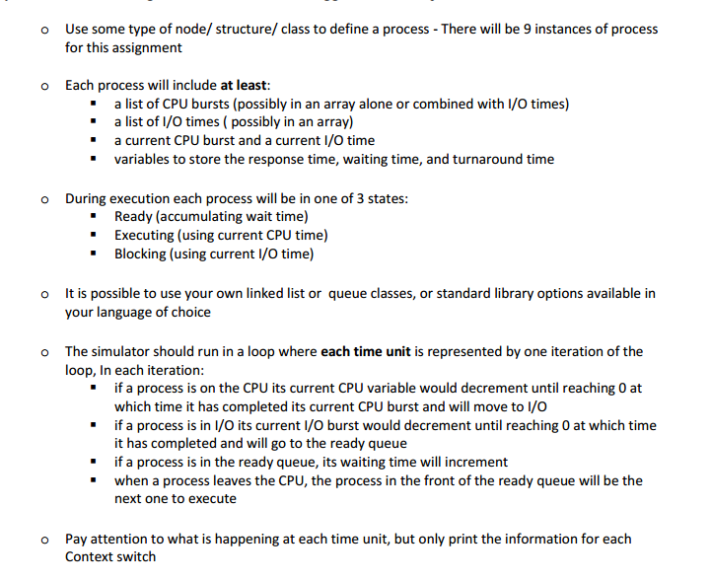
1. Implement the FCFS (non preemptive) CPU scheduling algorithm. Use any programming language. The code will be submitted with the report. Simulate and evaluate with the set of processes described below. For each algorithm (FCFS) Calculate the CPU Utilization, Response time (RT) per process and average, Waiting Time (WT) per process and average, and Turnaround Time (TT) per process and average. Assumptions: 1. All processes are activated at time 0 2. Assume that no process waits on I/O devices. 3. After completing an I/O event, a process is transferred to the ready queue. 4. Waiting time is accumulated while a process waits in the ready queue. 5. Turnaround time is a total of (Waiting time )+(CPU burst time )+(I/O time ) 6. Response time is the first measure of waiting time -arrival at time 0 until the first time on the CPU Process Data: process goes \{CPU burst, I/O time, CPU burst, I/O time, CPU burst, I/O time,......., last CPU burst } P1 {6,41,5,42,7,40,8,38,6,44,5,41,9,31,7,43,8} P2 {9,24,7,21,8,36,12,26,9,31,11,28,8,21,12,13,7,11,6} P3 {7,21,8,25,12,29,6,26,8,33,9,22,6,24,4,29,16} P5 {6,33,7,44,5,42,9,37,8,46,5,41,7,31,4,43,3} P6 {8,24,12,21,11,36,12,26,9,31,19,28,10,21,6,13,3,11,4} P7 {7,46,3,41,12,42,8,21,4,32,6,19,12,33,10} P8 {6,14,7,33,8,51,9,63,10,87,11,74,8} P9 {4,32,5,40,6,29,4,21,5,44,6,24,4,31,5,33,6} - All code for the FCFS implementation must be in one text file - The process data must be included in the source code file and cannot be read from an input file - The FCFS CPU scheduler simulation should print the following information onto the screen at each context switch - Current time - The list of processes in the ready queue and the length of the next CPU burst - The list of processes in I/O and the remaining time left in I/O - The next process to be dispatched onto the CPU - Only print information on each context switch, do not print at each time unit - The end of the FCFS execution the calculated results must be displayed on the screen and must be well formatted. - The results include (CPU utilization, RT, WT, TT (per process and average) - Use some type of node/ structure/ class to define a process - There will be 9 instances of process for this assignment - Each process will include at least: - a list of CPU bursts (possibly in an array alone or combined with 1/0 times) - a list of 1/O times ( possibly in an array) - a current CPU burst and a current 1/0 time - variables to store the response time, waiting time, and turnaround time During execution each process will be in one of 3 states: - Ready (accumulating wait time) - Executing (using current CPU time) - Blocking (using current 1/O time) - It is possible to use your own linked list or queue classes, or standard library options available in your language of choice - The simulator should run in a loop where each time unit is represented by one iteration of the loop, In each iteration: - if a process is on the CPU its current CPU variable would decrement until reaching 0 at which time it has completed its current CPU burst and will move to 1/O - if a process is in I/O its current I/O burst would decrement until reaching 0 at which time it has completed and will go to the ready queue - if a process is in the ready queue, its waiting time will increment - when a process leaves the CPU, the process in the front of the ready queue will be the next one to execute - Pay attention to what is happening at each time unit, but only print the information for each Context switch
Step by Step Solution
There are 3 Steps involved in it

Get step-by-step solutions from verified subject matter experts
 Study Help