







Question: i post this prviously too but i got code incorrect . can i get clean and working c++ code for this lab 3 assugnment .
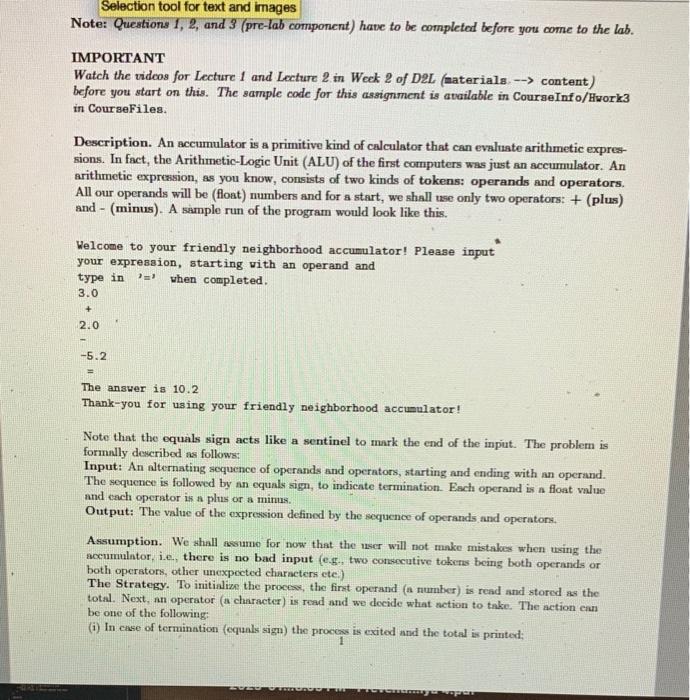
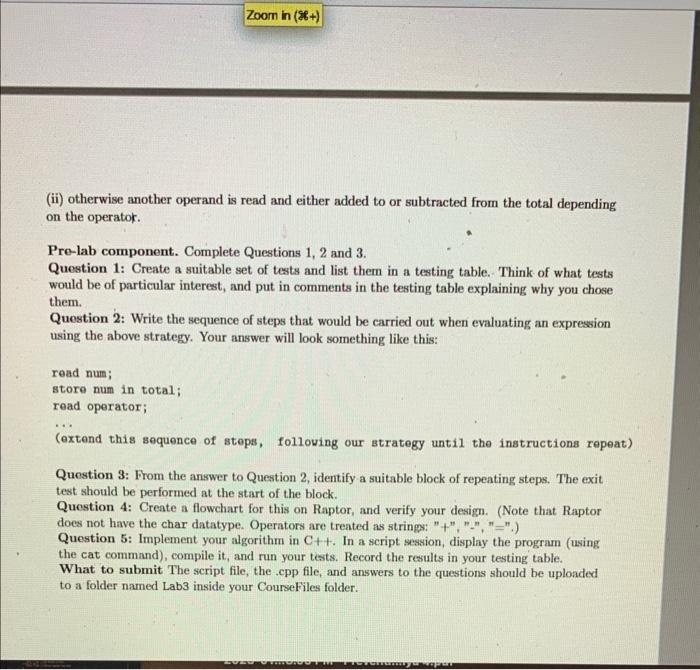
Selection tool for text and images Note: Questions 1, 2, and 3 (pre-lab component) have to be completed before you come to the lab. IMPORTANT Watch the videos for Lecture 1 and Lecture 2 in Week 2 of D2L (materials content) before you start on this. The sample code for this assignment is available in CourseInfo/Huork3 in CourseFiles. Description. An accumulator is a primitive kind of calculator that can evaluate arithmetic expressions. In fact, the Arithmetic-Logic Unit (ALU) of the first computers was just an accumulator. An arithmetic expression, as you know, consists of two kinds of tokens: operands and operators. All our operands will be (float) numbers and for a start, we shall use only two operators: + (plus) and - (minus). A sample run of the program would look like this. Welcome to your friendly neighborhood accumlator! Please input your expression, starting with an operand and type in a= when completed. 3.0 2.0 5.2 = The answer is 10.2 Thank-you for using your friendly neighborhood accunulator! Note that the equals sign acts like a sentinel to mark the end of the input. The problem is formally described as follows: Input: An alternating scquence of operands and operators, starting and ending with an operand. The sequence is followed by an equals sign, to indicate termination. Each operand is a float value and cach operator is a plus or a minus. Output: The value of the expression defined by the sequence of operands and operators. Assumption. We shall assume for now that the user will not make mistakes when using the accumulator, i.e, there is no bad input (esg., two consecutive tokens being both operands or both operators, other unexpocted characters ete.) The Strategy. To initialize the process, the first operand (a number) is read and stored as the total. Next, an operator (a character) is read and we docide what action to take. The action ean be one of the following: (i) In case of termination (equals sign) the process is exited and the total is printed: (ii) otherwise another operand is read and either added to or subtracted from the total depending on the operator. Pre-lab component. Complete Questions 1, 2 and 3. Question 1: Create a suitable set of tests and list them in a testing table. Think of what tests would be of particular interest, and put in comments in the testing table explaining why you chose them. Question 2: Write the sequence of steps that would be carried out when evaluating an expression using the above strategy. Your answer will look something like this: read num; store num in total; read operator; (extend this sequence of steps, following our strategy until the instructions repeat) Question 3: From the answer to Question 2, identify a suitable block of repeating steps. The exit test should be performed at the start of the block. Question 4: Create a flowchart for this on Raptor, and verify your design. (Note that Raptor does not have the char datatype. Operators are treated as strings: " + ", "nn, ", ".) Question 5: Implement your algorithm in C+. In a script session, display the program (using the cat command), compile it, and run your tests. Record the results in your testing table. What to submit The script file, the .cpp file, and answers to the questions should be uploaded to a folder named Lab3 inside your CourseFiles folder
Step by Step Solution
There are 3 Steps involved in it

Get step-by-step solutions from verified subject matter experts
 Study Help