



Question: i provided the case study and questions ..i need answers of questions. Case For part B of this case, click here. On October 16, 2001,
i provided the case study and questions ..i need answers of questions.
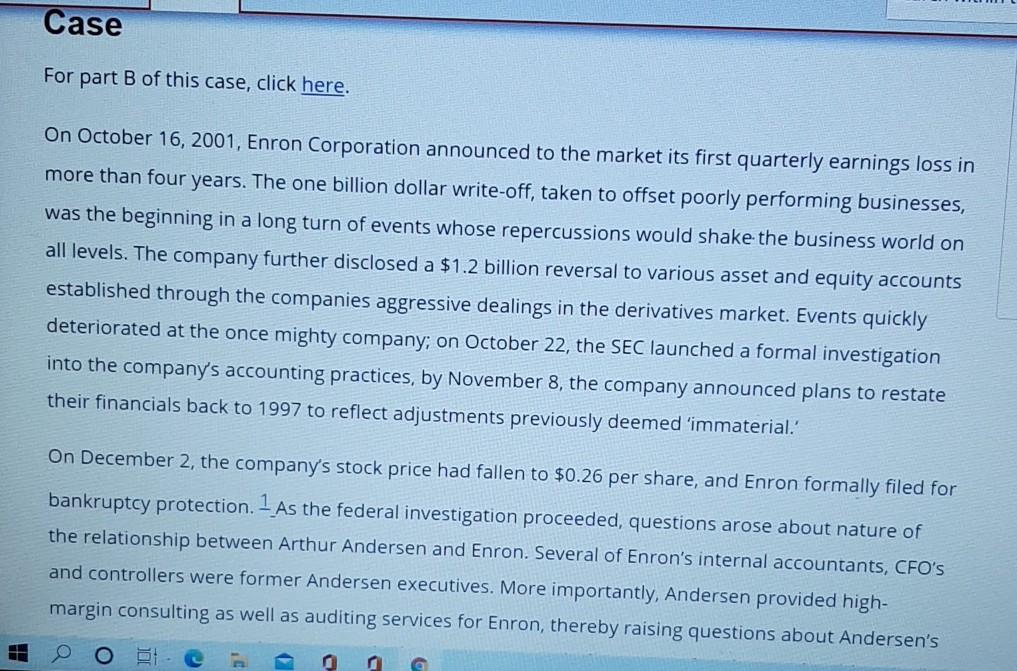
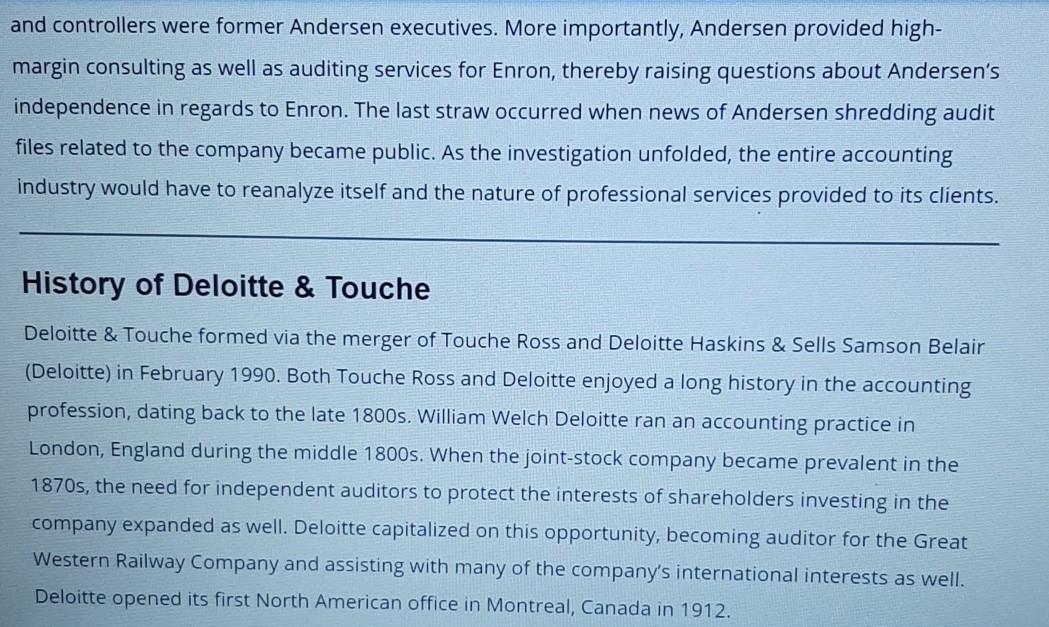
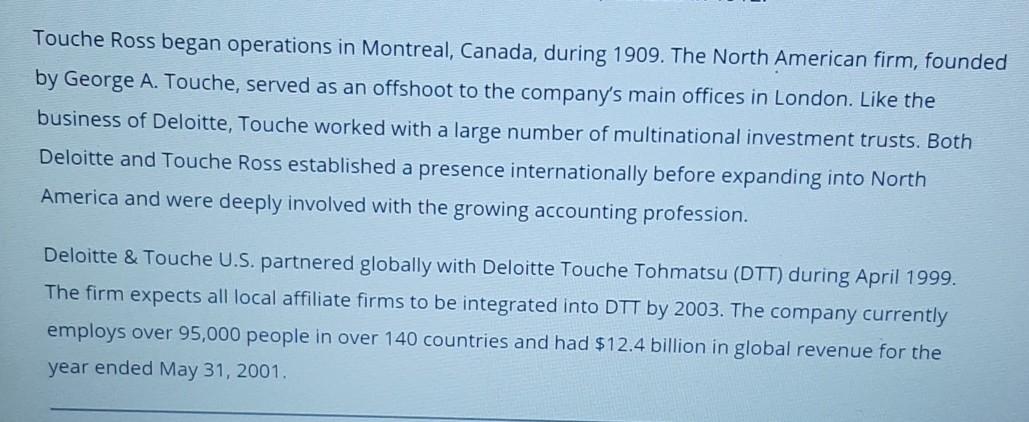
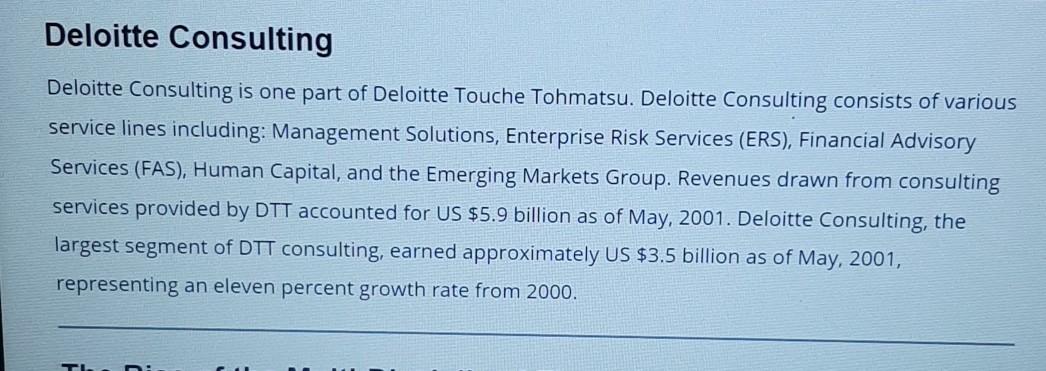
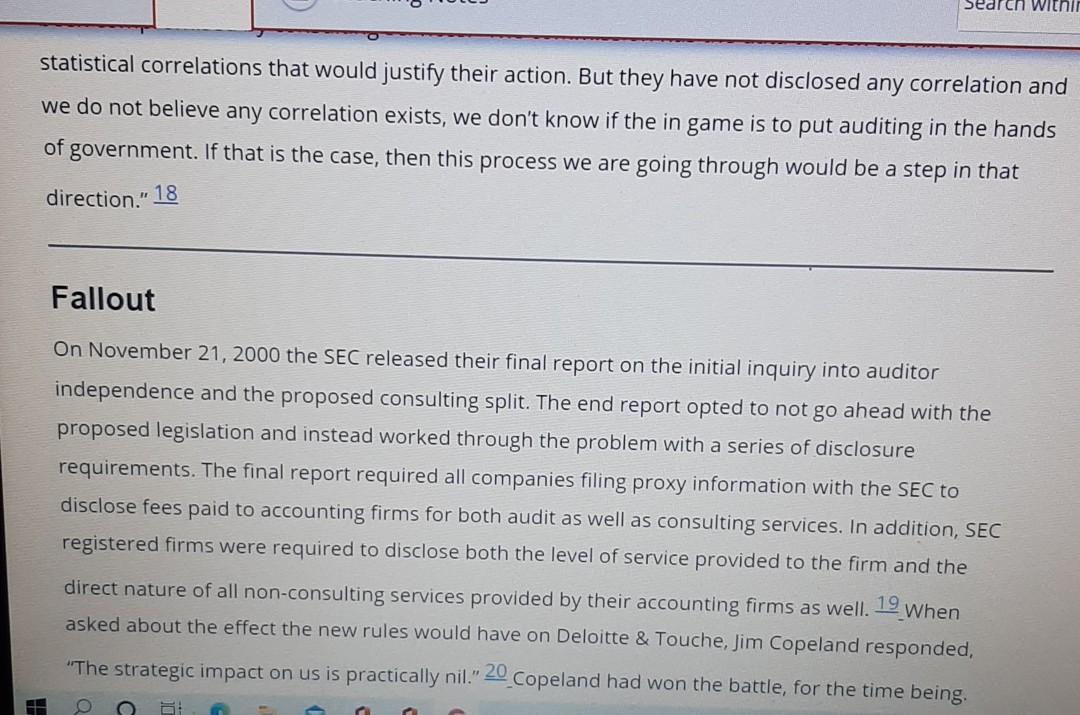
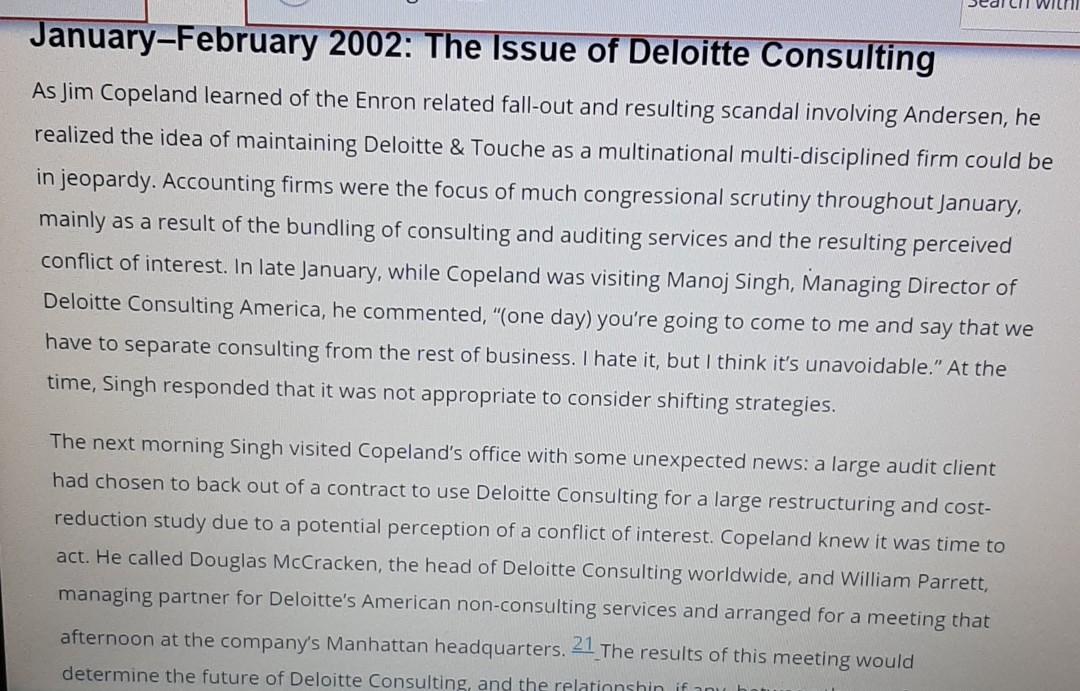
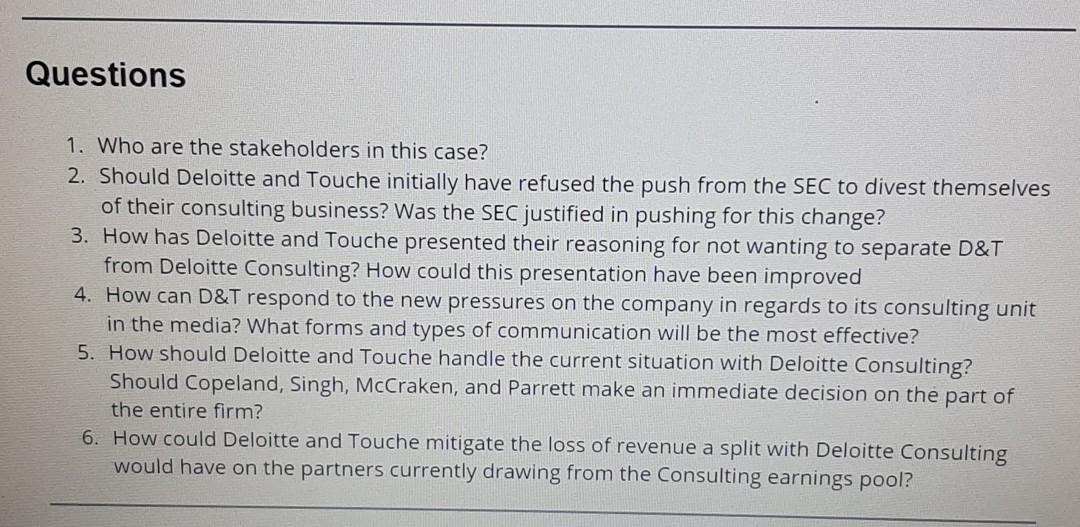
Case For part B of this case, click here. On October 16, 2001, Enron Corporation announced to the market its first quarterly earnings loss in more than four years. The one billion dollar write-off, taken to offset poorly performing businesses, was the beginning in a long turn of events whose repercussions would shake the business world on all levels. The company further disclosed a $1.2 billion reversal to various asset and equity accounts established through the companies aggressive dealings in the derivatives market. Events quickly deteriorated at the once mighty company, on October 22, the SEC launched a formal investigation into the company's accounting practices, by November 8, the company announced plans to restate their financials back to 1997 to reflect adjustments previously deemed 'immaterial.' On December 2, the company's stock price had fallen to $0.26 per share, and Enron formally filed for bankruptcy protection. 1 As the federal investigation proceeded, questions arose about nature of the relationship between Arthur Andersen and Enron. Several of Enron's internal accountants, CFO's and controllers were former Andersen executives. More importantly, Andersen provided high- margin consulting as well as auditing services for Enron, thereby raising questions about Andersen's and controllers were former Andersen executives. More importantly, Andersen provided high- margin consulting as well as auditing services for Enron, thereby raising questions about Andersen's independence in regards to Enron. The last straw occurred when news of Andersen shredding audit files related to the company became public. As the investigation unfolded, the entire accounting industry would have to reanalyze itself and the nature of professional services provided to its clients. History of Deloitte & Touche Deloitte & Touche formed via the merger of Touche Ross and Deloitte Haskins & Sells Samson Belair (Deloitte) in February 1990. Both Touche Ross and Deloitte enjoyed a long history in the accounting profession, dating back to the late 1800s. William Welch Deloitte ran an accounting practice in London, England during the middle 1800s. When the joint-stock company became prevalent in the 1870s, the need for independent auditors to protect the interests of shareholders investing in the company expanded as well. Deloitte capitalized on this opportunity, becoming auditor for the Great Western Railway Company and assisting with many of the company's international interests as well. Deloitte opened its first North American office in Montreal, Canada in 1912. Touche Ross began operations in Montreal, Canada, during 1909. The North American firm, founded by George A. Touche, served as an offshoot to the company's main offices in London. Like the business of Deloitte, Touche worked with a large number of multinational investment trusts. Both Deloitte and Touche Ross established a presence internationally before expanding into North America and were deeply involved with the growing accounting profession. Deloitte & Touche U.S. partnered globally with Deloitte Touche Tohmatsu (DTT) during April 1999. The firm expects all local affiliate firms to be integrated into DTT by 2003. The company currently employs over 95,000 people in over 140 countries and had $12.4 billion in global revenue for the year ended May 31, 2001. Deloitte Consulting Deloitte Consulting is one part of Deloitte Touche Tohmatsu. Deloitte Consulting consists of various service lines including: Management Solutions, Enterprise Risk Services (ERS), Financial Advisory Services (FAS), Human Capital, and the Emerging Markets Group. Revenues drawn from consulting services provided by DTT accounted for US $5.9 billion as of May, 2001. Deloitte Consulting, the largest segment of DTT consulting, earned approximately US $3.5 billion as of May, 2001, representing an eleven percent growth rate from 2000. Tini The Rise of the Multi-Disciplined Firm Large accounting firms operating in the United States are generally run as Limited Liability Partnerships, a form of legal partnership. Under LLP statutes, partners may avoid personal liability for malpractice committed by other partners. Only those partners who commit wrongful acts (negligence) and their direct supervisors may be held directly liable. Traditionally, these statutes have allowed accounting firms a balanced means to grow business without the constant threat of lawsuits. 2.When a partner is admitted into an LLP, they are generally responsible for an initial capital contribution to the firm. In exchange for this capital contribution, they receive "shares" in the partnership, which are used in determining total revenues paid to the partner in a given year. Total income earned is divided by the number of outstanding shares and the resulting amount is paid proportionately to each partner based on share ownership. 3 Audit partner income within the Big-5 accounting firms falls between $250,000 and $1.5 million annually. In exchange for these distributions, partners are usually required to bring in a certain level of additional new business yearly while continuing to make capital contributions to the firm. O Throughout the 1990s, revenues associated with auditing and core accounting services remained flat when adjusted for inflations; total revenues drawn from these core-businesses composed less than fifty percent of total revenues earned. 4 As a result of this trend, many firms have turned to higher margin service offerings, such as consulting and legal (outside the U.S. only) in an effort to increase earnings across the partnership as a whole. The money brought in globally by non-audit sections of the LLP is pooled into total earnings available to audit partners and then distributed via the process described above. As the nature of accounting firms' revenues have shifted to non-audit services, the importance of these revenues to the average auditing partner's bottom line has increased. As the level of consulting services increased, many accounting firms began to notice that growth and profitability within the consulting arm of the business greatly outpaced that of auditing. Several firms even implemented a loss-leader strategy with their audit practices: pricing audits to firms at or below cost in an effort to increase spending on high-margin consulting engagements. 5 James E. Copeland Jim Copeland serves as Chief Executive Officer of Deloitte & Touche in the United States and its global parent, Deloitte Touche Tohmatsu. Copeland also serves on the Board of Directors of various groups including The September 19th Fund, the U.S. Chamber of Commerce, and the U.S.-Japan Business Council. Jim graduated from Georgia State University and joined a predecessor firm of Deloitte & Touche in 1967. He became a partner in 1977 and quickly ascended to vice chairman and regional managing partner. His peers elected him National Managing Partner in November 1994. He became CEO in 1999.6 Conflict with Arthur Levitt and the SEC The rapid change in the accounting industry alarmed SEC Chairman Arthur Levitt, a proponent of auditor independence. Levitt argued that the current arrangements and relationship between the auditing and consulting arms of the Big 5 accounting firms impugned the firms' independence. Offering consulting services to audit clients effectively enmeshed accounting firms in their clients businesses. I Levitt believed these consulting services were incompatible with audit services and proposed a split between them for all firms. The move by Levitt on consulting services, although surprising, was one of a progression of steps the SEC Chairman had undertaken to help bring the accounting profession back to its roots. His main goals were to improve financial reporting and auditor independence. In September 1998, Levitt made news by announcing a crackdown on five specific accounting practices, which he believed companies used to "manage" or smooth their earnings over time in order to improve annual results and meet Wall Street estimates. 8 As a part of his action plan on the matter, Levitt authorized the Public Oversight Board (POB) to create a panel and further review the effectiveness and overall state of the auditing process and accounting profession. Hi The POB's report on the situation in the profession blasted the level of independence within the accounting firms. The study found many partners owned stock investments in clients they worked on, and it additionally noted levels of increasing consulting fees to auditing fees compared to firms total revenue. This report had far-ranging effects on the accounting profession and the SEC. As a result of the study, Levitt and the SEC formally crafted a proposal designed to force all auditing companies to split-off their consulting from their auditing practices. The American Institute of Certified Public Accountants (AICPA), the professional membership group to which CPAs belong, threatened to withhold funding from the POB as a result of the report. 9 Actions taken by the Big 5: To Split or not to Split" The consulting issue and SEC proposal went to comment stage in September of 2000. During the comment stage of a proposal to change accounting rules, firms businesses, academics, and other interested parties are welcome to correspond with the SEC about the potential change before a final change is promulgated. Initially, all the firms in the Big 5, Deloitte & Touche, Andersen, Ernst & Young (E&Y), KPMG, and PricewaterhouseCoopers (PwC), opposed the level of changes proposed by Levitt, although PwC and E&Y supported certain aspects of the proposal. 10 The firms and the AICPA stepped up legislative efforts to stop the proposal from being accepted in its original form. However, as time passed, and Levitt and the SEC continued support of the proposal, some of the Big 5 firms heeded the advice of Levitt. KPMG: KPMG announced plans to separate its consulting arm in January 2000 via a complete spin- off from the rest of KPMG. 11 The split was to take the form of an initial public offering. Those partners opting to leave the firm were paid out of the KPMG LLP entity and became full-fledged employees of KPMG Consulting. The new company, KPMG Consulting, has operated independently of KPMG since the split. OO 1 Ernst & Young: Although E&Y supported limited reform within the consulting industry, they were against the full split which Levitt proposed. However, in February 2001, E&Y announced plans to sell their consulting unit to the French company Cap Gemini for 43.5 million shares and $590 million. The plan was approved by a vote of the E&Y partners. E&Y elected to sell their consulting practice to Cap Gemini in May 2000. 12 Pricewaterhouse Coopers: PwC announced plans to sell their consulting business to Hewlett- Packard in September 2000. The agreement between the companies called for a $17-18 billion acquisition price, paid for in both Hewlett-Packard stock as well as cash. 13 However on November 13, 2000, Hewlett-Packard announced that it was backing out of its bid to buy PwC's consulting business as a result of a steep decline in the company's stock price. 14 As a result of the failed merger, PwC kept their consulting business but vowed to stop offering consulting services to audit clients. The company sold their pension/benefit consulting practice in early 2002 and plans to initiate an IPO to eliminate the remainder of the practice. 15 Andersen: Andersen lost its consulting arm in a non-voluntary split, which occurred in January 2001. The former Andersen Consulting now operates as Accenture. Despite the spin-off, Andersen continued to offer advisory consulting services to their clients through their audit-arm. 16 Deloitte & Touche: Deloitte & Touche argued vehemently against the proposed changes made by the SEC. Jim Copeland, Deloitte and Touche's CEO, frequently stated his beliefs about consulting and auditing services - as well as his determination to keep Deloitte & Touche a multi-disciplined firm. Copeland showed his objections throughout the debate process of the SEC action saying any proposal "that makes it more difficult for us to access and maintain technology expertise in the age of technology can't be a good idea." 17 Further discussing the matter, Copeland said, "The SEC is trying to force us to sell off the very skills needed to do high quality audits. You simply cannot do a modern audit without the IT and actuarial skills that exist in our consultancies." Copeland also argued that the SEC had not been empowered to regulate the accounting profession, but to regulate the capital markets. Its interference in the sector remained a puzzle to him. Copeland claimed the SEC had no basis for its action and had itself admitted it could not identify a single audit that had been compromised by consulting services. "The commission has the data to seek the kind of 1 Search within statistical correlations that would justify their action. But they have not disclosed any correlation and we do not believe any correlation exists, we don't know if the in game is to put auditing in the hands of government. If that is the case, then this process we are going through would be a step in that direction." 18 Fallout On November 21, 2000 the SEC released their final report on the initial inquiry into auditor independence and the proposed consulting split. The end report opted to not go ahead with the proposed legislation and instead worked through the problem with a series of disclosure requirements. The final report required all companies filing proxy information with the SEC to disclose fees paid to accounting firms for both audit as well as consulting services. In addition, SEC registered firms were required to disclose both the level of service provided to the firm and the direct nature of all non-consulting services provided by their accounting firms as well. 19 When asked about the effect the new rules would have on Deloitte & Touche, Jim Copeland responded, "The strategic impact on us is practically nil." 20 Copeland had won the battle, for the time being. WILT January-February 2002: The Issue of Deloitte Consulting As Jim Copeland learned of the Enron related fall-out and resulting scandal involving Andersen, he realized the idea of maintaining Deloitte & Touche as a multinational multi-disciplined firm could be in jeopardy. Accounting firms were the focus of much congressional scrutiny throughout January, mainly as a result of the bundling of consulting and auditing services and the resulting perceived conflict of interest. In late January, while Copeland was visiting Manoj Singh, Managing Director of Deloitte Consulting America, he commented, "one day) you're going to come to me and say that we have to separate consulting from the rest of business. I hate it, but I think it's unavoidable." At the time, Singh responded that it was not appropriate to consider shifting strategies. The next morning Singh visited Copeland's office with some unexpected news: a large audit client had chosen to back out of a contract to use Deloitte Consulting for a large restructuring and cost- reduction study due to a potential perception of a conflict of interest. Copeland knew it was time to act. He called Douglas McCracken, the head of Deloitte Consulting worldwide, and William Parrett, managing partner for Deloitte's American non-consulting services and arranged for a meeting that afternoon at the company's Manhattan headquarters. 21 The results of this meeting would determine the future of Deloitte Consulting, and the relationshin if anu Questions 1. Who are the stakeholders in this case? 2. Should Deloitte and Touche initially have refused the push from the SEC to divest themselves of their consulting business? Was the SEC justified in pushing for this change? 3. How has Deloitte and Touche presented their reasoning for not wanting to separate D&T from Deloitte Consulting? How could this presentation have been improved 4. How can D&T respond to the new pressures on the company in regards to its consulting unit in the media? What forms and types of communication will be the most effective? 5. How should Deloitte and Touche handle the current situation with Deloitte Consulting? Should Copeland, Singh, McCraken, and Parrett make an immediate decision on the part of the entire firm? 6. How could Deloitte and Touche mitigate the loss of revenue a split with Deloitte Consulting would have on the partners currently drawing from the Consulting earnings poolStep by Step Solution
There are 3 Steps involved in it
1 Expert Approved Answer
Step: 1 Unlock

Question Has Been Solved by an Expert!
Get step-by-step solutions from verified subject matter experts
Step: 2 Unlock
Step: 3 Unlock